
In 2006, the MeToo Movement began to change the narrative around sexual violence in the modern era. Thank you, Tarana Burke, and all those who have continued to speak out since then. Your voices are being heard.
Many of us, however, associate MeToo with Harvey Weinstein beginning in 2017 (his convictions were overturned by the New York Supreme Court in April 2024, but the California conviction still stands). The (hashtag) #MeToo movement grew following actress Alyssa Milano’s now-famous tweet encouraging women to voice their experiences with sexual violence. On October 15, 2017, she wrote, “If you’ve been sexually harassed or assaulted write ‘me too’ as a reply to this tweet.” The response was overwhelming.
In 2023, I call on legal historians to join the MeToo Movement and use their skills to give a voice to those who have reported such traumas in the past, to bring context to sexual violence in the present. Like the organizers behind MeToo, I believe that “healing is a form of action” and telling the truth about the past is part of that healing.
It is the responsibility of legal historians, like me, to help victims of sexual assault by linking the past and present landscapes. We must write about the experiences of those who have sought justice from a system full of legal actors which have historically allied against rape survivors, the great majority of whom are women.
We can bear witness to these facts by tracking sexual crimes over centuries through court records, and the action or inaction of those who have carried, and still carry, the responsibility of prosecuting and adjudicating such crimes. By mining local records, we learn what those who work the system does not want us to see – that America’s historically gendered legal system, a tiered structure, has consistently supported the patriarchy and rarely fulfilled its duty to seek truth in cases of sexual violence and coercion. Yes, I said it.
Lindsborg, Kansas, 2018
Our first case-in-point comes from Kansas. Swedish immigrants settled Lindsborg, or “Little Sweden,” as it is known to locals, in 1869. It hosts Bethany College, a small, private Christian College and one of the oldest higher-learning institutions in the state. But here, things went wrong for Madison Smith, a first-year student at the college in 2018.
In February 2018, Smith was spending time with a friend, Jared Stolzenburg, someone she had known for approximately six months. They had a lot in common and felt mutual attraction for each other. Their sexual encounter begun consensually that evening, however, it took a violent turn when Stolzenburg began to slap and strangle Smith to the point, as she later testified, that she could not verbally withdraw consent. Forced fellatio and anal penetration followed, and Madison feared for her life.
After reporting the crime to authorities, and undergoing a medical examination, Smith and her parents met with the county attorney, Greg Benefiel, to discuss a plan of action based on the evidence collected by the college and local police officials (though not the medical examiner’s report). Benefiel asked to speak to her alone at that meeting, and then proceeded to tell her that he would not be filing charges of rape. He stated that the entire incident was nothing more than a case of “immature sex.”[1] Benefiel proceeded to tell Madison’s parents the same thing after she demanded they be allowed to return to the room. One week later, Madison’s mother returned to the courthouse and unsuccessfully pleaded her daughter’s case to him again. The next day she contacted the Kansas Attorney General’s office. In a seemingly acquiescent response to this appeal to a higher authority, Benefiel informed the family in April that he was going to file charges for aggravated battery, or aggravated sodomy, but not rape. In fact, he filed no charges at all for another sixteen months. When Benefiel did file charges for aggravated battery, Stolzenburg was arrested and bonded out. The District Court finally then set a trial date – more than two years after the alleged assault.
Unsatisfied with the lesser charge of aggravated battery, the Smiths sought a new course of action. Fortunately for them, a law passed by the Kansas legislature in 1887 offered hope. If the family could get enough signatures on a petition (based largely on the voting population of the county) to bring before the judge of the District Court, Smith would have her day before McPherson County jurists. Unfortunately, Smith’s efforts were met again with the concerted effort of a county attorney set on disrupting the judicial process.
After discovering Smith’s plan to initiate a petition to call her own grand jury under this statute – a law on the books in only five other states, including Nebraska – court proceedings were quickly rescheduled to happen almost immediately. At this hearing, Stolzenburg pled guilty to aggravated battery, most likely advised to do so by his attorneys in the hopes that such a plea would halt any action on forming a grand jury for the purposes of deliberating charges for rape, a much heftier charge. But it did not work as planned. Three judges did review the petition, but they proceeded to throw it out based on a technicality related to a missing signature.
This did not stop the Smiths who immediately set to work building a second petition. They met with success this time in utilizing the uncommon legal procedure allowing citizens to call forth their own grand jury. As per the law, fifteen registered voters from the county were called up to consider charges of rape. Initially, Benefiel was slated to be a member of the grand jury as a local representative of the legal process. The Smiths, however, now with their own attorneys, appealed based on Benefiel’s conflict of interest with the case, and they won this appeal. A special prosecutor was brought in Benefiel’s stead – a colleague of his from a neighboring county. On October 18, 2021, Smith finally testified before the grand jury to no avail. This homogenous body of mostly white men, over the age of 50, voted to halt the legal process after three and a half years. They would not bring an indictment for rape, and Stolzenburg’s previous guilty plea to aggravated battery would stand. He received two years of probation. And though one might believe, in this instance, that the legal system worked, that justice was served because Stolzenburg received a sentence for aggravated battery, the result was not a judicious outcome. [2]
For Madison, the trauma remains fresh in her memory. As she recently shared with me at the 2024 Conference on Crimes Against Women, where her soon-to-be-released documentary, Loud Enough, premiered, the trauma she experienced was not limited to the act of rape itself. She “felt as though the justice system had raped me once again by belittling the trauma I experienced. I was heartbroken and lost. Survivors should not have to fight this hard to still be denied justice. We live in a world where criminals are fought for more than survivors of violent crimes.”
Indeed, Smith’s case should have gone to trial. Yet, it remains but one example of how little the legal system has changed over centuries. Her case reads little different than cases prosecuted in the states of Kansas and Nebraska in the late nineteenth century. [3] Like Smith, who experienced blatant obstruction on the part of the local legal system to bring charges of rape, despite cause and statutory support, others have similar stories to tell from centuries before. This evidence rests within local county courthouses. Notably, there is no statute of limitations on claims of membership in the #MeToo club.
My research, based on county and district court records, land records, census records, newspaper accounts, and privately held family collections, links sexual assault in the modern era of the Great Plains to similar cases in Kansas and Nebraska during its most aggressive settlement period (between 1870 and 1900). Though a different time, the experiences of these women demonstrate an all-too-familiar storyline as told in their own words. If my deep dive into Great Plains court records delivers one punch, it is that the law is not consistent, nor has it been carried out with altruistic intentions by men dedicated to the judicious application of the laws. Regrettably, my findings commiserate with those of other legal historians who have also studied sexual violence in other regions and eras in American history.
Bastardy and Rape
In Red Cloud, Nebraska, in 1887, Annie Sadilek pressed bastardy charges against Charley Kaley, but she could have, according to her pre-trial testimony, pressed charges for rape.[4] To the literary world, Sadilek is better known as Ántonia Shimerda, the powerful protagonist in Willa Cather’s 1918 novel, My Ántonia. However, it is Sadilek’s real-life experience which illuminates the limitations of the state’s rape law and civil procedure in bastardy suits as administered by local officials.
Between 1877 and 1886, the Nebraska Supreme Court 1) established the need for the state to prove force as a primary component of the definition for rape; 2) drew boundaries around acceptable reporting times at six months; and 3) solidified their stance on the requirement of corroborating testimony as absolutely necessary, a standard which remained in place until the late 20th century.[5] These factors, likely led Sadilek to charge Charley Kaley with bastardy, a civil suit, instead of rape, providing a win for the State because it would not burden the county or state with the financial welfare of Annie and her child. Bastardy, under Nebraska law, seemed to represent the “hybrid” nature of the situation, having “some of the characteristics of a civil action, and some of a criminal prosecution.” Mothers in bastardy suits were never “criminally” liable but men were judged and fined by the courts if found guilty. Generally, however, these statutes [were] mere police regulations, enacted solely to prevent the maintenance of a bastard (the legal term at the time) child from becoming a county charge.
As in the present-day case of Madison Smith, Sadilek likely had little input on what charges were brought. But unlike today, Sadilek also likely had no opportunity to seek advice outside of her locality nor the confidence to challenge the county attorney. Even if she did, Nebraska did not follow Kansas’ example and pass their citizen grand jury law until 1939 meaning, in comparison to Smith, she could not force the county attorney to bring charges he might have been reluctant to bring.[6] Instead, the pretrial deposition began in accordance with Nebraska bastardy law and thus allowing the county attorney to proceed in a manner perhaps less damaging to his career (should he lose the case and spend the community’s resources). At that time, December 17, 1887, Annie did describe her assault and resultant pregnancy under which the bastardy suit was prosecuted.
In her testimony, Annie explained that on “Decoration Day,” May 30, 1887, she danced with Charley Kaley at Mr. Mason’s store though she acknowledged she also “expected to have trouble with him.” [7] Kaley asked to see where she lived, and the couple departed the dance together. Upon arriving at the fence gate, Kaley let her know that he “had got tired of the other women and wanted to bang someone else,” at which point Annie told him that she “didn’t want to have any trouble with him.” When she resisted his advances, he then tripped her and “threw [her] down beside the gate,” eventually using “shears or knife” to cut down her “tight drawers.” He covered her mouth, told her to “shut up,” and not make a noise. When he was “perfectly through,” he buttoned his trousers and left.[8]
In applying legal analysis to Sadilek’s options before the law, this case demonstrates the complexities of the gendered legal systems facing women, like Sadilek, who sought some form of justice through local courts. In the end, however, Sadilek’s child died at about six weeks old, and her bastardy suit became moot – in the court’s eyes there was no longer a child for which Kaley was financially responsible. The child, born c. February 1888, according to Sadilek’s given timeline, was likely deceased when Sadilek filed to dismiss the bastardy charges in April 1888. Additionally, through judicial interpretation the Nebraska Supreme Court had established previously in Fisk v. State (1979) and Matthews v. State (1886), a six-month window, at most, for reporting rape. In Sadilek’s case, the assault had occurred almost a year before she filed to dismiss the bastardy charges. Thus, she had no legal grounds to file rape charges and no reason to believe the county would act on her behalf in this regard.[9]
Race and Rape
Another frontier case, between 1880-1882, in Nicodemus, Kansas, delivers another fascinating, yet despicable, history of child rape and judicial negligence grounded in the ineptitude of local lawmen serving this racially segregated county of Graham. Made up of both white settlers and Exodusters – colonies of mostly formers slaves who left the South after the Civil War to take advantage of homesteading opportunities in the West – this unique setting proved unready for such a challenge as it was simultaneously undergoing the legal processes of county organization; it remained judicially tied to the neighboring county of Rooks, a standard procedure for the region until court systems could be established in the new county.
When eleven-year-old Maria “Lidah” Hickman was allegedly assaulted by twelve-year-old James Jackson in December 1880, the local paper noted that county officials were “indulg[ing]” in proceedings for a case of rape.[10] Pre-trial depositions were taken four months later, but the Graham County District Court did not convene a jury until October 1881. A trial commenced at that time but without a verdict. Weeks later, an unnamed reporter alluded to a chaotic episode of lost “papers,” bad liquor, and a brawl between the county’s legal minds over the matter of the “boy Jackson,” recognizing that this prolonged judicial process was proving a significant departure from the standard for a speedy trial.[11] A continuance was issued for the next term of court and a second slate of jurists was drawn on March 5, 1882.

“District Court Proceedings,” The Millbrook Times, April December 22, 1881.
When the Graham County District Court finally ruled in April 1882, Judge W. H. Pratt, in his final instructions to the second jury, clearly established the parameters around which the jury could decide the guilt or innocence of Jackson according to the state’s definition of rape. He schooled the jurors on the ways to discern the credibility of the accuser and the case’s many witnesses offering corroborating testimony, but most importantly, he reached to English Common Law – not American or state law – for precedent which offered the “presumption” that a male younger than fourteen could not effectually carry out penetration, a medico-legal concept that dates back to Sir Matthew Hale in the seventeenth century.[12] However, the judge and jury did use Kansas law to benefit the accused rather than the accuser, as the age of consent for girls in 1880 was ten years. This made Hickman’s claim of rape – asserted by her father because of her minor status – easier to dismiss. In other words, Hickman could consent because of her age, but Jackson was acquitted because of his. Hickman, and others like her, would remain susceptible to legal sexual advances until the Kansas legislature raised the sexual age of consent for females to 18 in 1887.
Sexual Coercion and Statutory Rape
In April 1895 in Smith County, Kansas, during this reform era which sought to change to state laws for the age of sexual consent for women, sixteen-year-old Daisy Lammey brought forward charges of statutory rape against a distant relative, Charley Glenn. Her testimony illustrated the insufficiency of seduction law to describe her experiences with Glenn, who, according to Lammey, sought out her presence on multiple occasions as she was walking home from school. He, at one point, chased her down the road, and at another juncture, petitioned to “hire” her, promising the gift of a “gold finger ring” in exchange for favors.[13] A third incident – also occurring on her walk home from school – finally proved successful for Glenn who, after “he kept teasing” Lammey (despite her refusal) “accomplished his work that time.”[14]
With the Glendale school located on grounds owned by Glenn’s father, and within a short distance of younger Glenn’s residence, Lammey had no possible road to walk home without his notice.[15] Because of Glenn’s gender and age (24), he had the freedom to roam as he pleased and advantageously position himself where he could monitor Lammey’s daily moves. In modern terms, we would call this stalking.
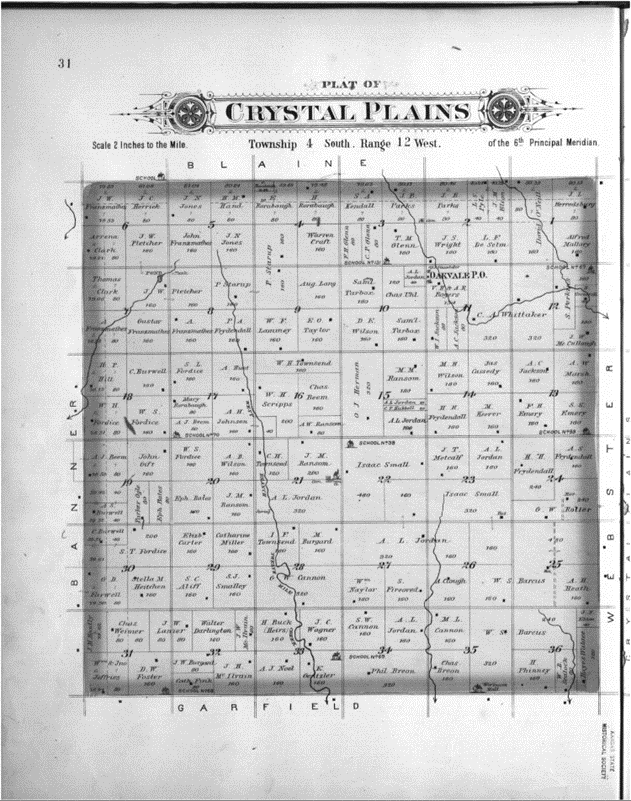
Plat Book, Smith County, Kansas. Compiled from County Records and Actual Surveys, Northwest Publishing Co., 1900, page 31, Kansas State Historical Society. Both Lammey and Glenn land holdings, in addition to the schoolhouse, are found in sections 9 and 3.
The new age-of-consent law of 1887 effectively barred women under the age of eighteen, like Lammey, to consent to sexual relations. And in this instance, Lammey’s case demonstrates a less than enthusiastic, and downright obstructive, local response by County Attorney E.S. Rice to prosecute and carry out the law. When Glenn brought forth a countersuit, charging Lammey with incest in an effort to destroy her reputation (a common legal tactic acknowledged under law), Rice chose to split the state’s counsel so that he could defend Glenn while his partner continued on with the statutory rape case. In the end, Rice wiped the docket of both cases as he determined that furthering either case “promise[d] the disruption of an Entire neighborhood.”[16] Lawmen like Rice had much prerogative in 1895, and as noted in Madison Smith’s case, they still do.
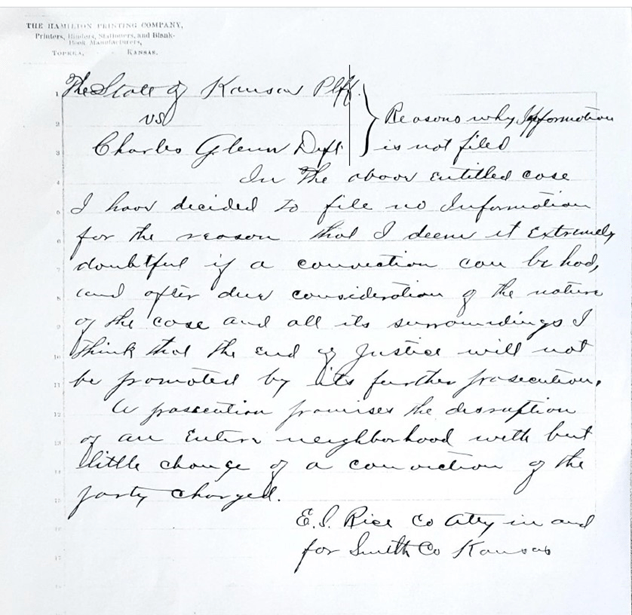
“Reasons why Information is not filed,” The State of Kansas v. Charles Glenn (1895), Case File No. 2453, Smith County District Court, Smith County, Kansas.
Conclusion
Legal historian Kermit L. Hall once posited that the “legal culture of the Great Plains,” has largely been forgotten and its legal systems historically ignored. We, as historians, have failed “to probe the ways in which modes of economic production and social organization on the Plains have shaped and been shaped by the law,” displacing the region as only a “legal backwater,” rather than a source of seminal research.[17] This region, galvanized by masculine dominance and explosive population growth in the late nineteenth century, still exists as an understudied bridge between early America and the modern American landscape. And the region’s legal records, housed within hundreds of local judicial repositories, hold remarkable insight into matters of gendered, racial, ethnic, and classist import, demonstrating that the courtrooms of the Plains played host to the captivating experiences of women, young girls, and their respective community structures.
Great Plains’ records give a voice to those who sought out the services of their community’s earliest governing bodies. So, the future of this research is also a call to action to preserve the records which prove the US legal system has been stagnant in protecting the rights of individuals who suffer first from sexual violence and/or coercion, and second, at the hands of legal agents who manipulate or obstruct the judicial process, especially at the local level.
We need to “heal from the patriarchy,” as noted by another modern-day rape survivor, Kamilah Willingham.[18] We must not lose these stories to time nor accept the stymied processes which too often result from the attempted erasure of sexual violence, as with the outcome in Madison Smith’s case and thousands more. Despite the old adage by Sir Matthew Hale, rape can be proven. What seems most difficult is finding those individuals who will see the process through in judicious form and cease perpetuating a tolerance for sexual violence to the benefit of those who stand to gain the most from its erasure.
We need to acknowledge the continued failures of local legal actors to respond dutifully on behalf of those who assert claims of sexual assault or have done so in the past. We also need to recognize that successful prosecutions remain the exception, but not for want of claim. Additionally, the tendency to shame and embarrass the survivor during an adversarial legal process remains all too common. These findings are blatantly obvious when comparing the sociolegal atmosphere surrounding sexual violence and coercion in the modern era alongside the legal processes of the past.
To this end, let us begin our efforts to mine and preserve the records that prove the long history of sexual violence and abuses by local agents of law. We must seek change, study all regions, and time periods, and search local court records (that often fly under the radar of rape calculations) so that patterns can be demonstrated unequivocally as bent to the advantage of the accused rather than the accuser. We must come together to demonstrate that our systems of law still suffer from the influence of white patriarchal forces.[19] We have so much yet to learn about this history. Legal historians, in this age of #MeToo, must act.
[1] The State of Kansas v. Jared Peter Stolzenburg (2019), McPherson County District Court, McPherson, Kansas, 19-CR-202, and the police report, 18-049.
[2] This criminal investigation and resultant legal actions have been well documented, both nationally and internationally. See the following reports from APNews; BBC News; CBS News; Fox4 News of Kansas City; and The Washington Post, respectively, among others: https://apnews.com/article/kansas-sexual-assault-mcpherson-f6508fab65bf89bf76c7c79a4a9e7859; https://www.bbc.com/news/world-us-canada-58729321; https://www.youtube.com/watch?app=desktop&v=rDOwvjZ4HBI; https://fox4kc.com/news/kansas-woman-convening-own-grand-jury-after-prosecutor-refuses-to-file-sexual-assault-charges/; https://www.washingtonpost.com/national/a-prosecutor-says-no-to-a-rape-charge-so-a-college-student-calls-her-own-grand-jury/2021/05/18/2ea9a130-b766-11eb-a5fe-bb49dc89a248_story.html AND https://www.washingtonpost.com/nation/2021/11/03/college-student-who-called-her-own-grand-jury-doesnt-get-rape-charge-she-sought-her-attacker/. Also see “Justice for Madison,” Boardman Training and Consulting, https://justinboardman.com/justice-for-madison/, all accessed October 21, 2023.
[3] Donna Devlin, “Women of the Great Plains and the ‘Disruption’ of Neighborhoods: Challenging Sexual Violence and Coercion Through Local Courts of Law in Kansas and Nebraska, 1870-1900, With a Segue to the Present,” (Dissertation, University of Nebreska-Lincoln, 2023, https://digitalcommons.unl.edu/dissertations/AAI30487700/.
[4] Anna Sadilek v. Charles Kaley (1887), Civil Case No. 747, Webster County District Court, Red Cloud, Nebraska.
[5] Garrison v. State, 6 Neb. 274 (1877); “Rape is defined to be the unlawful carnal knowledge by a man of a woman, forcibly and against her will . . . The general rule is well settled that the woman must oppose the act, and that if she in any manner favor it the party accused cannot be convicted of rape. The exceptions to the rule are where the woman is non compos, or has been reduced to a state of insensibility and violated while in that condition, and cases where consent has been induced by fears of personal violence; further, in Fisk v. State, 9 Neb. 62, 2 N.W. 381 (1879), if such charges were not brought “until about six months after the commission of the alleged offense,” the courts could dismiss charges. For this specific reference to Fisk, see Matthews v. State, 19 Neb. 330, 27 N.W. 234 (1886), page 336; Matthews v. State, 19 Neb. 330, 27 N. W. 234 (1886); also in Matthews, if “no marks [were] left upon the person or clothing, and no complaint [was] made at the first opportunity,” doubt could then be placed upon the accuser, and the corroboration of witnesses became necessary to validate claims by the accuser even if the accused offered no testimony in his defense. For additional explanations of the corroboration requirement for rape in Nebraska, see Frederick K. Starrett, “Nebraska’s Rape Corroboration Rule – What and Why,” Creighton Law Review 8 (1975): 56. The corroboration rule was applicable to other crimes, but effective for rape cases in Nebraska until 1989, leaving Nebraska among the states with the toughest evidentiary standards for decades. See also George Fisher, “The Jury’s Rise as Lie Detector,” The Yale Law Journal 107, no. 3 (December 1997); 702, n. 594. Fisher notes Nebraska’s corroboration rule as “unusual” on page 701.
[6] See Ch. 29-1401 in Dorsey William C., Compiler. Compiled Statutes of Nebraska 1929. + Supplement, Lincoln, Neb, State of Nebraska, State Journal Co., page 726; see also the changed language as written in Dorsey William C., Compiler. Compiled Statutes of Nebraska 1929. + Supplement, Lincoln, Neb, State of Nebraska, State Journal Co., 1941, page 324, and Richard E. Shugrue, “The Grand Jury in Nebraska,” Creighton Law Review, 33, No. 1 (1999); 57.
[7] At this time, what we know as Memorial Day was called Decoration Day.
[8] Annie Sadilek v. Charles Kaley. For a look at Sadilak’s deposition in its entirety, see my website under construction. Note that in both Smith’s and Sadilek’s cases, and in many others, part of the violence is about controlled silence during the act of rape; Smith was strangled, and Sadilek’s mouth was stifled. Additionally, in both of these cases, and the other discussed here, none represent the mythic contouring of rape as an act committed by strangers; as in most cases of rape, the acts were committed by acquaintances. See the Rape, Abuse & Incest National Network organization for recent statistics related to this fact and others.
[9] See footnote 6 about Fisk and Matthews.
[10] “Local,” The Millbrook Times, December 17, 1880, accessed November 6, 2021, retrieved from Newspapers.com.
[11] “Local,” The Millbrook Times, December 17, 1880; “District Court Proceedings,” The Millbrook Times, April December 22, 1881, accessed November 6, 2021, retrieved from Newspapers.com.
[12] Sir Matthew Hale, Historia Placitorum Coronӕ, or The History of the Pleas of the Crown, Vol. 1 ( England: Oxford University, 1736), 630/730. Note: these pages are numbered inconsecutively, and this volume was posthumously published in the next century. But the limitations of the male are specifically written: “An infant under the age of fourteen years is presumed by law unable to commit a rape, and therefore it seems cannot be guilty of it, and tho in other felonies malitia supplet ӕtatem in some cases as hath been shewn, yet it seems as to this fact the law presumes him impotent, as well as wanting discretion.” See also Alfred Swaine Taylor, Medical Jurisprudence, 5th edition, Edward Hartshorne, ed. (Philadelphia: Blanchard and Lea, 1861), 500.
[13] “Testimony in the Preliminary Examination,” by Daisy Lammey, in The State of Kansas v. Charles Glenn (1895), Criminal Case No. 2453, Smith County District Court, Smith County, KS, page 4.
[14] “Testimony in the Preliminary Examination,” by Daisy Lammey, State v. Glenn, page 5.
[15] Plat Book, Smith County, Kansas. Compiled from County Records and Actual Surveys, Northwest Publishing Co., 1900, 31, Kansas State Historical Society, accessed October 6, 2019, https://img.kansasmemory.org/00061091.jpg. Glendale Country School District No. 131 was presumably so named because the school was built on land purchased by the county from Thomas M. Glenn, Charley’s father, on April 12, 1888. It sat on the southwest corner of the SE quarter of Section 3, Township 4, Range 12 (Crystal Plains) adjacent to the path leading to Charley’s house. A comparison of the 1900 plat map and land records at the Smith County Courthouse verify the spatial positioning of the crime described in Daisy’s testimony (the school, her home, T.M. Glenn’s home, and Charley’s home) in regard to where their encounters likely took place. According to Daisy, the first three encounters took place approximately ¼ mile west of the school after it had let out for the day; she attested to a total of at least six encounters between 1892-1894. Though the school is no longer standing, a rough driveway still divides the property which belonged to Thomas M. Glenn and the adjoining property which belonged to his son, Charley.
[16] This directive signed by county attorney, E.S. Rice, is found in the Glenn case file (as noted in the caption); an identical version is found in the countersuit filed by Glenn against Daisy and her brother, The State of Kansas v. Daisy D. Lammey and Eljie Lammey (1895), Case File No. 2458, Smith County District Court, Smith County, Kansas. Appearance docket entries note the dates of the filings as September 3, 1895.
[17] Kermit L. Hall, “The Legal Culture of the Great Plains,” Great Plains Quarterly 12, no. 2 (Spring 1992): 86-87.
[18] Kamilah Willingham, “Healing is Resistance: In the Wake of Sexual Violence,” oral presentation at the University of Nebraska-Lincoln, September 21, 2022. Willingham’s experiences at Harvard Law School were highlighted (along with many others) in a recent documentary entitled The Hunting Ground in 2015.
[19] According to the American Bar Association in 2022, 70% of federal judges are male; 78% are white males; see https://www.americanbar.org/news/abanews/aba-news-archives/2022/08/new-report-on-profession/, accessed October 21, 2023. Of the roughly 1.3 million lawyers nationwide, 62% are male and 81% are white, whether male or female; see https://www.americanbar.org/content/dam/aba/administrative/market_research/2022-national-lawyer-population-survey.pdf, accessed October 21, 2023. In Kansas in 2023, according to the National Association for Women Judges (NAWJ), 33% of its state judges were women; in Nebraska, that percentage is lower at 30%. For a breakdown of all states, see NAWJ’s site at https://www.nawj.org/www.nawj.org/statistics/2023-us-state-court-women-judges. For further details about the lack of diversity on state supreme courts, see the May 2022 report from the Brennan Center for Justice at https://www.brennancenter.org/our-work/research-reports/state-supreme-court-diversity-may-2022-update.
Featured Image Caption: “Reasons why Information is not filed,” The State of Kansas v. Charles Glenn (1895), Case File No. 2453, Smith County District Court, Smith County, Kansas.
 Clio and the Contemporary

Leave a comment