
Earlier this month, the Supreme Court of the United States ended its 2023-2024 session, which saw conservative rulings that limited the power of government to regulate pollution, bring criminal charges against a president, and protect minority rights, among others. A common refrain of media outlets is that faith in this decidedly right-leaning Supreme Court is at a record low. However, these pundits tend to focus their analysis on overall polling numbers. Approval of the Supreme Court depends on the poll respondent’s party affiliation, showing a deep divide in Americans’ views on government. Democrats decry a rightward turn of the Supreme Court, in recent decades, but the truth is that the American high court has almost always been staunchly conservative.
The Court frustrated progressive reform efforts on everything from the citizenship of Black people and integration in the 19th century, child labor, and workplace safety in the early 20th century, to voting rights, gun regulation and environmental protection in the late 20th and early 21st centuries. The progressive Warren Court (1953-1969) that implemented many Civil Liberties and Civil Rights protections was an anomaly in US history. Indeed, Georgetown Law Professor David Luban wrote that the Warren Court was not only the most liberal court, it was the “only liberal Supreme Court in American history.”
Harvard Legal Historian Morton J. Horwitz wrote in a law review article that the Warren Court was the only one to empathize with “the outsider,” such as racial and religious minorities, political dissenters, and the criminally accused. Horwitz attributes this empathy to the post-World War II American self-consciousness and moral leadership by President Harry Truman. “Looking back to Nazism or across the ocean to Stalinism, Americans after 1945 were obsessed with defining and defending democratic principles. They were increasingly made aware of the emergence of the Third World. The experience of black fighting men in segregated units during World War II reopened issues of second-class citizenship,” Horwitz wrote.
News outlets speak of the current Supreme Court as not only having a solid conservative majority, but also as “polarized.” The three justices appointed by Democrats often disagree sharply with some or all the court’s six justices appointed by Republicans. The United States has almost always been a very politically divided nation. Conservative majorities on the Supreme Court are mistakenly viewed as unique to recent years, but they are really the norm in American history. So too is political polarization the norm.
To obtain a broad view of American polarization, political scientists Keith T. Poole and Howard Rosenthal created Voteview to track roll call votes from every Congressional session since 1789. They plotted this data along a liberal-conservative dimension. Voteview charts polarization, or ideological distance between members of Congress, based on their voting behavior. Poole, Rosenthal and political scientist Nolan McCarty wrote in Polarized America that a variety of factors track closely with polarization, including income inequality, views on Civil Rights, and recent trends in immigration.
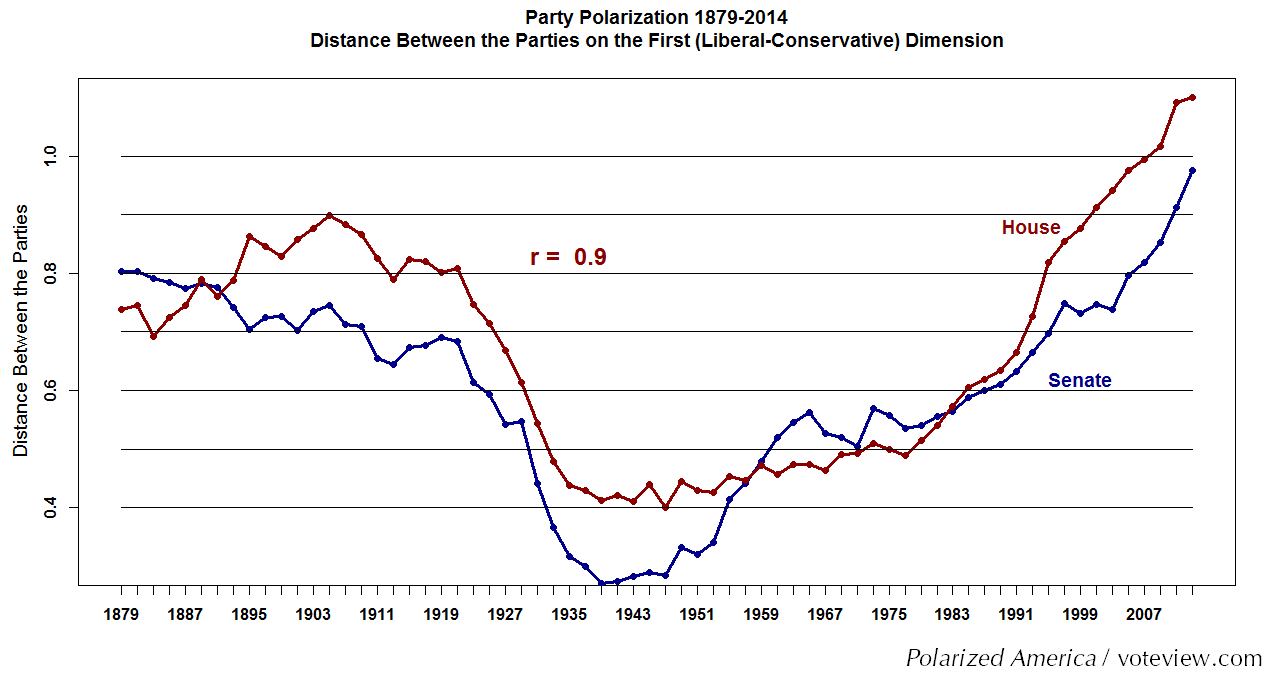
McCarty, Nolan, Keith T. Poole, and Howard Rosenthal 2006. America: The Dance of Ideology and Unequal Riches. Cambridge, MA: MIT Press. https://legacy.voteview.com/political_polarization_2014.htm, accessed July 22, 2024.
Although polarization has skyrocketed since 1980, the Voteview data show that Congress has been divided for much of American history. (While polling data is often used to measure public opinion, scientific polling was not pioneered until 1935 by Dr. George Gallup. For a broader perspective, I am relying here on Voteview’s Congressional votes as a polarization measure.) In fact, the low polarization years of the middle 20th century are the exception rather than the rule. The question of why polarization has risen in the past 40 years is the wrong one to ask. Instead, we should be asking, why did the middle of the 20th century see so much cross-party voting?
It wasn’t that Congress members were united on the issues in the 1950s, 1960s, and 1970s; rather they found themselves in ideologically heterogeneous and changing political parties as Democrats embraced Civil Rights and economic programs for minorities and Republicans pursued a more religious and pro-business platform. Since 1980, the parties have undergone what political scientist Morris P. Fiorina calls an ideological “sorting,” in which Republicans consistently represented more conservative points of view and Democrats took more liberal positions. Therefore, what seemed to be a time of cross-party unity in Congress was party platform confusion.
Indeed, the United States was founded by a group of people who were almost hopelessly divided over major issues in the late 1780s, and the US lost three-quarters of a million people fighting over these divides in the 1860s. Fissures in American politics are not unique, and they have been much more severe in the past. Both conditions of political polarization and a conservative Court are not new. They are fundamentally who the United States is as a nation. The first step, as they say in recovery circles, is admitting it.
Featured Image: Millhiser, Ian. Aug 8, 2022. “What happens when the Supreme Court is this unpopular?” Vox Media. https://www.vox.com/policy-and-politics/23292022/supreme-court-abortion-dobbs-roe-wade-unpopular-polls-kansas, accessed July 22, 2024.
Visit Voteview for more information and charts.
 Clio and the Contemporary
Leave a comment