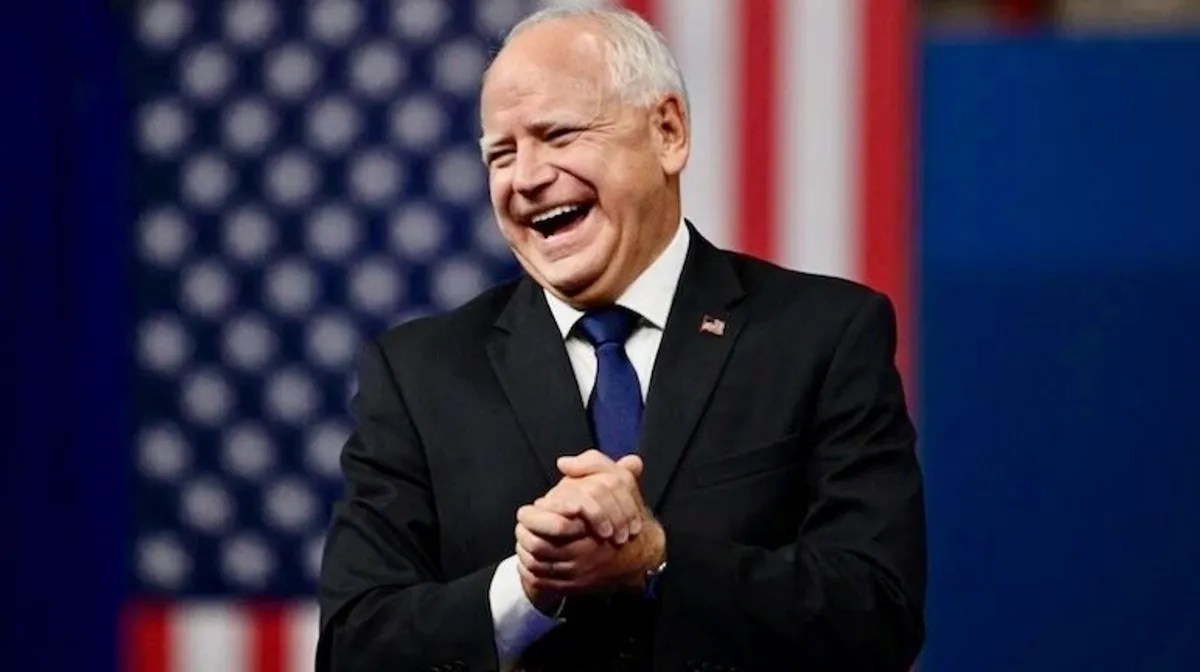
Vice President Kamala Harris’s choice of Minnesota Governor Tim Walz as her running mate has been particularly inspired, as both a policy, skills, and compatibility decision as well as a vibe shift in the 2024 presidential race. In just a few weeks on the campaign train, Walz has received tremendous news coverage because of his political record and the public’s receptivity to him. His collaboration with Harris has also proved cathartic for voters in a country grappling with increasingly hostile nativism and anti-immigration sentiment focused on mass deportations, a Supreme Court hellbent on undermining the rights of women and LGBTQ+ people, unfettered misogyny in GOP campaigns nationwide (particularly in the rhetoric of presidential candidate Donald J. Trump and vice presidential candidate JD Vance), and a men’s rights/militia movement recruiting disaffected white men pedaling violent anti-democratic fantasies as part of the continuing coup attempt that began on January 6th, 2021. The Trumpian political climate has been one of fear, contempt, and violent rhetoric, so the playfulness of Harris and Walz (especially together) has provided some affective relief for Democrats worried about the fascist policies of another Trump Presidential administration.
Democratic enthusiasm for the Harris-Walz ticket has been apparent in crowd size as the duo have canvassed the nation. The sold-out Harris-Walz campaign events are important, in part, because they have harnessed optimism and joy in the wake of the mega-successful Taylor Swift Eras tour, where Swiftie dads carpooled their daughters and friends to arenas worldwide. The social media embrace of “Swiftie dads” as a source of positive masculinity helped normalize healthy bonding between dads and their kids (especially their daughters) and was operating against the misogynistic politics of grievance, anger, and toxic masculinity. that the Trump Presidential campaigns have amplified over the past eight years. The softer (“pop”) side of fatherhood at the concerts has been both financially lucrative and generally praised, creating space for a kind of assertive (but not abusive) and playful arena of masculinity that Tim Walz seems to have in spades. Likewise, the convention demonstrated that he loves his kids and the outpouring of affection and support for Guy Walz is strengthening associations of healthy fatherhood to Tim Walz. It helps that he’s anti-elitist, he’s affable, and he seems to be genuinely interested in connecting with voters, which is something the ticket needs in order to be competitive in the swing states. It’s time for white men to do positivity and joy in politics, and Tim Walz is leading by example. He’s the white dude that white dudes need.
The major entrée for Walz into the conversation about the future of the party was The White Dudes for Kamala fundraising call on July 29th, 2024. Affinity groups are great for building political identification, and The White Dudes for Kamala massive Zoom call was a watershed for political organizing because white men called in and thought together about how white masculinity has been impacted by MAGA politics. While the call raised $4.5 million for the Harris campaign, it also offered white men a safe venue (alongside celebrities like Mark Hamill and Jeff Bridges) to talk about their participation as white men in Democratic Party politics, process the social turmoil of the Trump administration, and learn to support a Black female candidate. Walz stood out telling the thousands assembled, “One person’s socialism is another person’s neighborliness.” This refrain stuck and now it operates as a foil to Trump’s cold, financial, individualism. Indeed, Walz’s midwestern communalism recasts neighborliness as both quintessential American manliness and political fitness. While the “crisis in masculinity” has always operated as white male panic in periods of social change, Trump successfully modeled and cultivated the “angry white man” as a political archetype. In contrast, white men engaging in electoral politics now with the Harris campaign are moving beyond the alienation of the archetype and into a new kind of political agency, characterized more by openness than defensiveness, more by collaboration than domination. Call it the Ted Lasso effect, this acknowledgement that white men are beleaguered but want to embrace the sensing, feeling white (coach) man as a cherished architect of our political future.
Indeed, Walz is so palatable right now because heterosexual white men, in particular, want different options for how to be white men. They don’t want to “man up.” They want to be softer, happier, more connected, better parents. They want to nurture and support their queer kids (especially in the face of devastating anti-trans laws) with happier marriages. They are doing more care work and have fewer skills. They feel constrained by the nostalgia for the breadwinner and by hypermasculine archetypes. Importantly, they aren’t sure how to talk about these issues as political issues. While white masculinity is perpetually “in crisis,” this political moment highlights the challenges of how white men can and should mobilize as liberal democratic values are threatened by Trump’s bid for fascism. Walz is both a product of and answer to the trajectory of white supremacy and sexism that produces anxiety for white men but in this moment, he’s operating what I call a “focusing figure.” He’s offering a new form of social and political agency for white men that avoids the paranoia, avoidance, defensiveness, and aggression of the “angry white man,” directed as it is at vulnerable people. Rather, Walz focuses our attention instead on the figure of the open, engaged, and responsible white male collaborator who will amplify his Black female running mate while herding white men into a new formation of their political identity.
The mobilization among (mostly) heterosexual white men who want to mobilize for Democrats and/or for progressive values has happened in the wake of the 2020 George Floyd protests, which profoundly impacted them. Yet it felt like they didn’t have an outlet. The GenXers and older Millennials now have the maturity and feel the responsibility to change. This is their real political foray into their racial awareness as liberals or as progressives. (They did not do this during the Obama Administration, and it took Biden throwing his support behind a Black woman to create space for this kind of introspection and political connection after eight years of MAGA propaganda).
The White Dudes for Kamala call was also a watershed because it functioned as a consciousness-raising group (like the feminist ones in the 60s) that saw performing vulnerability alongside donating money as transformative to their identity category. This is an essential combination for a thriving social democracy and for more durable democratic governance structures that are inclusive of white men who are grappling with social changes and have liberalized the kinds of roles they can and should occupy (especially at what is arguably the end of neoliberalism. Although affinity group organizing has always been an important and successful part of presidential races, “white men” have not explicitly identified as an affinity group. Their whiteness was invisible and unstated. The White Dudes for Kamala call evidences tremendous success for white collective liberation activists as well as the consciousness-raising that has happened around the movement for Black lives. The Harris/Walz campaign has offered huge, virtual spaces for this kind of organizing that explicitly names race alongside sex as markers of affinity.
Although VP picks are often underrated/seen as not politically important, the Walz pick is not just a strategic choice. Rather, it’s a tangible moment where the Popular Front against the (gender/race) fascism of Trump/Vance and MAGA has been solidified with a classical liberal agenda. While the popular front against fascism in the 1930’s was unsuccessful, it sought to center labor to resist what was a grievance politics of ethnic scapegoating and authoritarian politics. The postwar culture was filled with agency panic, anxiety about the “white family” and reproduction, and both sex panic and race panic about social deviance, creating the opportunity for social change while also foregrounding surveillance and imprisonment as paranoid strategies to contain these impulses for liberation. Consolidated into neoconservatism by the 1980s and expressed through the language of (white) “family values,” the postwar anxieties were repackaged. This recursive structure of feeling and policy is part of what Hofstadter calls the “paranoid style of American politics,” and it ebbs and flows with shifts in political power. With Harris being the first Black female nominee for president in US history, her choice to add Walz signals not just his policy bona fides but also the role that his heterosexual whiteness and masculinity play in assuaging fears of agency panic in a political climate that, because of Trump, has been increasingly described as authoritarian.
The Walz pick also demonstrated that Harris is moving away from Obama’s protégés (like PA Governor, Josh Shapiro), given that his most popular policies in Minnesota are bread-and-butter liberalism. It seems likely that Harris and Walz will be more approachable about popular coalition-building. The pushback from elected officials and activists on Palestine is an example of where the Democratic ticket will perhaps listen, learn, and change directions, especially as activists adjust strategies amidst the volatile negotiations. She and Walz are not yet (and may not be) totally boxed in by “what has been.” Indeed, this famous Harris aphorism speaks simultaneously to moving beyond Biden’s policies (yes, even perhaps on Palestine), moving beyond preconceived notions about the electability of a Black female president, and moving beyond the toxic and violent model of white masculinity successfully cultivated by the highest executive office in the country.
The big question yet-to-be-resolved is how to manage the disenfranchised GOP white men who were “never Trumpers” and who have left the party. Their white masculinity is, perhaps, different from the angry white men who follow Trump and the white liberal men whose agency is in flux, even though they feel deeply alienated from their former party. They may end up being part of the coalition, nonetheless, in part because of the media focus on Trump’s Project 2025. Certainly, the Trump campaign trades in nostalgia for an earlier point in U.S. history (before women and people of color could vote, own property, or access due process) where the myth of the white male breadwinner helps consolidate both grievance culture and the imagined primacy of the white, middle-class family. This is partly driven by the destruction of the middle-class by decades of tax cuts for the rich and erosion of social services, including access to quality public education. Walz, though, offers a contrasting series of policy successes that have expanded the middle class in the state of Minnesota. But Walz is not offering nostalgia. He embodies the consistently available, caring, emotionally supportive, hard-working dad from middle America, not driven by nativism, anti-immigration sentiment, misogyny, or fear of LGBTQ+ people. He’s a wholesome foil for what Skye de Felix and I have called elsewhere, “predatory masculinity,” to describe white male victimhood, scapegoating of women, and this lethal combination of rage and nostalgia. Nonetheless, talking to white men now about their fathers, families, and disappointments has the potential to open them to new futures. Tim Walz provides the opening for those conversations.
Walz is a white guy who hunts and fishes. He is a veteran. He is a proud dad whose family benefited from invitro fertilization (IVF). He supports unions, queer kids, and abortion rights. He is pro-family, and not as a talking point but as a point of integrity. He appointed attorney Keith Ellison to prosecute George Floyd’s killer (although he also sent in the national guard during the rebellion). He honors the legacy of musician Prince Rogers Nelson. He funds school lunches. He brings a heavy dose of liberalism back to the Democratic Party with a secure, un-self-conscious, and mildly self-deprecating style. Decency is important to him, and it has become clear that Tim Walz offers an antidote to toxic white masculinity. He is coaching the nation into a new model of authentic relationality beyond Trump’s rhetoric of alienation and into a kind of Midwestern communalism that can reconnect affinity groups—including white men—online and in person in ways that just may form a new civics.
Featured Image: US Democratic vice presidential candidate Minnesota Governor Tim Walz speaks at Temple University in Philadelphia on August 6, 2024. © Brendan Smialowski, AFP. See Rawstory.com.
 Clio and the Contemporary