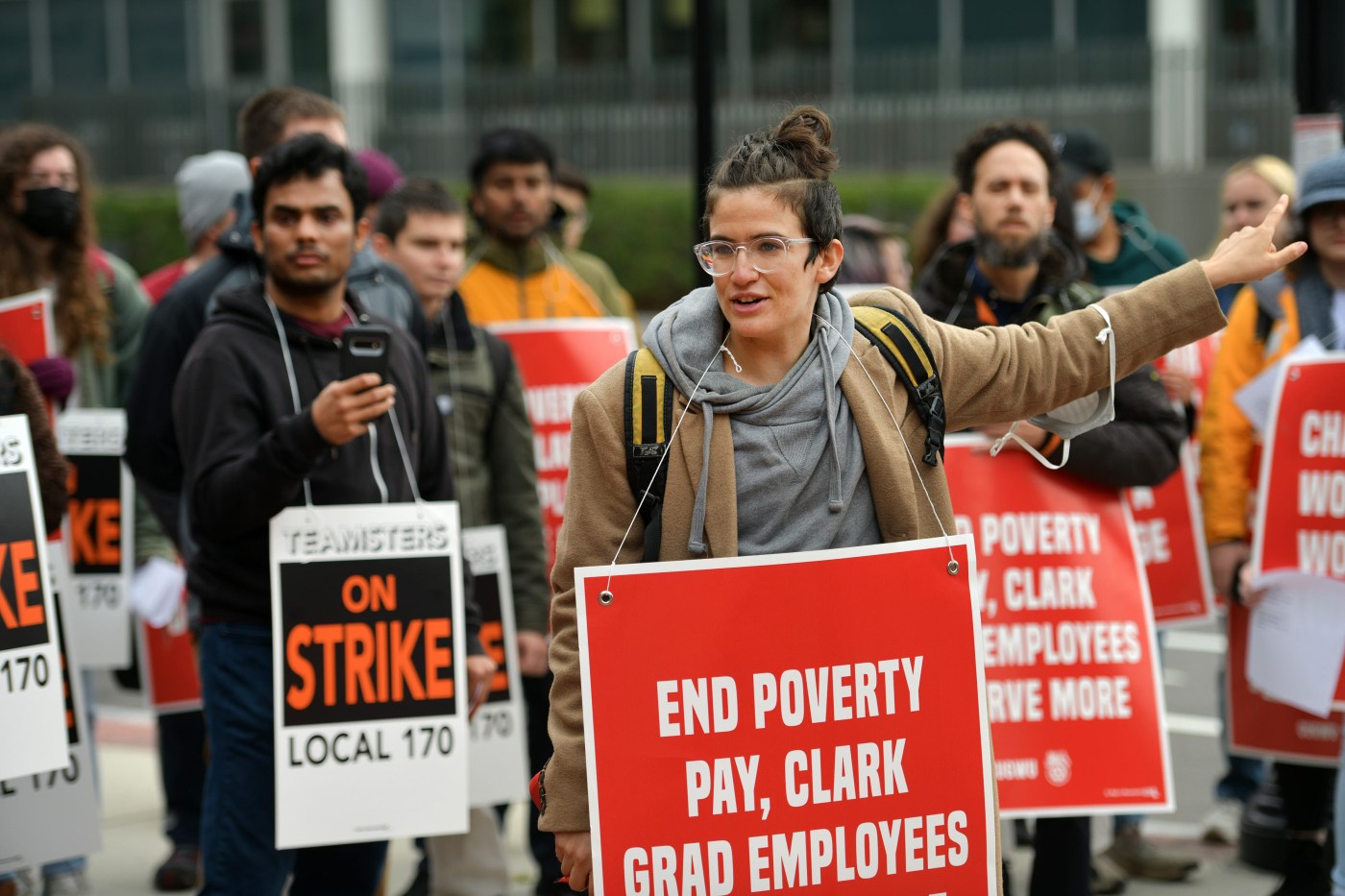
Labor unionization is having a moment. After decades of declining union membership, the 2010–2020s have brought an increase in unionization efforts and victories. From Starbucks employees to fast food workers, from restaurant staff to Chippendales dancers, everyone seems to be organizing. Amidst this new resurgence of organized labor, are graduate student unions that are organizing Masters and PhD students and helping to address long-standing issues at universities and in academia as a whole.
This piece will discuss the definition and importance of a union and address questions like what are dues? What is a collective bargaining agreement? And—perhaps most importantly—how do I organize?
What are unions?
Unions are two things at once. At a basic level, a union is formed when workers decide that they have each other’s backs. This concept—known as solidarity—is the backbone of union organizing. At this level, co-workers consciously decide to care about workplace issues that affect their co-workers and themselves, and they commit to doing something to better conditions for all. This commitment can at times mean placing the interests of others above yourself and pushing for solutions that may not directly change your situation. For instance, workers can band together to deal with a discriminatory boss, hours being cut, or a lack of care for workers with children. Solidarity forces workers to center the needs of others, rather than engage in solely individualistic goals. Without solidarity, unions simply do not function.
At the same time, unions are institutions. Most graduate student unions have formalized their union within larger, established unions. Graduate students and post-docs in the University of California system, for example, formalized their unions with the United Auto Workers (UAW) and became UAW locals 4811 and 2710, respectively. Organizing—and formalizing—a union with an established union can help graduate students learn about organizing tactics and bargaining contracts (more on that below) from experienced labor organizers. In addition, established unions can help bring attention and resources that graduate student unions may not receive if they were independent.
What do unions do?
Unions do a myriad of things. In terms of graduate students, unions help us speak with one voice to our employer: universities. This unified voice allows us to have an important say in everything related to our work. This could be anything from teaching assignments to gender-neutral bathrooms, from reduced (or even free) public transportation to pay raises, from support with childcare to reasonable accommodations for disabled graduate students.
The agreement between a union and the university is formalized in what is known as a Collective Bargaining Agreement (CBA)—a type of contract. A CBA is created through bargaining, a process where student representatives and university representatives deliberate, negotiate, and agree on several issues, including benefits, working conditions, and wages. The CBA is a legally binding document for both sides.
If the terms that the union and the university have come to are not met in any respect, the union can file what is called a grievance to make sure that the terms are met and make workers whole again.[1] Making a worker whole can be anything from back pay to an academic appointment being upheld, from bathrooms being designated as gender-neutral to public transportation costs being met, childcare—or stipends to help pay for childcare—or accommodation such as ramps, disabled—accessible doors or other accommodations.
For graduate students, like all workers, unions and CBAs help us keep universities accountable.
What are union dues and why do I need to pay them?
One of the things that can be hard for graduate students to understand is the fact that the university where they learn as students is an employer to them as workers. Whether you believe that academia is a calling or not, the university is an employer, and graduate students are workers.
Like all employers, universities strive to keep costs of labor down and prefer that their employees (graduate students in this case) do not unionize. Should graduate students succeed in unionizing, universities would like these unions to be as ineffective as possible. To this end, universities use their considerable budgets (the University of California system alone has an operating budget of close to $50 billion) to employ individuals—mostly lawyers and labor relations representatives—to stop labor actions and gains. Some of these individuals are employed to create obstacles and help universities receive favorable language during CBA negotiations.
To push back against this, unions need funds. These funds go into salaries for those who assist graduate students in organizing, they go towards legal fees to fight and win grievances and unfair labor practice (ULP) suits; and—as a last-ditch measure—they go towards strike funds when, and if, graduate students need to walk off the job to put pressure on the university. Paying union dues, in essence, is a matter of solidarity as dues go towards efforts to help co-workers fight against employers.
In 2017, the US Supreme Court ruled that workers need to voluntarily agree to pay dues. This ruling had the effect of making all workplaces “open shops.”[2] Now, instead of having dues automatically deducted from their paychecks, all union members must sign a dues authorization form to pay dues. While meant to be a blow to unions, this ruling has had the effect of making organizing a workplace even more important. To have the funds necessary to win, workers must make sure that all union members are signing dues authorization forms—and understanding the importance of dues—to continue to push back against employers.
How do I organize?
There are several different schools of thought around labor organizing. There is the structural organizing model that was advocated by the late, great labor organizer Jane McAlevey—former organizing director for the American Federation of Labor and Congress of Industrial Workers (AFL-CIO), national healthcare director at Service Employees International Union (SEIU), and the author of many books on labor organizing, including Raising Expectations and Raising Hell and No Shortcuts: Organizing for Power in the New Gilded Age— and many organizers subscribe to it. There is momentum-based organizing seen in unionization efforts at Starbucks franchises, used by auto workers in the South, and employed by the Amazon Labor Union. In any model, what is at the heart of organizing is conversations.
Organizers have what are called organizing conversations. These conversations have specific steps that help to lead workers from individuals who conceive of themselves as having individual problems to members of a union who conceive of themselves as having collective problems.
These steps are:
- Listen to how people are already talking to each other about the workplace and workplace problems and find out how you can have more of those conversations.
- Respond to what workers see as individual problems by framing them as collective problems.
- Bring people together by asking them to meet inside or outside of work about something you know they care about to build a sense of commonality and solidarity.
In its basic function, organizing your co-workers is about having conversations. While this could seem daunting, much of what organizing requires is what you are already doing.
Think for a second about other graduate students who you feel close to. These might be lab mates, writing buddies, study pals, or a significant other. Think about the conversations that you have regularly about the work that you do. You will probably find yourself thinking about them venting their frustrations about the university to you. You might also find yourself in these conversations trying to collectively find solutions to the problems they are presenting to you. In these conversations, you are engaging in a foundational and important step in organizing conversations.
This process is the first step of organizing. In these conversations, you are surfacing problems that exist in your workplace. Everyone has issues in their workplace; however, most of us wrongfully believe that these issues are individualized, or we believe they can’t be changed and so we overlook and minimize these issues. This leads us to the second step of organizing conversations: making individual problems collective.
We do this by having more conversations and connecting issues. For example, a co-worker who has children and takes issue with the lack of childcare support provided by the university finds themselves often having to leave seminars to take care of their children. Meanwhile, another co-worker who is disabled finds themselves with a lack of support when it comes to medical appointments. These issues are interconnected as the collective issue is a lack of support for students who do not fall into the “normative” idea of a graduate student. Connecting these issues creates a larger collective issue that can be addressed by a union. Ultimately, organizing helps us as graduate students to create the university as a workplace that works for all.
While there is much more that unions provide for graduate students, this article aims to get you started as an organizer. The next step is to get involved with the graduate union that already exists at your institution or to get in touch with other graduate students and begin organizing an independent graduate student union. Here are some resources to help you along the way:
The Emergency Workplace Organizing Committee provides organizing resources
Forming a union at a non-union workplace
Your rights during union organizing
Worker Organizing Resource and Knowledge Center
[1] Grievances are to be cleared in meetings between labor representatives and employers, however, they sometimes end up going to arbitration. More on that can be found here: https://www.adr.org/sites/default/files/LaborRules-Web.pdf
[2] “Open shop,” and “closed shop” terminology denotes the status of labor organizing in a workplace. A “closed shop”—or “Union shop”—is one in which members have been organized, are paying dues, and any new hires are required to join the Union and pay dues. Conversely, an “open shop” is one in which new employees are not required to join an existing union as a condition of employment.
Featured Image: Credit Christine Peterson, Telegram and Gazette, USA Today Network
 Clio and the Contemporary
Leave a comment