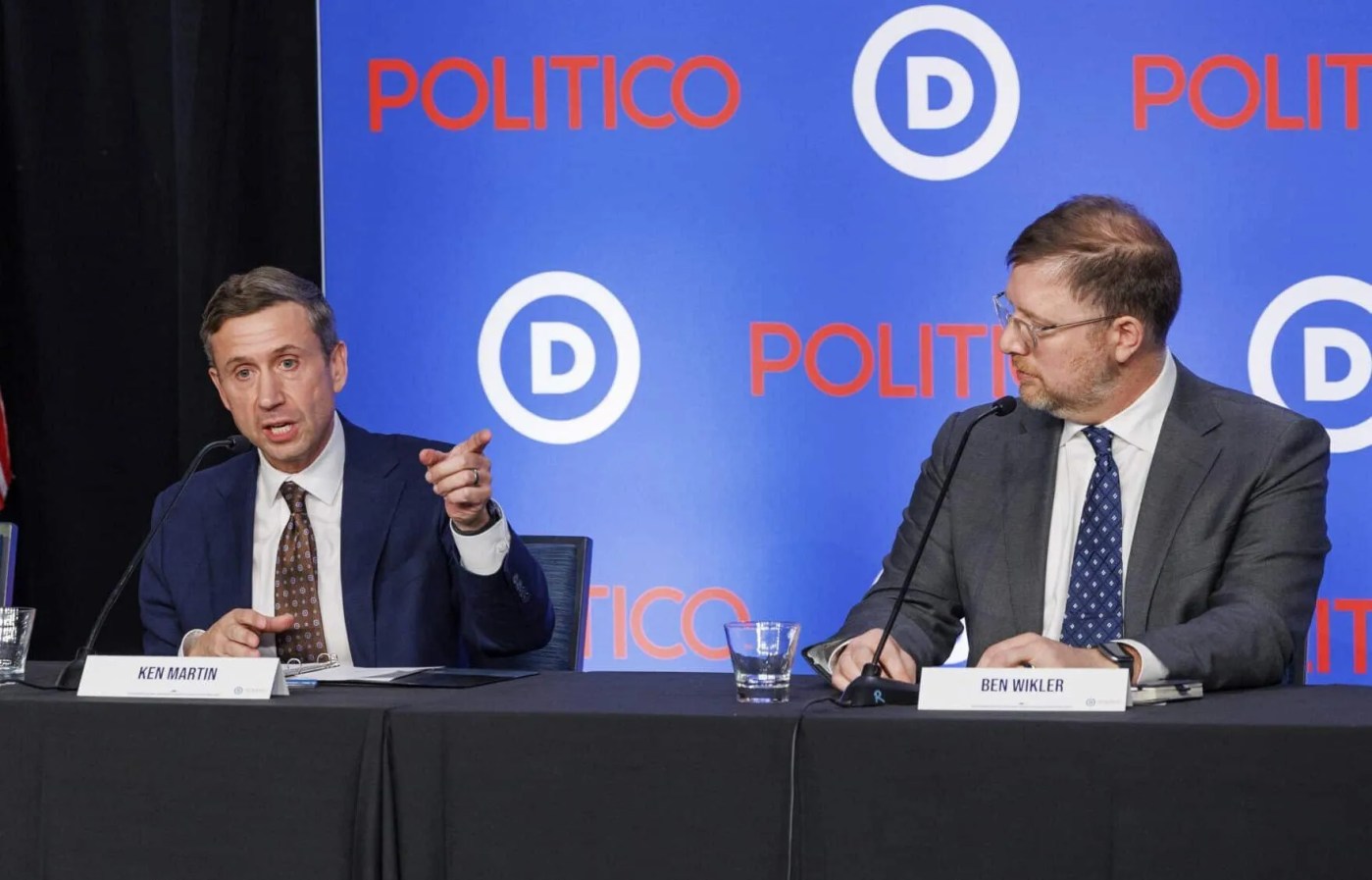
In the heated race to secure the Democratic National Committee (DNC) chairmanship, outlets like Politico have argued that there is little difference politically between Ken Martin, chair of the Minnesota Democratic-Farmer-Labor (DFL) Party, and Ben Wikler, chair of the Democratic Party of Wisconsin. Both men are generally progressive, support year-round organizing, and back a 50-state strategy for DNC activity; if anything, The American Prospect’s Micah Sifry observed, their differences are more “generational and stylistic.”
But Politico also noted, almost as a throwaway, that both men are state party chairs from the Upper Midwest—as if that’s a common profile of DNC chair. Rolling Stone observed that the race is a “Midwest Nice Fight”—without any acknowledgement of why the Midwest matters…or what its politics are.
No DNC chair has ever hailed from the Upper Midwest (Minnesota, Wisconsin, Iowa, Michigan, North Dakota, and South Dakota). No DNC chair since Howard Dean (Vermont, chair from 2005-2009) has even hailed from a northern state. Since then, it has been an unbroken run of moderate Southerners: Donna Brazile, Debbie Wasserman Schultz, Tom Perez, and Jaime Harrison. In that time, the failings of the Democratic Party—to win the presidency, maintain majorities in Congress, and avoid hemorrhaging seats in state legislatures across the country—are well-documented.
Political observers can note that both Martin and Wikler hail from the Upper Midwest—but they should work harder to understand what that actually means. The region has unique political traditions tailor-made for the momentum gathering behind economic populism in the Democratic Party. Both men, in their formative political years, worked for candidates who explicitly and intentionally centered their politics in the “progressive populist” traditions of Midwestern liberalism and successfully rebuilt their state parties in that grassroots image.
Midwest’s Progressive Populist Tradition
Both Minnesota and Wisconsin have political legacies characterized by insurgent, left-wing third parties: the Farmer-Labor Party in Minnesota, featuring a coterie of Socialist-influenced populists, and the Progressive Party in Wisconsin, led by the sons of Robert “Fightin’ Bob” La Follette. Both parties won election by embracing government-sponsored forms of unemployment relief during the Great Depression, brash oratory demonizing corporate wealth and influence, and working-class economic populism that bridged farm-labor and rural-urban divides.
A generation of insurgent progressives turned to those legacies after Republicans swept Democrats out of the governorships of Minnesota, Wisconsin, North Dakota, and South Dakota, and seven U.S. Senate seats in those four states plus Iowa, in 1978 and 1980. Many moderate Democrats—especially the “New Democrats” and the Democratic Leadership Council at the national level—concluded that the party should moderate its stances to win back power.
But when, in the 1980s, the Upper Midwest faced a double whammy of economic downturn—the inseparable crises of deindustrialization and the collapse of family farming—the candidates from whom Martin and Wikler learned rejected those calls to moderate and, instead, pitched a plan of multiracial, working-class, economic populism that rebuilt Democratic parties from the grassroots up.
In Wisconsin in 1986, Ed Garvey, former executive director of the NFL Players Association, beat a Democratic party-backed moderate in the U.S. Senate primary and earned the praise of In These Times for running “a rainbow coalition campaign” that “link[ed] labor and environmental groups, urban workers and farmers, women’s rights campaigners and the LGBTQ community.” While Garvey lost in the general election, Garvey-allied grassroots groups helped Wisconsin Democrats gain seats in the state Assembly.
More prominently, Paul Wellstone called upon nearly two decades of grassroots activism in Minnesota and built a working-class, economically-populist coalition that sent him to the U.S. Senate in 1990. Traveling the state in his signature green bus, Wellstone held off moderate DFLers in the endorsement race and primary election, then beat a two-term Republican incumbent behind quirky campaign ads that attacked corporate wealth and breathlessly listed his support for the environment, organized labor, public education, universal health care, and more.
Sometimes successful, as in Wellstone’s 1990 and 1996 campaigns, and sometimes not—in 1998 Garvey ran for governor against three-term incumbent Tommy Thompson, losing by 21 points—Wellstone and Garvey’s David-versus-Goliath stories provided formative lessons for Martin and Wikler about politics and party-building. Martin interned on Wellstone’s 1990 campaign for the U.S. Senate, and in 1998, at just 17 years old, Wikler worked for Garvey, who refused to accept campaign donations over $100 to call attention to the issues of money in politics.
Those backgrounds informed their future political careers. Martin became a DFL campaign and policy veteran, helping the party retake the governorship in 2010 and becoming party chair in 2011—now a legacy of success in which the DFL has not lost a statewide election since 2006. As Martin prepared for the national limelight in the DNC race, Minnesota Attorney General Keith Ellison noted that Martin could bring the party’s mantra, “We all do better when we all do better”—a Paul Wellstone saying—to national politics. Martin, in an interview with John Nichols published yesterday in The Nation, repeated calls for the DNC to “win the Wellstone Way.”
So too does Wikler have claim to that model of progressive success. With a background working for MoveOn and Al Franken’s radio show before the comedian successfully ran for Senate in Minnesota—not out of line with the Wellstone tradition, it’s worth noting—Wikler can certainly lay claim to party-building from the grassroots. Since he took over the state party following the 2018 elections, Wisconsin Democrats have won eight of eleven statewide elections and helped ensure a liberal majority on the state Supreme Court, which overturned the state’s gerrymandered electoral maps.
Both men appear to have succeeded where Wellstone and Garvey failed—in their attempts to remake their state Democratic parties around ideas of inclusive, economic democracy. Garvey failed in an ill-fated bid for party chair following his 1986 defeat, and Wellstone’s 1992 creation of the “Wellstone Alliance” quickly drew the rebuke of establishment DFLers from liberal Minneapolis congressman Martin Sabo to budget-hawking Rep. Tim Penny.
Despite these failures, the political legacies of Wellstone and Garvey, proved more enduring. In 2002, Garvey established “Fighting Bob Fest,” a progressive festival to spur political action in the La Follette tradition. After Wellstone’s untimely death in 2002, his campaign staffers established Wellstone Action, an activist training organization. Tim Walz was one of its first alumni. And now, with Martin and Wikler jockeying to lead the DNC, the politics of Wellstone and Garvey may finally be making their way to the top, some three decades later.
New Direction for the Democratic Party
Martin or Wikler’s victory would be a rebuke to the moderate, centrist impulse in the Democratic Party. In the wake of Ronald Reagan’s 1984 electoral college landslide over Walter Mondale, Wellstone complained that “The Democratic Party never committed itself to mobilizing the electorate from below,” arguing Democrats were “trying to appeal to the same affluent, white, male constituency as the Republicans and we can never win at this game.” They had made no effort, Wellstone alleged, “to bring in grassroots leadership and cement their involvement and commitment to the party.”1
Will either Midwesterner in the race be able to do that? Martin has already hedged, distinguishing that as DNC chair he would only take money from “good billionaires,” not “bad billionaires.” Rolling Stone and others have called attention to Wikler’s relationship with LinkedIn founder and cryptocurrency backer Reid Hoffman.
A charitable reading of this would suggest that Martin is trying to split the difference between the economic realities of modern Democratic Party politics and his political upbringing in Minnesota. Others might point to the nature of fundraising in politics, highlighting Wikler’s effectiveness at overcoming the power of dark money in Wisconsin.
Nonetheless, the two men appear to be the front-runners. Martin has publicly claimed a wide lead in pledged DNC delegates, a gap Wikler has disputed and claimed to have eroded in the past week. Wikler, conversely, has argued for creating an “independent, progressive media ecosystem,” earning endorsements from several swing-state governors and several public-sector unions.
Martin and Wikler will certainly find allies to their progressive politics should either win the leadership fight. Bernie Sanders was an ally to Wellstone and Garvey alike and his supporters certainly embrace many of the views of the 1980s Midwestern populists. The winner might have allies in leadership, too, like vice-chair candidate James Zogby—most prominently an advocate for Palestinian rights, but he also served as deputy campaign manager for progressive populist Jesse Jackson in 1988, among other positions. Of course, neither Martin nor Wikler has an exclusive claim to the working-class. In an interview with Jacobin, former Bernie Sanders campaign chair Faiz Shakir has implied that the two Midwestern front-runners are insufficiently bold parts of the party’s status quo—Shakir launched his own campaign for DNC chair with less than a month before the election. Sanders—long an ally of Wellstone and Garvey alike—embraced many similar views to the 1980s Midwestern populists.
In another connection to the history of Midwestern progressive politics, Wellstone served as the Minnesota chair for Jackson’s 1988 presidential campaign, shortly after asking “If the Democratic party appeals to the affluent voters on this basis of their economic self-interest with a business oriented Republican program, then why do we need a Democratic party?”2 Currently, that sentiment appears to be ascendant in the Democratic Party. As Prospect columnist David Dayen noted, “virtually every Democrat, from AOC and Bernie Sanders to James Carville and Rahm Emanuel, agrees with repositioning the Democrats as more economically populist.” Note the word “repositioning” – implying that what Democrats like Emanuel support is a cynical embrace of economic populism, necessitated only because polls say so. In the estimations of Carville and Emanuel, Democrats abandoned economic populism at the expense of identity liberalism, concerned with—in the words of one Slate article—”their trans pronouns and their Latinx language policing.” That implies the same thing it meant in the 1980s to Jesse Jackson’s Rainbow Coalition and the late 2000s to the anti-corporate movements: give us your votes, then take a back seat when it’s time to make policy.
Yet the success of Martin and Wikler—building winning teams in nominally-purple Midwestern states and, especially in Minnesota, passing laws covering everything from abortion rights to free school lunches—implies that working-class solidarity can be built in the Democratic Party. Of course, progressive Midwesterners have tried previously to reshape the DNC and failed. Most recently, Minnesota Attorney General Keith Ellison in the race for DNC chair in 2017. Even Wellstone was imperfect—see the Minnesotan’s vote for the Defense of Marriage Act in 1996, which his sons later claimed was one of the few votes he regretted.
Today, though, the Midwesterners who learned from Wellstone and Garvey are the front-runners, each promising to rebuild the national Democratic Party the same way they rebuilt progressive Democratic politics in their states. They call to mind Wellstone’s earlier promise: that he came from “the Democratic wing of the Democratic Party.” That mantra inspired a new generation of Democratic leaders in the Midwest—one of whom may just run the Democratic National Committee next week.
- Paul Wellstone to DFL State Central Committee, July 22, 1985, 1. Box 1, Folder “Speech Notes and Democratic Party”, Paul D. Wellstone Papers, Carleton College Archives and Special Collections, Northfield, MN. ↩︎
- Paul Wellstone to DFL State Central Committee, December 26, 1984, 3. Box 16, Folder “Strategic Planning and Vision,” Democratic-Farmer-Labor Party. Minnesota State Central Committee Records. Minnesota Historical Society. ↩︎
Featured Image: Ken Martin (left) and Ben Wikler (right) speaking at a Democratic National Committee forum (Andrew Roth, Sipa USA via AP Images)
 Clio and the Contemporary
Leave a comment