
In July 2024, Republicans gathered in Milwaukee, Wisconsin to officially make Donald Trump their Presidential nominee. As Trump and other speakers spoke, many attendees held up premade signs declaring, “Mass Deportations NOW.” It is no secret Trump made mass deportations a central theme of his campaign. From claiming Venezuelan gangs had taken over an apartment complex in Colorado to infamously claiming that Haitian immigrants in Ohio were eating dogs and cats, Trump promised he would invoke the 1798 Alien Enemies Act to deport violent undocumented immigrants and “Make American Safe Again.”
On March 15, 2025, now President Trump did indeed invoke the Alien Enemies Act, declaring the Venezuelan gang, Tren de Aragua, a terrorist organization infiltrating the United States on behalf of the Venezuelan government. Legal challenges immediately ensued and we now know that many people who Immigration and Customs Enforcement (ICE) rounded up in their initial raids were not actually gang members but rather innocent bystanders caught in the frenzy for a photo-op and boost removal numbers.
While Trump is certainly not backing down from human trafficking immigrants to an El Salvador prison camp, as of April 10, 2025 he does seem to be acknowledging there is an issue with his “mass deportation” plan—that the United States relies on (im)migrants for the smooth operation of its economy. At a Cabinet meeting, Trump floated an idea that undocumented people working on farms and in hotels should be allowed to leave the country (thus honoring his campaign pledge to his base) and then reenter the United States legally as “contract laborers.”
Trump stated, “we have to take care of our farmers, the hotels and, you know, the various places where they tend to, where they tend to need people.” He then explained that US employers would have to vouch for immigrants: “So a farmer will come in with a letter concerning certain people, saying they’re great, they’re working hard. We’re going to slow it down a little bit for them, and then we’re going to ultimately bring them back. They’ll go out. They’re going to come back as legal workers.” He promised to work with immigrants who “go out … in a nice way.”Yet while Trump touted this plan as a possible saving grace for US industries that rely on immigrant labor, it places business owners in a personal debt to him as they come hat-in-hand seeking an exemption (it also conveniently glosses over his own need for laborers as a hotel owner).[1]
This plan of creating a contracted labor force indebted both to the United States and their direct employer is not new historically. It mirrors the Bracero Program that commenced during World War II and continued until 1964. It could even be argued Trump’s purportedly “new” immigration plan should be called “Bracero 3.0.” While there have long been work visas in the United States, what sets apart the Bracero program, and in this case Trump’s new plan, is the targeted benefit to only certain segments of the economy and the indebtedness it creates for the workers. Trump could utilize the current work visa programs, though they are criticized as being cumbersome and inadequate because the overlapping combination of a slow approval process and the timing of crop cycles often render the programs useless. Trump could reform the current system and deal with the deeper issues plaguing the US immigration system. Instead, he is simply choosing to ignore the system altogether, opting instead to create a new category of imported labor.
Rise of the Bracero Program
The fact is immigrants have long been essential to the US economy and labor market, and US presidents have sought to utilize immigrants, especially those of Latinx descent, during times of “national emergency.” In doing so, US industries have exploited, racialized, and scapegoated immigrants who find themselves abused in an on-again off-again relationship. Migrant workers find themselves shuttled back and forth across the border for the benefit of the US economy.
Xenophobia reached a fever-pitch during WWI as many US officials feared that European immigrants may bring radical ideas like Communism, Socialism, and Anarchism into the country. That year, Congress passed the Immigration Act of 1917, which implemented an $8 head tax and a literacy test for prospective immigrants. While these changes applied to everyone, it was the first time the United States put any real stipulation on Mexican laborers crossing the southern border.
Immediately, agribusiness across the country cried foul and convinced Secretary of Labor William Wilson to allow for a “temporary” suspension of the head tax and literacy test for “illiterate Mexican laborers.” Growers demanded this exemption, fearing no one would be around to harvest their crops. Wilson agreed to the suspension as a temporary wartime emergency measure and Mexican labor continued unabated, until the stipulations resumed in 1921. Some scholars refer to this as the “trial” bracero program. Then, facing an economic downturn in 1922, the United States instituted a mass deportation of Mexican laborers, rounding up and “repatriating” an estimated 50,000 Mexicans back to Mexico.
As the Roaring 1920s set in, the United States once again welcomed Mexican laborers into the country, even excluding Mexico (and the Western Hemisphere) from the highly racialized 1924 National Origins Immigration Act, which added quotas to US immigration policy. However, that exemption was not for a lack of trying on the part of some immigration restrictionists. Representative John Box (D-TX) attempted to add the Western Hemisphere, or at least Mexico, to the quota system three separate times. The “Box Bills” of 1926, 1928, and 1930 painted all people of Mexican descent as racially inferior “hyper-breeders” who were poised to overrun the country and replace Anglos as the majority.
Even those opposed to the Box Bills did not paint Mexicans as welcomed immigrants or prospective citizens. Agribusiness similarly racialized Mexicans as inferior outcasts who were “racially suited” to perform the stoop labor of harvesting crops under the hot sun. Midwestern representatives stated unequivocally that migrant laborers were essential to their business and that without them, “every sugar factory in Michigan would stop.”[2]
This on-again, off-again history clearly demonstrates how vital Mexican migrant labor was and is, not just to the Southwest but to the Midwest as well. As is always the case, when Anglos racialize immigrants, it impacts more than those entering the United States; it typecasts all people of that descent already in the United States.
In late 1929, a new emergency arose as the stock market crashed and the Great Depression emerged. The United States turned, once again, to deporting “Mexicans” to secure jobs for real Americans. Between 1930 and 1935, spanning two presidents, the United States instituted a coerced “volunteer” deportation program euphemized as “Repatriation.” During this period, the United States rounded up and deported more than 1,000,000 persons of Mexican descent, 60 percent of whom were US citizens, born or naturalized. In some instances, police surrounded suspected immigrants, detaining them, arresting them, or simply putting them on a train for immediate deportation. Other Mexican and Mexican Americans found themselves lied to as relief agencies told them to go back to Mexico for a time and then return when the economy righted itself. This proved false because immigration officials counted those repatriated as leaving due to “paupery,” which made reentry difficult at best.
But, another national emergency would see Mexican laborers welcomed back into the United States with open arms. Facing a loss of farm laborers during World War II, as men deployed for wartime service, the United States government entered into an international agreement with Mexico, creating the Bracero Program (or Bracero 2.0 if you will) as a temporary work program that lasted from 1942 until 1964. What had been practiced during World War I was now perfected in World War II, as more than 4.5 million Mexican farm laborers entered the country over the program’s history, despite the rampant mistreatment. Contrary to popular memory, the Bracero program was not just a Southwestern project; Braceros went all over the nation, including thousands yearly to the Midwest where they primarily picked sugar beets, cherries, apples, and tomatoes.
For US Agribusiness, the Bracero program was a godsend. The US program only imported single Mexican men who labored on temporary contracts, were tied to one farming location, could not unionize, and would never be eligible for citizenship. The contracts ranged from one to six months in length, and, after the conclusion of the contract, Braceros would be returned to Mexico where they could reapply for the program. However, there were times the growers “suggested” to Braceros they not return to Mexico and instead just remain on the farm after their contract ended. This put Braceros in a precarious position, having to fully rely on the good graces of the landowner, who could dangle deportation over the men’s heads should they step out of line or complain.
The whole Bracero entire experience dehumanized Mexican laborers – all in the name of a “national emergency.” When prospective Braceros applied for the program, they were often taken into a shower room to prepare for entry into the United States. As one Bracero stated, “Once we got there, they’d send us in groups of two hundred, as naked as we came into the world, into a big room about sixty feet square. Then men would come in masks, with tanks on their backs, and they’d fumigate us from top to bottom. Supposedly we were flea-bitten and germ-ridden.” Once in the United States, the living conditions were often atrocious. Anglos forced Braceros to stay in mass-constructed tract housing that often-lacked proper running water, sanitation, and basic necessities.[3]
As scholars have noted, the Bracero program transformed Mexicans into a mono-dimensional commodity that devalued and dehumanized Mexicans, dismissing what made them human – their culture, their experiences, their families, their individualized selves. Equating Mexican culture with diseased, seasonal, stoop labor was central to creating a negative referent to exploit Mexicans as a cheap, disposable labor. This process would have larger implications.
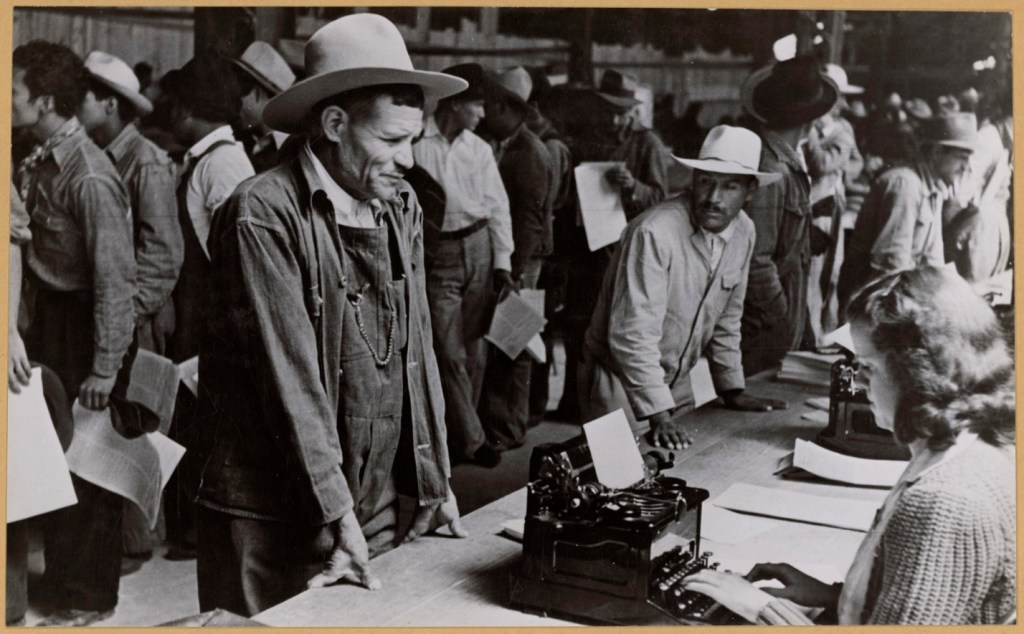
Migrant workers from Mexico who have been accepted to do farm labor in the U.S. through the Bracero Program, ca. 1942–ca. 1945. (National Archives Identifier 7452192)
Dehumanizing Mexicans
While there was some definite financial benefit for Mexican workers, the reduction of Mexican humanity racialized not just the Braceros but all people of Mexican descent in the United States, especially because most Anglos in the United States did not distinguish between citizens and noncitizens.
What Trump is proposing is a rerun of an old policy that functions for two purposes: 1) to provide cheap, exploitable, expendable laborers who have to rely on the paternalistic goodness of their US employers (and, presumably, the shifting whims of President Trump); and 2) to devalue and racialize immigrants as well as those US citizens who happen to have a similar complexion, culture, or language. Trump’s immigration proposal attempts to codify white supremacy by solidifying Anglos at the top of society with a permanent (im)migrant underclass to make the economy hum for the benefit of the wealthy.
Trump is likely doing this to salvage the economy in the wake of his botched tariff trade war and widespread fear of deportations that has had many businesses hurting for workers. Indeed, Florida became the latest Southern state to relax child labor laws in an attempt to fulfill labor needs. The move followed Florida’s own war on undocumented and immigrant labor. Trump’s new Bracero 3.0 could once again be seen as a workaround for replacing (im)migrant labor, this time for Trump’s new manufactured “national emergency,” which has been created by his other “national emergencies” regarding trade deficits and Venezuelan gangs.
But here is the bottom line: if implemented, this program would once again render invisible the (im)migrant communities that have long been part of the fabric of every region of the United States. This is not just a regional issue. Indeed, Latinx began arriving to the Midwest in the early 1920s and have a century-long permanent presence in the region. Yes, they picked crops as migrants and toiled in the automobile industry. But Latinx peoples also constructed neighborhoods, started baseball leagues, and pushed the labor movement to be more inclusive in the mid-twentieth century. For example, Mexican Americans were part of the United Auto Workers (UAW) and participated in the union’s first victory over General Motors in the 1937 Sit-Down Strike. And they pushed the union to address Latinx needs in subsequent decades, which included inducing the UAW to support farmworker rights in the 1970s.[4]
The demonization and dehumanization of Latinx immigrants by Donald Trump, starting with the announcement of his candidacy in 2016 to his Executive Orders targeting gangs and birthright citizenship in 2025 has always been about erasing the contributions of minority groups. Let’s be clear: Trump’s goal with this supposedly “new” immigration program is to make people question their neighbors, both in terms of their legitimacy in the country and their belongingness within their communities. It is intended to steal their humanity and view them only in terms of their “contribution to the economy.”
Featured Image: Attendees at the Republican National Convention hold up signs reading “Mass Deportation Now!” (NPR, Scott Olson/Getty Images)
[1] Suzanne Gamboa, “Trump floats plan for undocumented farm and hotel workers to work legally in the U.S.,” NBC News, accessed April 29, 2025. https://www.nbcnews.com/news/latino/trump-farmworkers-hotel-workers-undocumented-legal-rcna200722
[2] US Congress, House of Representatives, Committee on Immigration and Naturalization, Immigration from Countries of the Western Hemisphere, 70th Congress, 1st Session (Washington, DC: GPO, 1928), 623.
[3] Rigoberto Garcia Perez, interview by David Bacon, April 1, 2022, “The Story of a Bracero,” Labor Notes, accessed April 29, 2025, https://labornotes.org/2002/04/story-bracero. Also, see Deborah Cohen, Braceros: Migrant Citizens and Transnational Subjects in the Postwar United States and Mexico, (University of North Carolina Press, 2011).
[4] Brett T. Olmsted, Making Michigan Home: Mexican Americans Bridging the Rural-Urban Experience (University of Illinois Press, expected Fall 2025).
 Clio and the Contemporary
Leave a comment