“Every time Congress comes at public broadcasting, Big Bird is held up,” Sesame Street creator Joan Ganz Cooney told an interviewer in 1998, “as a crucifix is to a vampire.” Three years prior, when Rep. Eliot Engel (D-NY) took the floor to argue against proposed cuts to public broadcasting funding, he brandished a small Big Bird doll. “Don’t kill Big Bird,” he extolled, “because public broadcasting works, public broadcasting is good for the American taxpayer, and good for the American people.”
Since the 1967 creation of the Corporation for Public Broadcasting, every Republican administration except for President Gerald Ford, has campaigned to defund public broadcasting. Each threat has been met with a robust defense that emphasized the educational and cultural value of the children’s television shows on public broadcasting.
Most famously, when President Richard Nixon threatened to halve a $20 million grant to PBS, Fred Rogers, the patriarch of Mister Rogers’ Neighborhood, testified about the value of his program. His speech gave Sen. John Pastore (D-RI) goosebumps. “Looks like you just earned the 20 million dollars,” Pastore told Rogers at the conclusion of his comments.
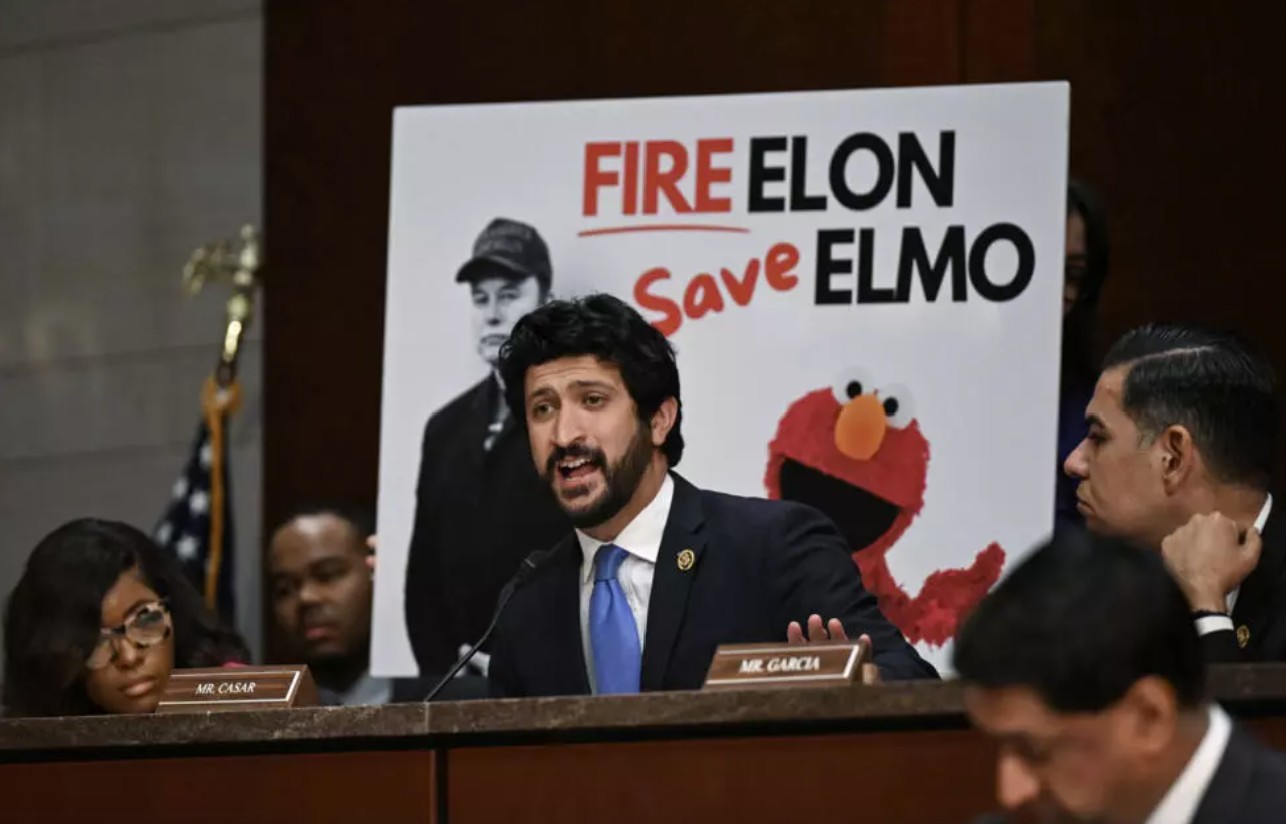
On March 26, 2025, when the House Committee on Oversight and Government Reform held a hearing about the future of public broadcasting, Democratic representatives used Elmo as their chosen prop. Standing behind Rep. Greg Casar (D-TX) and Rep. Robert Garcia (D-CA) as they made their comments was a poster of the furry red monster smiling next to the bolded phrase “FIRE ELON. SAVE ELMO.”
While Democrats waving a Big Bird doll around on the House floor to laud the importance of children’s television saved public broadcast funding in the past, this strategy does not seem likely to work in 2025 for three main reasons. First, conservative attacks on public education have become more vitriolic since the 1990s. Second, the Republican Party is increasingly resistant to external pressure to save public broadcasting. Finally, Sesame Street’s current lack of private funders has put the program on less stable footing, while the onslaught of other crises at the national level have stretched public broadcasting’s would be supporters thin.
Comparing the Fights over Public Broadcasting
The arguments at the March hearing, both for and against funding public broadcasting, directly echoed those from the past. Republicans couch their opposition to public broadcasting in the language of fiscal conservatism and are equally concerned with controlling the ideological perspective of the network. Democrats, meanwhile, champion public-private partnerships to sustain public broadcasting. Below are just a few examples of the parallels between the arguments from the hearing this spring and the congressional funding fights in the early 1990s.
1992: Sen. Trent Lott (R-MS) introduced an amendment to the Public Broadcasting Act to freeze proposed cuts. He argued, “In view of the $400 billion deficit that we face this year, and the $4 trillion national debt, it seems to me that a little restraint is in order.”[1] Democrats were quick to point out that public broadcasting accounted for a very small fraction of the federal budget and would result in minimal changes to the deficit or the national debt. A journalist later commented that cutting public broadcasting would pay the interest on the national debt for just three hours.
2025: Multiple representatives stated that cutting public broadcasting would help address the administration’s goal of cutting the nation’s $36 trillion in debt and the $1.8 trillion annual deficit. Rep. Ro Khanna (D-CA) clarified several times that public broadcast spending represents 0.01% of the federal budget.
1992: Political commentator George F. Will echoed Speaker of the House Newt Gingrich’s comments that public broadcasting was an elitist institution when he wrote, “Public television is a paradigm of America’s welfare state gone awry. It is another middle-class—actually, upper middle-class—entitlement.” Vice President Al Gore responded that, “Public broadcasting is the only source of educational programming available to every American.” He described its broad accessibility and its reach into lower-income homes across the United States as “the opposite of elitist.”
2025: The subcommittee chairwoman Rep. Marjorie Taylor Greene (R-GA) opened the hearing by calling NPR and PBS “radical, Left-wing echo chambers for a narrow audience of mostly wealthy, white, urban liberals and progressives, who generally look down on and judge rural America.”
1992: Sen. John McCain (R-AZ) argued for defunding public broadcasting over Tongues United (1989), a documentary on discrimination against Black gay men. McCain felt the content of the documentary was too controversial to even describe it to his fellow senators. His comments aligned with the renewed moral panic on the right about homosexuality, most famously broadcasted by 1992 Republican presidential nominee, Pat Buchanan. This was the same year that panicked parents and pundits speculated about Bert and Ernie’s potentially queer relationship.
2025: Rep. Greene amplified culture wars rhetoric in her comments too, fixating on a New York public station’s digital series that featured a drag queen reading a children’s story. She erroneously charged that the performer appeared on PBS children’s programming, calling the individual a “child predator” and said it was just one example of public broadcast programming that was “sexualizing and grooming children.”
1992: Republicans were particularly resentful of journalist and former White House Press Secretary Bill Moyers’ continued presence on public broadcasting, including his coverage of the 1992 presidential election. Laurence Jarvik, an associate at Heritage Foundation, once commented of public broadcasting: “The high priest is Bill Moyers. The sacred symbol is Big Bird.”
2025: Chairman James Comer (R-KY), other Republican members of the subcommittee, and Michael Gonzalez a senior fellow at the Heritage Foundation, listed examples of what they perceived to be a liberal bias in public broadcast reporting, including how NPR covered the COVID-19 pandemic, Russian interference in the 2016 election, and Hunter Biden’s laptop.
Big Bird… Brought to You by the Letter $
In the 1990s, Big Bird, or Sesame Street more broadly, was the sacred symbol for Democrats too. President Bill Clinton and Vice President Al Gore, looked to Sesame Street as an ideal model for the future of public broadcasting. By the 1990s, the Children’s Television Workshop, now Sesame Workshop, the nonprofit production company that makes Sesame Street, did not receive direct federal funding. Through the use of public-private partnerships and commercial business ventures, the Workshop was mostly financially independent of the government. Clinton and Gore valued public broadcasting, but wanted to see more programs adopt this model. “No one is more interested in streamlining government than President Bill Clinton and me,” Gore stated. “We want to reinvent government so that it works better and cost less, and there is nothing that works better and cost less than public broadcasting.”
Clinton and Gore’s defense of public broadcasting against constant Republican attacks to defund it did not lead to robust funding for public broadcasting. Instead, public broadcasting adopted Sesame Street’s model by partnering with private capital. Across the decade, PBS programs added corporate sponsors at the beginning and of episodes. Juicy Juice sponsored Arthur. Huggies underwrote the second season of Barney & Friends. In 1998, Sesame Street added its first corporate sponsor: a $1 million sponsorship deal from the indoor playground company, Discovery Zone.
The decision to add a corporate underwriter angered many viewers. “It’s sad that ‘Sesame Street’ would deliver children to Discovery Zone,” Gary Ruskin, a spokesman for Commercial Alert, said in reaction to the decision. “We don’t want [the Workshop] to finance ‘Sesame Street’ to the detriment of the children who watch it.”Sesame Street executives defended themselves against such attacks. Executive Gary Knell argued that Sesame Street was an attempt to produce quality children’s television with very few resources and “at a time when government funding and foundation funding have been declining.” What options were left?
The consistent attacks against public broadcasting have made it a precarious broadcasting partner for shows like Sesame Street. During Gingrich’s attacks on public broadcasting in 1995, Sesame Street producers prepared an exit strategy and started exploring the creation of a new cable network that could potentially broadcast Sesame Street instead of PBS.
In 2015, executives signed a deal with HBO (now MAX) to fund and distribute new seasons of Sesame Street. This past fall, MAX chose not to renew its contract with Sesame Street, leaving the show without a broadcasting partner for the first time in its history. Sesame Street’s future has grown more precarious with cuts to federal grants, like USAID funding for the Iraqi version of the show, Ahlan Simsim. In March, Sesame Workshop cut 20% of its staff as it continued negotiations to find a new broadcasting partner.
Sesame Street has struggled financially before and the fate of public broadcasting has often felt grim. But in the direst moments, a Big Bird doll, a few sentiments from Mister Rogers, and the potential effects on rural stations (and voters) rallied enough support for public broadcasting to persuade Republicans that cuts were politically unwise.
In our current political climate, it is harder to see any of those tactics being persuasive. While many Americans still love Big Bird, public outrage is directed at the bigger threats to democracy and Republicans seem more concerned with losing favor with Trump than their constituents, who will be hurt most by the cuts to public broadcasting. The Trump administration has also escalated its attacks against public broadcasting. On April 15, the Trump administration drafted a memo, for congressional approval to rescind the next two years’ worth of funding for the Corporation for Public Broadcasting.
Republicans seem poised to deliver on a decades-long promise to defund public broadcasting. The House Committee on Oversight and Government Reform’s decision to hold the hearing and the Trump administration’s plan to have Congress trigger the cuts feels notable when Trump is otherwise allowing DOGE to cut federal spending at all levels of government with little oversight, regard for the law, or public-facing justification.
The public broadcasting cuts are set up to give congressional Republicans a win and, as Democrats at the hearing argued, distract from the administration’s other actions. “It’s Sesame Street that’s making things expensive, it’s Mr. Rogers that’s blowing taxpayer money. It’s listeners like you. It’s absurd,” Rep. Casar contented. The hearing, he argued, was a distraction. “Madam Chair, leave Elmo alone. Bring Elon in for questioning instead.”
Featured Photo: US lawmakers including Democrat Gregorio Casar (C) discuss the nation’s public broadcasting services during a government reform hearing on Capitol Hill. Photo Credit: Drew ANGERER / AFP
[1] Senator Lott, speaking on Public Telecommunications Act of 1991, S. 1504, 102nd Cong., 2nd sess., Congressional Record 138, pt. 10 (June 3, 1992), 13119.
 Clio and the Contemporary
Leave a comment