A 13-year old boy was doing his job cleaning equipment inside of a conveyor belt when it turned on, dragging him and tearing open his arm.[1] Identified only as Marcos, he was contracted through a third-party to work at a meat processing plant owned by Purdue Farms.[2] He was an undocumented child worker from Guatemala, and his low-waged labor helped subsidize the meat industry’s continued domestic production of meat.
As the Trump administration offers various explanations for its tariffs that include the goal of returning manufacturing to the United States, it is helpful to look at an industry that never left.[3] Domestic meat production skyrocketed in the late 19th century, and its history offers an insightful lesson on what it took for manufacturers to remain domestic producers.
Unionizing the Industry
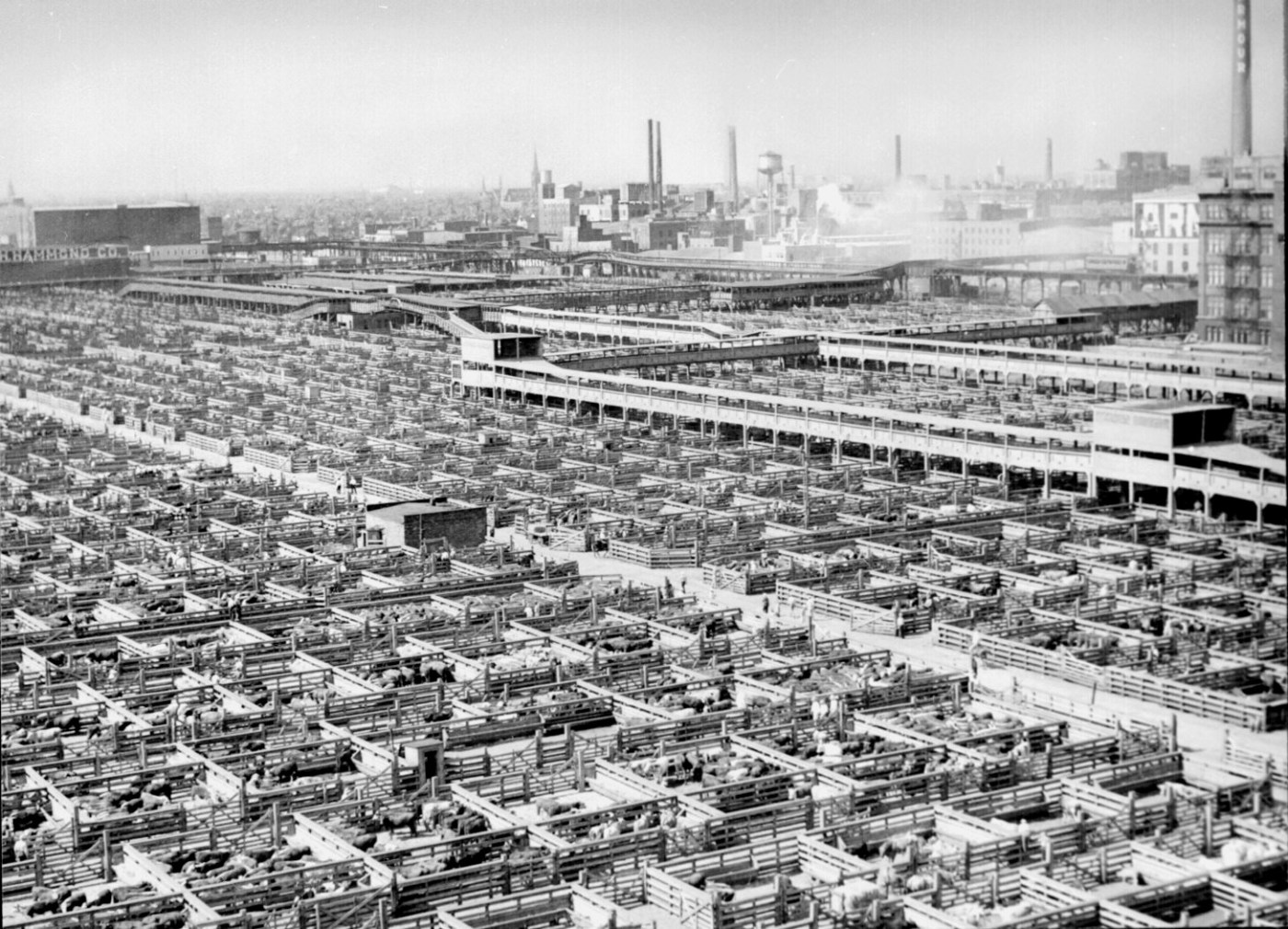
The origins of the modern meatpacking industry created the very conditions that would also drive workers to spend decades fighting to unionize the industry. The industry emerged in the 1870s thanks to a group of ruthless businessmen who adapted the most modern technology available while harnessing a sudden drop in cattle prices, and through risking their workers’ safety and well-being. The industry that they created was located in the upper Midwest, particularly the great meatpacking plants of Chicago.[4] Unlike the prior model that relied on hogs and human muscle and was based out of Cincinnati, cattle and mechanization cemented their power.[5] These new meatpacking plants slaughtered cattle from across the Great Plains and Southwest, developed a mechanized system to process meat, and shipped their products across the globe, but mostly to consumers on the East coast. Four or five firms, like Armour and Swift, quickly consolidated the industry using refrigeration, railroads, and aggressive business tactics. These firms soon formed the dreaded “Beef Trust” and created an oligopoly that rested on concentrated buying of animals (particularly cattle) and concentrated selling power with their meat retailers spreading across the country.
Consolidation had other important effects, particularly for workers who found themselves with fewer employers to choose from. For decades, workers—largely foreign-born, poor white, or Black—toiled in unhealthy environments as they handled dangerous animals, large machines, and sharp blades in packing plants. Unlike the previous version of the industry, this work was done year-round thanks to new technologies that allowed fresh meat to be chilled enough to minimize spoilage. The number of meatpacking workers in this era grew at an incredible pace, from 8,366 in 1870 to 68,500 in 1920.[6] At the same time, 185 plants produced $12 million in profits, which grew to 1,304 facilities making $4.2 billion in profits in red meat.[7] Though this workforce was largely made up of adult men, women and children had important jobs within the industry.
Workers in these factories struggled to unionize. By the turn of the century, the American Federation of Labor managed to organize the Amalgamated Meat Cutters and Butcher Workmen of North America, the first successful meatpacking union, in a handful of factories. In 1904, the union went on strike over skilled workers’ wages, and tens of thousands of workers walked out of the factories. But, in a testament to the sprawling system of meat production, production hardly dropped, and consumers did not support the strike. Following the strike and the passage of the Meat Inspection Act of 1906—thanks in part to an assist from Upton Sinclair’s The Jungle—the federal government slowly reigned in the industry. In 1920, the biggest packers agreed to a consent decree, and the federal government passed the Packers and Stockyard Act of 1921.[8] These changes strengthened the federal government’s regulatory power and reinvigorated meatpacking workers’ rights and efforts to unionize their industry.

A “Disassembly” line in a meatpacking plant, date unknown.
That is exactly what happened during the Great Depression in the 1930s. The passage of the National Labor Relations Act of 1935 allowed a major burst of unionization. Although the AFL chose not to include packinghouse workers, the newly formed Congress of Industrial Organizations (CIO) welcomed such workers with open arms. By 1937, the CIO created a union to compete with Amalgamated, which eventually became the United Packinghouse Workers of America (UPWA). Before long, the UPWA had 60,000 members in 70 plants while the older Amalgamated had 7,700 members in 22 plants.[9] The resulting unionization wave, backed by federal government power during World War II, secured industry-wide concessions from the owners, including wage increases in the meatpacking plants run by the big four. In the decade after the war, upwards of 90 percent of the industry was unionized.[10]
While unionization secured wage improvements, working conditions in the plants had not changed much by the end of World War II. A board of investigators looking into meatpacking worker conditions in 1946 described work in meatpacking as still being done largely by manual labor and as “hard, disagreeable, unpleasant.”[11] Sausage and hot dog manufacturing provides a glimpse into what workers endured in the plants.[12] After the slaughter and most of the packing was done, the offal (or entrails and other muscle tissue like hearts) would be sent to a specialty room, usually beneath the slaughtering floor, where women cleaned, sorted, and sent the organs out to their proper place, including the sausage room.
Black women made up the majority of the workforce, with one woman explained that, “It was terrible,” and that, “It was an awful job.”[13] Men would then run the massive cutter and sausage pumps, which would push meat into intestines prepared by women. Linkers, a woman’s job, then twisted the casings into links since no machine could match a skilled linker’s speed. This process changed by the end of the 1950s with the adoption of artificial casings and the mechanization of stuffing and linking with the Frank-O-Matic. Afterward, the industry made sausages by increasingly relying on machines with people to guide and correct the process, rather than through skilled labor.
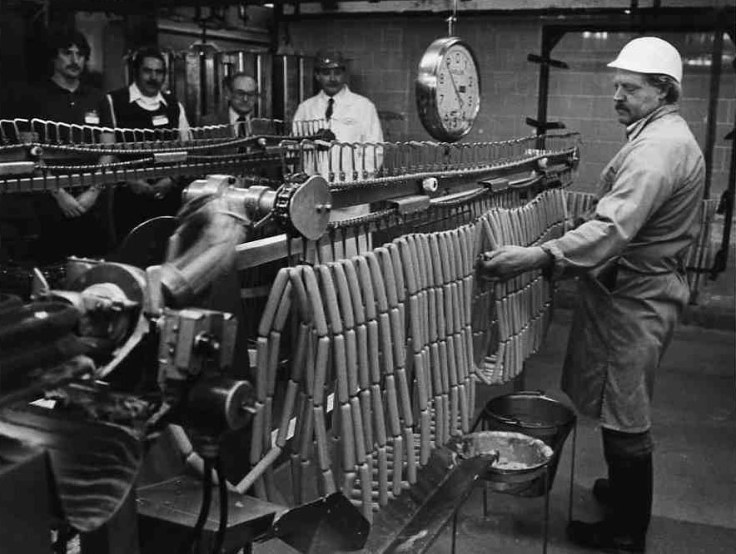
Made-Rite Sausage Company employee Ken Bakkie demonstrates the Frank-O-Matic (Photographer Frank Stork, Sacramento Bee Collection, 1983/001/SBPM02122)
Decline of Union Power
The 1950s to the 1980s saw two intertwined trends that greatly reduced the power of labor unions and prepared the industry to stay within the United States during the offshoring of American industry. One trend, as seen with sausages, was the increased reliance on machines and the reduction in most skilled labors. By eliminating jobs that took years to learn, employers could fire their workforce more readily without a subsequent loss of output. The other trend was the death of the Beef Trust through a slow process of decentralization.[14] First with pork, and then with beef, the largest meat packers lost their market dominance to companies like Smithfield and IPB (known various as Iowa Beef Packers, Iowa Beef Processors, or simply IBP), who did not have to adhere to prior labor union contracts or agreements since they were not one of the original big packers from Chicago. To unionize these plants, workers must force each firm to agree on a per factory or sector basis or launch another industry-wide wave of strikes that give the corporate leaders no choice but to sign a new master compact. By the 1980s, these new conglomerates enacted strict anti-union policies.
The meatpacking industry shifted out of the older multi-story brick buildings in places like Chicago and Kansas City and into sprawling facilities in states like Nebraska and North Carolina. In some places, factories stayed in the same places but remodeled and then hired back workers at reduced wages and without union protection. For example, Wilson, the last remaining company of the former trust, declared bankruptcy in 1983 allowing the company to restructure a pork processing plant and reduce worker pay from $10.69 an hour to $6.50 an hour after reopening.[15] Another, more famous example, is Hormel in Austin, Minnesota.[16] The company made peace with its union in the 1940s but, by the late-1970s, began to reconsider this relationship when it started hiring workers from outside the local area. Management looked for workers who would work for the new wage of $9 per hour, down from $15.[17] Tensions flared until 1985 when local P-9 went on strike. Hormel managed to break the strike, which resulted in white, native-born Austin residents permanently losing their meatpacking jobs.
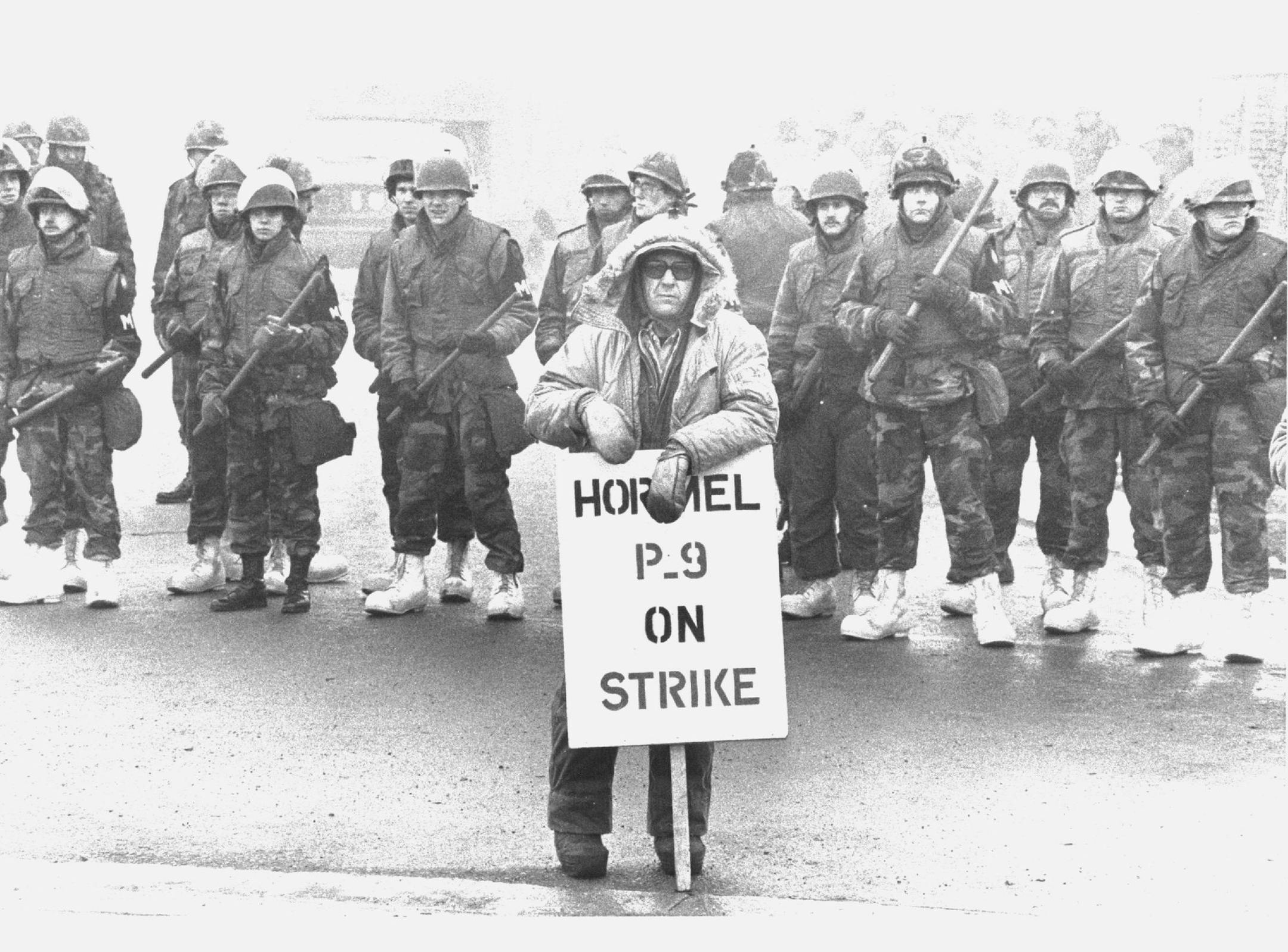
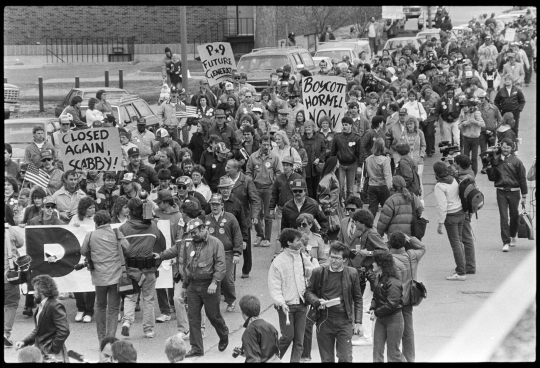
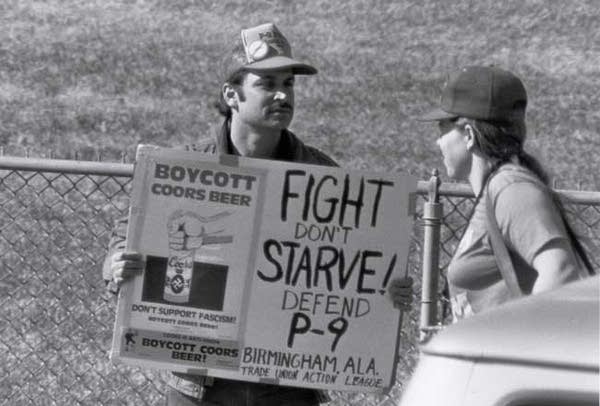
Images from the 1985-86 Hormel Strike, which lasted over 13 months making it one of the longest strikes in Minnesota history.
To undercut unionization efforts and reduce labor costs the meatpacking industry decided to rely on a mostly immigrant workforce. This increasingly immigrant workforce was made up of both documented and undocumented workers, with undocumented workers making up an estimated 25 percent of the workforce in two meatpacking states.[18] With a workforce unable to resist the new management techniques that prioritized speed and efficiency above all else, working conditions quickly deteriorated. Injuries rose throughout the 1980s and 1990s, becoming a scandal that the industry spent the first two decades of the 21st century fixing.[19] By the 1990s, workers faced increasing line speeds that gave them little time to respond to mistakes or to rest. For example, in a Sioux City plant, two women trimmed 540 hog tongues an hour in the 1960s. By 1988, one woman had to trim 785 tongues per hour.[20] Hormel’s subsidiary, which it created in 1987 to get around its union wages in Austin, Quality Pork Processors Inc., sped up the line “from 750 heads per hour when the plant opened to 1,350 per hour in 2006, though the workforce barely increased.”[21] The company had been given special permission to speed up lines without checking with the U.S. Department of Agriculture.
Meatpacking work remains difficult and demanding. Turnover rates in the industry climb higher than 100 percent in factories, meaning that every year the entire workforce is replaced.[22] Injuries remain common, the work is grueling, and immigration policies allow workers to be punished/threatened with deportation whenever the employer decides to call the federal government.[23] Meanwhile, union density in the industry, as of 2024, has fallen to 13 percent from a high of 90 percent in the decade after World War II.[24] Undocumented workers are now the backbone of the industry, allowing employers to use federal immigration raids to control its workforce.[25] It is cliché for historians to call the post-1970s meat industry a jungle again, but the unfettered power of the meat industry allowed them to keep meat production domestic even as they expanded in the 2000s to become global monopolies. If the United States wants to onshore its industrial base, politicians must confront the labor conditions like the ones that drove 13-year-olds like Marcus into dangerous factories as a cost-cutting method for an industry to afford to remain onshore. One can only hope the strategy is not replicated to “Make America Great Again”.
Featured Photo: The maze of livestock pens and walkways at the Union Stock Yards, Chicago, Illinois, USA. Library of Congress’s Prints and Photographs division.
[1] Hannah Dreier, “Tyson and Perdue Are Facing Child Labor Investigations,” New York Times, September 23, 2023.
[2] Purdue Farms entered into an agreement with the U.S. Department of Labor on January 13, 2025 and agreed to pay $4 million in restitution and to organizations that fight child labor. It is unclear if the Trump administration will hold the company to account. Hannah Dreier, “Meatpacking Companies to Pay $8 Million for U.S. Child Labor Violations,” New York Times, January 16, 2025.
[3] Scholars have long been documenting and explaining the changes since the 1990s by participating in the industry and working in plants. Deborah Fink, Cutting into the Meatpacking Line: Workers and Change in the Rural Midwest (Chapel Hill: University of North Carolina Press, 2000); Timothy Pachirat, Every Twelve Seconds: Industrialized Slaughter and the Politics of Sight (New Haven: Yale University Press, 2011); and Alex Blanchette, Porkopolis: American Animality, Standardized Life, and the Factory Farm (Durham, NC: Duke University Press, 2020).
[4] On the emergence of Chicago meatpacking system, see William Cronon, Nature’s Metropolis: Chicago and the Great West (New York: Norton, 1991), ch. 5; Joshua Specht, Red Meat Republic: A Hoof-to-Table History of How Beef Changed America (Princeton: Princeton University Press, 2019); and Dominic A. Pacyga, Slaughterhouse: Chicago’s Union Stock Yard and the World It Made (Chicago: University of Chicago Press, 2015).
[5] On Cincinnati and hog production, see Jimmy Skaggs, Prime Cut: Livestock Raising and Meatpacking in the United States, 1607-1983 (College Station: Texas A&M University Press, 1986), 36-44; and L. J. Anderson, Capitalist Pigs: Pigs, Pork, and Power in America (Morgantown: West Verginia University Press, 2019), 110-37.
[6] Jimmy M. Skaggs, Prime Cut: Livestock Raising and Meatpacking in the United States, 1607-1983 (College Station: Texas A&M University Press, 1986), 108-09.
[7] Skaggs, Prime Cut, 90.
[8] For a description of these changes, though one that deemphasizes the federal government’s regulatory powers, see Skaggs, Prime Cut, 100-28.
[9] Horowitz, “Negro and White, United and Fight!”: A Social History of Industrial Unionism in Meatpacking, 1930-90 (Urbana and Chicago: University of Illinois Press, 1997), 147.
[10] U.S. Department of Labor, Bureau of Labor Statistics, “Collective Bargaining in the Meat-Packing Industry,” Bulletin No. 1063 (Washington, DC: Government Printing Office, 1952), 1.
[11] Edwin E. Witte, Raymond W. Starr, and Clark Kerr, “Report and Recommendations of the Fact-Finding Board in the Meat Packing Industry Case,” February 7, 1946, p. 14, OF 407-B Meat Packers Strike, Box 1331, OF 407-B, White House Office Files, Harry S. Truman Presidential Library, Independence, MO.
[12] This description comes from Roger Horowitz, Putting Meat on the American Table: Taste, Technology, Transformation (Baltimore: Johns Hopkins University Press, 2006), 86-93.
[13] Virginia Houston quoted in Horowitz, Putting Meat on the American Table, 88.
[14] U.S. Department of Agriculture, Economic Research Service, Food and Rural Economic Division, “Consolidation in U.S. Meatpacking,” by James M. MacDonald, et al., Report No. 785 (Washington, DC: Government Printing Office, 2000).
[15] Winston Williams, “Wilson Foods Fights Back,” New York Times, December 3, 1983.
[16] Horowitz, “Negro and White, Unite and Fight!”, 268-74.
[17] Donald Stull, Michael Broadway, and David Griffith, “Introduction: Making Meat,” Any Way You Cut It: Meat Processing and Small-town America, Donald Stull, Michael Broadway, and David Griffith, eds. (Lawrence: University of Press of Kansas, 1995), 1.
[18] U.S. General Accounting Office, “Community Development: Changes in Nebraska’s and Iowa’s Counties with Large Meatpacking Plant Workforces,” GAO/RCED-98-62 (Washington, DC: Government Printing Office, 1998), 2.
[19] Donald Stull, et al., “Introduction: Making Meat,” Any Way You Cut It, 3-4; U.S. General Accounting Office, “Workplace Safety and Health: Safety in the Meat and Poultry Industry, while Improving, Could be Further Strengthened,” GAO-05-96 (Washington, DC: Government Printing Office, 2005); and U.S. General Accounting Office, “Workplace Safety and Health: Additional Data Needed to Address Continued Hazards in the Meat and Poultry Industry,” GAO-16-337 (Washington, DC: Government Printing Office, 2016).
[20] Horowitz, “Negro and White, Unite and Fight!”, 277.
[21] Ted Genoway, “The Spam Factory’s Dirty Secret,” Mother Jones, July/August 2011, accessed May 15 2016, https://www.motherjones.com/politics/2011/06/hormel-spam-pig-brains-disease/.
[22] “Safety in the Meat and Poultry Industry, while Improving, Could be Further Strengthened,” 7.
[23] For an example of this playing out in one plant for a small group of workers, see Genoway, “The Spam Factory’s Dirty Secret.”
[24] Barry T. Hirsch, David A. Macpherson, and William E. Even, Union Membership, Coverage, and Earnings from the CPS, accessed April 18, 2025, https://www.unionstats.com/.
[25] See, for example, Ted Genoway, “The Spam Factory’s Dirty Secret,” Mother Jones, July/August 2011, accessed May 15 2016, https://www.motherjones.com/politics/2011/06/hormel-spam-pig-brains-disease/; and Jack Herrera, “After the Raid,” Texas Monthly, March 2025, access April 18, 2025, https://www.texasmonthly.com/news-politics/ice-raids-texas-immigrants-trump-deportation-cactus/.
 Clio and the Contemporary
Leave a comment