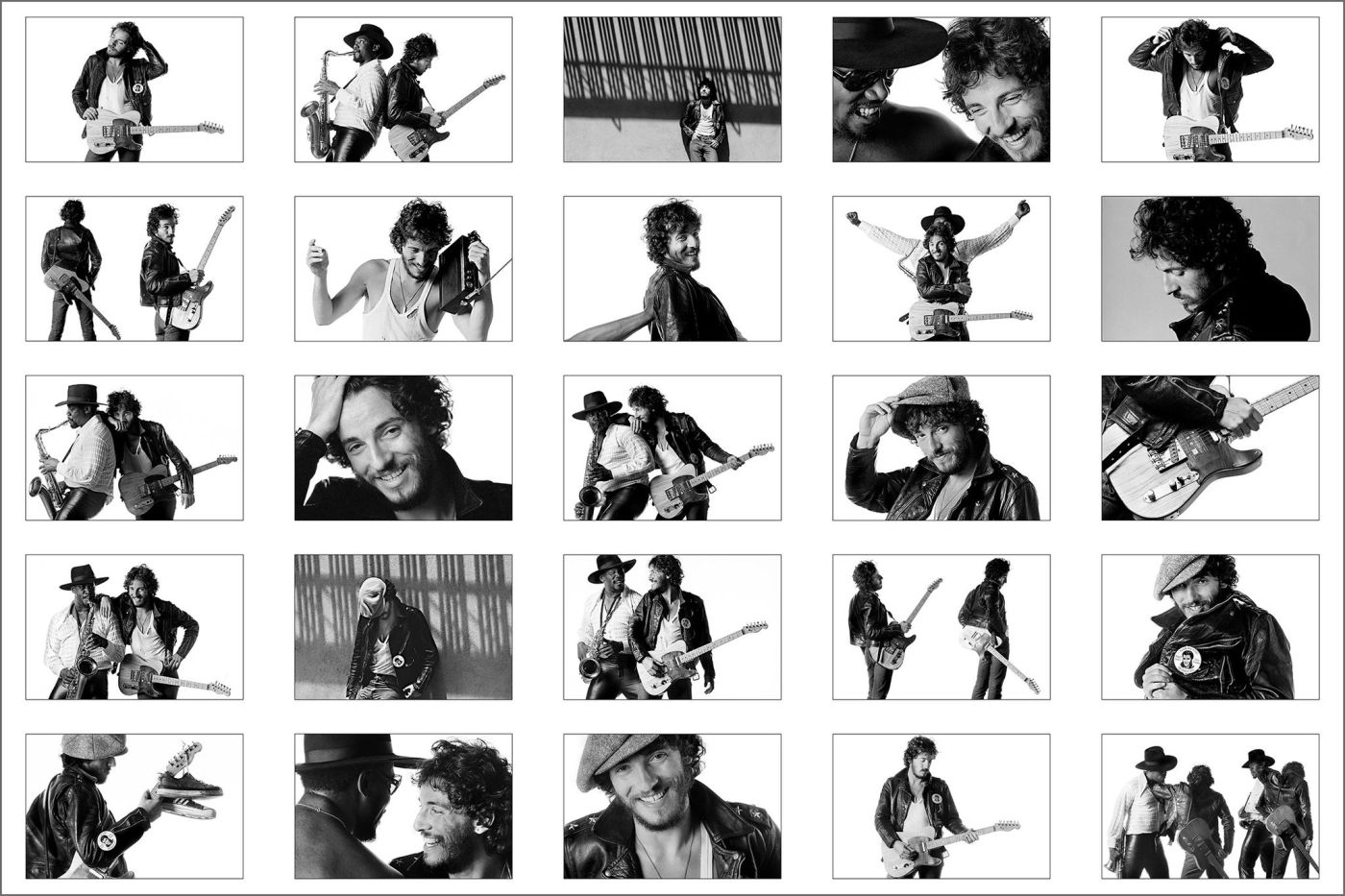
This week marks the golden jubilee of Bruce Springsteen’s Born to Run, and never has a classic album felt so utterly of its time while still sounding so vital. The record’s tentpole tracks (“Thunder Road,” “Tenth Avenue Freeze-Out,” “Backstreets,” the title cut, and the nine-minute “Jungleland”) have been staples of Springsteen’s marathon concerts for so long that it’s easy to forget just how unique the LP’s sound and vision were in 1975, an underrated year in popular music that also gave birth to an impressive array of hard-rock blockbusters, including Pink Floyd’s Wish You Were Here, Led Zeppelin’s Physical Graffiti, and Queen’s A Night at the Opera.
Those records can sound surprisingly fresh in 2025—mostly because rock bands never stopped aping them—but Born to Run feels dated, although in a good way. No album of its odd interregnum of a year, post-Watergate but pre-Bicentennial, takes more seriously its decade’s weird retro fixation with the 1950s. Cheery nostalgia for the Eisenhower era saturated pop culture as an escapist antidote to Watergate, the OPEC oil embargo, and the dissolution of sixties’ idealism. By 1975 Happy Days was on TV, Grease on Broadway (and soon onscreen with John Travolta), and American Graffiti and The Lords of Flatbush were recent movie draws (the latter a low-budget sleeper that introduced both Sylvester Stallone and Henry Winkler, aka Happy Days’s “The Fonz”). Meanwhile, fiction had The Wanderers, the debut novel of future crime writer Richard Price.[1]
Rock music, too, was full of aural shoutouts to the fifties. From Zep’s doo-wopish parody “D’yer Mak’er” and The Who’s “Long Live Rock” to The Stones’ “It’s Only Rock ‘n’ Roll” and John Lennon’s covers-only LP Rock ‘n’ Roll, musical titans of the 1960s retrenched within the sonic signifiers of Elvis, Chuck Berry, and Fats Domino. Doing so salved their uncertainty over rock’s apparent indirection after the Beatles’ break-up and the overdose deaths of Jimi Hendrix, Janis Joplin, and Jim Morrison.
BTR differs from these throwbacks, however, even if Bruce does sport an Elvis button on the iconic LP cover. Springsteen’s barbaric yawp and cramped wall-of-sound arrangements, the latter spotlighting Clarence Clemons’s squalling tenor sax and Roy Bittan’s piano stabs, may evoke Link Wray, King Curtis, and Roy Orbison, but the songs are hardly Rocky Horror-style pastiche.[2] For Springsteen, the fifties were the chassis within which he retrofitted his souped-up ambitions for revitalizing rock. His drive to create a cri-de-cœur epic testing the continued viability of American mobility—both spatial and economic—backed by a road-tested pit crew of E Street virtuosi, revs the music up with “Hemi-powered” ardor.[3] With one significant exception, these songs either “scream down the boulevard” from the green light of their first groove, or they go zero to 100 in two verses. To mix the metaphor, BTR is a kind of reverse palimpsest that superimposed the original exuberance of fifties’ R&R atop grittier seventies’ guitar-and-bass rhythms in hopes of jump-starting rock out of its stagflationary doldrums.[4]
This connection to the past—umbilical but not parasitic—allowed Springsteen to express a quality that by the mid-seventies was almost in as short supply as cheap gas: optimism.[5] It’s a hyperbolic and even desperate optimism, for sure, full of macabre images in the title track of death traps, suicide raps, and dead-end towns where complacency “rips the bones from your back.” Still, for all this gore, by the time Bruce begs his idealized lover Wendy to “die with [him] on the streets tonight in an everlasting kiss,” it’s hard not to hear his narrator as an avatar of that apostle of 1950s’ high-octane acceleration, Jack Kerouac, echoing especially On the Road’s famous “The only people for me are the mad ones, the ones who are mad to live, mad to talk, mad to be saved.…” passage.
This feral romanticism further distinguishes BTR from its contemporaries. For Bruce rock’s road out of lethargy wouldn’t be paved with the smirky primitivism of the Ramones or the defiant apathy of Richard Hell and the Voidoids’ “Blank Generation,” both of which larp their fifties’ greaser and hipster personae. Nor, at least for the moment, was Springsteen in jeremiad mode, allegorizing the “death of the sixties” as the Eagles made a veritable career of doing in their late imperial phase with the sorcerous “Hotel California,” and the more mawkish “The Last Resort” and “The Sad Café.” Ten years down the road, of course, eighties-era Bruce would tackle head on the unresolved legacies of the baby boomers’ formative decade, howling out on behalf of neglected Vietnam vets on “Born in the U.S.A.” as Ronald Reagan’s conservative movement glibly insisted only staunch militarists could be true patriots. On BTR, however, the politics are implicit, and history evident only when one hears the music’s 1950s filigrees as earnest entreaties to burn some rubber as they had in heyday of the deuce coupe and Chevy 210. We may be stuck in this entropic moment, the songs said to mid-seventies’ kids, but that doesn’t mean we’re spinning our wheels searching for better.
Asphalt Arias and Noir Naturalism: BTR on Where the Seventies Were Headed
There’s a more musical term for categorizing BTR’s velocity and vigor. Springsteen namedrops it in “Jungleland,” a parable about a hot rodder/gang member nicknamed the Magic Rat who takes “a stab at romance” only to end up gunned down. “Man, there’s an opera out on the Turnpike,” Bruce wails, celebrating the cruising muscle-car culture of his native New Jersey. It was a risky word choice. Long before the mid-seventies common parlance had pejorated the adjective “operatic” into a synonym for emotionally overwrought and excessively theatrical, for anti-mimetic even. One BTR resister, Roy Carr of New Musical Express, would dismiss the album’s authenticity on just these grounds, claiming Springsteen’s “consciousness is strictly confined to West Side Story” (which was originally conceived as an opera). Another apostate, Todd Rundgren of “Hello, It’s Me” fame, agreed to produce an album of ersatz Broadway show tunes by another fledgling Jersey composer, Jim Steinman, only because he saw an opportunity to spoof what he considered BTR’s Wagnerian bombast; the result, Meat Loaf’s Bat Out of Hell, is pure kitsch, a parody of pop grandiosity that’s rock’s version of Bugs Bunny’s “What’s Opera, Doc?”
As funny as they are, both Meat and Bugs do a disservice to the high seriousness of opera, which arose as a dramatic vehicle for heightening mundane emotions into the realm of the extraordinary. In its heyday opera let audiences (including Emma Bovary) revel in the dizzying catharses available when abstractions like passion, betrayal, and madness are cast into soaring arias and rococo libretti. Although Springsteen has never explicitly stated it, one senses the opera metaphor was his device for mythopoetizing everyday detail to enliven listeners stuck in 1975’s post-Nixonian languor. The emotion he pours into his novelistic images and similes—Mary’s swaying dress in “Thunder Road,” the eroticized French cream and boots sported by the aloof love interest in the exquisitely horny “She’s the One,” even the wannabe bands who “flash guitars just like switch-blades” in the dive bars the Rat rumbles past on his road to ruin—all seem concocted to jolt audiences, if only momentarily, out of lives of quiet desperation. If postmortems wrote off 1975 as a blasé year of stasis and abeyance (“If it didn’t make things much better it didn’t make them much worse,” the New York Times shrugged), BTR insisted the stuff of poetry still existed, if only the fervor were found to seize upon it—
With one significant exception. Among BTR’s eightcuts, its seventh, “Meeting Across the River,” is its most atypical. It, too, evokes the fifties, but not rock ‘n’ roll—it’s a plaintive jazz ballad, its arrangement punctuated by Randy Brecker’s trumpet gusts, which color the music like foreboding cloudbanks. Not insignificantly, it’s also the record’s lone automotively deprived track: its unnamed narrator, presumably a small-time hood, has to beg a lift across the Hudson from his buddy Eddie to seal a shady deal possibly worth two grand. Although “Meeting” has its fans—most notably Billy Joel—it routinely lands last when online posters rank their BTR faves, considering it a “momentum killer.” Bruce apparently thought so too. The most intriguing episode in Peter Ames Carlin’s just-released Tonight in Jungleland, a granular account of BTR’s making, finds Springsteen and co-producer Jon Landau dismissing “Meeting” as a downer until then-manager Mike Appel browbeats them into recognizing its emotional and literary heft.[6] Whether Bruce has ever been fully convinced of its merits is debatable.According to one wiki, in the past half-century “Meeting” has been performed in concert a paltry seventy-four times, exactly 1,793 fewer than the title track.
That’s unfortunate for several reasons. As critics have noted, “Meeting” foreshadowed a significant vein of Springsteen’s songwriting about petty crooks, most famously “Atlantic City.” In his autobiography—fittingly titled Born to Run—the artist himself identifies the genre to which such works belong when he writes that his protagonists are often defeated “by the streets of my noir city.” Opera could not have a more diametrically opposed counterpart than noir; instead of ornately passionate, it is brutally defeatist. In this way, “Meeting” feels like a hardboiled rejoinder to the rest of BTR’s brawny but pie-eyed romanticism. Instead of the open road, one pictures its heroes headed straight toward a dead end—probably literally.
More importantly, the song anticipates the fatalism of the seventies’ second half. Post-fall of Saigon and amid the recessionary ravaging of the working class, this era saw sectors of the country doubting any Hail Mary could resuscitate the exhausted post-WWII boom and revive American pride. Some responded by escaping to the cloud-cuckoo-land of disco, others rutted in punk’s sty, but as the Ford interim devolved into the Carter malaise, the slice-of-life naturalism of “Meeting” proved the natural direction of Bruce’s storytelling. His next album, 1978’s stark Darkness on the Edge of Town, exclusively features downtrodden heroes like the narrator and Eddie who, while not specifically criminals, believe they have been criminally mistreated. A few years older than BTR’s narrators, they are men beaten down by disapproving fathers (as Bruce notoriously was), by divorce, by economic displacement and austerity politics. While they still claim to believe in “the promised land,” their stoicism suggests that if they pursued BTR’s “runaway American Dream” they’d get mowed over. In this sense, “Meeting” wasn’t a detour—noir was where Springsteen believed the country had headed.
That Other Great Seventies’ Operatic Fabulist, Born to Run (His Mouth)
This past May 14, Springsteen kicked off his 2025 European tour in Manchester, England, by denouncing the Trump Administration as “corrupt, incompetent and treasonous” and exhorting “all who believe in democracy and the best of our American experience to rise with us, raise your voices against authoritarianism, and let freedom ring.” 114 days of mayhem since MAGA reseized power had clearly put Bruce in full Lincoln mode as he decried “the richest men” for “taking sadistic pleasure in the pain that they inflict on loyal American workers” and the government for shanghaiing “residents off American streets and, without due process of law … deporting them to foreign detention centers and prisons.” Not surprisingly, the object of this ire responded with juvenile insults, attacking Springsteen as a “a pushy, obnoxious JERK” and a “dried out ‘prune’ of a rocker.” At a time when many corporations and cultural figureheads have zipped their lips to elude the long arm of presidential retribution, Bruce’s “J’Accuse…!” remains admirable, especially given that his politics have apparently cost him a not-insignificant chunk of his American audience. Yet the fracas is also a reminder that the president of the United States, like Bruce, is a creation of the mid-seventies.
Indeed, as it was for Bruce, 1975 was a pivotal year for Donald J. Trump. Two months before BTR made Springsteen a superstar, Trump settled a federal lawsuit charging his family’s real-estate management company with racial discrimination. Entering into a consent decree with the government without admitting guilt gave the future leader of the free world, under the tutelage of the mendacious fixer Roy Cohn, the first of many public-relations victories won by denying wrongdoing and countersuing disparagers into submission, survival tactics that this past spring alone have allowed him to extort millions from news organizations, bend universities to his will, and most likely to survive his lurid association with the dead pedophile Jeffrey Epstein. By the time of his 1975 victory Trump was already hyping his breakthrough Manhattan deal to resuscitate the run-down Commodore Hotel, a project that soon arm-wrestled an astonishing forty-year tax abatement from a nearly bankrupt metropolis that Gerald R. Ford had recently told (in not so many words) to “drop dead.” From there it was a short hop to Trump enjoying the type of gushing press haloing Springsteen when he famously landed on the covers of Time and Newsweek the same week in October 1975.
Yet BTR proved pivotal to Springsteen’s craft in ways wholly converse to Trump’s art of the spiel. It was Bruce’s first album to burrow deep into pop culture, borrowing allusions and tropes from sources like the 1958 Robert Mitchum moonshiner cult classic that lends “Thunder Road” its title. In terms of noir, this is another way in which “Meeting Across the River” remains significant. Its story of two also-rans chasing a big score offers a précis of great seventies’ crime fiction like George V. Higgins’s The Friends of Eddie Coyle and Cogan’s Trade, grim sagas in which lowlifes not only get their small-time dreams dashed but their heads, too. Earlier generations of noir writers tended to stage their blood-soaked plots as renunciations of post-1945 prosperity, consumerism, and social conformity, often by featuring amoral if not sociopathic narrators. Higgins and peers (including Elmore Leonard, who found his voice thanks to Eddie Coyle) saw their antiheroes as everyday Joes denied their shot at the American dream by the decade’s maelstrom of change—they were either witnesses to or veterans of the Vietnam debacle (Robert Stone’s Dog Soldiers, Newton Thornburg’s Cutter and Bone), Black urban nihilists (pretty much any Donald Goines character), or service-class women deprived of education (the British author Ruth Rendell’s A Judgment in Stone, in which a homicidal heroine’s illiteracy gives her away). Crushed by the system, these in-over-their-heads characters were rarely likable but always understandable.
Thanks to the noxious Cohn and his ambiguous Mafioso ties, Trump also built a persona from 1970s’ crime fiction. His often stylized tough-guy patter—itself operatic and memorably described as “mobster cosplay”—has been ridiculed more often than any trait other than his purportedly tiny tallywacker. More ominously, critics of Trump 2.0 attribute the shockingly successful implementation of his retrograde agenda these past six months to old-school Mafioso tactics celebrated in gangster lit, “a brutish world of transactional power” built upon “extortion, intimidation, and threat.” “The Godfather Presidency,” Vanity Fair described it last month. Yet there’s a big difference between Mario Puzo’s Don Corleone and the pukes and gutterballs noir writers favor. If Trump fancies himself the capo dei capi—the “boss of all bosses”—Springsteen identifies with the last-chance losers born not to run but to go down in a blaze of anonymity.
His populist empathy, unlike Trump’s populism stoking, is a vivid illustration of a point Umberto Eco made shortly before his death:
“It’s very boring to talk about winners,” he said. “Real literature always talks about losers.”
[1] Both American Graffiti (with its tagline “Where Were You in ’62?”) and The Wanderers, set during Kennedy’s Camelot, epitomize the “long fifties,” or how eras endure beyond specific decadal markers.
[2] The film version of Rocky Horror was released in September 1975, almost exactly a month after BTR.
[3] HEMIs were the preferred engines of drag racers and hot rodders because their dome-shaped combustion chambers allowed for greater power and speed.
[4] BTR’s secret weapon is E Street bassist Gary Tallent, whose R&B-influenced runs and climbs are the pedal to the songs’ metal.
[5] In 1975 gas prices averaged 57 cents a gallon, or $3.41 in 2025 dollars—which is actually higher than this year’s average of $3.22.
[6] The story is all the more remarkable given their candidates for its replacement were two decidedly lightweight pop trifles, “Linda, Let Me Be the One” and “Lonely Night in the Park.”
Photo Credit: © Eric Meola. These and other outtakes from Meola’s famous June 20, 1975 photo shoot for the Born to Run album cover will be on display at the Bruce Springsteen Archives & Center for American Music at Monmouth University from September 5-December 18, 2025.
 Clio and the Contemporary
Leave a comment