
The “Thrilla in Manila,” the rubber match between boxing legends Muhammad Ali and Joe Frazier, has rightly become revered in boxing history. Also billed as “Super Fight III,” Muhammad Ali vs. Joe Frazier III was held on October 1, 1975, at the Aaneta Coliseum in Quezon City, the then-capital city of the Philippines. One of the most significant bouts in boxing history featured ferocious fighting, a legendary rivalry, an extraordinary winning purse, and relentless publicity by famed African American event promoter, Don King. In an unprecedented move, both Ali and Frazier became the co-winners of the 1975 Fighter of the Year award by Boxing Writers Association of America (BWAA).[1] As the 50th anniversary of the fight approaches, the “Thrilla in Manila” emerges as not only the story of two extraordinary boxers’ pushing themselves to their physical limits, but also embodies creativity and entrepreneurship within the African American community, as well as a climactic event in the history of American sports in the 1970s.
Setting the Stage: Backdrop of the Thrilla
In 1970,Muhammad Ali returned to boxing after a three and a half-year suspension for refusing the draft during the Vietnam War on the grounds that his religion, the Nation of Islam, rejects participation in wars. Initially, mainstream media reviled Ali for his resistance, but by 1970, public sentiment had shifted due to the overlapping influences of the anti-Vietnam War movement, pro-ethnic identity movements, and the women’s rights movement, resulting in renewed enthusiasm for Ali’s career. Professional boxing, particularly heavyweight boxing, had burgeoned in popularity due to Americans’ penchant for sport entertainment.[2] Sports Illustrated, the major American sports magazine, celebrated his return with its article, “Welcome Back, Ali!”[3] The article acknowledges the lingering reluctance of many American cities to host Ali’s first post-reinstatement bout, while Atlanta had rallied around Ali, largely due to the promotion efforts of State Senator Leroy Johnson, the first African American legislator in Georgia since Reconstruction. Atlanta’s commitment to racial tolerance, which Johnson attributed to Ralph McGill, influential editor and publisher of the Atlanta Constitution, had created a progressive environment that welcomed Ali.
Ali’s redemption via his reinstated license also marked a meaningful moment in African American communities. Black newspapers ran celebratory headlines such as “Ali Finds Justice in Atlanta,” “Re-Emancipation Occurs in Georgia,” and “Clay Kayos [sic] N. Y. Boxing Commission.”[4] Ali’s return to boxing marked a turning point as Black America underwent a major shift from the Civil Rights Movement, an integrationist movement, to the Black Power Movement , a nationalist movement. In May 1970, days after National Guard fired on students at Kent State University in Ohio, killing four, city and state police shot at student protestors at Jackson State University—a historically Black university—killing two. Marion Jackson reported in Atlanta Daily World: “the bursting emergence of the Negro toward freedom and justice was unmercifully being defected back into the status quo.”[5] Between the restoration of his boxing license and his win in his first comeback fight against Quarry, Ali’s double victory became redemptive for the African American community.
During Ali’s suspension, Joe Frazier, aka “Smokin’ Joe,” had become a rising star in the boxing world. The Call and Post labeled him the boxer of the year of 1969; immediately prior to the match against Ali, Frazier won three heavyweight titles, making him the undisputed heavyweight champion.[6] Mark Karam of the Sports Illustrated described as a “ubiquitous, relentless and a thrilling puncher of volume,” blending rhythm, pace, and physicality.[7] Frazier’s Southern religious Christian upbringing, in combination with his reticent demeanor, was often contrasted to Ali’s outspokenness and flamboyant embrace of his staunch Black Muslim principles.[8] In his autobiography, Frazier claimed, “When I first began knowing [Ali], he wasn’t a bad to be around,” but journalists emphasized these differences, leaning into the racial and patriotic undertones.[9] Both mainstream and Black newspapers characterized Ali as “too Black and too un-American” while depicting Frazier as “a surrogate of white hope.”[10] Though media coverage amplified this tension, Ali and Frazier leaned into their differences while promoting their matches, with Ali openly taunting Frazier in racially-coded ways while Frazier consistently insisted on referring to Ali as “Clay.”
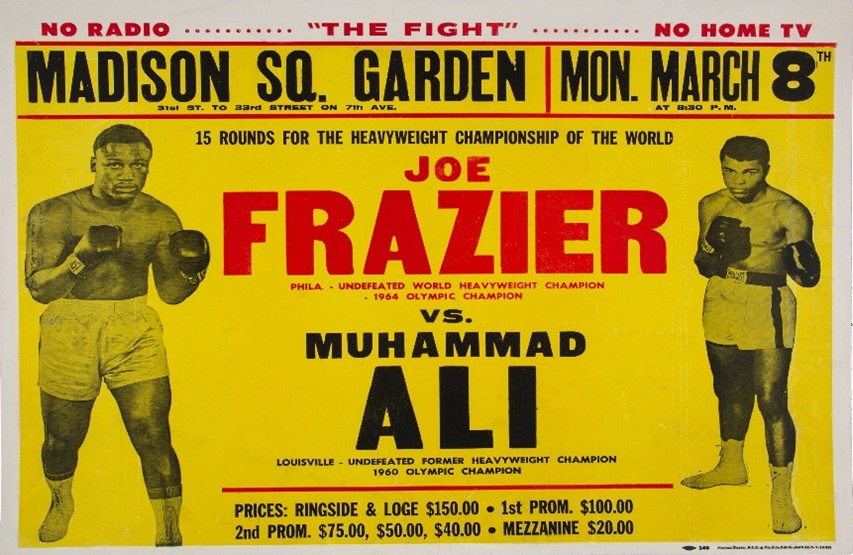
The first of the three matches, Joe Frazier vs. Muhammad Ali, on March 8, 1971, was billed as the “Fight of the Century,” or simply the “Fight.” An estimated 300 million viewers worldwide watched via closed circuit television. The fight itself boasted the highest purse ever, $2.5 million for each boxer. A full 15-round bout resulted in a unanimous decision declaring Frazier the winner, but Ali’s powerful blows caused Frazier lengthy hospitalization, and the financial success of this first fight led promotors to seriously consider their rematch potential. Even with the unanimous decision in Frazier’s favor, boxing fans continued to debate the question, “who won the fight?”[11]
Despite high expectations immediately after their first match, it took three years for a rematch to gain traction. Between the first two matches, Ali won his court battle, Clay v. United States, with a unanimous decision in 1971. The last stages of Ali’s legal battle occurred against the backdrop of 1970–1971, years that saw uprisings in cities in Georgia, Florida, and New Jersey; the Jackson State Killings in Mississippi; and Angela Davis’s arrest. In this context, the Supreme Court ruling in Ali’s favor was significant within the African American community as both a Civil Rights victory and a reinforcement of religious freedom. The [Baltimore] Afro-American, declared the Supreme Court’s decision as a “great triumph…over Establishment traditions,” while rebuking Americans for having allowed “their emotions and prejudices [to] contribute to a major miscarriage of justice…”[12] Other Black newspapers ran headlines such as Ali “Scores TKO Over U.S. Army” and “Wins Big Fight with Uncle,” emphasizing that the result was unanimous despite the absence of Thurgood Marshall.[13]
Frazier-Ali II took place on January 28, 1974. Billed as “The Super Fight II,” this second match-up has, today, a lower profile in comparison to the historic first and third fights.[14] Yet the post-fight article in The New York Times estimated that the second Ali-Frazier fight paid at least $2.6 million for each contender (others estimated $3 million apiece), the highest purse in sports history in 1974.[15] The rematch is also significant as it helped both contenders regain momentum. Since their fight in 1971, both boxers had suffered painful title losses. In January 1973, George Foreman beat Frazier in a technical knockout after two rounds, stripping Frazier of his WBA, WBC, and Ring titles in a single fight. In March 1973, Ali lost the North American Boxing Federation (NABF) title to Ken Norton in a famous bout in which Norton broke Ali’s jaw. The Ali-Frazier rematch was also important because of the outcome: unlike his agonized loss in their first fight, Ali defeated Frazier by a unanimous decision after full 12 rounds, making, in his words, the “three-year wait worth it.”[16] Despite Ali’s tendency to badmouth his rivals, he recognized and respected Frazier’s feat: “Joe Frazier is great. I didn’t know he was that good a fighter.”[17] Ali added, “I can’t say nothing bad about him”[18] With rumors looming about retirement, Frazier meanwhile stated, “I see no reason why I should stop,” and “I definitely want him again. I want him one more time.”[19]
“A Level of Boxing Violence Seldom Seen”: The Thrilla in Manila
The year 1975 was a critical juncture in United States history. The end of the US war in Vietnam and a joint space mission with the Soviet Union symbolized the decline of Cold War tension. At home, the African American community found itself at a crossroads. The Black Power Movement declined because of continuing repression of Black organizations and activists by the Federal Bureau of Investigation (FBI)’s Counter Intelligence Program (COINTELPRO). The Black community reeled from the deaths of prominent figures including entertainer Josephine Baker chemist Percy Lavon Julian, minister of the Nation of Islam Elijah Muhammad and light heavyweight boxer Ezzard Charles. Ali, a follower and mentee of Elijah Muhammad and a supporter of Ezzard Charles was devastated by their deaths.[20] At the same time, Black representation continued to grow, ranging from politics with Secretary of Transportation William Coleman to sports. Notably, in a late December round-up of “1975 Newsmakers,” The Chicago Defender asserted, “The biggest sports story of 1975 was undoubtedly”—not the Thrilla in Manila, but Arthur Ashe’s championship at Wimbledon..[21]
Increased television exposure and the co-existence of four all-time greats—Muhammad Ali, Joe Frazier, George Foreman, and Larry Holmes—made the 1970s the golden age of heavyweight boxing.[22] International bouts brought political and financial incentives to many countries, such as Indonesia, Malaysia, Venezuela, and Jamaica. The Philippines became a critical venue when Don King, noted African American boxing promoter and key member of Ali’s team, negotiated with Lope Sarrel, Jr. to bring the historic match to Manila.[23]After three years under tough martial law, Philippine dictator President Ferdinand Marcos was grateful for the opportunity to stage such a high-profile event in his country. Marcos and his profligate First Lady Imelda, known for her lavish lifestyle, were pleased to invite both Ali and Frazier to a presidential reception as part of the festivities surrounding the bout.[24]
The fight started at 10:45 a.m. on Wednesday, October 1 (10:45 p.m. Eastern Daylight Time on Tuesday, September 30). The Philippine Coliseum, about 16 miles from Manila, boasted more than 25,000 seats. “Unlike their first two fights,” wrote Dave Anderson of The New York Times, “Ali-Frazier III maintained a level of boxing violence seldom seen.”[25] Despite Ali’s win by Referee Technical Decision/Retired (RTD) after the 14th round, the public saw that “the champion, who […] floats like a butterfly and stings like a bee’ was in serious trouble for some time.”[26] An exhausted Ali dropped flat after the decision. In his autobiography, Ali recalled it as “the hardest fight I’ve ever had in my life—the deadliest and the most vicious.”[27] Angelo Dundee, Ali’s longtime cornerman, also admitted that the brutal fight was equally matched and came down to stamina in the end; he noted, “both guys ran out of gas, only my guy had an extra tank.”[28] The confident and outspoken Ali, who had repeatedly vilified Frazier in advance of the fight, paid the highest compliments to Frazier afterwards, calling him “the best fighter I’ve ever met.”[29] Ali later reminisced, “The third time Joe Frazier surprise[d] me with his stamina, his relentlessness and the gunpowder in his blows.”[30] After 41 rounds of boxing over three big fights between 1971 and 1975, “The Thrilla in Manila” on October 1, 1975 concluded Ali and Frazier’s epic boxing matches.
The Legacy of the Thrilla in Manila, the Epic Fight in Heavyweight Boxing History
In the 50 years since the conclusion to the trilogy of matches between Ali and Frazier, media outlets as varied as The New York Times, The Los Angeles Times, and The Irish Times, among many others, have declared the “Thrilla in Manila” the greatest fight in the modern era renowned for its ruthless physicality as well as the boxers’ storied, bitter rivalry.[31] Viewers of the Classic Sports Network (later ESPN Classic) chose Ali-Frazier III, “The Thrilla in Manila,” as the best sporting event of the 20th century.[32] The fight, which sold out the 25,000-seat Philippine Coliseum, resulted in $1.5 million ticket revenue, a record in 1975.[33] In order to provide live coverage of the fight to the United States, Home Box Office (HBO), which originated in 1972, used satellite broadcasting for the first time.[34] Despite the fact that the fight was scheduled for a weeknight (which would typically result in lower viewership than a weekend fight), crowds viewed closed-circuit footage of the bout from 350 arenas and theaters in the United States and Canada.[35] The worldwide television audience was estimated at 700 million across 60 countries, including the Soviet Union, which broadcast satellite coverage for the first time.[36] News coverage did not stop with the fight’s conclusion. Ali’s affair with Veronica Porché emerged during the event publicity, and the subsequent confrontation with his wife, Khalilah Ali, generated tabloid-worthy drama outside the ring and filled extra columns in periodicals.[37]
The “greatest clash in the storied history of the heavyweight division”[38] not only reinforced Ali’s status as a formidable boxing talent, but also demonstrated Black innovation in entrepreneurship, and served to mark multiple turning points for both Frazier and Ali.
Validation of Muhammad Ali as “the Greatest”
The “Thrilla in Manila” cemented Ali’s regularly self-proclaimed identity as “the Greatest.” Sports historians now recognize that his three-time undisputed heavyweight championship record differs markedly from records of other eras, such as those of Joe Louis or Rocky Marciano. Unlike Louis and Marciano, Ali faced numerous title holders including Sonny Liston, Ken Norton, Earnie Shavers, Larry Holmes, and George Foreman, all while in their primes.[39]
The Thrilla also exhibited Ali’s “speed, boxing skill, punching power, and raw courage.”[40] Although Angelo Dundee conceded that both Ali and Frazier nearly “ran out of gas,” Ali persevered.[41] As early as 1975, Bill Lee proclaimed that “no one in heavyweight history ever punched with more blinding speed and accuracy than [Ali].”[42] Ali, notably, attributed this excellence to his opponent, Frazier, whom he called the “toughest and roughest.” Ali added that Frazier “brought out the best in me and the best fight we fought was in Manila.”[43]
In 1995, Eddie Futch compared the rubber match between Riddick Bowe (his trainee) and Evander Holyfield to the Thrilla. During his long career, Futch had trained legendary boxers, including Ken Norton, Larry Holmes, Trevor Berbick, and Joe Frazier, all of whom had defeated Ali at least once. Yet Futch stated “neither [Bowe nor Holyfield] is as good as Muhammad Ali,” and “neither one has the die-hard drive of Joe Frazier.”[44] Ali’s performance in the Thrilla demonstrated his training strategy and fight execution alongside his superb physical condition; these attributes led to his legacy, embodied by Sports Illustrated magazine declaring him Sportsman of the Century. Ali was also a record-six-time recipient of The Ring magazine’s “Fighter of the Year” designation.
Black Economic Excellence
The three Ali-Frazier matches also demonstrated African American entrepreneurship that served as inspiration for social and economic advancement of the wider community in the 1970s. The Amsterdam News reported that Frazier-Ali I, the “Fight of the Century,” involved a record number of African American promoters, including the fighters, their managers, and over 200 other employees in various capacities.[45] The promoter of the Thrilla, Don King, also promoted three of Muhammad Ali’s heavyweight championship title fights in the mid-1970s, including the October 1974 title fight between George Foreman vs Muhammad Ali in Kinshasa, Zaire, billed as “The Rumble in the Jungle.” These fights made King “one of the most successful [B]lack businessmen in America.”[46]
In the 1970s, African American community development struggled in a business world dominated by White-run financial institutions. Don King’s perceptive understanding of the money-making potential of Black athletes transformed community aspirations of successful entrepreneurship. He watched the first Frazier-Ali fight from prison in 1971; after he was released in 1972, he started boxing promotion. Despite his fallout with Ali after the Thrilla, Don King’s was astute in his conviction of the economic influence of boxing: “[The Thrilla in Manila] ain’t just a sportin’ event. This here is a dramatic contribution to world’s economy.”[47] King guaranteed Ali $4.5 million against 43 percent of the gross gate and Frazier $2 million against 23 percent, which could have grossed Ali $9 million and Frazier $5 million. It might have been the highest purse in 1975.[48]
Carter G. Woodson, a pathbreaking historian and the founder of the Association for the Study of African American Life and History (ASALH), argued in 1933 that successful Black entrepreneurship, not just to enter the field of economic success but to learn to lead the world, must not emerge not from “slavish imitation of others,” but from the originality African Americans have within themselves.[49] More than four decades later, Don King’s boxing promotion embodied Woodson’s ambitions. King, later named the “Greatest Promoter of All Time” by the WBC, “Promoter of the Century” by the WBA in 1994, and the “Greatest Promoter in History” by the International Boxing Federation (IBF) in 1996, maintained his stance of helping “all Americans” and not “seeking strength through the ethnicity of any group”[50] He also defended Ali’s Black “dignity and pride,” and five years after the “Thrilla in Manila,” King donated significant amounts of money to several national Black organizations “in the fight for economic parity and social justice for Blacks in the country”[51] Don King’s incisive recognition of the power of Black-led business teams working to promote Black athletes served as an important bridge from Woodson’s 1933 vision of business leadership that transformed and galvanized African American community to the establishment of successful Black entrepreneurship in the boxing industry and beyond.
The Pinnacle and Aftermath
The 1975 “Thrilla in Manila” marked the beginning of the end of the boxing careers of both fighters. Joe Frazier announced his retirement eight months after the Thrilla in 1976 when he lost against George Foreman. In his memoir, Frazier describes Foreman as “a wrecking ball in boxing trunks” in January 1976. When fighting Ali, Frazier had felt evenly matched, remarking that “[Ali] had fought to the point of exhaustion.” Just four months earlier, Ali had described Frazier’s ruthless performance in the Thrilla as being “the closest thing to death.” In contrast, Foreman easily beat Frazier in five rounds; Frazier ruefully noted that Foreman fought as if it were “a day at the beach” for him.[52] After his loss to Foreman, Frazier realized how steeply his fighting ability had declined since fighting Ali. He decided to retire, dedicating time to training his son, Marvis Frazier, who debuted as a professional heavyweight boxer in 1980. In 1981, Frazier came out of retirement for a bout with Floyd Cummings, which ended in a draw. The Philadelphia Inquirer opened their Frazier vs Cummings report by lamenting, “It’s one of the sad things in sports that the ego, spirit, determination and guts of athletes outlive the usefulness of their legs, the speed of their hands and the durability of their bodies.”[53]
Ali also hinted at retirement after the Thrilla, though he fought longer and more frequently than Frazier. Over time, Ali’s decline in health became more visible to fans. Ali himself pointed to the Thrilla as his most punishing fight, after which his physical troubles started.[54] In 1976 he stated, “I got my eardrum busted in Manila training for Joe Frazier, […] I would advise nobody to box if they get hit too much and it’s too dangerous.”[55] Dave Anderson of the New York Times observed in 1984, “During his 14 fights in the six years that followed, Muhammad Ali was never the same after that Thrilla in Manila […].”[56] In the biography by Thomas Hauser, Ali’s longtime physician, Freddie Pacheco, became seriously concerned about Ali’s deteriorating physical condition stating, “[After Ali-Frazier III, Ali] really started to fall apart. He began take beatings, not just in fights but in the gym.”[57] In 1984, Ali made a formal announcement of his Parkinson’s syndrome diagnosis.
The Thrilla in Manila also marked a positive turning point for Ali and Frazier to begin thawing their bitter conflict with mutual respect. Ali’s repeated vilification of Frazier emerged during promotion for their first fight and continued through the lead-up to their third fight, most infamously through his insulting rhyming phrase, “chilla, killa, thrilla in Manila with a gorilla,” which outraged and hurt Frazier.[58] Ali justified his hostile words against Frazier as a response to Frazier’s insistence on calling him Clay (a reference to Ali’s pre-Nation of Islam birth-name, Cassius Clay). To Ali, Cassius Clay is a slave name, which is an insult to his name and religion.[59]
Ali’s apologies to Frazier began immediately after the Thrilla’s conclusion. Ali apologized publicly to Frazier’s son, Marvis, right after the fight, describing Frazier as “a great man and a great fighter,” adding “I’m sorry I hurt him.”[60] Frazier was dissatisfied with Ali not directly apologizing him and insisted on calling Ali “Clay” throughout their lifetimes, including in his autobiography in 1996.[61] However, Frazier concluded his autobiography by stating, “We [Ali and Frazier] were, I think, what is good about boxing –skill and passion, and the both of us tapping deep into ourselves for that extra effort. In that ring, we brought the best out of each other.”[62] In 2001, during a telephone interview with the New York Times, Frazier embraced Ali’s apology: “I’ll accept it, shake his hand and hug him when I see him. We’re two athletes of the world. Why we been biting off bullets? […] Life’s too short.”[63]

Conclusion: Black Steel
The “Thrilla in Manila” produced a cultural movement that transcended sport. The 2022 book by James Conyers and Christel Temple, Muhammad Ali in Africana Cultural Memory, suggests defining what they call “hero dynamics” such as Ali’s from the perspective of the African American community, incorporating “historical context, cultural definition, and ancestral determination” to properly remember and memorialize.[64] Through an Africana-centered lens, Ali’s heroic influences both emerge from a culturally grounded context and become engraved within the African American community as inspiration for current and future generations.[65] Through that lens, the Thrilla in Manila and the wider trilogy of matches represent a multidimensional act within African American culture. The brutally-contested fights themselves form the center of the story, but they are not the whole story.
The crucible of cultural conflict represented by Ali and Frazier was unique in the 1970s, when Black athletes were still, in some quarters, “expected to be seen, not heard—silent, self-effacing producers, not loquacious, verbose, entertaining performers who attracted attention to themselves,”[66]as Harry Edwards described in his dedication to Muhammad Ali. Yet Muhammad Ali was a cultural hero for many African Americans. His story also charted a historic path for Black entrepreneurs to capitalize on the prosperity of sports, led by promoter Don King. Most importantly, the Ali-Frazier matches served as an opportunity for African American cultural affirmation, as well as a visible demonstration of the tension between “the pieces of the Brotherhood,” as Gwendolyn Brooks put it in “Black Steel.” In this poem, inspired by the Frazier vs Ali I match, Brooks recognizes the “Calculated Blaze” represented by pitting these men against each other not only in the ring, but also outside of it. She expresses the hope that “When the last bell’s business dulls away, / Know that the echo’s message is black love.” The true legacy of the Thrilla in Manila culminates in “reconciliation and renewal” between Ali and Frazier, two superb boxers in their primes, grappling not just with each other’s punches, but with the undisputed heavy weight of cultural and social expectations.
Black Steel: Joe Frazier and Muhammad Ali (1971)
By Gwendolyn Brooks
The one hand is your Language.
The other hand is your Art.
You ripen toward the center of the ring!
You startle into steel!
You hunt and hit and hurt!
It is your roaring-thing.
The Uttermost of Warriors in the world!
The Vigorous Valiant, the Dazzle of them all.
But
when the last bell’s business dulls away,
know that the echo’s message is black love.
Pick up the pieces of the Brotherhood.
Let
black love survive the Calculated Blaze.
Let
black love survive the Challenge and the Blood.
[1] “Ali, Joe Frazier Honored,” Chicago Defender, August 17, 1976, 21.
[2] John Wong, “American Sports, 1970-1979,” Encyclopedia of Sports in America: A History from Foot Races to Extreme Sports, Ed. Murry Nelson,Vol Two, 2009, 423.
[3] Martin Kane, “Welcome Back, Ali!” Sports Illustrated, Sep 14, 1970, 20-23.
[4] “Ali Finds Justice in Atlanta,” Special to the AFRO, Afro-American, September 12, 1970, 9; Sam Lacy, “Re-Emancipation Occurs in Georgia,” September 12, 1970, 8; “Clay Kayos N.Y. Boxing Commission,” Chicago Daily Defender, September 15, 1970, 26.
[5] Marion Jackson, “The Fight for the Future,” Atlanta Daily World, October 25, 1970, 10.
[6] “Frazier Considered Boxer-of-The-Year,” Call and Post, Jan 3, 1970, 7B.
[7] Mark Karam, “Show Biz Is Out Boxing Is In,” The Sport Illustrated, February 16, 1970, 14.
[8] Martin Kane, “The World Champion Nobody Knows,” The Sports Illustrated, November 16, 1970, 36, 38.
[9] Joe Frazier with Phil Berger, Smokin’ Joe: The Autobiography of a Heavyweight Champion of the World, (New York: McMillan, 1996), 83.
[10] Jeffrey Sammons, Beyond the Ring: The Role of Boxing in American Society, (Urbana: University of Illinois Press, 1990), 212. See Brad Pye, “A Southern Ali Supports,” Los Angeles Sentinel, January 14, 1971, B1; A.S. Doc Young, “Good Morning Sports” on Ali-Frazier Fight in Chicago Daily Defender, March 1, 1971; Norman Unger, “Ali chosen to ‘whup’ Frazier,” the Chicago Dily Defender, March 8, 1971, 24; Dave Brady, “Ali’s ‘Great White Hope’ Contention Draws ‘I Don’t Care’ From Frazier,” The Washington Post, February 28, 1971, C7.
[11] Floyd McKissick, “Who Won the Fight?” New York Amsterdam News, April 3, 1971, 6.
[12] “Muhammad Ali ‘Vindicated’,” Afro American, March 13, 1971, 1, 9.
[13] “Muhammad Ali Scores TKO Over U.S. Army,” Atlanta Daily World, July 2, 1971, 5; “Ali Wins Big Fight with Uncle,” the Louisiana Weekly, July 3, 1971, 1, 11; “High Court Reverses Ali’s Draft Conviction,” Afro-American, July 3, 1971, 1-2.
[14] Mark Kram, Ghosts of Manila: The Fateful Blood Feud Between Muhammad Ali and Joe Frazier, (New York: Harper Collins, 2001), 2.
[15] Dave Brady, “Ali Makes Three-Year Wait Worth It: Frazier Loser on All Cards,” Washington Post, January 29, 1974, D1; Norman O. Unger, “New Yorkers Snub ‘Super Fight II’,” Chicago Defender, January 29, 1974, 21; Gerald Eskenazi, “Each Get About $2.6-Million,” New York Times, January 30, 1974, 27.
[16] Brady, “Ali Makes,” D1.
[17] Frank Dolson, “This Time, Ali Looked Like a Winner,” Philadelphia Inquirer, January 29, 1971, B2.
[18] Steve Cady, “Ali Says ‘No Bad Feeling Between Us,” and Talks of Super Fight III Joe Frazier,” New York Times, January 29, 1974, 24.
[19] Skip Myslenski, “Frazier: ‘I thought I won’,” Philadelphia Inquirer, January 29, 1971, B2.
[20] According to Norman O. Unger, “Muhammad Ali Won’t Change His Style,” Chicago Defender, March 1, 1975, 19, Ali “dropped everything and rushed to Chicago” to Elijah Muhammad’s side while he was preparing for his March 24 bout. He lamented, “If I had a choice, and it ever came to that, I’d lay down my life for him.”
[21] “1975 Newsmakers,” Chicago Defender (Big Weekend Edition), December 27, 1975, 1.
[22] Carlo Rotella, “So Many Fearsome Contemporaries,” New York Times, December 25, 2011, SM28.
[23] “Ali to Defend Against Frazier,” Daily Independent Journal, May 29, 1975, 38.
[24] Official Gazette: Republic of the Philippines, Vol. 71, October 6, 1975, 480.
[25] Dave Anderson, “Ali Retains Title as Fight Is Stopped After 14th,” New York Times, October 1, 1975, 31.
[26] “Ali’s Sting Still Supreme, But It Took 14,” Journal News, October 1, 1975, 1; In official records, RTD gets counted as TKO (Technical Knockout). Most publications describe Ali’s win as TKO.
[27] Muhammad Ali with Richard Durham, The Greatest: My Own Story, (New York: Ballantine Books, 1976), 502.
[28] Thomas Hauser, Muhammad Ali: His Life and Times, (New York: Simon & Schuster, 1991), 322.
[29] Brad Pye, Jr, “Ali Fights For ‘Freedom’,” Los Angeles Sentinel, October 9, 1975, B3.
[30] Ali with Durham, the Greatest, 508-509.
[31] Red Smith, “Ali, Frazier Not Eager to Retire,” New York Times, October 3, 1975, 21; “Sugar Ray, Duran Await ‘Brawl in Montreal’,” Weekend Chicago Defender, June 21, 1980; Steve Spinger, “Off the Mat,” Los Angeles Times, May 3, 2001, VYD3; “Boxing Legend Who Starred in Battles with Ali: Joe Frazier,” Irish Times, November 12, 2011, 14.
[32]“Sporting Events to Remember and Forget,” Newsday, December 1, 1996, B11.
[33] “Champ Ali Wins ‘Thrilla In Manila’,” Pittsburgh Press, October 1, 1975, 57.
[34] Lee Winfrey, “Home Box Office: It’s Come A Long Way Through the Years,” Philadelphia Inquirer, April 16, 1989, C-8.
[35] Deane McGowen, “Ali-Frazier Gross Likely to Set Mark,” New York Times, October 2, 1975, 65.
[36]“Champ Ali,” 57.
[37] Newspapers and tabloids widely reported Ali’s extra-marital escapade with Veronica Porché, an actress and his then-mistress. Porché attended promotional events with Ali after his then-wife, Khalilah (Belinda) Ali, left Manila before the match. The story that President Marcos referred to Porché as Ali’s wife during his post-match greeting became a big scandal. See Neil Milbert, “Bitter Belinda Roots ‘for the Best Man’,” Philadelphia Inquirer, October. 1, 1975, 4D; “Muhammad and Belinda Ali: Is Their Marriage on the Rocks?” Ebony, December, 1975, 176-180; “Belinda: Up to Muhammad to Patch Up the Marriage,” Hartford Courant, October 2, 1975, 75.
[38] Eddie Jefferies, “Marvis Frazier –Smoking Less, But Enjoying More,” New Pittsburgh Courier, May 25, 1990, 2.
[39] Richard Hoffer, “Muhammad Ali:1942-2016,” Sports Illustrated, June 13, 2016, 32.
[40] Bill Lee, “With Malice Toward None,” The Hartford Courant, January 9, 1976, 52B.
[41] Ibid.
[42] Ibid.
[43] Hauser, Muhammad Ali, 326.
[44] Chris Defresne, “Futch Sees Bowe-Holyfield III as a Thriller,” Los Angeles Times, November 2, 1995, VYC17.
[45] Dick Edwards, “Black Stake in Fight,” New York Amsterdam News, March 6, 1971, 1-2.
[46] Hauser, Muhammad Ali, 261-262.
[47] Mark Kram, “-Manila- For Blood and For Money,” Sports Illustrated, September 29, 1975, 23
[48] “Frazier Badly Beaten After Taking Early Lead,” The Los Angeles Times, October 1, 1975, 8; “Ali Smokes Frazier in 14th Round,” The Escanaba Daily Press, December 31, 1975, 22; “Fight Marks End of Era,” The Escanaba Daily Press, December 31, 1975, 22.
[49] Carter G. Woodson, Miseducation of Negro, Reprint of 1933 edition, AMS Press, 1977, 167.
[50] Collie Nicholson, “Don King is the Promoter of the Century,” Call and Post, December 30, 1999, 6C; “Black Promoter Says Ali Is A Symbol,” Chicago Defender, January 14, 1975, 21.
[51] “Don King Gives $125,000 to Advance Social Justice,” Afro-American, October 18, 1980, 6.
[52] Frazier with Berger, Smokin’ Joe, 172.
[53] Lewis Freedman, “Frazier Still Trusts his Skills; He’ll Lose Weight, Keep Fighting,” Philadelphia Inquirer, December 5, 1981, 25.
[54] “Muhammad Ali’s Book Reveals Shocking Truth About Disease That is Crippling Him,” Jet, July 15, 1991, 16-17.
[55] Ibid.
[56] Dave Anderson, “For Ali, What Price the Thrilla in Manila?” The New York Times, September 23, 1984, S11.
[57] Houser, Muhammad Ali, 349.
[58] “Ali Calls Frazier a ‘Gorilla’,” Los Angeles Sentinel, Jul 24, 1975, 14.
[59] Kram, “-Manila-,” 30.
[60] “The Champion,” Louisiana Weekly, October 11, 1975, 13; Houser, Muhammad Ali, 92.
[61] Frazier with Berger, 166.
[62] Frazier with Berger, Smokin’ Joe, 200.
[63] Richard Sandomir, “No Floating, No Stinging: Ali Extends Hand to Frazier,” New York Times, March 15, 2001, D1, D6.
[64] Christel N. Temple, “‘Something Greater Than Pride’: Muhammad Ali and Black Cultural Mythology,” Muhammad Ali in Africana Cultural Memory, ed by James L. Conyers, Jr., and Christel N. Temple, (New York: Anthem Press, 2022), 10.
[65] Ibid, 3.
[66] Harry Edwards, “Dedication: In Memory of Muhammad Ali, 1942-2016,” The Revolt of the Black Athlete, 50th Anniversary Edition, (Urbana: University of Illinois Press, 2018).
Gwendolyn Brooks, “Black Steel: Joe Frazier and Muhammad Ali,” Special Collections, University of Delaware. Accessted October 1, 2025, https://exhibitions.lib.udel.edu/four-poets/exhibition-item/black-steel-joe-frazier-and-muhammed-ali/
Featured Image: Featured photo: Muhammad Ali and Joe Frazier 1974 Press Photo, United Press International, January 1974, Wikimedia.
 Clio and the Contemporary


Leave a comment