
The legend lives on from the Chippewa on down
Of the big lake, they called Gitche Gumee
The lake, it is said, never gives up her dead
When the skies of November turn gloomy
The most famous shipwreck in American history took place on the evening of November 10, 1975, when the iron ore tanker Edmund Fitzgerald went down in a Lake Superior gale, taking 29 crewmen to their deaths. The next year, what would normally have been a tragic but short-lived story became immortal thanks to the songwriting talent of a young Canadian folk singer, Gordon Lightfoot, who penned a sea-shanty ode to the lost ship and men, “The Wreck of the Edmund Fitzgerald.” Despite its radio-unfriendly 6-minute running time, “Wreck” spent 21 weeks on the 1976 Billboard Hot 100 charts, topping out at number 2. The song has become an enduring American classic, with a haunting, earworm-worthy melody almost guaranteed to take up permanent residence in listeners’ heads.
The ship was the pride of the American side
Coming back from some mill in Wisconsin
As the big freighters go, it was bigger than most
With a crew and good captain well seasoned
“The Fitz never backed away from a storm.” So went the common wisdom about what was the largest ship on the Great Lakes during most of its seventeen years in service between 1958 and 1975. The Fitz hauled taconite ore from Canada and Minnesota across Lake Superior and through Michigan’s Soo Locks down into the lower lakes and the steel mills of the Midwest, where it would be turned into the automobiles, trucks, tractors, machines, tools, and yes, ships, that were the muscle and sinews of the postwar American industrial economy. Captain Ernest McSorley, the Fitz’s crusty skipper, would say that “you don’t make money sitting in port,” and on November 9, 1975, with a major storm about to blow into Lake Superior from the southwest, he matched words with deeds, steering the freighter out of its Superior, Wisconsin port into what became one of the worst weather events in that water body’s history.
The captain wired in he had water comin’ in
And the good ship and crew was in peril
And later that night when his lights went outta sight
Came the wreck of the Edmund Fitzgerald
On the evening of November 10, 1975 at 7:20 p.m., having fought high winds and massive waves, with visibility poor and the ship listing at the bow under the weight of the taconite ore that had broken through the holds and shifted forward, the Fitz went down. It was in Canadian waters, some 17 miles northwest of Whitefish Point, Michigan. A few minutes earlier, Captain McSorley had radioed, “we are holding our own.” They were the Fitz’s last, haunting words.

Named after the President and Chairman of the Board of Northwestern Mutual, Edmund Fitzgerald was launched June 8, 1958 at River Rouge, Michigan. At 729 feet and 13,632 gross tons she was the largest ship on the Great Lakes, for thirteen years, until 1971.
They might have split up or they might have capsized
They may have broke deep and took water
What Sank the Fitz?
We’ll never know for certain, and this, along with Lightfoot’s indelible musical tribute, goes a long way toward explaining the obsessive interest in the ship that is reaching a new peak as the 50th anniversary of the wreck approaches on November 10 of this year. The Canadian government, in whose territory the Edmund Fitzgerald sank, has appropriately declared the wreck off-limits as a grave site, making the 1995 expedition to recover the ship’s bell the last time any human being will view it with their own eyes.
That leaves us with theories. Some believe the Fitz hit a shoal near shore and damaged its keel. Others say the hatches on deck gave way and flooded; this was the conclusion of the Coast Guard report on the accident in its immediate aftermath and was even a lyric in Lightfoot’s song until he changed it in the light of new evidence. The Fitz may have broken apart on the surface of the lake and sank. Or it could have been the victim of a series of huge, “rogue” waves, for which Lake Superior is notorious, that hit the ship like blows from a heavyweight boxer, slamming it to the bottom.
We do know that the ship was overloaded, overworked, and aging, that it had been constructed with low-grade steel, and that its welding was sub-standard. It also had a loose keel, the structural beam that runs from bow to stern along the bottom of a ship, which Captain McSorley knew about but chose to ignore, hoping to squeeze one more sailing season out of the ship. “I don’t give a f**k,” he was overheard to say when he was told of the defect. “All the son of a bitch has to do is stay together one more year. After that I don’t give a s**t what happens to it.”1
McSorley wasn’t the only one. Oglebay Norton Corporation, the shipping firm that operated the Fitz, skimped on maintenance, treating it as little more than a cash cow. Combine all this with a brutal storm on this most brutal of the Great Lakes, and the result was the wreck of the Edmund Fitzgerald.
There is, however, a broader explanation for the tragedy of the Fitz, one that extends beyond the sailors who steered it, the engineers who constructed it, and even the “gales of November” that helped sink it. The wreck of the Fitzgerald was a metaphor for that of the American industrial economy, centered in the same Midwest the ship called home, in the last third of the twentieth century. Years of neglect and conscious decisions by corporate executives and policy makers doomed both the American industrial economy and the Fitzgerald.
Great Nations Build Things
It has been said that “great nations build things,” and the United States stopped building things around the time the Fitz went down. For most of the twentieth century, the federal government offered subsidies to the American shipbuilding industry that kept it competitive with foreign firms and made it possible for the nation to be the “arsenal of democracy” needed to win the Second World War. By the 1970s, however, those supports had disappeared, and the government was tacitly encouraging the purchase of ships overseas, a great boon to the economies of South Korea, Japan, and in time, China, while Midwest shipyards declined and shuttered.
As they did, their home communities spiraled. The knock-on effects were dire: hollowed out downtowns, closed or relocated factories, generational joblessness, drug use, and deaths of despair. The 1970s ushered in the era of neoliberalism in the American economy, featuring an emphasis on markets, free trade, tax and spending reductions, and deregulation. In a globalized economy that stressed mobility of goods, labor, and capital, American industries and workers were inherently disadvantaged. Why make it in the USA if you could buy it cheaper somewhere else? America was unprepared for a world economy of which it was not the sole master. As Thomas Nelson and I write in Wrecked: The Edmund Fitzgerald and the Sinking of the American Economy, the United States “lacked a simple industrial strategy to guide tax policy, education and workforce development, trade agreements and investment in basic science research. The United States would navigate the shoals of an emerging global economy rudderless.”2
The neoliberal order – what we call in our book the “Washington Consensus” – continued into the 21st century, under Republican and Democratic presidents alike, and its weight sank the Edmund Fitzgerald just as surely as a bad keel, an overloaded cargo, and the gales of November. As early as 1945, a group of American economic analysts were warning that “it is important to bring home to our people that the rest of the world pays little attention to maintaining a free market.”3 The last half-century has proved them right. The Fitz thus also fell victim to the all-too-human delusion that words speak louder than actions.
In a musty old hall in Detroit, they prayed
In the Maritime Sailors’ Cathedral
The church bell chimed ’til it rang twenty-nine times
For each man on the Edmund Fitzgerald
But there have been recent signs that the Washington Consensus is cracking, with fissures on both its right and left flanks. Bernie Sanders and Donald Trump are bitter political enemies, but both have called for American-centered economic policies that nurture and protect domestic industries and products. Both advocate, in their own ways, strategic industrial policies that will make it possible to “build things” in the United States once again. The inclusion in the so-called “One Big Beautiful Bill,” recently passed by Congress, of some $29 billion to redevelop American shipbuilding, is a step in the right direction. Fifty years after effectively recommending that potential ship purchasers look overseas, it is now possible to envision them being produced in American shipyards. In a time of extreme partisan division, this would be a development welcomed on both sides of the aisle. Job creation, much of it unionized. Economic growth. Enhanced national security. And, perhaps, a new lease on life for the cities and towns of the industrial Midwest that the Fitz and its crew called home.
And all that remains is the faces and the names
Of the wives and the sons and the daughters
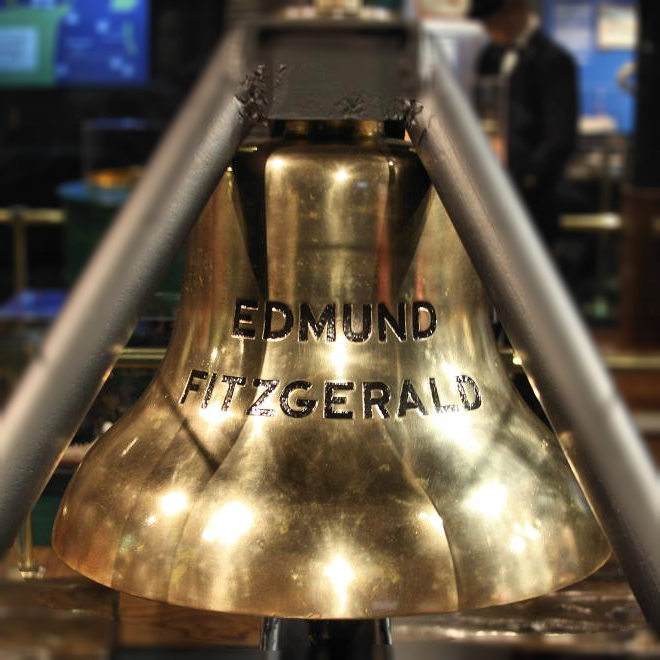
The Fitzgerald’s 200 lb. bronze bell was recovered on July 4, 1995. On display at the Great Lakes Shipwreck Museum.
On November 10, exactly fifty years after the wreck of the Edmund Fitzgerald, the bell in Detroit’s Mariners’ Church will ring 29 times in memory of the men who perished. Some 370 miles to the north, at the Great Lakes Shipwreck Museum in Whitefish Point, Michigan, the Fitz’s recovered bell will also sound in a private ceremony for the family members of the crew. Both will remind us that the loss of the Edmund Fitzgerald, while an economic tragedy, was above all a human one. Yet the ringing of a bell – or the playing of a hit song – need not be the only ways to memorialize these 29 men. Employment, security, and opportunity for the “wives and the sons and the daughters” they left behind, and those who come after them, would be the most fitting memorial of all.
1 Thomas M. Nelson, with Jerald Podair, Wrecked: The Edmund Fitzgerald and the Sinking of the American Economy (East Lansing: Michigan State University Press, 2025), 75.
2 Ibid., 22.
3 Ibid., 111.
Featured Photo Credit: Bob Campbell/Courtesy Great Lakes Shipwreck Historical Society
Lyrics used throughout come from Gordon Lightfoot’s “Wreck of the Edmund Fitzgerald,” Summertime Dream, 1976.
 Clio and the Contemporary
What did we learn from the song “Wreck of the Edmund Fitzgerald?” The same thing we learned from Longfellow’s allegoric poem “The Wreck of the Hesperus.”
LikeLike