You think life is fire, that progress is eruption;
that wherever you shoot you hit the future.No.
-Rubén Darío, “To Roosevelt,” 1903
The past 72 hours have been a whirlwind that kicked off with the kidnapping of Venezuelan president Nicolás Maduro and his wife, Cilia Flores, by US Special Forces early Saturday morning. The Trump administration justified the act as a “law enforcement operation,” spiriting them to a Brooklyn jail before they will stand trial in New York City for drug trafficking and other indictments. Never mind that President Trump recently pardoned former Honduran president Juan Orlando Hernández, a right-wing compatriot, for similar offenses. There is clearly more at play here than narcotrafficking, including oil, ideology, US influence in the hemisphere, hubris, and a long history of US intervention in Latin America.
In the hours after Maduro’s kidnapping, Trump announced that the United States would “run Venezuela,” pointing to Secretary of State Marco Rubio and Secretary of War Pete Hegseth as the US officials responsible. He added that it would be US oil companies who would get in to “take back” Venezuelan oil and “start making money.”
Absent from Trump’s press conference and Rubio’s subsequent media tour on Sunday were even a façade of concern about Venezuelan sovereignty. Of Venezuelan opposition figures with some legitimacy to claim leadership, Trump favors neither the likely winner of the 2024 presidential election, Edmundo González, nor the Nobel Peace Prize winner, María Corina Machado as future Venezuelan leaders. While Secretary Rubio seemingly walked back Trump’s claim that the United States would run Venezuela, both Trump and Rubio have been clear that Venezuela’s government will bend to US policy demands or face “consequences” similar to or worse than Maduro’s.
It may be easy to link present events to US interventionism during the Cold War. From the CIA-orchestrated coup in Guatemala in 1954 through the military dictatorships that covered nearly the entirety of Latin America in the 1970s and 80s, comparisons abound. We ought look instead to the early twentieth century to better conceptualize the stance of the Trump administration vis-à-vis Venezuela and US hegemony in the Western hemisphere. If the Cold War was primarily concerned with preserving spheres of influence in a global contest with the Soviet Union, Progressive-era US interventionism aimed to bend the Western hemisphere to the dictates of American industry. Teddy Roosevelt modeled his foreign policy on “speak softly and carry a big stick,” as he and his successors repeatedly intervened in hemispheric neighbors. Trump, however, apparently sees no need to speak softly while he champions US business interests and extends the threat of intervention beyond Venezuela to include Mexico, Colombia, and Greenland.
Progressive-Era US Imperialism in the Western Hemisphere
When the United States inserted itself in the Cuban struggle for independence from Spain in 1898, the US was not yet the world power that it would become after World War II. Yet with the American West conquered, Native Americans pushed onto shrinking reservations, Jim Crow segregation largely in place, and Gilded-Age industrial capitalism exploiting a rapidly growing urban working class, the drums of expansionism were pounding. As Greg Grandin argued in The End of the Myth, US expansionism became a “gate of escape” to avoid reckoning with the very real problems of race and class that punctured the myths of liberty, freedom, and prosperity that were the American ideal.
Although Cuba gained independence from Spain in 1898, the United States maintained military of control of the country until 1902 when it passed governance to Cuban leaders under the terms of the Platt Amendment. The law, written into the Cuban Constitution, granted the United States the unilateral ability to intervene in Cuban governance and to veto and amend Cuban law; it also leased land (Guantánamo) to the United States for naval bases on the island. Prior to 1902, US military caretakers had successfully sidelined Afro-Cubans from potential public leadership in the pending independent state, thus effectively imposing Jim Crow segregation and disfranchisement on its neighbor 90 miles to the south of Jim Crow Florida. José Martí, the primary intellectual author of Cuban independence, envisioned a multiracial Cuba free of the racial castes that defined both Spanish colonialism and his observations from his travels in the United States. He did not live to see either independence or his post-racial dream discarded by the occupying United States.
US companies were at first dominant in the Cuban sugar sector but quickly expanded their presence with oil refineries and control over a new Cuban tourist industry made up of hotels, casinos, and brothels. The island was, effectively, an outpost of American capitalists built upon a foundation of US racial ideology until the 1959 Cuban Revolution; Fidel Castro expropriated US industries in 1960, and President Eisenhower responded with an economic embargo that remains to this day.
Following the consolidation of US dominance over Cuba in 1902, the United States continued its meddling in the region and beyond. It constructed a colonial government over the Philippines through brutal war that claimed hundreds of thousands of Filipino lives and imposed racial and religious divisions onto the Philippines in ways that continue to resonate today. It promoted Panamanian independence from Colombia in 1903 and gained complete control over the Panama Canal Zone, which it maintained unilaterally until 1979 and jointly until 1999. As a result, the United States monitored the primary shipping route connecting the Pacific and Atlantic Oceans for nearly a century and maintained large military installations that would later serve as training grounds for Cold War counterinsurgencies conducted by Latin American nations themselves.
President Theodore Roosevelt’s 1904 Corollary to the Monroe Doctrine argued that the United States had the authority to act as an “international police power” in the hemisphere against “wrongdoing.” Under President Wilson, US Marines landed throughout the hemisphere, most notably occupying and running both Haiti (1915-1934) and the Dominican Republic (1916-1924) at the behest of US banks and corporations.
The United Fruit Company’s hegemony in early twentieth-century Guatemala, Honduras, Colombia, and Ecuador coined the moniker “banana republics” to denote US corporate control of theoretically independent nations. And oil would become the key resource for American and British profiteering as the decades marched on, particularly in Venezuela after oil was discovered there in 1922.

These early twentieth-century US occupations, US-backed coups and military governments, and US corporate monopolies were underpinned by American policymakers who cared little about promoting an image of Latin American sovereignty and even less about actual sovereignty. Throughout the region, personalistic dictatorial regimes coexisted with US corporations; the result was the enriching of US industrial oligarchs and investors alongside a sliver of Latin America’s elite. Such control mirrored US internal dynamics of racial and class hierarchy, undergirded by scientific racism’s “certainty” of white superiority and, in turn, the idea that white people were the only ones “fit” to rule in the hemisphere.
President Woodrow Wilson’s virulent racism, the first Red Scare, and the immigration restrictions of the 1920s defined the era’s racial and ethnic politics at home and shaped the thinking that undergirded US policy towards its neighbors. This was especially clear in the case of Haiti, the avowedly black nation that emerged from slave rebellion a century earlier and stood in stark contrast to the slaveholding territories that surrounded them. When Wilson invaded Haiti, the US forced a new Constitution that would allow foreign land ownership, which had been outlawed since the Revolution because the former slaves understood that land meant freedom. Even further, the occupiers and their Haitian collaborators instituted press censorship, forced labor, and racial segregation that mirrored the US South. The occupation, and broader US meddling in the region, only came to an end with the Great Depression and President Franklin Delano Roosevelt.
Good Neighbors?: Foreign Policy Reorientation and Cold War Contradictions
When President Franklin Roosevelt announced the Good Neighbor Policy in 1933, he attempted to reset regional relationships in the context of the Great Depression, looming conflict in Europe, and social conflict in the United States. Through cultural exchange and hemispheric collaboration, this foreign policy reorientation presaged the post-WWII consensus that the world ought to be governed by mutual respect for sovereignty, equal rights, and self-determination of the peoples of the world. In Latin America, as the Cold War developed, self-determination and anticommunism sat uncomfortably together in the eyes of US policymakers.
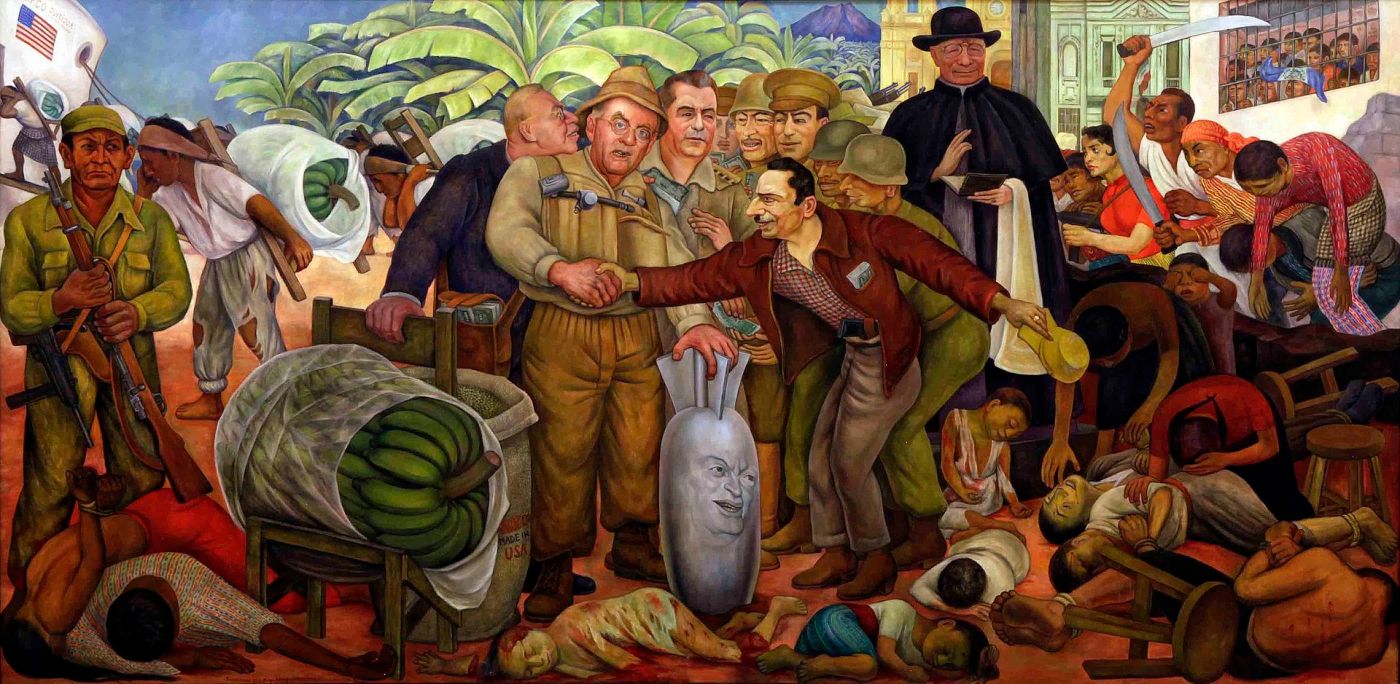
The United States recognized that America’s policy of anticommunism in the Western Hemisphere would have to sit behind an image of Latin American sovereignty. The first Cold War coup in the Americas came in 1954 when the United States handpicked exiled military office Carlos Castillo Armas to overthrow the democratically elected President of Guatemala, Jacobo Árbenz for the crime of expropriating— with compensation—and redistributing land owned by the United Fruit Company. The act was memorialized in Mexican painter Diego Rivera’s Gloriosa Victoria, created that same year, which placed the coup leader next to Secretary of State John Foster Dulles, with CIA director Allen Dulles and US Ambassador John Peurifoy looking on. President Eisenhower’s face is emblazoned upon a bomb, and Guatemalan Archbishop Mariano Rossell y Arellano blesses the political transaction. For Rivera and many onlookers at the time, the United States seemed to be in complete control of Guatemala.
Castillo Armas lasted a short time in office before another coup and a succession of Guatemalan leaders during the Cold War who, while allied with the United States, had broad discretion in how they waged anticommunist state violence. Such autonomy culminated in the documented genocide of over 200,000 indigenous Guatemalans in the early 1980s; at the time, the Reagan administration publicly dismissed allegations of human rights violations while internally worrying about the excesses of violence.
Similarly, military dictatorships across Cold War Latin America often acted in concert with US anticommunist interests, brutally launching dirty wars against “subversion” that had a staggering human cost of tortured, imprisoned, disappeared, and exiled citizens. But the US allies in these countries also bucked US demands in favor of their own national interests either to bolster national elites and business interests or to manage internal dissent. A US-allied Venezuelan President Carlos Andrés Pérez nationalized the oil industry in 1976 in the midst of an oil boom and high prices. The United States and US oil companies were only partially placated by continued partnerships with the Venezuelan state oil company. Such action would have been unthinkable during the Roosevelt and Wilson administrations.
By contrast, today Trump and Rubio aren’t promising autonomy to a Venezuela reeling from Maduro’s kidnapping. Venezuelan Vice President Delcy Rodríguez, was sworn in by the country’s Supreme Court as acting president in the hours after the kidnapping. Initially defiant in the face of US posturing, she has since moderated her stance to emphasize cooperation within the bounds of international law. The Trump administration has not bothered with such diplomatic niceties. Instead, they are standing firm on the demand that Venezuela will bend to the United States and allow American oil companies to essentially take over the oil industry and the largest known oil reserves in the world.
From Teddy to Trump: The Monroe Doctrine Returns Supercharged as the Donroe Doctrine
While the history of Cold War intervention rightly shapes international responses to Maduro’s kidnapping, the emphases of US policymakers today are more in line with those of the early twentieth century and especially the aftermath of Cuban independence from Spain and Wilson’s occupation of Haiti.
President Trump does not share concerns about Latin American sovereignty—or even its appearance—that have shaped US policy in the region since the FDR administration. As the situation in Venezuela continues to develop, we should not lose sight of the long and varied history of US intervention in Latin America. With outright racism, nativism, and xenophobia emanating from the current White House, ICE raids tearing apart immigrant communities, Vice President JD Vance declaring that “you don’t have to apologize for being white,” the parallels between the Progressive Era and Trump administrations are clear; these include views of Latin America, policies towards immigrants, and ideas about race. Trump’s invocation of the Monroe Doctrine, now “superseded” as the “Don-roe Doctrine,” is as clear a statement as can be that his administration sees few limits to the exercise of US military power in the region.
In the short term, it seems that Trump and Rubio are motivated by the promise of US oil companies making a killing in a post-Maduro Venezuela. In addition, Rubio clearly hopes that Venezuela is the domino that finally topples Cuba, the nation that has bedeviled US presidential administrations since Eisenhower. Regardless of whether American oil companies surge into Venezuela or Cuba ceases to be communist, one thing is certain: there will be more death. Loss of life in Latin America was the one constant that tied together US interventions in the region across the twentieth century. Yet this same history is also a history of resistance and anti-imperialism. The history of resistance to US intervention has been a constant—not only in twentieth-century Latin America but also in Vietnam and, more recently, Iraq. Past interventions plead with Americans to heed the Nicaraguan poet Rubén Darío’s warning: América, “it dreams. And it loves, and it vibrates, and it is the daughter of the Sun. Be careful.”
Featured Image: Diego Rivera, Gloriosa Victoria, 1954, Wikimedia Commons
 Clio and the Contemporary
Leave a comment