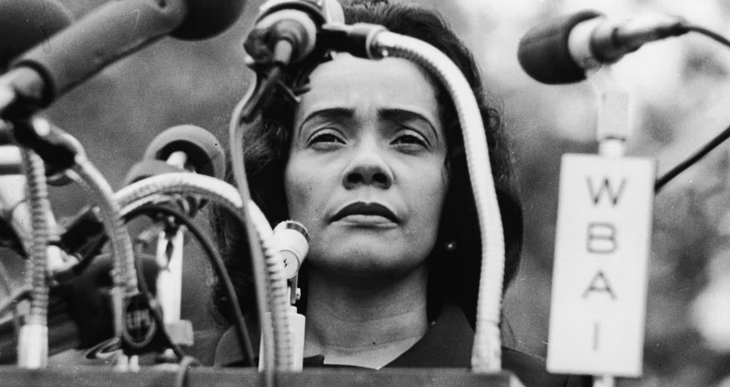
In honoring Dr. Martin Luther King Jr.’s legacy, it is both appropriate—and overdue—to discuss the significance of Coretta Scott King. And not just as the wife, and eventual widow, of Martin Luther King, Jr.; but as an important activist and shaper of Dr. King’s ideas. As historian Jeanne Theoharis has argued, Mrs. King was a significant figure in her own right. But, as with many female figures of the past, her historical importance—and that of Black women in the Civil Rights Movement more broadly—has often been minimized or negated; and that can lead to erasure, even in plain sight.
There are only two book-length scholarly works on Coretta Scott King. Most of the popular books featuring her are geared towards children and teenagers. While it is, of course, important for young people to know who Coretta Scott King was, it is also telling that more scholarly works have not featured her activism or influence on Martin. Omitting her intellectual contributions to the Civil Rights Movement is to allow a narrative of the Kings; of Civil Rights era; and of American history writ large, to showcase “great men” alone in making decisions, and carrying out the actions that produce history. In the predominant public memory, women like Mrs. King are often relegated, or consigned, to stand behind men only as dutiful wives and mothers. Less room is given for women to be activists, theorists, organizers, and leaders in any significant measure, although Black women were all of these things throughout the duration of the movement.
I do not want to perpetuate that historical erasure of Black women. Instead, I want to follow the lead of Coretta and Martin, who defined their marriage as unconventionally collaborative. In fact, Coretta insisted, and both Martin, Jr. and Sr. agreed, that the vow of obedience be removed from their wedding ceremony.[1] When Coretta declared, “I was called, too,” she insisted we remember her not as a shadow of her husband, but as an equal.
In her memoir, My Life, My Love, My Legacy, Mrs. King opened by admitting that most people did not know the “real her because they only saw or thought of her as ‘Mrs. Martin Luther King, Jr.’” She wanted readers to get to know “Coretta,”[2] the young woman who loved to sing and dance, who stood up for herself against racial injustice at a liberal northern college, who became active in the peace movement while in college—and remained so throughout her entire life–, who debated whether or not she should date—much less marry—Martin Luther King, Jr., and who remained an internationally renowned human rights activist in the wake of her husband’s assassination.
Coretta Scott’s story began in Heiberger, Alabama, a small, thoroughly segregated town, on April 27, 1927. Growing up in the Jim Crow South, young Coretta’s childhood was marred by racial violence, as was all-too common at the time. The family’s home, which her father had built with his bare hands, was burned to the ground on Thanksgiving night when she was 15 years old. Racist whites in town resented her family’s economic independence, so they destroyed his property.[3] Her family owned their own land, and her father transported lumber in the truck he owned. Later, after saving enough money to open his own lumber company, it too was burned to the ground within a few months when he refused to sell to a white man. Even with these devastating shocks, less than five years later, in 1946, Coretta Scott’s father opened a grocery store and gas station on the family’s land that remained in operation for decades, serving Black and white customers.[4]
These experiences with racial violence, however, affected Coretta deeply, shaping her entire life. There was no legal recourse for her family in the face of deliberate arson and destruction of property. The Southern legal system did not acknowledge Black Americans’ rights as citizens of the United States, and law enforcement officers were often either members of, or co-conspirators with, white supremacist groups. Coretta Scott King said that she did not experience kind white people or those who considered her a full human being until she got to Lincoln Normal School, a semi-private school that she and her older sister, Edythe, attended. The faculty at Lincoln was almost equally white and Black; predominantly Northern in terms of the white teachers; and affirming of the students, both in terms of the curricular offerings and nurturing students’ talents.[5]
It was Coretta Scott’s mother, Bernice McMurry Scott, who continually emphasized the importance obtaining a good education, even though she had not progressed beyond the fourth grade herself. It was, of course, no mean feat to send one child—let alone three—to high school in the Deep South, as many counties had no public high schools for African Americans. Southern local governments did not believe Black children needed schooling beyond the elementary grades. It was a testament to the fortitude of the Scotts that both daughters—and later their younger brother—attended secondary school over ten miles from home. Mrs. Scott actually drove the bus that transported the neighborhood’s Black children to and fro.[6]
During high school Coretta’s mind was being opened in a variety of ways. She learned to love classical music, for example. She met a young pacifist named Bayard Rustin for the first time who introduced her ninth-grade class to the principles of nonviolence and the anti-colonial struggles throughout the British Empire.[7] Coretta Scott would get to know Rustin well over the course of their lives, but her introduction to the peace movement began as a teenager in the midst of Jim Crow Alabama.
Throughout childhood, her mother planted college ambitions in Coretta, though no Alabama state institutions admitted African Americans. The state preferred to pay for African American students to attend higher education institutions out of state than integrate their own schools.[8] Coretta graduated from Lincoln Normal School as valedictorian and followed her sister Edythe north to Antioch College, an unconventional liberal arts college in Yellow Springs, Ohio, on a scholarship.[9] Students were required to work off-campus part of the year and attend classes the remainder of the year. While Coretta was excited to experience life outside the shadow of Southern Jim Crow, she found racial discrimination also existed in the North. Antioch’s work requirement ultimately made Coretta advocate for herself against racial injustice.
To complete her elementary education major and qualify for teaching certification in Ohio, Coretta was required to work as a teaching assistant in public and private schools in Yellow Springs. There were no Black teachers in the Yellow Springs public schools, and she was the College’s first Black elementary education major. After Coretta had completed her year in the Antioch private school, she was denied placement in the public schools because of her race. This was happening at liberal Antioch, north of the Ohio River. But, of course, racial discrimination knows no geographic boundaries.
Coretta sought support from mentors and peers but found none. The supervisor of student teaching told Coretta that Blacks and whites should not mix. Antioch College’s president provided no relief. She appealed to the local school board to no avail, and her fellow white students did not mobilize on her behalf. Ultimately, Coretta faced the unfair choice between traveling nearly ten miles from campus to student teach at a segregated elementary school in Xenia, Ohio, or spending another year at the private school in Yellow Springs. She refused to teach in a segregated school, for escaping segregation was why she had left Alabama. However, Coretta wrote a poignant and defiant letter condemning the College administration for failing to intervene on her behalf, and arguing that this kind of injustice would harm the entire country in the long-term. She wrote, “My precious time and money have been spent for a commodity which I never received only because my skin color happened to be darker. . . . This kind of injustice which I experienced is mild compared to what Negroes are facing all the time in our society. . . . Do you then wonder why America as a leader among the nations in the world cannot command more respect among the common people who make up the majority of the world? Her inner corruption cannot long persist without backfiring.” She reflected on this moment later, recalling in her memoir, “This was the first time I stood up publicly against discrimination, and I found that I rather liked making waves and being a catalyst for change. . . . I knew that I would be black the rest of my life, so I could not back down or remain silent in the face of the injustice I would inevitably face.”[10]
Despite that unfortunate experience, Coretta Scott learned other valuable lessons at Antioch that sharpened her political focus on peace activism. Coretta became active in racial and peace struggles on- and off-campus. She once again met Bayard Rustin, who came to Antioch to lecture on peace activism, having been jailed during World War II as a conscientious objector. She became involved in the Antioch NAACP and a student group pursuing global peace in the wake of the Second World War, and she began considering herself a pacifist, a position in line with her religious beliefs. She brought these ideas into electoral politics, joining Henry Wallace’s presidential campaign with the Progressive Party in 1948. The Progressive Party platform included ending segregation, supporting voting rights for blacks, and national health insurance.[11]
After graduating from Antioch with degrees in education and music, Coretta Scott transferred to the New England Conservatory of Music in Boston, one of the best in the country, in the fall of 1951. In the break between her first and second semesters, she was encouraged to go on a date with a young, charismatic divinity student from Atlanta. For Coretta, rather than love at first sight, she found Martin King too short, and too forthright with his affection for her. While he was pretty certain they would be married, she was not even sure whether she wanted a second date.[12] As this encounter reveals, Coretta Scott was not a woman without opinions or agency. She was reflective and made only the decisions that aligned with her mind and spirit.
After Coretta Scott became Mrs. Coretta Scott King in June 1953, and Martin Luther King, Jr. rose to prominence as the head of the Montgomery Improvement Association (MIA) during the Montgomery Bus Boycott, she and other women worked alongside the men of the MIA doing secretarial tasks—typing, mailing, filing, and responding to phone calls as virtual press secretaries. She also acted as a sounding board, helping develop ideas and themes for speeches, and in some cases standing in for her husband.[13] Coretta was not only a loving wife, not only a loving mother, but also a lover of the civil rights and peace movements, and an agitator for racial and economic equality in her own right.
Throughout their life together, Coretta Scott not only shared her well-formed political and moral views with Martin King, but she helped shaped his ideas. For example, it was Coretta that first spoke publicly in opposition to the Vietnam War, addressing an anti-war rally at Madison Square Garden in New York City in 1965. According to Jeanne Theoharis, “Later that year, she took her husband’s place when he changed his mind about addressing a peace rally in Washington, D. C. Asked whether he had educated his wife on these issues, he said, ‘She educated me.’”[14] Though the criticisms of his antiwar positions, in his words, “emotionally fatigued” him, Coretta and other Black women antiwar activists, such as Fannie Lou Hamer, Diane Nash, and Rosa Parks, “stepped into the breach.”[15] “Few black Americans did more to infuse an antiwar ethic into the civil rights movement and a civil rights ethic into the antiwar movement than Coretta Scott King did.”[16] This is a representative example of the influence Coretta Soctt King held within the Civil Rights Movement, but it began well before 1965.
In the two decades before 1965, Coretta’s activist involvement continued to evolve and deepen. She already knew Bayard Rustin, for example, by the time Martin met him as a married man. As Mrs. King, not only did Coretta help her husband craft his speeches and sermons, she also fundraised for the Southern Christian Leadership Conference (SCLC) by performing classical musical concerts. Over time, she incorporated spirituals and movement songs interspersed with anecdotes that highlighted racial inequality and the need to support SCLC.[17] She expanded her influence in global diplomacy by attending the founding meeting of the National Committee for a Sane Nuclear Policy in 1957 and represented Women’s Strike for Peace at a nuclear-disarmament conference in Geneva in 1962.” Dr. King won the Nobel Prize, in 1964, and according to Jeanne Theoharis, Coretta ”impressed upon him the role he must play in pursuing world peace. She considered it her burden, as well.”[18]
Dr. and Mrs. King, as part of SCLC, began planning the Poor People’s Campaign in the fall of 1967. Marion Wright Edelman, head of the NAACP Legal Defense and Education Fund, suggested the idea to Dr. King. He described the campaign before its launch as, “the beginning of a new co-operation, understanding, and a determination by poor people of all colors and backgrounds to assert and win their right to a decent life and respect for their culture and dignity” (SCLC, 15 March 1968). Many leaders of American Indian, Puerto Rican, Mexican American, and poor white communities pledged themselves to the Poor People’s Campaign.”[19]
Throughout their time as a married couple, Coretta Scott King remained steadfast in the pursuit of racial and economic equality, and global peace. After Dr. King’s assassination on April 4, 1968, Coretta Scott King rededicated herself to these issues. She remained so influential that President Richard Nixon and Secretary of State Henry Kissinger required FBI briefings on her activities for years after Dr. King’s death.[20] Coretta Scott King worked diligently to memorialize her husband, through the continuation of the Poor People’s Campaign that was being planned before her husband’s death, through the formation of the King Center for Nonviolent Social Change, and by engineering the passage of legislation for a national federal holiday, Martin Luther King, Jr. Day—finally signed into law in 1983, and observed in 1986.
Besides the work to institutionalize her husband’s memory, Coretta Scott King became an internationally renowned peace, women’s rights, and anti-Apartheid activist. She continued to forcefully critique American capitalism. She protested the war in Vietnam through marches, political meetings, and public statements. She always highlighted the role of women in both the civil rights and antiwar movements, arguing that the late 1960s was the time for “woman power.” Women, according to Mrs. King, were “a force that not only stood to end the war in Vietnam but also, in her estimation, had the potential—the power—to cut the legs out from underneath racism and poverty.”[21]
In the late-1970s, Mrs. Scott King began speaking out against discrimination against the LGBT community. In 1977, Coretta Scott King helped organize the National Women’s Conference in Houston; the first meeting of its kind in the U. S. since the Seneca Falls Convention in 1848. Several of the women’s groups in attendance advocated constitutional bans of same-sex marriage. Mrs. King advocated for gay rights in private conversations at the convention, arguing that gays and lesbians had just as much right to legal protections as any other group. She wrote, “I believe unequivocally that discrimination against people because of their sexual orientation is wrong. . . . Racism, sexism, anti-Semitism, and bigotry based on sexual orientation are all forms of intolerance that are unworthy of America as a democracy.” Coretta Scott King pointed out that gays and lesbians had been present in every civil rights campaign Dr. King had led, and deserved hers and the nation’s support.[22] She continued her advocacy on behalf of gay rights publicly and privately throughout the remainder of her life.
During the 1980s and 1990s, Mrs. King, through the King Center, advocated to end apartheid in South Africa by encouraging corporate divestment of American companies, by using the Center as a forum for political mediation amongst South African political parties, and by visiting the country in 1986 to meet with leaders there, including Archbishop Desmond Tutu.Until her passing in 2006, Coretta Scott King demonstrated in myriad ways that she was a committed activist for peace and equality. She did not merely follow in the footsteps of her husband, she joined her steps with his, walking beside him, in service to her God and all of humanity. Like many women of her day, Coretta Scott King was expected to be a dutiful mother, satisfying the desires of her husband. Also like many women of the day, she did much more, forging a path that was wide enough and deep enough to inspire many others to action. She has not been recognized enough for her contributions to eliminate inequality of all kinds in the U. S. and throughout the world. We should not perpetuate those errors of omission any longer.
Featured Image: “Peace-In-Vietnam” Rally, Central Park, New York, NY, Hulton Archive/Getty Images. CNN.
[1] Coretta Scott King, My Life, My Love, My Legacy (New York: Henry Holt and Company, 2017), 49.
[2] King, My Life, My Love, My Legacy, 5.
[3] Theoharis, “Women Have Been the Backbone of the Whole Civil Rights Movement,” The Atlantic, 18; King, My Life, My Love, My Legacy, 11.
[4] King, My Life, My Love, My Legacy, 14-5.
[5] King, My Life, My Love, My Legacy, 23.
[6] King, My Life, My Love, My Legacy, 16-7.
[7] King, My Life, My Love, My Legacy, 25.
[8] King, My Life, My Love, My Legacy, 36-7.
[9] King, My Life, My Love, My Legacy, 26.
[10] King, My Life, My Love, My Legacy, 31-2.
[11] Theoharis, “Women Have Been the Backbone of the Whole Civil Rights Movement,” 18; King, My Life, My Love, My Legacy, 32-3.
[12] King, My Life, My Love, My Legacy, 39.
[13] King, My Life, My Love, My Legacy, 64; Portlock, “‘Woman Power!’ Coretta Scott King and the Vietnam War Era” (Chapter of unpublished Ph.D. Dissertation, University of Rochester), 7.
[14] Theoharis, “Women Have Been the Backbone of the Whole Civil Rights Movement,” 19; John Portlock, “‘Woman Power!’ Coretta Scott King and the Vietnam War Era,” 5-6.
[15] Portlock, “‘Woman Power!’ Coretta Scott King and the Vietnam War Era,” 30.
[16] Portlock, “‘Woman Power!’ Coretta Scott King and the Vietnam War Era,” 5.
[17] King, My Life, My Love, My Legacy, 33, 101, 103.
[18] Theoharis, “Women Have Been the Backbone of the Whole Civil Rights Movement,” 19.
[19] Martin Luther King, as quoted in “Poor People’s Campaign,” The Martin Luther King, Jr. Research and Education Institute,https://kinginstitute.stanford.edu/encyclopedia/poor-peoples-campaign, Accessed on January 11, 2019.
[20] Theoharis, “Women Have Been the Backbone of the Whole Civil Rights Movement,” 17.
[21] Portlock, “‘Woman Power!’ Coretta Scott King and the Vietnam War Era,” 27-8.
 Clio and the Contemporary
Leave a comment