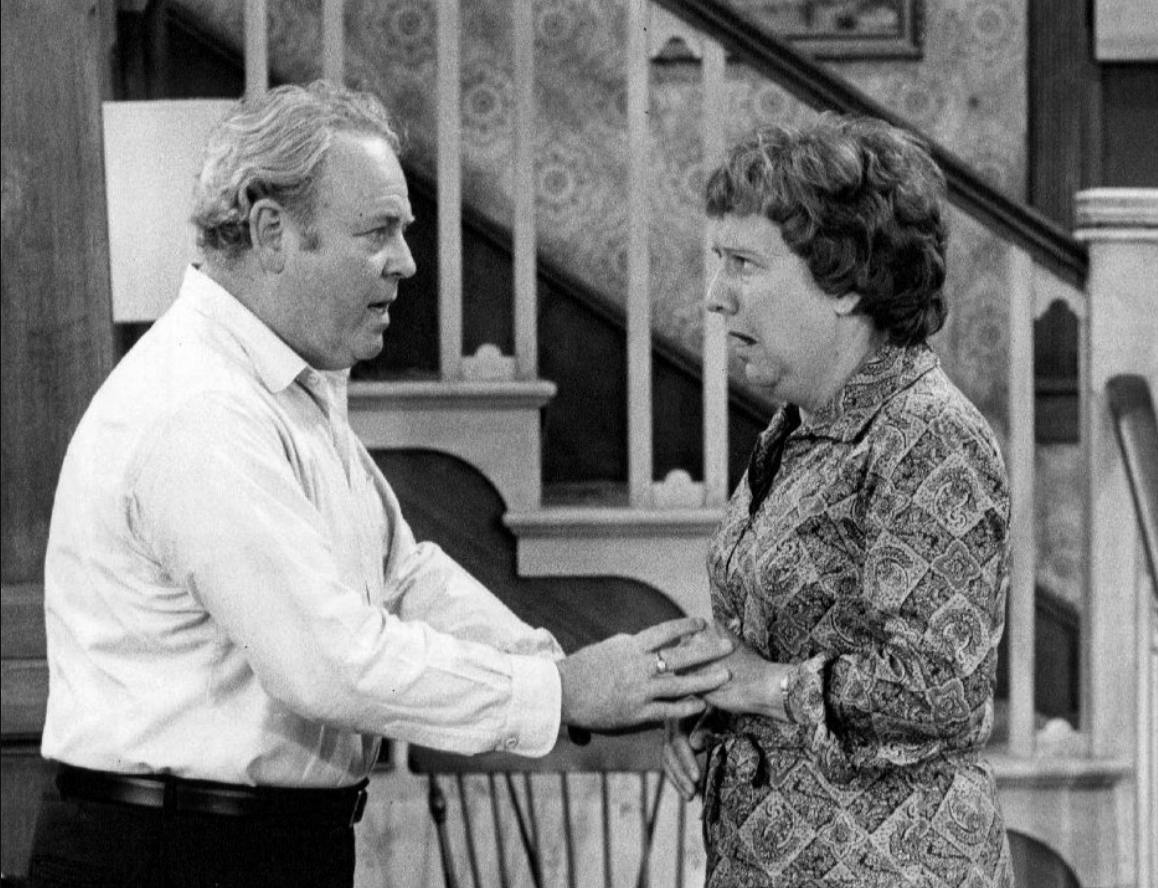
Fifty-five years ago this month, January 12, 1971, a disclaimer appeared on television screens tuned to CBS across the nation: “The program you are about to see is All in the Family. It seeks to throw a humorous spotlight on our frailties, prejudices, and concerns. By making them a source of laughter, we hope to show – in a mature fashion – just how absurd they are.” It was a watershed moment, even if it went by without much notice at the time. With All in the Family, producers Norman Lear and Bud Yorkin took the domestic situation comedy and introduced real life – warts and all.
On 704 Hauser Street in Queens, New York, the bigoted Archie Bunker (played by Carroll O’Connor) and his ingenuous wife Edith (Jean Stapleton) lived with their pollyannaish daughter Gloria (Sally Struthers) and her bleeding-heart husband Michael Stivic (Rob Reiner). The show featured heated arguments about everything from the women’s movement, residential segregation, and the war in Vietnam to the right order to put on your socks and shoes (“the whole world puts on a sock and a sock and a shoe and a shoe,” Archie insisted while Mike explained that he “like[s] to take care of one foot at a time”).
It became the most successful television show of the 1970s and is considered one of the most influential shows of all time. It topped the ratings for a record-breaking five consecutive seasons with as many as 60 percent of all television sets in the US tuned to the show. Moreover, the success of the show revolutionized the relationship between television entertainment and politics.
When All in the Family came on the air, it broke barriers. Situation comedies in the 1960s tended to be escapist amusement featuring flying nuns, talking horses, shipwrecks on deserted islands, or set in the pastoral towns of Mayberry and Hooterville. Where earlier shows avoided contentious and political subjects, All in the Family courted controversy. From the very first episode, Archie, Edith, Gloria, and Mike argued about religion, politics, race, and sexuality. And outside the Hauser Street set, controversy followed.
Early reviews revealed a divide between those who thought it was irresponsible to have Archie Bunker use slurs against minorities on prime time and those who believed satire could combat bigotry. TV Guide called it “the best show on television” while the Associated Press deemed it “a half hour of vulgarity and offensive dialogue.”[1]
Civil rights advocates and other grassroots activists argued about the show’s impact. While the earliest conversations focused on bigotry, it was the reaction from feminists that sparked a change in situation comedies for decades to come. When women complained about the limited writing for the women in the Bunker household, a sentiment shared by both Frances Lear and Peggy Yorkin, their husbands, as the show’s producers, realized they needed to make a change. Norman Lear, on the advice of his wife Frances, turned to the president of the Los Angeles chapter of the National Organization for Women (NOW), Virginia Carter, to bring an activist voice to the production process.
Carter, a physicist by trade, had no experience in either television or entertainment more broadly. In fact, like many feminist activists, she had been critical of television for demeaning and stereotyping the women’s movement.[2] Now, she was charged with making sure the number one show on television was on the right side of history when it came to women. Tandem Productions, Lear’s and Yorkin’s independent production company (which boasted not only All in the Family among its hits, but also Sanford & Son, Maude, Good Times, and The Jeffersons) hired Cater. There, she collaborated with interest groups, advocacy organizations, and academics to research political, social, or controversial topics addressed on the show.
When Lear wanted to engage with the theme of sexual violence, for example, Carter was responsible for researching the subject. She and Lear collaborated with the Santa Monica Hospital Rape Treatment Center to bring subject knowledge and heightened sensitivity into the writer’s room. “These organizations,” Lear told the writers’ room, “do have things they would love women to know.” And having Edith face a would-be rapist in the house would help inform tens of millions of women about how to best deal with the threat of sexual violence. The writers were scripting a comedy show, but as many critics and viewers had understood from the outset, a comedy show with a message. In this particular episode, the key was to find a way for Edith to save herself. Rewrites followed rewrites until the script satisfied not only the writers’ room but also Carter and advocates from the Rape Treatment Center. The result was an episode that not only showed Edith fighting off a rapist alone in the Bunker household (while the rest of the family plans a surprise birthday party for her next door) but also explored her emotional trauma in the aftermath of the attack. Writing for the Washington Post, Tom Shales hailed it as “television at its very, very best.”
Welcoming activists and advocates into the production process, Carter modeled ways for a situation comedy to engage political and social issues. Over the years and decades since, the model became the norm for writers and producers on sitcoms eager to address issues such as drunk driving, health, same-sex marriage, police brutality, and immigration rights. “Television can be broken into two parts […] before Norman and after Norman,” producer Phil Rosenthal (Everybody Loves Raymond) often remarks. Lear’s success with All in the Family gave writers permission to bring their own experiences and interests to the script, but it was the work of Carter that made sure the political and controversial issues were handled with insight and with input from affected groups on prime time, thus ensuring that comedy with a message, not merely comedy with controversy, became Lear’s lasting contribution.
[1] See Oscar Winberg, Archie Bunker for President: How One Television Show Remade American Politics (University of North Carolina Press, 2025), 26.
[2] For studies of women on television, see Susan J. Douglas, Where the Girls Are: Growing Up Female with the Mass Media (Crown, 1995), Bonnie J. Dow, Prime-Time Feminism: Television, Media Culture, and the Women’s Movement since 1970 (University of Pennsylvania Press, 1996), and Window Dressing on the Set: Women and Minorities in Television (US Commission on Civil Rights, 1977).
Featured image: Carroll O’Connor and Jean Stapleton as Archie and Edith Bunker in All In the Family, September 21, 1973. CBS Television, Public domain, via Wikimedia Commons.
 Clio and the Contemporary

Leave a comment