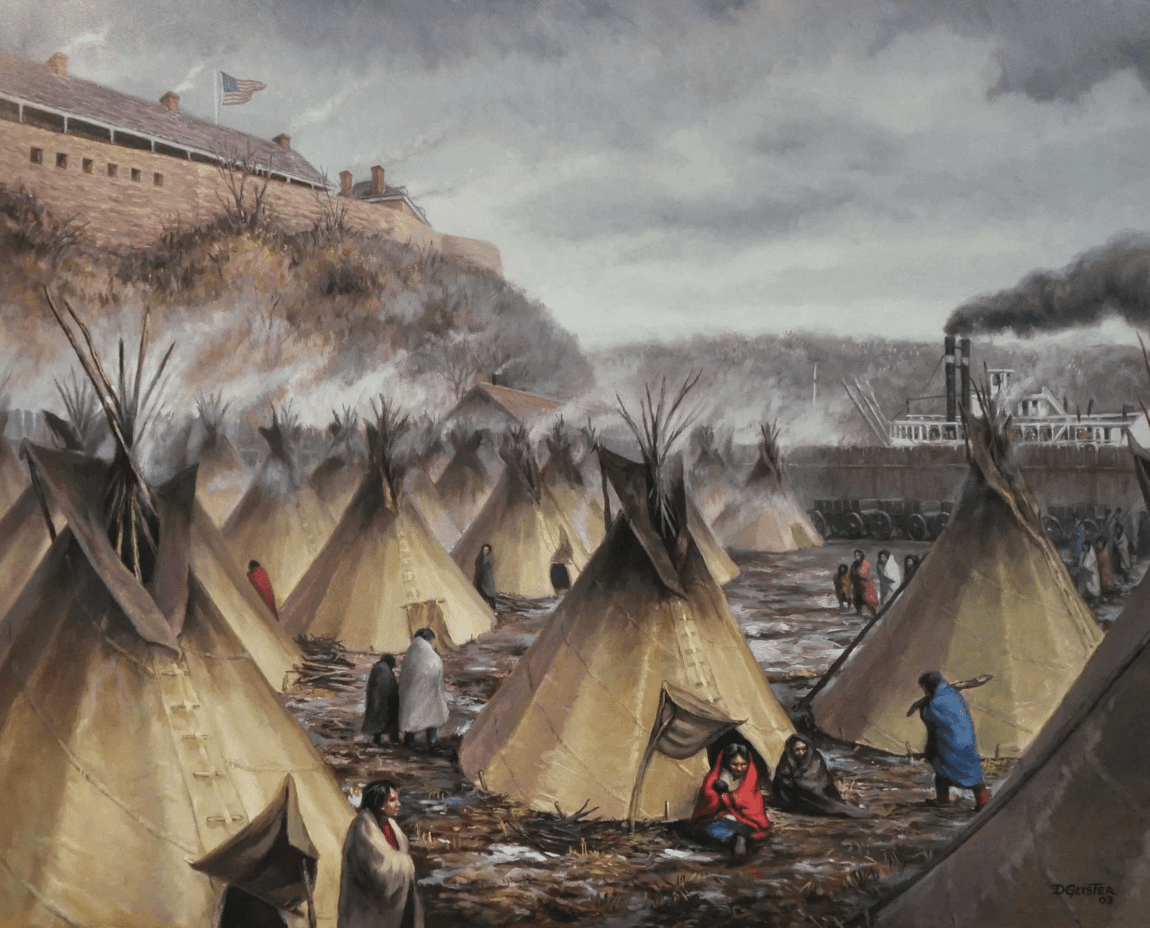
On January 13, 2026, federal immigration agents arrested and detained four Oglala Lakota men living below an underpass in Minneapolis, Minnesota, simply for looking like illegal, undocumented immigrants. The four men were held at the Immigration and Customs Enforcement (ICE) detention center at the Whipple Building near Fort Snelling, a site notoriously connected to the detainment of hundreds of Dakota people after the US-Dakota War. Frank Star Comes Out, the tribal leader of the Oglala Lakota, called on the federal government to release these four unhoused men. The Department of Homeland Security withheld information from Star Comes Out unless his nation entered in an immigration agreement with the federal government. These Lakota rejected the demand as it threatened their sovereignty and uprooted political agreements that Lakota and the US government had signed over one hundred years ago. Elsewhere in the Twin Cities, federal immigration officers murdered Renee Nicole Good and Alex Pretti, sparking national outrage and renewed protest over violence federal enforcement tactics. These deaths connect to a much longer history of federal and state violence being used against Indigenous people and other communities in Minnesota.
In 2021, I developed a “microsyllabus” on Indigenous-settler violence during the Gilded Age and Progressive Era. The collective project sought to explore the role of racial violence during the period as a scholarly response to the 2020 murder of George Floyd by Minneapolis police officer Derek Chauvin.1 I argued that the Gilded Age and Progressive Era cannot be understood without centering Indigenous experiences of physical and/or structural violence. This gave me the opportunity to explore settler colonialism not as a closed historical episode, but as an ongoing logic of governance. At the time, the invitation felt urgent. I could not have anticipated that five years later I would feel compelled to revisit these same questions after federal immigration officers murdered Good and Pretti just blocks from where Chauvin killed Floyd.2
These recent killings unfolded alongside a broader pattern of racialized federal violence in Minnesota.3 Structural violence affects many communities in Minnesota, but my aim here is not to collapse past and present into a single story. Instead, I trace continuities in how federal power has operated through violence, surveillance, and exclusion in Minnesota’s Indigenous past. By returning to the aftermath of the US-Dakota War of 1862, I show how physical and structural violence against Indigenous peoples shaped state development and federal practices that continue to structure the present.
Federal and State Violence in the US-Dakota War
The longer history of federal violence begins with the conditions that produced the US-Dakota War of 1862. The failure of the federal government to deliver annuity payments promised under the 1851 Treaties of Traverse des Sioux and Mendota precipitated the conflict. The withholding of provisions and funds produced widespread starvation among Dakota communities, pushing many to a breaking point. Violence erupted after four young Mdewakanton Dakota hunters killed settlers near Acton, Minnesota, an incident that rapidly escalated into open warfare between eastern Dakota bands and white settlers, settler militias, and eventually the US Army.4
The war spread like wildfire in the Minnesota River Valley. Battles affected not only Dakota people, but white settlers wanting to stay out of the action. The war destroyed towns, pushed people into refugeedom, and even led to the Dakota taking white captives. By September 1862, US Army troops defeated Taóyateduta (Little Crow) and his warriors at the Battle of Wood Lake.5 Violence shaped the aftermath of the US-Dakota War. While Taóyateduta and others escaped west, those who remained were deceived into surrendering under the promise of release. Instead, a military tribunal rushed 393 Dakota men through trials that often lasted no more than two minutes, without translation, legal counsel, or meaningful evidence. The tribunal sentenced 303 men to death. After reviewing the transcripts, President Abraham Lincoln reduced the number of executions to thirty-eight. On December 26, 1862, one week before Lincoln signed the Emancipation Proclamation, the US Army hanged all thirty-eight Dakota men at once in Mankato, Minnesota, in what remains the largest mass execution in United States history.6
Execution was only one component of a broader regime of removal and confinement. The US Army forcibly expelled Dakota women, children, and elders from their reservations along the Minnesota River and marched them to Fort Snelling in St. Paul. For Dakota people, they called the space Fort Snelling occupies Bdote, which was—and remains—a sacred Dakota cultural center. As University of Minnesota historian David Chang recently noted, Fort Snelling has long served as a site of federal occupational power since its inception in the early nineteenth century.7 The army confined approximately 1,600 Dakota people in a concentration camp enclosed by wooden palisades, where disease, malnutrition, and neglect ran rampant. Between November 1862 and March 1863, an estimated 300 people died. In Spring 1863, the Army transported the survivors hundreds of miles by steamboat and overland to the Crow Creek Reservation in present-day South Dakota, where people faced the continued threat of malnutrition and disease, while living on land deemed unhealthy for white farmers.
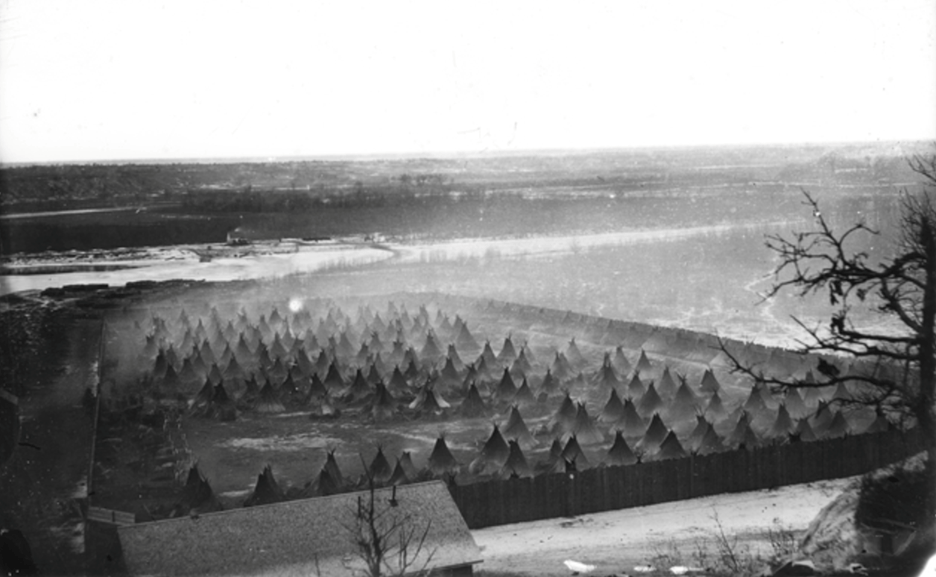
A view of the Dakota concentration camp at Fort Snelling, St. Paul, Minnesota, courtesy of the Minnesota Historical Society.
Calls for Indigenous removal were accompanied by explicit fantasies of permanent surveillance and forced labor. White Minnesotans openly advocated for the eradication of the Dakota from Minnesota. John Wickes Taylor, a special agent for the Minnesota Treasury Department, proposed relocated all Dakota people to Isle Royal in Lake Superior, where the US Army could establish a penal colony placing the Dakota “under severe military surveillance” and force them into an agricultural economy built on coerced labor.8 This plan never materialized, but the US Army continued on with their goals of removing all Indigenous people from Minnesota.
Even those Dakota men spared in the Mankato execution by President Lincoln remained subject to federal incarceration and separation from their families at Camp McClellan in Davenport, Iowa.9 While sentenced for life, these Dakota men remained in Camp McClellan until 1866 when President Andrew Johnson pardoned the men and allowed them to reunite with their families at Crow Creek. Many, however, never made it home as they too faced wretched conditions at the military prison.10
Continued Extra-judicial Violence after the US-Dakota War
Federal violence also extended beyond Minnesota’s borders, targeting Dakota people who refused to surrender. The US Army pursued Dakota communities that fled west into Dakota Territory, many of whom settled at Mni Wakháŋ (Spirit Water), known to non-Dakota people as Devils Lake.11 White Minnesotans framed these communities as a persistent threat, prompting the organization of “punitive expeditions” led by Henry Sibley and Alfred Sully between 1863 and 1865. These campaigns sought not only to punish Dakota people who fled Minnesota but also to clear routes through Dakota Territory.12
These expeditions relied on the deliberate targeting of civilians and subsistence resources. At Whitestone Hill, Sully’s forces murdered between 150 and 300 Indigenous people, the majority of them civilians, and destroyed thousands of pounds of dried bison meat prepared for the forthcoming winter months.13 This massacre included people from other Indigenous nations, like the Lakota, who played no role in Minnesota’s US-Dakota War. In addition to these expeditions, the aftermath of the war further institutionalized racialized violence at the state level.14 The federal government abolished all treaties with the Dakota people, while the State of Minnesota instituted a bounty system paying up to $200 per Dakota scalp. In 1863, Taoyateduta (Little Crow) and his son Wowinape returned briefly to Minnesota to forage for horses and berries. When Taoyateduta was killed in a firefight near Hutchinson, Minnesota, settlers scalped his body and submitted for the state bounty before they confirmed his identity. Wowinape escaped but was later captured, tried, and imprisoned at Camp McClellan until 1866.15 A year later, hired US Army agents kidnapped two Dakota chiefs who had moved 500 other Dakota people into British Canada. The agents delivered them to US military authorities, shipped south to Fort Snelling, tried, and in 1865, executed for their role in the US-Dakota War.
In addition to extralegal violence, the postwar period was also defined by the creation of the Knights of the Forest nearby Mankato, Minnesota.16 During and after the US-Dakota War, Ho-Chunk people lived on reservation lands nearby Mankato, Minnesota. While the Ho-Chunk primarily stayed out of the conflict, white Minnesotans felt very wary about Indigenous people living nearby their settlements. The Knights operated as a clandestine, militia-like network committed to the removal and eradication of all Indigenous people from the state of Minnesota. The organization, similar to the Ku Klux Klan, rained terror down on the Ho-Chunk if they ventured off of their reservation, and helped pressured the government to relocate the Ho-Chunk to other lands that would become the Winnebago Reservation in Nebraska.17
Taken together, the aftermath of the US-Dakota War reveals how federal power in Minnesota was forged not simply through law and policy, but through violence, surveillance, and systematic denial of Indigenous sovereignty. Military tribunals, mass execution, forced removal, incarceration, punitive expeditions, bounty systems, and clandestine settler organizations all worked in concert to remake the state through Indigenous dispossession. These practices linked federal authority to the management and elimination of Indigenous people in Minnesota.
Indigenous people have faced the threat of federal violence since before the creation of the Department of Homeland Security in 2003. During the late-1960s, American Indian Movement (AIM) leaders formed patrols to protect the Minneapolis’s city streets from state sanctioned violence and police brutality. Agents from the FBI or the Bureau of Indian Affairs often surveilled Native activists they deemed as threats. One key example of this practice is the case of Leonard Peltier (Anishinaabe and Očhéthi Šakówiŋ), a member of the American Indian Movement accused and imprisoned for many years for the murder of two FBI agents. Peltier was found guilty even though the federal government withheld evidence that could have supported Peltier’s case. He was later commuted in one of President Joe Biden’s final acts of his presidency. Peltier’s case is one of many that show how federal officials circumvent factual evidence to use power over Indigenous people, the same power used to arrest and detain them for simply looking non-white in the United States.
When Indigenous people in Minnesota are racially profiled, arrested, and detained in DHS custody without due process, the violence cannot be separated from history. Federal power in Minnesota has long relied on surveillance and power to manage populations deemed threatening to the state. They use coercive measures and clandestine operations to punish those that resisted or rebuke federal authority.18 Beyond the four Oglala Lakota men detained by ICE, Native Americans continue to face ongoing threat by immigration agents, within and outside of Minnesota. Understanding this history demands that we recognize ICE’s presence in Minnesota not as a crisis of the moment, but as the latest chapter in a long continuum of violence built on Indigenous dispossession, racialized control, and the erosion of sovereignty and rights in the name of order.
Featured Image: David, Geister, Internment Camp at Fort Snelling. Oil on panel. Brown County Museum, New Ulm, MN, 2003.
- See, Michael Lansing et al, “Exploring Racial Violence During the Gilded Age and Progressive Era: A Microsyllabus Project,” Journal of the Gilded Age and Progressive Era 20 (2021): 548-565. ↩︎
- Michael Lansing, “In Minneapolis, Spectacular Cruelty Meets Authentic Community,” Zocalo Public Square, January 28, 2026, https://www.zocalopublicsquare.org/in-minneapolis-spectacular-cruelty-meets-authentic-community/. ↩︎
- Yohuru Williams and Michael Lansing, “It’s a Police State in Minnesota,” Progressive, January 17, 2026, https://progressive.org/op-eds/its-a-police-state-in-minnesota-williams-lansing-20260117/. ↩︎
- For a concise overview of the history of the US-Dakota War, see Gary Clayton Anderson, Massacre in Minnesota: The Dakota War of 1862, The Most Violent Ethnic Conflict in American History (University of Oklahoma Press, 2019). ↩︎
- Readers can find additional information on the US-Dakota War in, Kenneth Carley, The Dakota War of 1862: Minnesota’s Other Civil War (Minnesota Historical Society Press, 2nd edition, 1976). ↩︎
- Paul Finkelman, ‘“I Could Not Afford To Hang Men For votes’: Lincoln the Lawyer, Humanitarian Concerns, and the Dakota Pardons,” William Mitchell Law Review 39, No. 2 (2013): 404-410. ↩︎
- Catherine J. Denial, Making Marriage: Husbands, Wives, and the American State in Dakota and Ojibwe Country (Minnesota Historical Society Press, 2013). ↩︎
- John Wickes Taylor, The Sioux War, What Shall We Do With It? The Sioux Indians, What Shall We Do With Them? A Reprint of Papers Communicated to the St. Paul Daily Press, in October 1862 (St. Paul: Press Printing Co., 1863). ↩︎
- Lincoln’s commutation of 265 death sentences is often cited as evidence of his humanitarianism, but these men were nonetheless removed from their families and given life sentences by President Lincoln.
Finkelman, ‘“I Could Not Afford To Hang Men For Votes,”’ 409. See, also, Linda M. Clemmons, Dakota in Exile: The Untold Stories of Captives in the Aftermath of the U.S.-Dakota War (University of Iowa Press, 2019). ↩︎ - Clifford Canku and Michael Simon, The Dakota Prisoner of War Letters (Minnesota Historical Society Press, 2013), 159. John Hauberg Photograph, Camp Kearney landscape and Dakota burial ground, 16, John Henry Hauberg Papers, Augustana College Special Collections, Rock Island, Illinois. ↩︎
- W. G. Gilbreath, “Minnewaukan,” North Dakota Magazine 1, No. 1 (May 1906): 43-44; Mark Diedrich, Mni Wakan Oyate (Spirit Lake Nation): A History of the Sistuwan, Wahpeton, Pabaksa, and other Dakota that Settled at Spirit Lake, North Dakota (Fort Totten, ND: Cankdeska Cikana Community College Publishing, 2007). ↩︎
- Paul N. Beck, Columns of Vengeance: Soldiers, Sioux, and The Punitive Expeditions, 1863-1864 (University of Oklahoma Press); Michael Burns, “The Civil War on the Northern Plains: John Pope’s Military Policies against the Sioux in the Department of the Northwest, 1862-1865,” The Great Plains Quarterly Vol. 38, No. 1 (Winter 2018): 88. ↩︎
- William Watts Folwell, A History of Minnesota, Vol. 2 (Minnesota Historical Society Press, 1921), 280. See, Dakota Wind Goodhouse’s blog for detailed Indigenous winter count images depicting the Whitestone Hill Massacre, “Remembering Whitestone Hill,” The First Scout, May 4, 2011, https://thefirstscout.blogspot.com/2011/05/remembering-whitestone-hill.html. ↩︎
- James Waldo Daniels, “General Sibley’s Campaign 1863,” James Waldo Daniels Papers, Reminiscent Articles nos. 5-11, undated, Folder No. 2, Minnesota Historical Society, St. Paul, Minnesota, 14; Clair Jacobson, “The Battle of Whitestone Hill,” North Dakota History 44, No. 3 (Summer 1972): 8-9. ↩︎
- “Scalps Wanted! $25 for Sioux Scalps, St. Cloud Democrat, July 9, 1863; “Bounty for Sioux Scalps,” The Weekly Pioneer and Democrat, July 24, 1863; Clemmons, Dakota in Exile, 27-28; Colette Routel, “Minnesota Bounties on Dakota Men during the US-Dakota War,” William Mitchell Law Review 40, No. 1 (2013): 21. ↩︎
- “The Knights of the Forest,” The Review (Mankato, MN), April 27, 1886. ↩︎
- For more on the Knights of the Forest, see Stephen Kantrowitz, Citizens of a Stolen Land: A Ho-Chunk History of the Nineteenth-Century United States (University of North Carolina Press, 2023) and Cathy Coats, To Banish Forever: A Secret Society, the Ho-Chunk, and Ethnic Cleansing in Minnesota (Minnesota Historical Society Press, 2024). ↩︎
- David Folkenflik, “Feds arrest Don Lemon, Minnesota Journalist and 2 others over church protest,” NPR News, January 30, 2026, https://www.npr.org/2026/01/30/nx-s1-5693756/don-lemon-arrest-cnn-minneapolis. ↩︎
 Clio and the Contemporary
Leave a comment