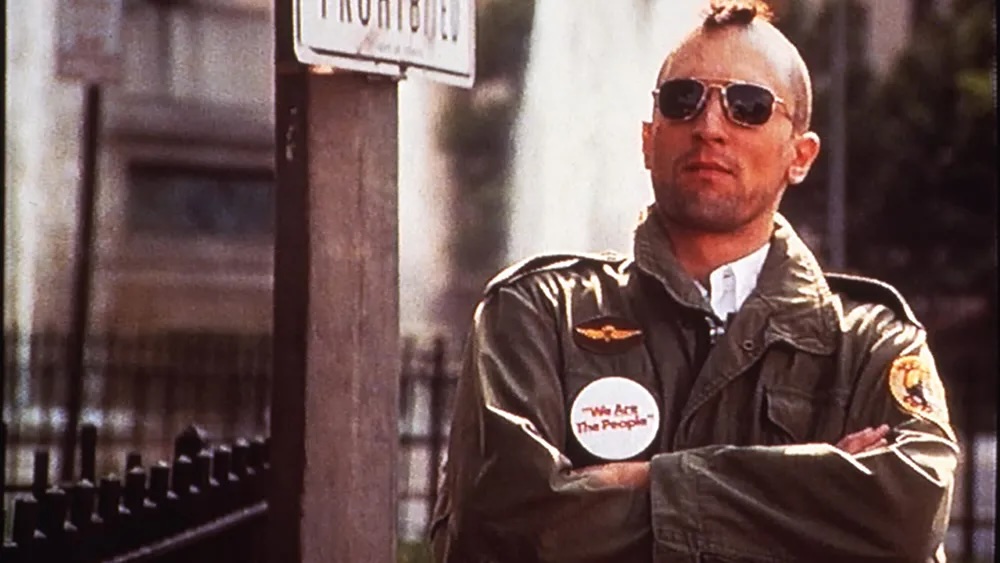
“Are you talking to me?” (You read that in Robert De Niro’s voice, didn’t you?)
This line is so culturally iconic that it has become detached from its original context: a deeply disturbed Vietnam veteran talking to himself with delusions of violent grandeur. It’s been a popular meme and even a hilarious sketch on Saturday Night Live. These famous lines make the trope of the “crazy vet” a comical figure.
On the fiftieth anniversary of the film’s release, it’s time to place Taxi Driver (1976) back within its historical context. In the 1970s, films such as Coming Home (1978) and The Deer Hunter (1978) emphasized the disillusionment of veterans who were experiencing disabilities, psychiatric trauma, and readjustment difficulties in a post-Vietnam society. Like many male-fantasy Vietnam War-era films, Taxi Driver contains some historical truths but also reinforces deeply problematic myths about veterans, homecoming, and trauma.
Psychiatric Trauma in Homecoming Narratives
Taxi Driver reflects common fears about Vietnam veterans returning to the United States. In 1971, Vietnam veteran John Kerry warned Congress “about what the result is of the feelings these men carry with them after coming back from Vietnam. The country doesn’t know it yet, but it’s created a monster, a monster in the form of millions of men who have been taught to deal and to trade in violence, and who are given the chance to die for the biggest nothing in history; men who have returned with a sense of anger and a sense of betrayal which no one has yet grasped.”[1]
On the surface, Taxi Driver is about a Marine Corps veteran named Travis Bickle (Robert De Niro) who served honorably and returned to New York City while dealing with trauma. In the 1970s, Dr. Robert J. Lifton, a psychiatrist specializing in studying war crimes, conceptualized post-Vietnam Syndrome as a combat stress unique to the conditions of fighting in Vietnam (such as measuring victory by body-counts, “free-fire zones,” and dehumanization).[2] Symptoms included delayed onset trauma, social ostracism, betrayal, guilt, feeling scapegoated, alienation, rage, psychic numbing, and disillusionment.[3]
Post-Vietnam Syndrome served as a powerful critique of the war itself as an “atrocity-producing situation,” in the words of Lifton, where ordinary people may “commit acts of evil.”[4] By the early 1970s, a majority of Americans believed that the war in Vietnam was not only a mistake, but that it was fundamentally and morally wrong.[5] Whistle-blower and Marine Corps veteran Daniel Ellsberg exposed that the US government had been lying about the war, and Ronald Ridenhour reported on war crimes at My Lai, where US soldiers massacred 504 unarmed civilians, mostly women and children.[6] Against this backdrop, popular media represented Vietnam veterans as mentally-damaged social pariahs coming home from a deeply unpopular war.
Influenced by Dr. Lifton’s research, in 1980, the DSM-III (Diagnostic and Statistical Manual of Mental Disorders, third edition) first included Post-Traumatic Stress Disorder (PTSD) as a diagnostic category. Symptoms included reexperiencing traumatic events (flashbacks), avoidance and numbing, and physiological arousal.[7] PTSD excluded some of the politicized social experiences of Vietnam veterans, described above, but many of the characteristics of post-Vietnam Syndrome remained among the criteria for PTSD.
Dr. Lifton described veterans with post-Vietnam Syndrome as “neither victims nor executioners.”[8] But, by the 1980s, depictions of Vietnam veterans in popular and political culture focused almost exclusively on their victimhood and their heroism. Key examples include the First Blood (Rambo) series starring Sylvester Stallone and the Missing In Action series starring Chuck Norris, hypermasculine films that propagate myths about victimized veterans and forgotten prisoners of war still abandoned in camps in Vietnam.[9] Taxi Driver’s Travis Bickle, however, is neither a victim nor a hero. He is an executioner.
Film director Martin Scorsese leaves Travis’s backstory to our imagination. The character often stares into the distance and loses time during conversations. Viewers do not see cinematic flashbacks to combat or torture (as in Rambo: First Blood Part II). In fact, we cannot even confirm that he served in combat in Vietnam. All we know is that he was honorably discharged from the Marines in 1973 (after the withdrawal of American troops from Vietnam). He experiences chronic headaches and insomnia. He self-medicates and self-harms.
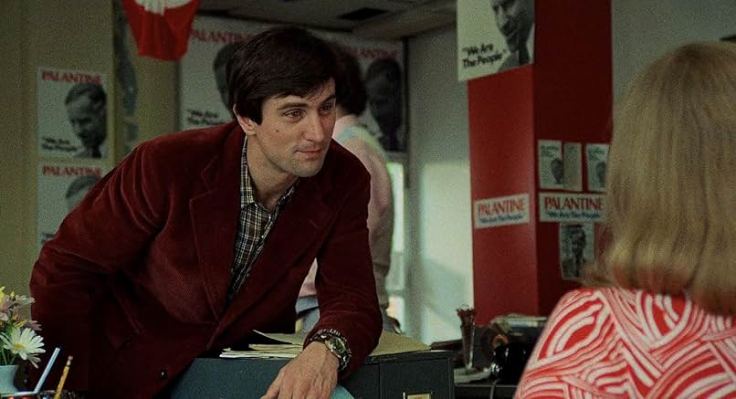
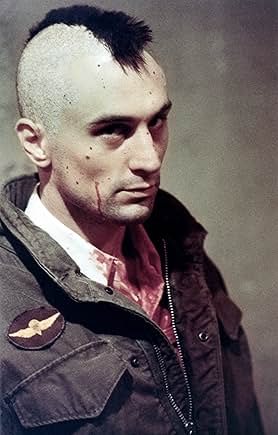
Travis traverses two separate worlds — the city at night and society during the day — but fits into neither. His physical appearance changes dramatically throughout the film, reflecting his inability to reintegrate. At night, he wears a field jacket and looks disheveled, red-eyed, and sleep-deprived. In the day, he sports a red velvet blazer with neatly combed hair and polished cowboy boots. He’s confident, even charming and handsome. Yet, by the end of the film, Travis has transformed into a vigilante, a would-be assassin, and a skinhead.
Trouble with Women
Travis Bickle lives in a liminal space, somewhere between military life and a civilian society where life went on without him. He seeks to escape into the underworld of the city at night among the prostitutes, pornography theaters, and pimps. In contrast, Betsy (the female lead character portrayed by Cybill Shepherd) is the embodiment of purity, wearing an elegant white dress. Travis becomes infatuated with her and begins to stalk her.
Betsy is an idealistic, intelligent woman who works in the campaign headquarters of a fictional presidential candidate Charles Palantine (Leonard Harris). Travis boldly approaches Betsy at her desk and convinces her to have coffee with him after work. She seems intrigued with this mysterious man. On their first date, Betsy says that he reminds her of a song by Kris Krisofferson: “He’s a prophet and a pusher, partly truth, partly fiction, a walking contradiction.” “You saying that about me?” Travis asks. “Who else would I be talking about?” replies Betsy. “I’m no pusher. I never pushed.” He is offended by the suspicion of dealing drugs. “No, just the part about contradictions,” she explains. “You are that.” The next line from Kristofferson’s song, “The Pilgrim” even more aptly describes the film’s troubled Vietnam veteran: “Takin’ ev’ry wrong direction on his lonely way back home.”
Unable to readjust to the social norms of casual dating, Travis brings Betsy to a porno theater on their second date. Of course, she is repulsed: “Taking me to a place like this is about as exciting to me as saying, let’s fuck,” she says, “We’re just different.”
This scene brings into stark contrast the innocence of a privileged young woman and the experience of a Vietnam veteran who would have, perhaps, enjoyed the comforts of sex workers in US military-sanctioned brothels in Vietnam.[10] At least, he would have been more accustomed to this environment than the campaign office where Betsy volunteers.
For Travis, this is a deeply personal rejection rather than a lesson in dating. Betsy’s repulsion does not jolt him back into the mainstream. Instead, he becomes an increasingly isolated and lonely man. He transforms from an awkwardly charming but likeable character into a dangerous stalker. Travis becomes a nighttime avenger determined to rid the city of crime and save a 12-year-old child named Iris (Jodie Foster) from prostitution.
The Dangers of Male Loneliness
From the depths of loneliness, the taxi driver becomes a radicalized veteran.“Loneliness,” Travis laments, “has followed me my whole life, in bars, in cars . . . everywhere. There’s no escape.”
Travis repeatedly tries to apologize to Betsy. She ghosts him, understandably. He tries to send flowers. The flowers are returned and left to rot. The stench exacerbates his headaches, and the scene symbolizes his decay. “I think I got stomach cancer,” he worries.[11] “You’re only as healthy as you feel,” he repeats three times.
Betsy stops answering his phone calls. He shows up at the campaign office, looking like a madman. This is the first time she sees Travis’ nighttime persona during the day. He’s traded the velvet blazer for the field jacket. Terrified, Betsy again rejects him. Travis yells, “You’re in hell! And you’re gonna die in hell like the rest of them!” Travis, as the narrator, speaks: “I realize now how much she’s like the others, cold and distant.” At this point, his loneliness becomes destructive. He’s paranoid, defensive, and rageful.
As it progresses, the film becomes increasingly violent towards women and filled with anti-Black racism. A jealous husband asks the taxi driver to park in front of an apartment to spy on his wife. “You know who lives there?” the customer asks. “A [N-word] lives there . . . I’m gonna kill her. With a .44 Magnum pistol. You ever see what .44 Magnum will do to a woman’s face?” the passenger asks.
This scene plants the seeds of Travis’s self-destruction. He buys handguns from a black-market arms dealer. He asks first about a .44 magnum. Then, he buys all the weapons the dealer has to offer, modifies them with the skills of a combat veteran, and prepares for war.
“June 29,” the narrator’s voice marks the dates like a soldier writing home from war. Travis reaches another turning point: he begins cleansing his body of toxins and doing calisthenics. “I gotta get in shape now. Too much abuse. No more pills. No more bad food. No more destroyers of my body.” Holding his arm over an open flame, Travis conditions his mind to endure pain.
At this point in the film, the troubled Vietnam veteran becomes another trope — the lone gunman out to enact vigilante justice. Convinced of his own moral superiority, Travis begins a quest to rid New York City of urban decay. Travis, in the narrator’s voice, states, “Listen you fuckers, you screwheads, here is a man who would not take it anymore. A man who stood up against the cunts, the dogs, the filth, the shit. Here is someone who stood up.”
In truth, Travis Bickle is an insecure, deranged man scorned by a woman with higher standards. “You talking to me?” he asks, pointing pistols at himself in the mirror, “Who the hell else are you talking to because I’m the only one here.” This iconic monologue circles back to his first date with Betsy. He must have replayed their conversation over and over again, obsessing over every detail of their interaction.
Complex Problems and Simplistic Tropes
The film is a powerful critique of society in post-Vietnam America: unemployment and “stagflation”; social unrest over race, crime, and drugs; and conservative angst about masculinity, femininity, and a presumed decline of “American values.” Today, similar economic, racial, and cultural conflict fuels political turmoil and violence.
Palantine’s political speeches may have resonated with a Vietnam veteran struggling to make sense of the world. “We are at the crossroads of history,” Palantine declares, “The wrong roads have led us into war, into poverty, into unemployment and inflation.”[12] With these words, we see Travis Bickle’s complete transformation. He’s skinned his head. And the politician continues, “We have reached the turning point. No longer will we the people suffer for the few.”[13] Travis then flees from the political rally and commences a killing spree.
Though an extremely flawed representation of Vietnam veterans, the film shows how some veterans could embrace extremism.[14] Travis would certainly identify with the so-called “male loneliness epidemic” of our own time.[15] Without a doubt, the character would have championed the “tough on crime” politics that dominated both major parties since the 1970s and led to the rise of mass incarceration.[16]
Taxi Driver also reinforces stereotypes and racialized tropes about criminality. Travis is an arbiter of extralegal violence in protection of white womanhood.[17] In one scene, during a grocery store robbery, Travis shoots a Black man in the face and walks away as the storekeeper beats the Black body with a crowbar, enacting what is essentially a lynching.
Set today, a man like Travis Bickle could become an I.C.E. agent like Jonathan Ross — the Iraq War veteran who shot Renée Good in the face and called her a “fucking bitch.”[18] On the other hand, the Taxi Driver protects children from thugs. Perhaps he would have joined the hundreds of veterans protesting I.C.E. and fighting back.
This is the problem with tropes of veterans as either crazy or heroes, then and now. Veterans cannot be reduced to archetypes. They are diverse, complex, and contradictory—the mark of the human condition, not marble statues frozen in time.
Saving the Damsel in Distress
Taxi Driver reaches its climax when Travis goes on a murderous rampage, killing pimps and profiteers of child sex trafficking. He then turns the gun on himself only to realize that he has already unloaded the ammunition into the face of a pimp. The cops enter with weapons drawn. Travis points his fingers to his temple, gesturing suicide and signifying the death of his darkest persona: the vigilante who sacrifices himself to cleanse the sins of the nation.
In the end, Travis kills the bad guys and rescues the 12-year-old prostitute, the damsel in distress — the Ann Daro to the King Kong patch embroidered onto his field jacket. But Travis Bickle is no hero. He’s a deeply disturbed, lonely Vietnam veteran. He’s the “crazy vet” trope that so many veterans openly despise.
To the extreme, his character shows the danger of untreated psychiatric illness, obsessive fixations on unattainable women, and vigilante impulses for violence.
In the final scene, the narrator’s voice reads a letter from the parents of the 12-year-old girl: “Iris is back in school and working hard. The transition has been very hard for her.” The camera slowly pans to show newspaper clippings documenting Travis’s recovery. The letter concludes, “You are something of a hero around our household.”
Lessons from a Fifty-Year-Old “Crazy Vet” Film
On the fiftieth anniversary of Taxi Driver — more than a half century since the end of the Vietnam War and amid the 250th birthday of the United States — we are at another “crossroads of history.”
Militarism threatens our basic civil rights and due process. As I write, federal agents are murdering citizens, tear-gassing crowds of peaceful protesters, incarcerating children, and occupying our cities. We must be critical of narratives about “cleaning up” cities, particularly when many associate their “decline” with immigrants, poor people, and disproportionately Black and Brown folks who have always been a central part of American cities and the American economy.
We must distinguish historical realities from the myths that have become entangled in the forever culture wars. If there can be a lesson taken from a 50-year-old “crazy vet” film, it’s this: cities are not saved by night crusaders and armed vigilantes. They are built by immigrants, poor people, and underserved Black and Brown communities and protected when thousands of people care for one another and stand together against fascism. We can borrow and adapt the tactics from the Vietnam War-era: civil disobedience, documenting police brutality and racial violence, investing in mutual aid, and organizing across racial and economic lines. Real-life heroes are the ordinary people who risk their lives to defend human rights.
Even Robert De Niro, at 82 years old, is using his platform to fight fascism. “I love this city. I don’t want to destroy it,” he said to a crowd in New York City, “Donald Trump wants to destroy not only the city, but the country and eventually he could destroy the world.”[19]
Featured image from Taxi Driver (1976) which is in the public domain in the United States because it was published in the United States between 1931 and 1977.
[1] “Transcript: John Kerry Testifies before Senate Panel, 1971,” NPR, April 25, 2006, https://www.npr.org/templates/story/story.php?storyId=3875422.
[2] Gerald Nicosia, Home to War: A History of Vietnam Veterans’ Movement (New York: Three Rivers Press, 2001), 159. For more on the conditions of fighting in Vietnam, see Christian G. Appy, Working-Class War: American Combat Soldiers and Vietnam (Chapel Hill: University of North Carolina Press, 1993).
[3] Chaim F. Shatan,” The Grief of Soldiers: Vietnam Veterans’ Self-Help Movement,” American Journal of Orthopsychiatry 43, no. 4 (1973): 651.
[4] This is a central concept in Dr. Lifton’s studies, including his research on Nazi doctors and congressional testimony on My Lai. See Robert Jay Lifton, Witness to an Extreme Century, A Memoir (Free Press, 2014).
[5] “Doubt on Vietnam Reported in Poll: Gallup Finds Public Lack of Confidence in President,” New York Times, March 7, 1971, https://www.nytimes.com/1971/03/07/archives /doubt-on-vietnam-reported-in-poll-gallup-finds-public-lack-of.html. See also, Patrick Hagopian, The Vietnam War in American Memory (Amherst: University of Massachusetts Press, 2009).
[6] For more on the Pentagon Papers and the My Lai massacre, see Christian G. Appy, Patriots: The Vietnam War Remembered from All Sides (New York: Viking, 2003).
[7] E.A. Brett, et. al., “DSM-III-R, Criteria for Posttraumatic Stress Disorder,” American Journal of Psychiatry (145 no. 10 (1988) 1232-6. Doi: doi: 10.1176/ajp.145.10.1232.
[6] Robert Jay Lifton, Home from the War: Vietnam Veterans—Neither Victims Nor Executioners (New York: Simon and Schuster, 1973).
[7] For an analysis of 1980s films that portray Vietnam veterans as the primary victims of a tragic war, see Christian G. Appy, American Reckoning: The Vietnam War and National Identity, particularly chapter 8, “Victim Nation” (Penguin 2015); for more on the politics of PTSD, see Fred Turner, Echoes of Combat: The Vietnam War in American Memory (New York: Anchor Books, 1996), 63; and Jerry Lembcke, PTSD: Diagnosis and Identity in Post-empire America (Lanham, MD: Lexington, 2013).
[8] Heather M. Stur, Beyond Combat: Women and Gender in the Vietnam War Era (Cambridge University Press, 2011), 39.
[9] The Veterans Administration began receiving medical claims for exposure to Agent Orange in the late 1970s, but this may be coincidence given that it had not yet become widely known in 1976.
[10] For more on the relationship between poverty and violent crime, see John Clegg and Adaner Usmani, “The Economic Origins of Mass Incarceration,” Catalyst 3, no. 3 (Fall 2019): 11–22. Black veterans had extremely high unemployment rates and were particularly vulnerable during the economic recessions of the 1970s. See, Herman Graham III, The Brothers’ Vietnam War: Black Power, Manhood, and the Military Experience (Gainesville: University Press of Florida, 2003).
[11] Many combat troops in Vietnam believed the war was a “rich man’s war” and a “poor man’s fight.” Eighty percent of combat troops in Vietnam were working-class. See Christian G. Appy, Working-Class War, 6.
[12] For more on how some groups of Vietnam veterans became extremists, read Kathleen Below, Bring the War Home: The White Power Movement and Paramilitary America (Harvard University Press, 2018).
[13] Research has shown that extreme loneliness can lead down the path of extremism. See, Brad Stulberg, “Extended Loneliness Can Make You More Vulnerable to Extremist Views,” Time, Nov. 3, 2022. Last accessed Feb. 2, 2026. https://time.com/6223229/loneliness-vulnerable-extremist-views/
[14] See Julilly Kohler-Hausmann, Getting Tough: Welfare and Imprisonment in 1970s America (Princeton, NJ: Princeton University Press, 2017). For more information on how the carceral turn affected Vietnam veterans, see Jason A. Higgins, Prisoners after War: Veterans in the Age of Mass Incarceration (UMass Press, 2024).
[15] For more on lynchings in defense of white womanhood, see Crystal F. Feimster, Southern Horrors: Women and the Politics of Rape and Lynching (Harvard University Press, 2011).
[16] Daniella Silva, Rebecca Cohen and Corky Siemaszko, “The ICE officer who killed a Minnesota woman is a war veteran who spent over a decade working for DHS,” NBC News, Jan. 9, 2026. Last accessed, Feb. 2, 2026. https://www.nbcnews.com/news/us-news/ice-officer-jonathan-ross-veteran-spent-decade-dhs-rcna253254
[17] Clip of Robert De Niro and Jan. 6 Officers, “News Conference on Former President Donald Trump” C-SPAN, May 28, 2024. https://www.c-span.org/video/?c5118930/robert-de-niro-president-donald-trump
 Clio and the Contemporary
Leave a comment