For anyone who’s ever taken a course in Black studies, there are certain mainstays like the documentary Eyes on the Prize, an unflinching look at the Civil Rights Movement, and anything written by Frederick Douglass. Even if you haven’t taken a Black studies or Black history class, you no doubt encountered Black history celebrations during February, when folks who have made a difference in the struggle for equal rights receive their flowers.
Unfortunately, the study of Black history is not so easy anymore with the current administration dismantling avenues to celebrate the achievements of Black luminaries and recognize the Black community’s contributions to the United States. It’s unclear what future generations will understand about slavery, racism, and Black resilience when there is a concerted effort to erase it.
This year, Black History Month celebrated a series of anniversaries. One hundred years ago, in 1926, the Association for the Study of Negro Life and History (ASNLH), founded by Dr. Carter G. Woodson, created the first Negro History Week in February 1926. In 1976, the one-week celebration expanded to a month. Ten years later, Congress designated February as Black History Month. This concerted effort to publicly celebrate Black history coincided with the development of the discipline of Black studies. In the 1960s, during the height of the Black Power and Civil Rights movements, students fought for courses that critically engaged with Black culture and history through interdisciplinary methods. The Bay Area, a cradle of the Black Power movement, was home to the first Black studies department in 1968 at San Francisco State University; the school also became the first to offer a four-year degree in the subject.
Despite this deep, one-hundred-year foundation, Black History Month in 2026 began in controversy. On February 5, Mississippi Today reported that the National Park Service had removed brochures from the Medgar & Myrlie Evers Home National Monument in Mississippi. Conflicting reports contended that the removal was to edit out the word “racist” to describe Byron De La Beckwith, Evers’s murderer, while others claimed that the brochure would no longer mention that Evers was found lying in a pool of blood. It is a fact that De La Beckwith was a self-avowed racist and member of the Ku Klux Klan. He openly bragged about shooting Evers. To remove the word racist from a description of the murderer of a prominent Black Civil Rights activist is deliberate and erases the context that gives meaning to this death.
While it is unclear if those revisions to the brochure will happen, these are part of the sweeping changes already underway in the National Parks and Museums. In a March 2025 executive order, “Restoring Truth and Sanity to American History,” President Trump ordered National Parks and Museums to remove signs and exhibits related to the horrors of slavery. Ironically, the bill’s purpose is to stop the “widespread effort to rewrite our Nation’s history.” This was to prevent national “shame” when discussing America’s past. Yet, through the government’s actions, they are the ones holding the pen and doing the rewriting. When museums like the Smithsonian and National Parks, such as Harper’s Ferry, Fort Pulaski, and others, remove exhibits that address slavery, it prevents honest conversations about how neither the White House nor the Capitol would exist without labor from enslaved people. The fact of the matter is that this country’s economy, for over two hundred years, was largely reliant on slave plantations and labor exploitation. Discussing the effects of slavery is not about just looking back. As Clint Smith discusses in How the Word is Passed, the history of slavery in America is foundational both to understanding contemporary systemic inequality and to finding a path forward.
Instead, the march continues to whitewash history. In January 2026, the National Park Service removed an exhibit from the President’s House in Philadelphia about slaves George Washington owned. In a city that has one of the highest concentrations of Black residents in the US, they are attempting to erase its history of slavery. A federal judge later ordered the exhibit to be returned. These efforts to sideline the prevalence of slavery in US history aim to create a politically expedient distance between the past and more recent calls for racial justice. To this end, other parts of Black history are being erased as well. Accomplishments of prominent Black Americans are being cropped out of the picture–literally. The Department of Defense purged its website of 26,000 images of war heroes from marginalized backgrounds to comply with the executive order’s directive to delete content focused on diversity, equity, and inclusion.
The actions of the federal government highlight the need for continued Black history in schools, which are the purview of state (not federal) governments and stand to empower the next generation to question public erasures of Black history. Unfortunately, some states, such as Florida, Arkansas, and South Carolina, are removing these studies. Florida specifically rejected the College Board’s African American studies from their AP curriculum back in 2023, and only included it in the 2024-25 school year once certain topics, such as critical race theory were removed. Florida’s Department of Education felt the College Board’s initial offering lacked educational value.
During the 1960s, the push by activists for college-level courses was born to provide a more critical examination of social, economic, religious, and political issues surrounding the Black experience, and to change the American educational system to minimize the Eurocentric bias inherent in mid-twentieth century US education. Today, in response to federal funding threats, more than 400 colleges have shuttered their Diversity, Equity, and Inclusion programs because executive orders have categorized them as discriminatory. It is unclear to what extent this will affect how Black History is taught in the classroom. Some states, like Ohio, Texas, and Florida, require professors to post their syllabi on a public database. Curriculum mandates–like those in Florida–prohibit discussions of systemic racism, censor what can be shared about Black history and set a dangerous precedent for other courses focused on ethnic studies.
Where does all of this leave us during the shortest month of the year, when we get to celebrate Black accomplishments while the underpinnings of both college-level Black studies and African American public history are being ripped away? Holidays are important, but they are often whitewashed and taken for granted, and their origins get lost over time. For example, Memorial Day is better known as the kickoff to summer, but it was originally called Decoration Day. It started after the Civil War on May 1, 1865, when freed slaves in Charleston, South Carolina, honored slain Union soldiers by decorating their graves. Or MLK Day, which some believe was President Reagan’s attempt to reframe King’s legacy by presenting him as a moderate seeking a colorblind society rather than a racial justice activist. Juneteenth became a national holiday in 2021, but given the semantic squeamishness around any mention of enslavement, the holiday’s origins can’t even reliably be taught in many schools.
Black History Month may be here to stay, with its various celebratory events and performances, and that’s important. But to maintain and honor the history of Black Americans, the courts may be a useful tool in preserving Black history curriculum in schools. The United States must confront the truth about its history in classrooms and in public—parks, museums, and government websites. Those who aren’t fortunate enough to take a course in Black Studies must not be deprived of the opportunity to learn about Black history and the foundational role of Black people in the creation of the United States. We must continue to study and celebrate the Black experience in all its forms, not as a way to divide but as a way to uphold the past while marching into the future.
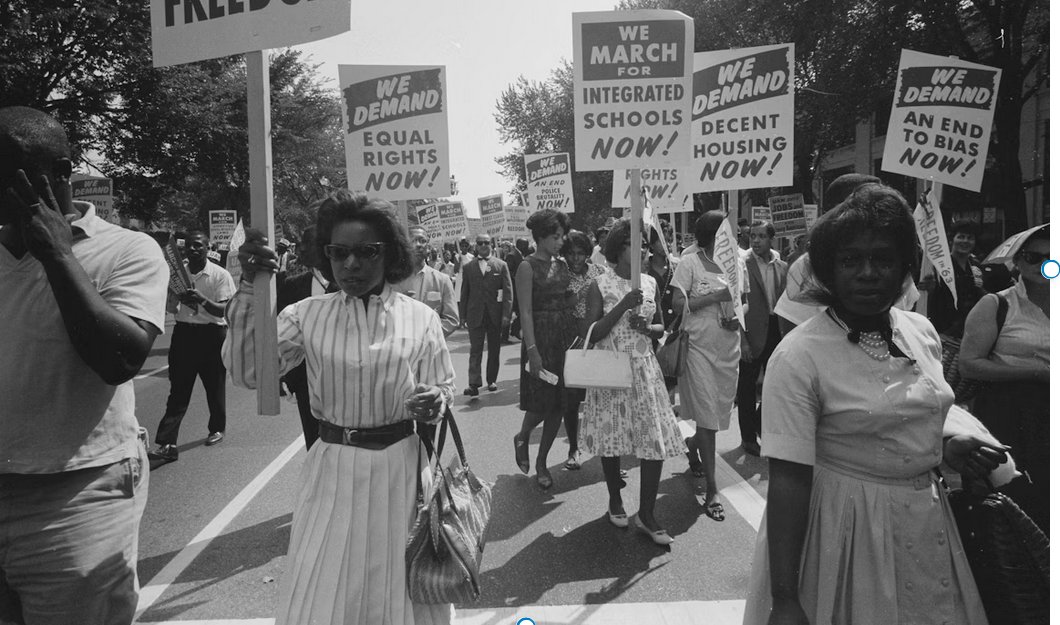
Featured Image: Warren K. Leffler, “Civil rights March on Washington, D.C.,” 1963, Library of Congress.
 Clio and the Contemporary
Leave a comment