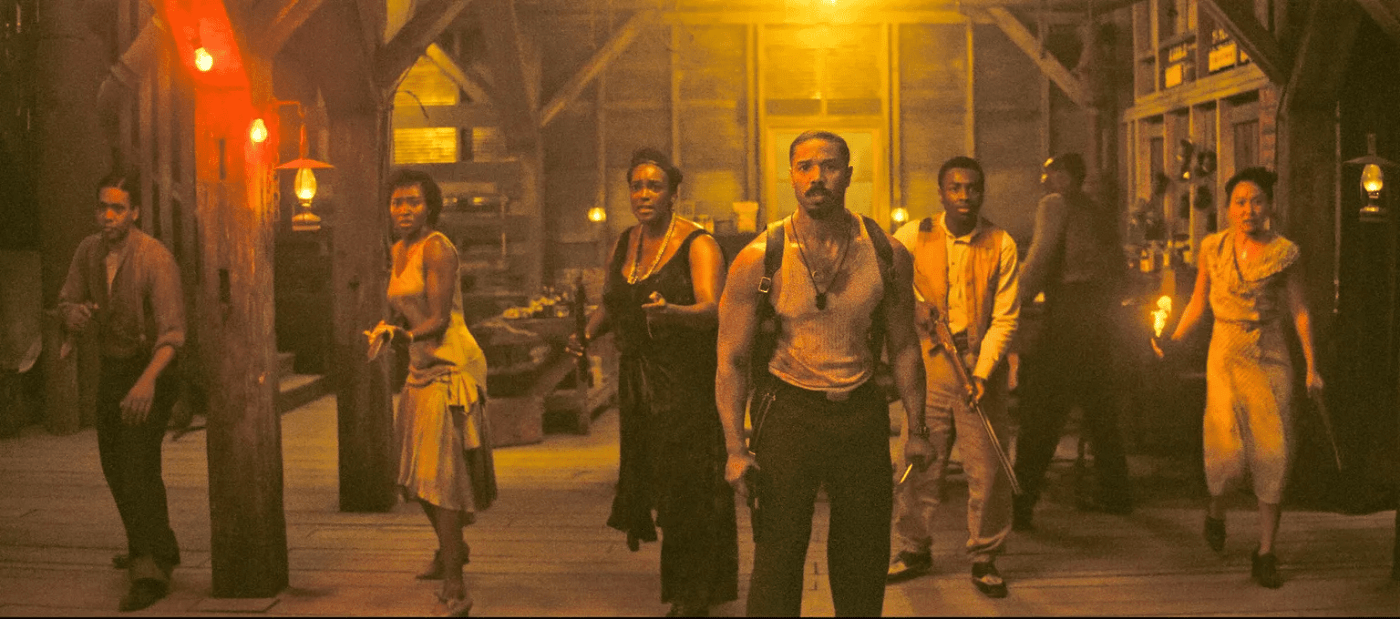
Ryan Coogler’s 2025 film Sinners is a genre defying work. The film is set in the heart of the Mississippi Delta in 1932, where Jim Crow apartheid is still the law of the land. It is at once a period piece and a vampire horror story. Coogler’s merging of historical periodization and fantastical horror grounds the film in the context of the US South while giving the film a transcendent message about culture, identity, and violence. Indeed, if Coogler’s message gets blurred at times between the genres, the film does not fail to spark debate about the United States’ most defining contradictions of race, national belonging, and the double-binds of cultural assimilation.
This piece wades into those debates by analyzing the film’s varied visions of liberation, limitation, and authenticity. Ultimately, Sinners forces audiences to confront much larger themes in Black American history such as debates over conflicting visions of liberation and various interpretations of Black American religious experience.
White Visions of Black Futures
Sinners provides audiences with two distinct antagonists—Remmick and his vampire brood and the Ku Klux Klan—and, in doing so, engages in an ongoing conversation surrounding anti-Black racism. Remmick and his ever-growing, multicultural vampire brood claim to be focused on “fellowship and love.” Despite this claim, they are the film’s main antagonists as the besiege the main characters in their Juke Joint refuge. Bookending the film are the KKK, members of which sold Smoke and Stack–twins portrayed seamlessly by Michael B Jordan—the warehouse that would become the Juke Joint. The Klan members are engaged in a charade to sell the space to Black investors only to arrive the next day and murder them. In setting up these two seemingly oppositional forces, Coogler provides an important intervention into two competing white visions of Black America—assimilation or annihilation.
The debate surrounding the dangers of these competing white ideologies was best articulated by the Rev. Dr. Martin Luther King Jr. in his “Letter from a Birmingham Jail.” While incarcerated in Birmingham for protesting segregation, Rev. King wrote of his disappointment with the lack of real actionable support he received from white moderates. This led Rev. King to conclude that “the Negro’s great stumbling block in the stride toward freedom is not the White Citizens Councillor or the Ku Klux Klanner but the white moderate who is more devoted to order than to justice.” In King’s estimation, the white moderate was more of a threat to Black liberation due to their claims of support that were never backed by action. Rather, white moderates continually questioned the tactics used by activists and erected obstacles to liberation by arguing that they could agree with “the goal” the Black community sought but not its “methods of direct action.”
Halfway through the film, Remmick appears at the entrance of Smoke and Stack’s Juke Joint claiming to be a moderating force. He and his vampire brood state that they are not there to do damage, but to engage in fellowship, believing that race and racism are foreign and beyond their understanding. However, the fellowship that this brood offers is a form of all-encompassing assimilation. Everyone Remmick turns, regardless of their prior culture, become an extension of Remmick’s own old-Irish cultural expression.
This nod to a prior subsumption of Irish culture pairs with Annie’s (Wunmi Mosaku) narration at the opening of the film. She mentions three general cultural traditions–Native America, the Irish, and West Africa–who have gifted musicians, or “firekeepers,” that have brought healing through their music as they bridged life and death by transcending time and space. This power, Annie warned, also attracted a vague “evil.” The horror of the evil vampire horde represents the horror of social death via assimilation. By choosing to foreground the assimilation of Irish Americans, Coogler points to the historical fact that whiteness has a history. Those who were once outside the bounds of whiteness, in this case the Irish, even with their traditionally pale white skin, became assimilated over time. A key prerequisite to this assimilation into American whiteness required Irish immigrants to adopt anti-Blackness as a core ideology. Further, this process of assimilation into American whiteness involved a loss of authentic Irish ethnic identity, and that is the horror of assimilation to whiteness for all who encounter it. Coogler’s social realism positions assimilation into American society–into whiteness–as the loss of one’s real social and cultural authenticity.
This assimilation is best exemplified by the Irish folk song scene. In this scene, Remmick and his multi-cultural brood sing “The Rocky Road to Dublin.” As Remmick sings, the vampires dance in traditional Irish ways with the song. This group, some of whom had just minutes earlier been dancing to the Blues and other forms of Black musical expression in the Juke Joint, are now stripped of that cultural expression and have had it replaced only by the expression that Remmick has deemed proper. There is a sense that the authenticity of all cultural expression has died along with them–Irish music has lost its connection to the historical context of the living people who created it. Despite his stated belief in fellowship and being older than certain frameworks of racism, Remmick the vampire now represents a white vision of assimilation where the multicultural clients of the Juke Joint lose their own identity and become an extension of him as an un-dead, bloodless yet bloodthirsty, vampire hivemind.
Conversely, the Ku Klux Klan are largely an afterthought in the events of the film, yet the danger they represent lurks in the background. When the KKK returns at the end of the film to kill whoever is left at the junk joint, all it takes to deal with them is a tommy submachine gun as Smoke’s satisfying vendetta in the concluding moments of the film show. While the vampires require planning and struggle to defeat, the KKK’s threat only requires a straightforward attack to repel their goal of annihilation
The message of these two threats is clear. The vampire brood comes with smiles, promises, and supernatural strength designed to mask their intentions to suck the blood of the free Black people of the Juke Joint and rob them of their life and their authenticity. While one might assume that the KKK would be the overt threat to Black existence, representing annihilation, the vampire brood, promising fellowship and assimilation is the far greater threat to Black cultural authenticity.
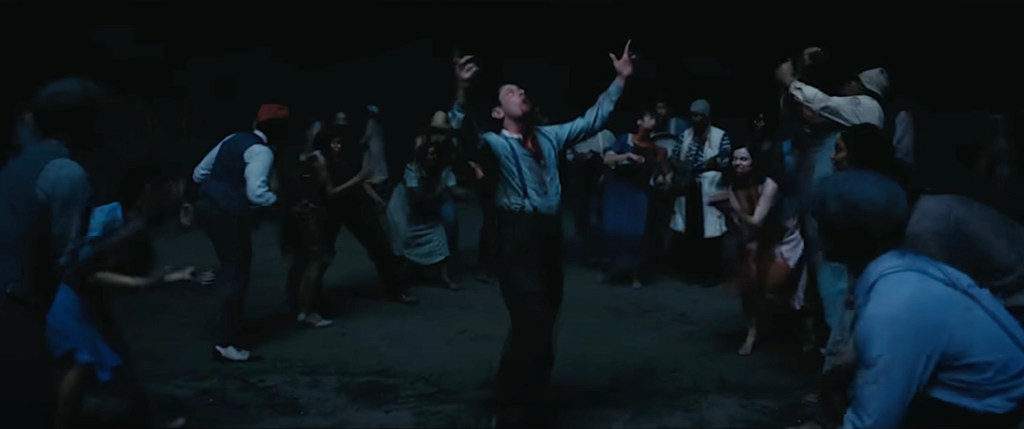
Irish-immigrant vampire Remmick leads his vampire brood in a rendition of “Rocky Road to Dublin.” (Photo Courtesy of Warner Bros. Pictures)
What Kind of Liberation?
Throughout Sinners, Ryan Coogler presents several, at times contradictory, visions of Black liberation. The first vision sees liberation through capitalism. When Smoke and Stack return to Mississippi their goal is to set up a Juke Joint and make money for themselves by providing a space of Black entertainment. We learn through conversations with figures from their past that Smoke and Stack grew up in abject poverty in Jim Crow Mississippi. They fled the South for Chicago where they inserted themselves into a dispute with rival immigrant gangs and stole liquor that they planned to resell for a profit at their new venture.
While Smoke and Stack are interested in bettering their condition through their Juke Joint venture, their plan sets up interesting questions surrounding capitalism and Black liberation. In attempting to make their Juke Joint a success Smoke and Stack recruit “Preacher Boy” (Miles Caton), their young cousin whose Pastor father disagrees with their methods, and Delta Slim (Delroy Lindo), an aging local musical legend who has fallen into alcoholism, plying him with more alcohol to have him be the main attraction at their venue. Even though their Juke Joint is filled on its opening night, the twins find that they are running a deficit and would soon be out of both money and alcohol as their customers are in the same precarious economic position that they previously fled.
While Smoke and Stack are certainly not the same as those who created the socioeconomic conditions in Jim Crow Mississippi represented in the film, they do find themselves resorting to similar cutthroat methods employed by capitalists to secure their own success. They marvel at Preacher Boy’s musical talent, not because of his ability to play the blues and express a uniquely Southern Black experience, but because he could potentially make them money. Likewise, the twins recruit Delta Slim by appealing mostly to his alcoholism, once again, in an effort to make money. Their financial plan also exploits the same groups of people that they had grown up around; offering them a space to express themselves, be in community and drink, so long as it enriched the twins. Despite the fact that their tactics brought them into direct conflict with Remmick and his desires, the focus of the twins on a capitalist vision of ascension leaves one to question just who the true vampires in the film are.
Cultural authenticity is also key to Coogler’s idea of liberation. This is best represented through Annie’s character and her distinctly Black cultural knowledge. Annie is first introduced in the film as the local healer of the Black community, well versed in the use of herbs and magic. Figures such as Annie have a long history in the African Diaspora. Enslaved Africans brought this type of knowledge with them to the Americas where their expertise was always viewed as a direct threat to empire by providing an alternative to top-down hegemony. These African spiritual beliefs were adapted to their new surroundings in the Western Hemisphere, perhaps best represented in enslaved people’s cultural adaptation of the cymbee—water based spirits—from the Kongo to low country South Carolina. These healers—at times known as medicine men or women—continued to be important and trusted figures in Black communities after emancipation. We see the importance of this status with Annie. For example, Annie is the first person in the Juke Joint to identify the vampires, and when she proclaims to those gathered in the establishment that they are dealing with vampires is not questioned (as it would be in most other horror films). Rather she is immediately believed, not just because of what the others had already seen, but because of her position within the community and a belief that she would know.
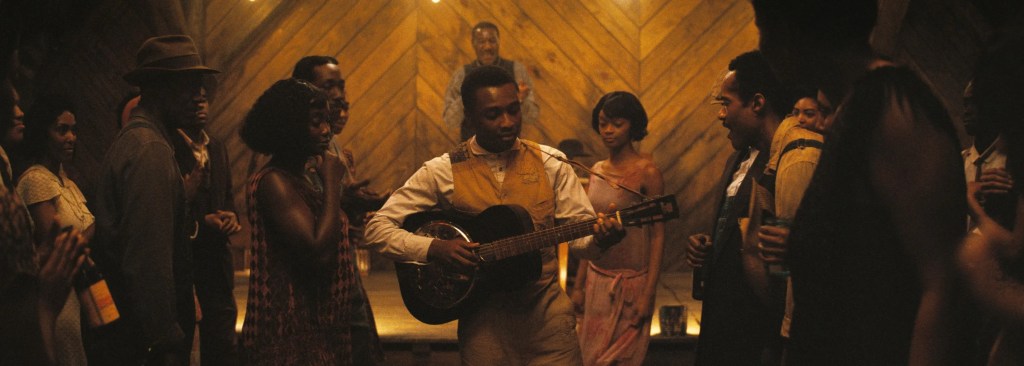
Sammie “Preacher Boy” Moore (Miles Caton) performs “I Lied to You” in the Juke Joint. (Photo courtesy of Warner Bros. Pictures)
Blues as Gospel
Sinners most transcendent scene takes place during Preacher Boy’s Juke Joint performance of “I Lied to You.” As Preacher Boy plays, artists representing rock, hip-hop, African tribal, gospel and xiqu transcend space and time to co-inhabit the Juke Joint. While these musical forms are distinct both in terms of style and the period from which they originate, Coogler seems to be hinting at the shared origins of these musical expressions. More than just the shared expression represented by these musical forms, Coogler points us towards a thesis that flips importance and understanding of Black music and spiritual representation.
Born of the struggles of Southern Black folk in the 1860s, the Blues was, for Black people of the time, “essential for transcending what seems to be the nation’s limitations.”[1] The Jim Crow South presented these limitations in legion. From where one could live to how one could make a living, from how one was to address white people (if at all) to access to accommodations and rights, the Jim Crow South was an ample muse for blues musicians. Likewise, Gospel music offered hope to Black people during and after enslavement. Tied to the early articulations of liberation theology—a reading of the bible that believes that God is on the side of the oppressed—gospel music, in a Black Christian church setting, offered hope to Southern Black folk. Songs such as “There is a Balm in Gilead,” and “Precious Lord, Take My Hand,” maintained that while times were tough, God would make a way.
Historians of Black religion in the United States have long wrestled with the complicated role of Black Protestant churches. On the one hand, scholars have established that Black Protestant churches were a critical part of African American life and organizing before and after emancipation. Before emancipation, the creation of autonomous Black churches in the northern states–especially the African Methodist Episcopal church and the African Methodist Episcopal Zion church–were powerful symbols of Black presence, strength, and religious authority in American society in addition to their more practical roles as central spaces of institution building. Among enslaved Black Americans before the Civil War, Christianity functioned as an “invisible institution,” providing an autonomous religious framework for resistance, identity formation, and even, at times, open rebellion. On the other hand, scholars have pointed to the spectrum of politics within Black churches of the Reconstruction period. They were critical organizations in missions of uplift and the movement to create civil institutions interested in claiming state resources and protections for Black Americans. However, their political postures evolved over time, often defying reductive dichotomies, e.g. accommodationist–progressive or conservative–revolutionary. Though autonomous Black churches remained focused on supporting the Black community, at times they were more conservative and withdrawn from formal politics. At other times they were prophetic in their critique of U.S. society. And, at other times, they became highly organized around missions for formal political progress.[2]
While the characters in Sinners seem to believe in a dichotomy between the Juke Joint and the Protestant church, Coogler posits that these two spaces are not so dissimilar. This is perhaps best exemplified by Preacher Boy. His name alone signifies the cross-pollination of the church and the blues. Turning his back on his Reverend father, it is Preacher Boy’s song that attracts Remmick and his brood to the Juke Joint in the first place showing that his father’s warning that if he kept “dancing with the devil… one day he’s gonna follow you home” was true. At the same time, when Remmick has Preacher Boy cornered and is about to kill and assimilate him into his followers, Preacher Boy begins to recite the “Lord’s Prayer” and is shocked to hear Remmick begin to recite it with him. Ultimately it is not religion, but a representation of the blues—Preacher Boy’s guitar—that saves him as Smoke embeds it in Remmick’s head as the sun comes up, turning the brood to dust.
Through Coogler’s story we can see a clear critique of Christianity, though not religion or spirituality itself. In Coogler’s representation, the Black church and the Black minister (as represented through Preacher Boy’s father), two powerful figures throughout African American historiography, view the Juke Joint and its clientele as lost in sin. Throughout the film, Coogler subtly and overtly critiques the Black Christian church as a legacy of colonialism—best represented by Delta Slim’s statement that the “Blues wasn’t forced on us like that religion. Nah, son, we brought that with us from home. It’s magic what we do. It’s sacred… and big”— as if to say that the Juke Joint is the “real” church of Black America.
The Blues then represents the real unadulterated gospel. In this reading the Blues does not act as gospel, but rather is gospel, while the Juke Joint itself represents the “real” church for those trapped in the Jim Crow South. Upon returning to his father’s church the next day, Preacher Boy must decide which religious path he will take: that of the Black church, or of the Blues. Deciding to not let go of the guitar that saved his life, Preacher Boy once again turns his back on his father and the Black church and drives away from Mississippi with his guitar sitting shotgun. Preacher Boy chooses the “real church”—which has proven its power to him—versus the one forced on both him and his people.
Throughout the film, Coogler gives the audience no definitive answer as to who the titular “sinners” of the film are. Those in the Juke Joint, Smoke and Stack, Remmick and his brood, and the KKK are all strong contenders for this title. However, Coogler seems to suggest that the real “sinners”’ of the film are all who remain outside the Juke Joint and its authentic religious belonging, asking to come—and seeking to force their way—in. As each of these groups cast their gaze upon the Juke—from the Black Christian minister to the KKK terrorists to supernatural vampires of the night—it is as if the audience, too, is a part of this critique as they gaze upon the Juke Joint through the screen. The film reverses their gaze by centering the Juke Joint and its religious truth as if to say, we the audience, are possibly sinners as well.
Ultimately, Sinners gives viewers much to ponder long after its credits have rolled, which is the true hallmark of good art. Beyond being a simply sensational film, Sinners allows anyone who engages with it to dive deep into the themes and historical debates present at the time—and currently—within the Black community and those that frame a larger understanding of the United States.
[1] Douglas Henry Daniels, “The Significance of Blues for American History,” The Journal of Negro History 70, no. 1/2 (1985): 14.
[2] See Barbara Savage, Your Spirits Walk Beside Us: The Politics of Black Religion, 2008; Nicole Myers Turner, Soul Liberty: The Evolution of Black Religious Politics in Post Emancipation Virginia, 2020.
This piece was co-authored by Omari Averette-Phillips and Taylor Black.
Featured Photo: Courtesy of Warner Bros. Pictures
 Clio and the Contemporary
Leave a comment