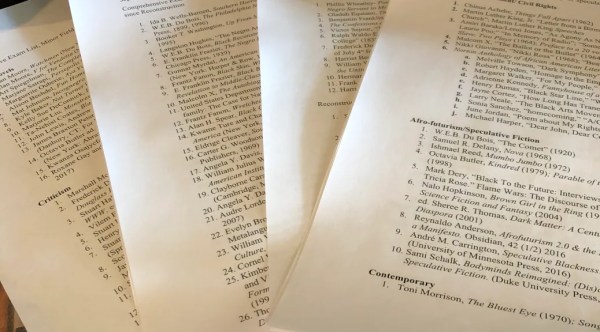
While most graduate students focus on the labor of reading for comps, compiling the reading lists themselves takes time and reflection. Be strategic and minimize your workload, but also be aspirational by considering the themes you want your future dissertation to explore.
Written & Oral Comps
The written and oral portions of your comprehensive exams may seem daunting, but try to remember that when you get to this step you are ready.
From the Comprehensive Exam to the Prospectus Defense: Using Comps as a Roadmap for the Prospectus
When you’re getting ready to draft your dissertation prospectus, your comprehensive exams can be a helpful tool. Here’s some advice on how to use your comps for a great prospectus.
Reading, Remembering, and Reorienting for Comprehensive Exams
Comprehensive exams are less about recalling every detail of every book than about building a durable system of arguments, interventions, and stakes. Read with precision, take structured notes, test your memory, and lean on community—the process is as much formation as it is evaluation.
What are Comps?
Comprehensive Exams, or 'Comps,' can be confusing and intimidating for graduate students, but the first step to conquering Comps, and the fear they elicit, is to understand what they are, what they are designed to test, and how they work.
What to Think About When Thinking About Grad School: So, you want to do a PhD?
Embarking on a PhD in history can be incredibly rewarding, but before you apply, it's best to have a clear-eyed view of academia as a whole (including the various types of universities where you might study and work), the life (and limits) of being a PhD student, and the realities of the academic job market.
What to Think About When Thinking About Grad School: Questions to Guide Undergrads Contemplating a Master’s or PhD
Considering an MA or PhD in history? This guide helps students figure out what about grad school appeals to them, what degrees they actually need to do the things they love, and whether they're in the right place to start grad school now.
Digital Tools for the Humanities
Machines reconfigure work. And yet, historians or other humanistic researchers rarely think about the way that our digital workflows—the tools that we use to do our work—enable or disenable the kinds of questions we pursue and the evidence that we marshal to answer them.
Labor Organizing in Graduate School
From Starbucks employees to Chippendales dancers, everyone seems to be organizing. Amidst this new resurgence of organized labor, graduate student unions are organizing Masters and PhD students and helping to address long-standing issues at universities and in academia as a whole.
Finding Summer Employment in Graduate School
The academic year is packed with work, meetings, readings, and teaching, but the summers can feel empty and hard to navigate. Here is some advice on how to find the summer employment opportunity that best fits your needs.