For history education in college today, instructors must engage students with humanities research in meaningful ways. The traditional teaching format with lectures, readings, and essays has become less compelling to Gen Z students. They prefer to learn history more actively. Instead of comprehending history in the classroom, they learn knowledge through participation instead of being passive receivers. Concerned about engaging students with community-based research, I designed and deployed a beyond-the-classroom project in which undergraduate students learned to research the recent history of their neighbors during the COVID-19 pandemic. This piece outlines the procedure of the project, from recruiting students to engaging them in community-based research, and can be adapted to other topics and locations.
From Research to Pedagogy
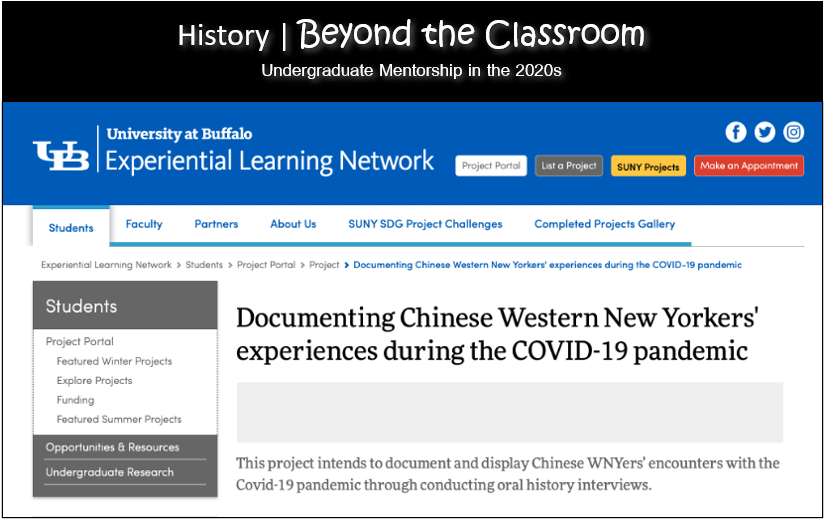
This project originated in my own oral history research., I documented the experiences of Chinese immigrants in Western New York during the pandemic. As a historian, Buffalonian resident, and victim of hate speech, I use my expertise in recording the difficulties Asian people encounter in the United States. During the implementation of this project, I noted its instructional use for college students. While the study of history can often seem remote from students’ everyday lives and distant from their neighborhoods, engagement with recent COVID-19 histories and local communities offered a fresh learning opportunity. With a focus on public history, I devised a research project that trained undergraduates to produce historical scholarship and disseminate academic knowledge about issues that impacted their lives and communities. In the summer of 2022, I posted the call for team members on the Project Portal of Experiential Learning Network at my home institution as follows. In a few weeks, I successfully recruited three college students to actively participate in my project.
Learning History and How to Do Oral History Interview
I assembled a team of students, including two Chinese international students who used their language proficiency to interview members of the Chinese immigrant community. I provided a set of training sessions. The first was a brief lecture about the historical context of the research project: the history of Chinese immigrants in the United States and the rise of pandemic-related anti-Asian sentiment. Then I provided the basic skills of oral history by assigning students to read and discuss guidelines on the Oral History Association’s website, such as “Remote Interviewing Resources” and “Best Practice.”
In addition to reading oral history skills on paper, students practiced their research skills by interviewed each other in mock interviews. They raised questions regarding each other’s experience during the COVID-19 pandemic, which are identical to the procedure they would take in real research.
After the training section, I bridged mentees and the Chinese immigrants who would like to be interviewed. Beginning with general questions, they shifted to specific questions regarding their experiences with the pandemic and their perception of racial relations during the national public health crisis. During the Zoom-based remote meeting, I supervised the interviewing procedure and facilitated the communication between mentees and interviewees.
The outcome of the beyond-the-classroom program
Besides two mentees as Chinese international students, the other one, L, has no Asian background. The language barriers prevented him from undertaking the interviews with those Chinese immigrants. However, he is also the only history major considering a career in public history. All three mentees learned how to process the recorded audio using Audacity. Through reading and discussing the software’s manual, they learned to adjust the volume, reduce the background noise, and make the interview material clear. The skills students acquire in this mentorship program can be applied in their future careers as oral or public historians.
While these students are all novices in making oral history, I received positive feedback from them. Besides learning and practicing the procedure of conducting oral history interviews, students also furthered their knowledge of it. Contrary to the prevalent perception of the Chinese immigrants’ traumatic experience with the pandemic, they learned about the Chinese Buffalonians’ exceptional experience. Besides being the victims of the pandemic, they succeeded in realigning with other members of the local community. For the non-Asian student L, his participation in the program furthers his knowledge of Chinese Buffalonians’ experience with the pandemic. While not directly talking with those Chinese immigrants, L also learned about their success in resilience against the public health crisis, which is still strange for non-Chinese audiences.
Making the Pedagogy of History Emplaced
In addition to training college students with research skills in oral history, this project aims to make the pedagogy of history beyond the classroom. Though some participants were not history majors, the acquisition of oral history skills translates to many disciplines and, more importantly, engages students in the contemporary history of the local community. As a community-based historian, I emphasize the pedagogy of emplacement in making higher education more engaged with society. For the college-level history coursework in the 2020s, it is urgent to attract students back to the classroom. Not different from their parents, Gen Z still like history but through playing video games and watching TikTok instead of reading books or taking courses. The emplaced history attempts to solve the problem alternatively: transcend the boundary between community and classroom.
 Clio and the Contemporary