Prof. Austin McCoy
West Virginia University
History Department
Course Description
Once marginal, hip-hop has moved to the center of mainstream popular culture. Now, hip hop culture can be found in high fashion, the tech and business world, commercials, movies and television shows. This course traces hip hop’s emergence and development in the United States and throughout the world from the 1970s to the present. We will investigate how artists drew from past Black cultural production as well as its origins in the African Diaspora to create a new culture.
With a strong emphasis on rap music, we will also consider how hip-hop culture arose out of Black and Latinx responses to economic crisis, urban decline, and political repression before the music industry eventually turned artists into laborers and music into a commodity. We will also consider the intersections between hip-hop, local and regional cultures, other genres of music and cultural production, technology, politics, and business. Lastly, and most importantly, this class delves into the internal politics of those who participated in culture, especially regarding issues of gender and sexism, homo- and transphobia, and violence.
Our goal is to understand the past better. In the last few years, we have heard and seen more gestures to history in the news, in politics, including presidential campaigns, and in culture. And since history comes in many forms, we may examine history in music, film, visual art, maps, and comics, in addition to books and articles. There is no better time to understand the ways in which history manifests itself culturally.
Course Learning Outcomes
- Introduce students to hip-hop culture as a field of study in history.
— Analyze how hip-hop culture changed over time.
— Analyzing connections between hip-hop and various histories - Introduce students to various forms of writing and evaluation of culture.
— Constructing arguments and critiques will be important—Argument and debate is a crucial aspect of hip hop, whether in song, in person, or in print. We will learn the parameters of various debates within the culture and the criticism arising out of the genre.
— We will consult various types of primary and secondary sources—works in history, album reviews, artist profiles, lyrics, music videos. - Learn to interpret the past by analyzing an array of primary and secondary sources.
- Present ideas and arguments about modern U.S. history in discussion and written format.
- Use historical knowledge to discuss contemporary events in U.S. politics and culture.
Our Learning Environment
This class contains explicit and graphic content. One cannot always separate disturbing content from the historical context or the topic of discussion. Consequently, it is important that we engage in respectful conversation, and are generous with each other, especially considering how some of the content could be triggering.
We will explore complex and politically polarizing concepts. Conversations about race, gender, class, and sexuality can be difficult. Consequently, our classroom serves as a safe space for us to talk, explore, and most importantly, learn. We will learn how to articulate well-reasoned arguments in class and in writing. Disagreements are okay. However, your comments should refer to the materials, not another person. In discussion, you will be expected to support your arguments in writing and conversation with quotes and textual references. Disrespectful behavior will not be tolerated.
Again, it is important to be generous and patient with one another since we all come from various backgrounds and experiences. Some of us will be new to many of the class topics, material, analyses, and language, while some of us may study or work on these issues outside of the class. No one will be penalized for making mistakes or disagreeing, but it is important to take the class seriously and not approach the material, nor engage each other, carelessly.
Regarding Language
To maintain a respectful environment, and to prevent any misunderstandings, we all will refrain from saying and writing epithets as well as sexist, transphobic, and homophobic terms that may appear in rap music. When necessary, saying “n-word” will do. This does not mean we will refrain from talking about the meaning of these terms in the context of hip-hop and popular culture. However, these terms, as well as their usage, are very complicated and the goal for us is to understand the complexities of language.
Instructional Materials
Jeff Chang’s Can’t Stop Won’t Stop: A History of the Hip Hop Generation – is available at the Campus Bookstore.
Albums
Kendrick Lamar, Good Kid, M.A.A.D. City (2012)
De La Soul, 3 Feet High & Rising (1989)
Missy Elliot, Supa Dupa Fly (1997)
Spotify Playlists
- Hip Hop History, 1973-1987
- Golden Era of Rap, 1988-1992
- Golden Era of Rap 2, 1993-1998
- End of Rap’s Golden Era, 1999-2004
- Rapping Women in the ‘80s and ‘90s
Regarding Music
You should be able to find the albums on Spotify and other streaming services. I will supply YouTube links to songs that do not appear on the playlist (and are not on Spotify). You should do all the reading/listening for the class prior to meeting. Documentaries and video clips will be shown in class.
General Course Requirements
- Complete all reading by the date it is listed in the syllabus. This is the baseline activity for the course, so be sure to budget your time accordingly.
- Participate in class discussions/activities in a manner that enhances learning for yourself and classmates.
- Complete all work by the date listed in the syllabus.
Assignments
*All papers are to be formatted as follows: 12-pt. Times New Roman, double-spaced, with 1-inch margins. All papers must be submitted as a .doc or docx file. Please do not submit any pdfs. I will contact you and ask that you resubmit your paper if fail to submit a .doc or .docx file. Please inform me if you have issues with your submissions.
All assignments are due by 11:59pm on the due date.
Album Response Papers
You will complete three 2-page double-spaced papers responding to the assigned albums. These will serve as a basis for in-class discussion. In these papers, you will identify and explain some of the major themes of the albums and class discussions. I suggest you listen to the albums before seeking out any reviews, so they do not influence your first encounter. You will want to think about why the album is important, what are the artists contributing to rap music, what the most important songs are, and what were the singles/videos for the album?
Autobiography (2 pages, minimum)
As lovers, fans, and students of music and art, certain artists, songs, and albums often help define moments in our lives, help shape understandings of our experiences, and help us understand the world around us. Music also may evoke memories—of a loved one, or a group of people, and a particular moment. You will write a short autobiographical essay explaining how you first encountered hip-hop culture and rap music. You should use these questions (at least) to tell your story: When did you first encounter hip-hop culture and rap music? What were your thoughts? What are some of your favorite artists, songs, and albums? What kind of memories do certain songs and albums evoke?
You will also need to put your autobiography into historical context—were there any significant larger events transpiring at any particular moment (i.e. Jay-Z’s The Blueprint was released on September 11, 2001) as you encountered hip hop culture and listened to rap?
The purpose of this assignment is for you to learn how to not only assess music but to use your experience as a vehicle for interpreting cultural artifacts and placing them into historical context. (You are allowed to pursue this assignment creatively and to write as much as you need.)
Song Analysis (1–2 Pages)
Everyone will choose a song released before 2001 and analyze its lyrical content. I will supply a list. You will want to interpret the meanings of the lyrics and the songs. What is the purpose of the song? Is the artist trying to tell a story or address a particular topic? Why is this song significant?
It is okay to do a little research about the song—what album does it appear on? Was it just a single? You may even consult Genius.com, but your interpretation must go beyond their annotations. In other words, you cannot merely copy their annotations into your analysis. What would be great is if you discovered errors in (or arguments against) their interpretations! You must choose a song that is not assigned in class to write about.
“Historical” Album Review (4 pages)
Everyone will choose an album released before 2001 and write a review essay. The reason for choosing an album before 2001 is to encourage you to not only listen to an album you might not have encountered before but to also place the album in a historical context. Like standard album reviews, you will evaluate the strengths and weaknesses of the album. However, you will also consider the following:
- What do other critics say about this album and how do they rate it?
- Try to find interviews of the artists and discuss their thoughts on the album.
- Read the liner notes: What other songs did producers and artists sample?
- Context: How does this album compare to the rest of the artist’s/group’s catalog?
- What year did this album come out? Did it have any impact on the genre and culture? Did it influence other artists?
- Does the album speak to any particular issues of the time?
Final Project + Paper
Students will apply the knowledge and insights gained from readings and class discussions to develop a project related to the contents of the course. In the second half of the semester, you will choose a partner and create a class project focusing on any of the subjects we cover in the course. Your project can take several forms—website, PowerPoint presentation, annotated bibliography, media/cultural project (i.e. a zine, comic book, short documentary, podcast), social media project (Twitter timeline, IG photo/image account, etc.). However, you will be required to complete a proposal and short bibliography, your actual project, a 5–7-minute presentation to the class on the last day of the course, as well as a final paper explaining your project, its significance, and how it relates to the themes of the course.
Components of Final Project:
- Proposal + Working Bibliography (2-pages, double-spaced)
- Project
- Can take any form (See above.)
- Presentation (7 minutes)
Final Paper (5 double-spaced pages, minimum)
- Should include an introduction outlining the project in your own words. Then you will discuss the project’s significance and how it relates to the themes of the course. Finally, you will reflect on your contribution to producing the project, how you used class materials to shape your projects, what you would like for readers/viewers to take away from your project, and what you have learned.
Late Assignment and Missed Exam Policy
If something arises that causes you to turn in an assignment late or miss an exam, please let me know as soon as possible. If you are going to miss an exam due to university-related business, please let me know at the beginning of the semester so we can work to schedule a time to make up the test.
Class Schedule
Week 1: Introduction
Aug. 17 (TH) – Introductions and What is Hip Hop Culture? Why Study it?
Week 2: Hip-Hop at 50 + Hip-Hop Historiography
Aug. 22 (T) – A Master Narrative of Hip-Hop?
- “Resisting Erasure: The Ms. Q&A With Dee Barnes, Hip-Hop Legend,” Ms. Magazine (2023)
Aug. 24 (TH) – Historical Roots (AUTOBIOGRAPHY DUE)
- Vann R. Newkirk, II, “King’s Death Gave Birth to Hip Hop,” The Atlantic (2018).
- Fernando Orejuela, “Rap’s African and African American Cultural Roots,” in Rap and Hip-Hop Culture
- John H. McWhorter, “How Hip-Hop Holds Blacks Back,” City Journal (Summer 2003)
Listen:
- Jubilarians, “Noah” (1940s) (YouTube)
- Pigmeat Markham, “Here Comes the Judge” (1968)
- Gil Scott Heron, “The Revolution Won’t Be Televised”
- The Last Poets, “When the Revolution Comes”
Week 3: Analyzing Songs: Autobiography, Narrative, Authenticity
Aug. 29 (T) – Autobiography, Narrative, Authenticity
- Jay-Z, “Honor Amongst Predators,” from Decoded (2010)
Listen:
- Biz Markie, “Vapors”
- Jay-Z, “Coming of Age”
- Lil’ Kim, “The Way I Am”
- Lauryn Hill, “The Miseducation of Lauryn Hill”
Aug. 31 (TH) – Analyzing Songs
- Bradley, “Storytelling,” in Book of Rhymes: The Poetics of Hip Hop
- Orejuela, “Listening Guide: Ice-T, ‘Rhyme Pays’” and “Listening Guide: “Lauryn Hill, ‘Doo Wop’ (That Thing)”
Listen:
- Ice-T, “Rhyme Pays”
- Lauryn Hill, “Doo Wop (That Thing)”
Week 4: Hip Hop’s Origins I: Political History & Migration
Sept. 5 (T) – Migration
- Chang, Introduction & Chapter 2
- Timothy Bella, “She threw a party to buy school clothes. Hip-hop was born that night.,” Washington Post (2023)
- Watch: ReMastered: Who Shot the Sheriff (Netflix documentary about Bob Marley)
Sept. 7 (TH) – The Album Review (SONG ANALYSIS DUE)
- “The Album Review,” from How to Write About Music (pgs. 18-23)
Week 5: Hip Hop’s Origins II: Urban History, & Deejay Culture
Sept. 12 (T) – Urban History
- Chang, Chapter 1
- Felicia A. Viator, “West Coast Originals: A Case for Reassessing the “Bronx West” Story of Black Youth Culture in 1980s Los Angeles,” American Studies, 2019 Jan 01. 58(3), 87-105.
Sept. 14 (TH) – Album Analysis #1 – Kendrick Lamar’s GOOD Kid, M.A.A.D. City (RESPONSE #1 DUE)
Listen:
- Kendrick Lamar, GOOD Kid, M.A.A.D. City
Week 6: Women in Hip Hop Culture + the Commodification of Rap Music
Sept. 19 (T) – Women Pioneers of Hip-Hop
- Cristina Veran, “First Ladies,” in Vibe Hip Hop Divas
Listen:
- The Mercedes Ladies Live at the T Connection (1979)
- Paulette and Tanya Winley – “Rhymin’ and Rappin’” (1979)
Sept. 21 (TH) – Sylvia Robinson, Sugar Hill Records, and the Commodification of Rap
- Chang, Chapter 7
- Orejula, “The Second Wave: ‘Rapper’s Delight Changes Everything,” 67-72
Listen:
- Sugar Hill Gang – “Apache”
- The Sequence – “Funk You Up”
- The Sequence & Spoonie Gee – “Monster Jam”
Week 7: The “First” Golden Era: Crack, War on Drugs, and the Reagan Era
Sept. 26 (T) – Hip Hop in the Reagan Era
- Chang, Chapter 9
Listen:
- Funky 4 + 1 – “That’s the Joint”
- Afrika Bambaataa – “Looking for the Perfect Beat”
- Kurtis Blow – “The Breaks”
- Grandmaster Flash and the Furious Five – “The Message”
- Run DMC – “Sucka M.C.’s”
Sept. 28 (TH) – Crack, the War on Drugs, and the Emergence of Gangsta Rap (HISTORICAL ALBUM REVIEW DUE)
Listen:
- Schoolly D, “PSK, What does it mean?”
- Ice T – “6 in the Morning”
- NWA – “Straight Outta Compton”
- Notorious BIG – “Ten Crack Commandments”
Week 8: Graffiti Wars/Style Wars
Oct. 3 (T) – Graffiti Wars
- Ari Goldman, “City is Losing Another Battle in Graffiti War,” New York Times (1983)
- Erik Nielson, “’It Could Have Been Me’: The 1983 Death of a NYC Graffiti Artist,” NPR Code Switch (2013)
- Lu Olivero, “Graffiti is a Public Good, Even as it Challenges the Law,” New York Times (2014)
- Heather Mac Donald, “Graffiti is Always Vandalism,” New York Times (2014)
Oct. 5 (TH) – NO CLASS
Week 9: Rap’s Consciousness: Nationalism, Afrocentricity, and Feminism
Oct. 10 (T) – Nationalism, Afrocentricity, and the Native Tongues
Listen:
- Public Enemy, “Fight the Power”
- Queen Latifah & Monie Love, “Ladies First”
- Jungle Brothers, “Black is Black”
- Stop the Violence Movement, “Self-Destruction”
Oct. 12 (TH) – The Politics of Sampling (RESPONSE #2 DUE)
- Peter Watrous, “Rap’s Trip to a New and Surreal Territory,” New York Times, March 2, 1990
Listen:
- De La Soul, 3 Feet High & Rising
Music Videos:
- “Potholes in My Lawn”
- “Say No Go”
- “Me, Myself, and I”
- “Eye Know Remix”
- “Buddy Remix”
Week 10: Moral Panics and G-Funk
Oct. 17 (T) – Moral Panics
Listen:
- 2 Live Crew, “Banned in the USA”
Oct. 19 (TH) – G-Funk (PROPOSALS DUE)
- Chang, Chapter 15
- Donovan X. Ramsey, “How Dr. Dre and Hip Hop Helped End the Crack Era,” GQ.com (2023)
Listen:
- Ice Cube – “Bop Gun”
- Dr. Dre & Snoop Dogg – “Deep Cover”
- Dr. Dre – “Nuthin’ But a G Thang”
- Warren G & Nate Dogg – “Regulate”
- Lady of Rage – “Afro Puffs”
Week 11: Rap in the 1990s, Part I
Oct. 24 (T) – East v. West: What’s Beef?
- “The Real Story Behind ‘Vibe’s’ East vs. West Cover,” Complex (2016)
- East/West Primary Source Documents
Listen:
- Notorious B.I.G. – “Who Shot Ya?”
- Tupac – “Hit ‘Em Up” & “Against All Odds”
- Mack 10, Ice Cube, and WC – “Westside Slaughterhouse”
- Common – “The B in Yoo”
- Tha Dogg Pound – “NY, NY”
- Capone N Noreaga, Mobb Deep, and Tragedy Khadafi – “LA, LA”
Oct. 26 (TH) – The Underground + The White Rapper
- “The Rise and Fall of Rawkus Records”
- Orejula, “What is Underground Hip Hop?,” 174
- Orejula, “White Rappers in the 1990s,” 169-171.
Listen:
- De La Soul, “Stakes is High”
- The Roots, “What they do” (video)
- Company Flow – “8 Steps to Perfection”
- Black Star – “Definition”
- Eminem – “My Name is…”
Week 12: Rap in the 1990s, Part II: The Resurgence of Women Rappers
Oct. 31 (T) – The Resurgence of Women Rappers
- Tricia Rose, “Bad Sistas: Black Women Rappers and Black Sexual Politics in Rap Music,” in Black Noise: Rap Music and Black Culture in Contemporary America
- Orejula, “Lauryn Hill,” 151-153
Listen:
- Lauryn Hill, “Doo Wop (That Thing)”
- Lil’ Kim – “Crush on You” (video)
- Missy Elliot – “The Rain (Supa Dupa Fly)”
Nov. 2 (TH) – Album #3 – Missy Elliot, Supa Dupa Fly (RESPONSE #3 DUE)
Listen:
- Missy Elliot, Supa Dupa Fly (Album)
- Missy Elliot, “We Run This” (Music Video)
Week 13: The Dirty South + The Bay
Nov. 7 (T) – “The South Has Something To Say”
- “Southern Hip-Hop Feminists Got Something to Say: The Ms. Q&A on Hip-Hop’s Reverse Migration,” Ms. Magazine (2023).
Listen:
- Outkast, “Synthesizer”; “B.O.B”; “Hey Ya”
- Scarface & Tupac – “Smile” (Video)
- Master P – “Ghetto D”
- Juvenile – “Ha”
- Trina – “Da Baddest…”
Nov. 9 (TH) – “Tell Me When to Go”: Hip Hop in The Bay
- Jonathan Abrams, “Out Hustling: The Bay Area,” in The Come Up: An Oral History of the Rise of Hip Hop
Listen
- Paris, “The Devil Made Me Do It”
- Digital Underground, “Doowutchyalike”
- Conscious Daughters, “We Roll Deep”
- The Coup, “Me and Jesus the Pimp in a 79 Granada Last Night”
- E-40, “Tell Me When to Go”
Week 14: Hip Hop Feminism + Gender/Sex Binary
Nov. 14 (T) – Hip Hop Feminism
- Aisha Durham, Brittney C. Cooper, and Susana M. Morris, “The Stage Hip-Hop Feminism Built: A New Directions Essay,” Journal of Women in Culture and Society (2013)
Listen:
- Queen Latifah – “U.N.I.T.Y”
- Salt N Pepa – “None of Your Business”
- Angie Martinez, Lil’ Kim, Left Eye, Da Brat, and Missy Elliott – “Ladies Night”
- Beyoncé and Nicki Minaj, “Flawless Remix”
- Rapsody, “Nina”
- Cardi B – “Money” (video)
Nov. 16 (TH) – Breaking the Gender/Sex Binary in Rap
- Jonathan Dee, “Sissy Bounce: New Orleans Gender Bending Rap,” New York Times, July 22, 2010
- Smalls, Shanté Paradigm Smalls, “Queer Hip Hop, Queer Dissonance” from Hip Hop Heresies: Queer Aesthetics in New York City (2022)
Listen:
- Young MA, “OOOOUUU”
- Lil’ Nas, “Montero”
- Big Freedia and Lizzo, “Karaoke”
Week 15: Rap Production & Globalization
Nov. 28 (T) – Rap Production
- Hilton Als, “Madlib’s Genealogy of Hip Hop,” The New Yorker (2016)
- Dan Charnas, “How J Dilla Reinvented Rhythm,” Rolling Stone (2022)
Nov. 30 (TH) – Hip Hop + Globalization
- “Vladimir Putin Says He’s Fearful of Rap Music, and That It Should Be Controlled,” Newsweek, December 15, 2018.
- Jeff Chang, “It’s a Hip Hop World,” Foreign Policy (2009)
- Sujatha Fernandes, “Made in Havana City,” in Close to the Edge: In Search of the Global Hip Hop Generation (2011)
Week 16: Hip Hop and Technology & Class Presentations
Dec. 5 (T) – “Art Official Intelligence”: Hip-Hop and Technology in the 21st Century
- Enongo Lumumba-Kasongo, “A(I) Rapper: Who Voices Hip-Hop’s Future,” Public Books (2022)
- Marc Tracy, “A ‘Virtual Rapper’ Was Fired. Questions About Art and Tech Remain,” New York Times (2023)
Listen:
- Beastie Boys, “Intergalactic”
- Kool Kieth, “I’m Seein’ Robots”
- Deltron 3030, “Virus”
Dec. 7 (TH) – Class Presentations
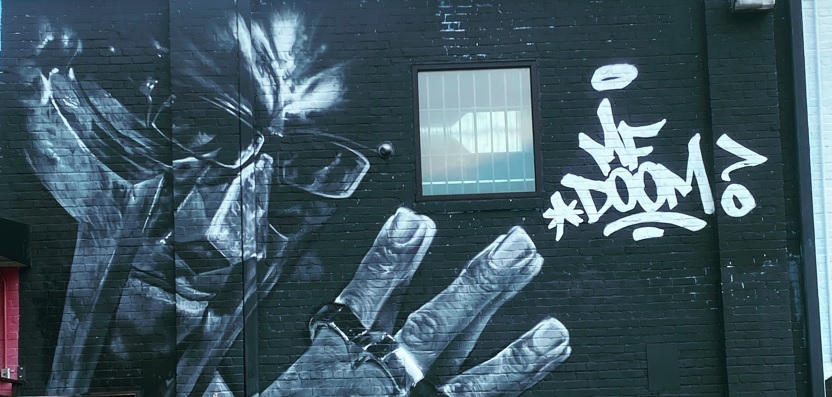
Featured image: DOOM mural in Atlanta, GA. Photo by author.
 Clio and the Contemporary
Leave a comment