
In 2020, many historical and cultural institutions shifted their community outreach and engagement in response to global health crises and long overdue (and ongoing) racial and social reckonings throughout the United States. These interconnected concerns were often aimed at history museums, long-seen as preservers of white supremacist versions of the past and unwilling to change their interpretations to meet contemporary demands. In my first installment for Clio and the Contemporary, Reinterpreting James Monroe’s Highland, I argued for historic house museums to embrace their complicated historical and institutional histories. Let us do away with simple, sanitized, and narrow historical interpretations. Among other things, like institutional transparency and community reconciliation, acknowledging a museum’s need for change enables its twenty-first century visitors to “feel comfortable with nuance and complexity”, to quote Lonnie G. Bunch III, Secretary of the Smithsonian Institution. Considering recent calls for change, museums can and should be centers for community (to paraphrase Secretary Bunch), organized around their common goals and interests—not the museum’s needs.

In Fall 2021, W&M students, faculty, and descendant community members gathered at Highland to discuss commemoration, shared authority, and reinterpretation. Photo by Jajuan Johnson, 2021.
At James Monroe’s Highland, we too engage with different communities of stakeholders. As a public site, we are open daily to visitors from all over the world. We engage with this community of visitors through self-paced exhibit experiences, guided history walks, English and Spanish language panels, and specialized programming. This community of visitors comes to us from their own ideological spheres, asking their own questions about how history is done. Working at a public history site reminds me that no community is monolithic or similar-minded. Even Highland’s more localized communities are composed of diverse needs, questions, and missions. What follows is a brief but not exhaustive discussion of Highland’s communities and how we work together towards related goals.
Highland Council of Descendant Advisors
Learn more about the Council here.
Video by Roy Petersen, Senior Educational Media Design & Production Specialist, William & Mary’s Studio for Teaching and Learning Innovation.
2016 was an important year for Highland. Not only were important research discoveries announced, but Highland staff connected with a community of individuals whose ancestors were enslaved at Highland by James Monroe and later owners of the property before and after Emancipation. The Council, as it is commonly referred to, is informed by the Rubric for Engaging Descendant Communities in the Interpretation of Slavery at Museums and Historic Sites—or, simply, the Rubric. For several years now, the Council has guided Highland on exhibit content and programming. The Council also conducts its own engagement with other descendant communities. Most importantly, the Council plans an annual Descendants Day event in June that brings people together around food, fellowship, and resource sharing. The most recent 2023 Descendants Day included a visit from descendants of enslaved families sold from Highland to Monticello, Florida in 1828—several members of the Highland Council had visited with this group in October 2022.
William & Mary’s Highland
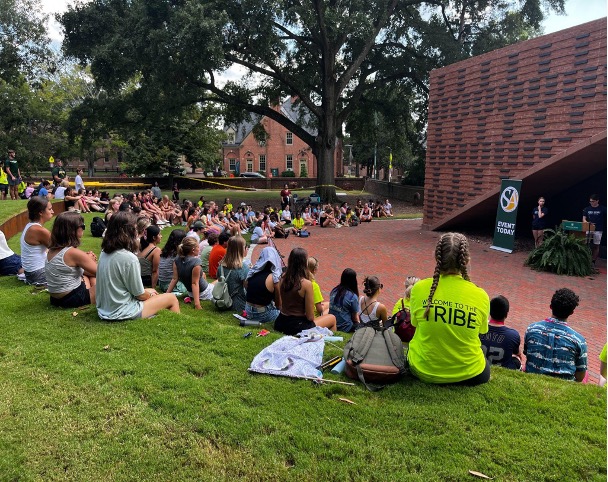
Incoming William & Mary students take their Community Values Pledge at W&M’s Hearth Memorial to Enslaved Laborers. Highland staff participated in this event and supported on-campus community initiatives. Photo by Maria DiBenigno, 2022.
Highland has been a part of William & Mary (W&M), a university located in Williamsburg, Virginia, since 1974. Although we are located almost one hundred and twenty miles west of the main campus, we engage with the campus community through a variety of initiatives and collaborations. Staying connected with the Williamsburg community allows Highland to respond to our campus stakeholders and share resources. Much of my own work as a Postdoctoral Research Fellow is made possible through the Sharing Authority to Remember and Re-Interpret the Past, a five-year, pan-university project funded by the Mellon Foundation. Here are just a few examples of our on-campus colleagues who engage and support Highland’s work:
- The Lemon Project: A Journey of Reconciliation: In 2009, W&M’s Lemon Project began to formally explore the university’s role as an enslaving institution and repair its relationship with local Black communities. My counterpart and co-instructor, Dr. Jajuan Johnson, an oral historian and genealogist, continues this work as the Lemon Project’s Mellon Postdoctoral Research Fellow.
- Institute for Integrative Conservation (IIC): The IIC is a recent W&M office with faculty and student research opportunities connected to transdisciplinary conservation efforts across campus. Highland has worked with undergraduate students on a variety of projects, including and cultural landscape studies. This work is co-facilitated by Highland’s Executive Director, Dr. Sara Bon-Harper, and faculty collaborators in Sociology, Anthropology, and Biology.
- National Institute of American History and Democracy (NIAHD): W&M’s NIAHD programs is an important place for university and high school students to explore public history and material culture. With an emphasis on experiential learning, NIAHD’s Pre-College Program visits Highland twice during the summer to discuss our research discoveries and explore the cultural landscape. I also share Highland’s work with NIAHD’s on-campus undergraduate and graduate students.
- Strategic Cultural Partnerships (SCP): Highland is one of William & Mary’s cultural institutions, and thus an integral unit within W&M’s SCP. We collaborate with the SCP staff on a variety of initiatives, from student engagement to media production, and work on the Sharing Authority Mellon grant.
- Geology Department: W&M Geology professor, Dr. Chuck Bailey, brings his students to Highland to utilize the site’s natural landscape and discuss deep geologic time. In this work, he and his students explore expansive ways to study and use the 525 acre site beyond the humanities. Dr. Bon-Harper collaborates frequently with these class visits.
- W&M Libraries and Special Collections Research Center: Highland utilizes library resources to conduct research, develop coursework, and host on-campus events. Our colleagues in Special Collections also provide support to us at Highland, including temporary exhibits.
Greater Charlottesville Area

During the first annual Descendants Day at Highland, communities came together and shared resources and research. Photo by Gene Runion, 2022.
In addition to Highland’s connections in Williamsburg, the site is also active and responsive to community initiatives and needs in central Virginia. We are in contact with our sister historic sites, and we also engage with other cultural and historical organizations as well as local schools. These are but a few of our community connections in the Piedmont region:
- Presidential Precinct: The Precinct’s mission is to “engage and inspire emerging leaders to address the most pressing challenges in their countries.” When the Precinct brings groups to Highland, we discuss issues of heritage, preservation, and engagement on a global scale. There is always something new to learn from our international partners.
- University of Virginia (UVA): Although Highland is a part of William & Mary, we work closely with UVA faculty, staff and students on class visits, research projects, and internships. Highland benefits from the expertise found at UVA, specifically concerning topics of university memory and institutional legacy.
- Descendants Day Participants: Highland’s annual Descendants Day event brings together communities from across the Commonwealth of Virginia. Groups come to enjoy the festivities and share their own research and resources, although Highland engages with many of these groups throughout the year. In 2024, we hope to involve W&M students in the planning and implementation of this annual event.
- Albemarle County Fair: Although the COVID-19 pandemic affected the extent of its operations, the Albemarle County Fair has returned to Highland with livestock, home arts, participatory crafts, and food vendors. Fair attendees might not visit Highland’s interior exhibits, but this multi-day event is an opportunity to bring communities to Highland and share experiences.
- Conservation Collaborators: Highland has always maintained its natural landscape and rented acreage to local farmers for their crops and livestock. In the last few years, Highland has partnered closely with its current tenant farmer, Rob Harrison, as well as regional conservation groups, to increase water quality and reintroduce native species to the property. After decades of plantation farming, these interventions help to extend Highland’s preservation efforts beyond its historic core.
As a public site, Highland’s communities are diverse, yet they are united by a common and committed interest in education, exploration, and engagement. None of Highland’s work is done in a vacuum, and the site’s mission and vision is strengthened by collaboration with these communities.
Featured Image: Photo by Grace Helmick, 2022
 Clio and the Contemporary
Leave a comment