Chapter 1 of Kevin Costner’s Horizon: An American Saga was a box office failure, but the cowboy masculinity it portrays helps to explain Trump’s victory.
Earlier this month Americans re-elected President Donald Trump and returned cowboy masculinity to the White House. During her truncated campaign Vice President Kamala Harris urged her fellow Americans to “turn the page” and look forward, but instead voters chose a Yale-educated New Yorker who’s never worked a day with his hands but who nonetheless represents the nostalgic myth of the nineteenth-century Wild West. To be clear, Harris, who was born in Oakland, California, is an actual westerner, but Trump’s white male identity and anti-establishment rhetoric allow him to slip into the role of rugged, masculine cowboy as easily as he’s slipped on a Texas-made Stetson.
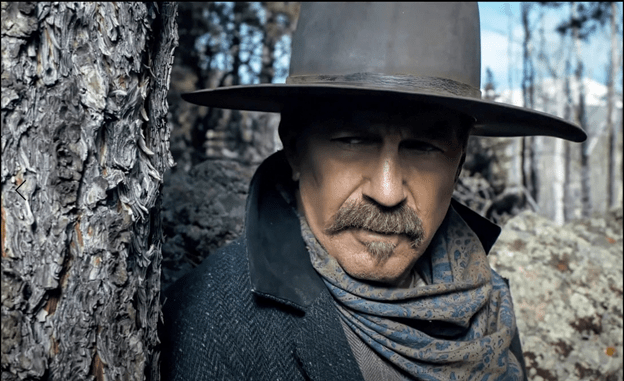
To perfect his fictionalized cowboy image, actor Kevin Costner reportedly tried on at least 10 hats before settling for the charcoal blue tall crown he wears as Hayes Ellison in Chapter 1 of Horizon: An American Saga. The film is a sprawling mega-Western with action occurring from Montana to Arizona in the post-Civil War West. It tells a fictionalized story of white Westward expansion and the quest for land in the mid-nineteenth century.
The characters are figments of Costner and co-writer Jon Baird’s imagination, but the Western history they bring to life reiterates disproven but familiar American tropes, including the mythic figure of the rugged, manly individualist who throws off constraints of society and government and pulls himself up by his own bootstraps. One of the central plots of the film is the story of white settler attempts to found the settlement of Horizon on Apache hunting grounds. First Lieutenant Trent Gephart (played by Sam Worthington) warns them off, but the settlers refuse to leave. In a scene that follows, Gephart’s superior, Colonel Albert Houghton, reprimands him for failing to understand the dreams of the common man who don’t come out here “like us.” “There’s no army of this earth,” Houghton opines, “that’s gonna stop those wagons coming little as they’re wanted.”
This story of struggle against institutional forces that would stop their progress is a key component of Trump’s appeal and of the making of Horizon. In August, Costner’s Territory Pictures and New Line Cinema cancelled Chapter 2’s premiere following Chapter 1’s dismal box office showing. The public and entertainment reporters wondered if the saga might be doomed, but in September, Costner vowed to soldier on, telling Entertainment Weekly, “I’m gonna make it.” Costner’s commitment to going it alone—he has already poured $38 million of his own money into the project—mirrors that of Trump who spent a reported $66 million on his 2016 campaign.
While Trump’s campaigns draw on Wild West imagery and rhetoric, Costner’s Horizon is directly indebted to turn-of-the-century cowboy mythology. Costume designer Lisa Lovaas based the ensemble for actor Luke Wilson’s character, Mathew Van Weyden, on a man Costner picked out from a Frederic Remington painting.
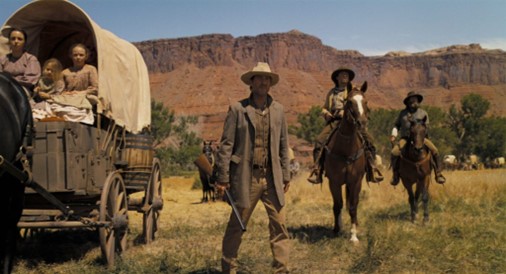
Luke Wilson, center, as wagon train leader Mathew Van Weyden in Horizon: An American Saga” Chapter One, a Warner Bros. Pictures release. Photo Credit: Richard Foreman.
The Yale-educated Remington began publishing cowboy art in the 1880s—more than two decades after the fictional Van Weyden’s train hit the Santa Fe Trail in the early 1860s—and continues to exercise outsized influence on popular (mis)understandings of the cowboy. Cowboys are often depicted as rugged individuals whose manliness derives from social and economic independence. In reality cowboys were wage-workers, cogs in a Gilded-Age industrial system just like their meat-packing factory and railroad-building counterparts. They were also much more diverse than the white males Remington depicted, and that Costner also favors. For instance, historians estimate that one in four cowboys were Black.
Costner’s Horizon and Remington’s art are exercises in gendered nostalgia separated by more than one hundred years. Remington’s turn of-the-twentieth-century oeuvre perpetuated ideas of individualist masculinity rooted in rural places even as the country was becoming more corporate and urban and men less independent. As Remington drew, painted, and sculpted models of an asynchronous masculinity on horseback, women crisscrossed the country by railroad and car advocating for their right to vote. To some turn-of-the-century Americans it seemed like a new era was imminent, but white women did not win the vote until 1920, and women of color had to wait much longer to exercise their constitutionally protected suffrage. Even a century ago cowboy imagery was out of step with the direction of the nation, but that was part of its appeal: a comforting persistence of what had supposedly been America’s glory days: the white, male-dominated Wild West.
Like Horizon, President-elect Donald Trump is out of fashion: an unabashed misogynist who frequently unleashes racist vitriol at his campaign rallies while wearing a red MAGA cap. Many presidents have worn cowboy boots and even trucker hats just like the infamous MAGA headwear (the most famous and frequent wearer was probably Ronald Reagan) but the mythical cowboy-character is also ably performed by the New York-born, Ivy-League educated Trump. It is no coincidence that Reagan the actor and Trump the showman have been so effective at leveraging the cultural conceit of the Wild West to serve conservative political ends. In politics as in show business image and perception trump reality.
The parallels between out-of-date Trumpism and anti-suffrage activism of Remington’s era are uncanny. In the final days of the campaign Trump announced that he planned to protect women “whether the women like it or not.” This at a time when more women finish college than men and almost 47% of US workers are women.
Horizon is similarly out of touch with female independence. In Costner’s saga, men’s protection of women serves as evidence of their admirable masculinity and their fitness for achieving their western dreams. Costner’s Hayes Ellison guides the single Marigold (played by Abbey Lee) away from the men who are after her and the child she’s caring for, and Gephart whips the fort’s doctor into shape on behalf of Sienna Miller’s Frances Kittredge who along with her daughter took refuge at the fort after her husband and son were killed. The white women in Horizon are opinionated and strong, but the dreams brought to life in Chapter 1 against a backdrop of stunning western vistas are those of white men.
In this, Costner’s Horizon differs from another much more popular recent Neo-western, 1883. 1883 is the prequel to actor turned writer and director Taylor Sheridan’s hit Yellowstone series, the final episodes of which premiered on November 10. Costner appeared as cattle rancher John Dutton before leaving the series, reportedly because of conflicts with Sheridan. Whereas Yellowstone is set in modern times, Sheridan’s 1883 covers a similar chronological period as Horizon. One of the most captivating characters in Sheridan’s 1883 is the white teenager, Elsa Dutton. Like real-life nineteenth-century suffragists, Elsa chafes against restrictive norms and costumes of middle-class Gilded Age womanhood. She finds herself on the westward trail, trading her heavy dress for the outfit of a cowboy and her domestic duties for managing the herd.

Isabel May herding cattle as Elsa. Credit: Paramount+
She’s also the narrator of western dreams: a dream that is about land for many in the wagon train but for Elsa is more about social and cultural freedom to break free of gender and racial norms. Before she dies, Elsa falls in love with and marries Comanche warrior Sam. Elsa’s death on her westward journey is an emotional low for the series, but her passing also ensures the survival of her western dream. By dying, Elsa escapes a return to conformity at the end of her journey and a West of barbed wire and fences that is foreshadowed throughout the series. There are flaws in 1883 to be sure, but the series dares to bring to life an American mythology that makes room for the overlooked and brings us closer to understanding our past.
It’s possible that viewers will come to embrace Horizon’s misrepresentation of our collective past as voters have embraced Trump. While there’s no word yet on when Chapter 2 might premiere, the segment received a 3-minute standing ovation at the Venice film festival. It also remains to be seen when voters will see fit to make room for a woman to occupy the highest political office in the country. What is clear is that the stories we tell ourselves matter. Just as 1883 has made room for Elsa, future westerns should make room for the Kamalas of the nineteenth century: daughters of immigrants who built their lives in the American West.
Featured Image Credit: Kevin Costner as Hayes Ellison in Horizon: An American Saga” Chapter One, a Warner Bros. Pictures release. Photo Credit: Richard Foreman.
 Clio and the Contemporary
Leave a comment