Instructor: Marcus Chatfield, MSc, PhD
Course Description
In the summer of 2023, journalist Michael Sokolove asked the University of Florida’s president, Dr. Ben Sasse, whether UF students are at risk of being indoctrinated by their professors. “Of course,” Dr. Sasse replied. In the same interview, he suggested that dogma about America’s past poses a special risk. History “totally does have an impact on the present,” he explained, “but you want to actually be teaching debates that allow people to get inside texts and wrestle. Because we don’t know the right answer on everything. I want more curiosity and less dogma. I want less indoctrination.”
Inspired by his cue, this course will arm students with the knowledge and skills needed to hone their curiosity, get inside texts, wrestle with dogma, and recognize indoctrination on campus and beyond. We will read primary and secondary sources. Class time will include a combination of lectures, discussions, and collective approaches to analysis. We will study the historical debates over indoctrination to understand how such undue influences may have threatened or seemed to threaten freedom of thought, personal autonomy, and self-determination—the touchstones of liberal democracy.
We are more likely to understand the importance of indoctrination when we see it in historical context and recognize the longstanding debates over its threat. Do we define it according to intentions or outcomes? Should we reject its methods or its content? Is it inevitable in education? Is there any such thing as a morally neutral type of indoctrination? How do we distinguish between education and indoctrination? However real or imaginary we may see the threats, we stand to benefit from learning how these debates have shaped United States history and why they matter today.
ASSIGNMENTS
First Essay, due week 3, minimum of 2,000 words
Discuss the key debates over indoctrination found in the course so far.
Use those debates to organize a response to key points you find in the New York Times Magazine article by Sokolove.
Use the materials from class to support your perspective.
Midterm Exam (essay two), due week 7, minimum of 2,000 words
Discuss the debates over indoctrination found in the course so far.
Contextualize the debates you find most interesting.
Use the course materials to illustrate the implications of the debates that you find most interesting
Third Essay, due week 10, minimum of 2,000 words
Think about the ideas and practices associated with indoctrination before and after WWII.
Consider the debates, institutions, and actual practices before and after WWII that you find most interesting.
Discuss how those debates, institutions, and practices before WWII compare with those after WWII.
Final Exam (essay four), minimum of 2,000 words
Consider the debates, institutions, and practices discussed in the course.
Identify and discuss the intellectual debates you find most relevant for analyzing the New York Times Magazine article by Sokolove.
Use those ideas to organize a response to the article. Include at least one key finding from each week.
COURSE SCHEDULE
Intellectual History of Indoctrination (Weeks 1-3)
Week 1 – Intellectual Debates
Michael Sokolove, “How Ben Sasse Became a Combatant in Florida’s Education Wars,” New York Times Magazine, Sep. 9, 2023.
Yukong Zhao, “Too Many College Students Have Been Indoctrinated in Extremist, Far-Left Ideologies,” Orange County Register (May 7, 2024).
Johan Dahlbeck, “Spinoza on the Teaching of Doctrines: Towards a Positive Account of Indoctrination,” Theory and Research in Education 19, no. 1 (2021): 78-99.
Week 2 – Ideas about Totalitarian Indoctrination
Allen W. Dulles, “Brain Warfare: Russia’s Secret Weapon; It Explains the ‘Confessions’ of Captured Americans,” U.S. News and World Report, May 8, 1958, 54, 56, 58.
“Statement of Edward Hunter,” 5-25, in “Communist Psychological Warfare (Brainwashing),” United States House of Representatives Committee on Un-American Activities, Mar. 13, 1958, Washington, D.C.
Susan L. Carruthers, “When Americans were Afraid of being Brainwashed,” New York Times, Jan. 18, 2018.
Lorraine Boissoneault, “The True Story of Brainwashing and how it Shaped America,” Smithsonian Magazine, Online, May 22, 2017.
Week 3 – Ideas About Propaganda and Indoctrination after WWI
Harold D. Lasswell, “The Theory of Propaganda,” The American Political Science Review 21, no. 3 (Aug., 1927): 627-631.
Elmer E. Cornwell, “Wilson, Creel, and Presidency,” The Public Opinion Quarterly 23, no. 2 (Summer, 1959): 189-202.
History of Indoctrination in the United States (Weeks 4-10)
Week 4 – Influences Before WWI
Selected pages:
Horace Mann, “Report for 1843, Seventh Annual Report of the Secretary of the Board of Education of Massachusetts,” [start with last paragraph on page 237, read 237-243].
Ernest Crosby, “How the United States Curtails Freedom of Thought,” The North American Review 178, no. 569 (Apr., 1904): 605-616.
J. B. Bury, “Freedom of Thought and the Forces Against It,” Chapter 1, pages 7-21, in J.B. Bury, A History of Freedom of Thought (New York: Henry Holt and Company, 1913).
Thomas Alexander, The Prussian Elementary Schools (New York: The Macmillan Company, 1919), read Preface, v-vi, and Chapter 13, 257-270.
Week 5 – “Benevolent” Indoctrination in the United States Before WWI
David Wallace Adams, Education for Extinction: American Indians and the Boarding School Experience, 1875-1928 (Lawrence: University Press of Kansas, 1995), up to page 59.
Week 6 – Education in the Shadow of Prussianism
John W. Studebaker, “Should Educational Organizations Safeguard Freedom of Thought and Instruction in American Schools?” The Phi Delta Kappan 18, no. 3 (Nov., 1935): 76-78.
Thomas D. Fallace, “In the Shadow of Prussianism,” 7-23, in Thomas D. Fallace, In the Shadow of Authoritarianism (New York: Teachers College Press, 2018).
Week 7 – Education in the Shadow of Totalitarianism
Benjamin Brickman, “The Relation Between Indoctrination and the Teaching of Democracy,” The Social Studies 35, no. 6 (Oct., 1944): 248-252.
Campbell F. Scribner, “‘Make Your Voice Heard’: Communism in the High School Curriculum, 1958-1968,” History of Education Quarterly 52, no. 3 (Aug., 2012): 351-369.
Week 8 – The Age of Reeducation, 1942 to 1974
Kurt Lewin and Paul Grabbe, “Conduct, Knowledge, and Acceptance of New Values,” Journal of Social Issues 1, no. 3 (1945): 53-64..
LaMar T. Empey and Jerome Rabow, “The Provo Experiment in Delinquency Rehabilitation,” American Sociological Review 26, no. 5 (1961): 679-696.
Whitney H. Gordon, LaMar T. Empey, and Jerome Rabow, “Communist Rectification Programs and Delinquency Rehabilitation Programs: A Parallel?,” American Sociological Review 27, no. 2 (1962): 256-258.
Week 9 – Reeducation as Liberal Education
Saul Pilnick, et al., “From Delinquency to Freedom,” Report to the US Department of Health, Education and Welfare Office of Juvenile Delinquency on Collegefields Group Educational Center, Laboratory for Applied Behavioral Science, Newark State College, 1967, [READ Johnny’s story, 99-125 and “Appendix D,” PDF pages 270-280].
Frank K. Salter, “Indoctrination and Institutionalized Persuasion: Its Limited Variability and Cross-Cultural Evolution,” 421-452, in Irenaus Eibl-Eibsfeldt and Frank K. Salter (eds.), Ethnic Conflict and Indoctrination: Altruism and Identity in Evolutionary Perspective (New York: Berghahn Books, 1998).
Week 10 – After “Individual Rights,” 1974 to the Present
Individual Rights and the Federal Role in Behavior Modification, A Study Prepared by the Staff of the Subcommittee on Constitutional Rights of the Committee on the Judiciary, United States Senate, 93rd Cong. 2nd sess., Nov. 1974, Washington, D.C., [Read the “Preface,” iii-v; “Introduction,” 1-2; “Behavior Modification Technology,” 11-17, section on The Seed, 182-200]
Thomas D. Nolan, “The Indoctrination Defense: From the Korean War to Lee Boyd Malvo,” Virginia Journal of Social Policy and Law 2 (Winter 2003): 435-465.
History of Education and Indoctrination in Florida (Weeks 11-13)
Week 11 – Florida before WWI
James Dean, keynote address to the State Conference of the Colored Men of Florida, Feb. 5, 1884, Gainesville [SKIM pages 1-8, READ 9-23].
Laura Wallis Wakefield, “‘Set a Light in a Dark Place’: Teachers of Freedmen in Florida, 1864-1874,” The Florida Historical Quarterly 81, no. 4 (Spring 2003): 401-417.
Week 12 – Progressive Florida
Shira Birnbaum, “Making Southern Belles in Progressive Era Florida: Gender in the Formal and Hidden Curriculum of the Florida Female College, Frontiers 16, no. 2/3 (1996): 218-246.
Week 13 – Florida after WWII
Karen L. Riley and Marcella L. Kysilka, “Florida’s Americanism versus Communism. Social studies Curricula and the Politics of Fear: Textbooks as Propaganda During the 1960s,” Internationale Schulbuchforschung 25, no. 1-2 (2003): 27-40.
Robert L. Dahlgren, “Red Scare in the Sunshine State: Anti-Communism and Academic Freedom in Florida Public Schools, 1945–1960,” Cogent Education 3, no. 1 (2016): 1-12.
Stacy Braukman, “Nothing Else Matters but Sex”: Cold War Narratives of Deviance and the Search for Lesbian Teachers in Florida, 1959-1963,” Feminist Studies 27, no. 3 (Autumn 2001): 553-575.
Current Events (Final Week)
Week 14 – Education Wars Today
Eliza Relman, “Florida Gov. Ron DeSantis Signs a Law Punishing Student ‘Indoctrination’ at Public Universities and Threatens Budget Cuts,” Business Insider (Jun. 23, 2021).
Re-read: Michael Sokolove, “How Ben Sasse Became a Combatant in Florida’s Education Wars,” New York Times Magazine, Sep. 9, 2023.
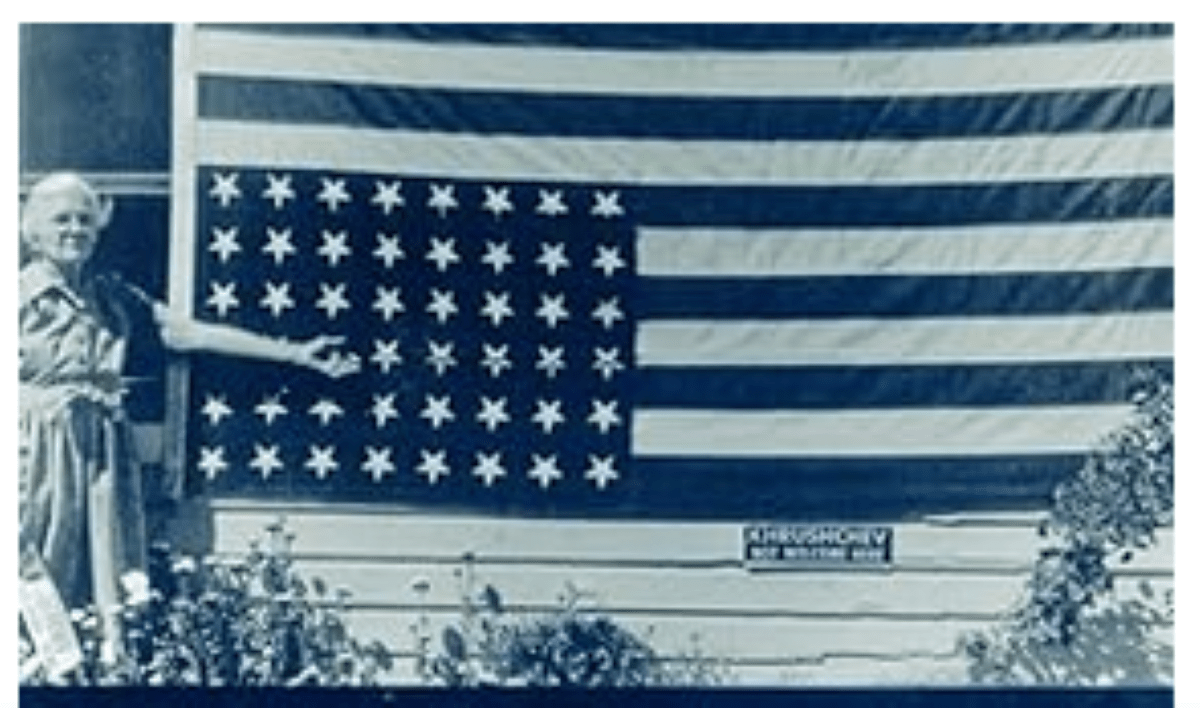
Featured image: Emily Kolp used the above photo on the book jacket for Jonathan M. Schoenwald, A Time For Choosing: The Rise of Modern American Conservatism (New York: Oxford University Press, 2001). The photo features a woman displaying an American flag that once covered her son’s casket. The flag is nailed upside down to the front of her house. Below the flag a sign reads “Khrushchev Not Welcome Here.” The woman in the picture was part of national movement protesting Soviet First Secretary Nikita Khrushchev’s 1959 visit to the United States.
 Clio and the Contemporary
Leave a comment