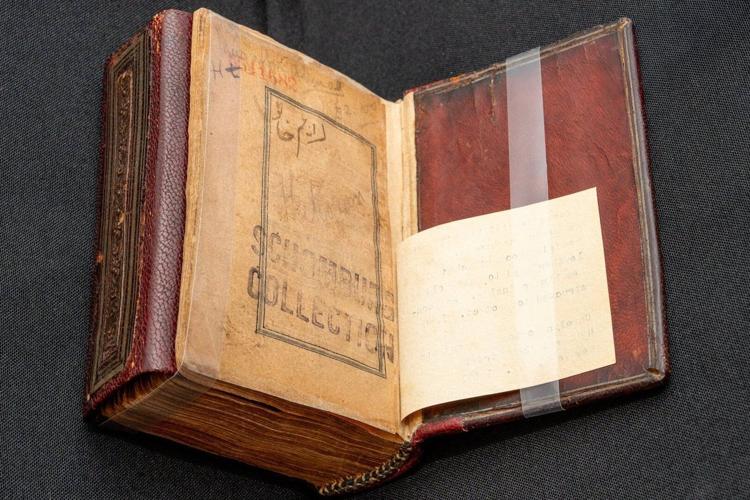
When New York City Mayor Zohran Mamdani was sworn in on a Qur’an from Arturo Schomburg’s collection, social media and news sites celebrated both the historic first of a Muslim mayor being sworn in with a Qur’an and the Qur’an coming from the now well-known Afro-Puerto Rican bibliophile, archivist, writer, and researcher.[1] The use of Schomburg’s Qur’an was celebrated on the island of Puerto Rico, a fact that reflects how the island has embraced Schomburg. Schomburg’s wide-ranging influence on New York City as well as Puerto Rican history is being recognized in a way never seen before.
Mayor Mamdani’s use of a Quran from Schomburg’s collection celebrates the ethno-racial and religious diversity of New York City. Mamdani’s choice also embraces the Afro-diasporic history and identity that Arturo Schomburg strove to create through his archive-building and auto/biographical writing. Schomburg’s project made it possible for a Ugandan American, Muslim man, whose father had to flee Uganda due to his South Asian heritage, to see himself in the African diasporic project that Schomburg imagined.
Schomburg’s Auto/Biographical Approach
When I first started writing my dissertation chapter on Arturo (Arthur) Alfonso Schomburg in 2017, finding peer-reviewed sources was a challenge. The work of Jossianna Arroyo, Jesse Hoffnung-Garskof, Lisa Sánchez-González, Elinor Des Verney Sinnette, and Adalaine Holton (as well as Flor Piñeiro de Rivera’s 1989 collection of Schomburg’s writing) provided a foundation,[2] but Schomburg wasn’t widely known in the mainstream, let alone his homeland of Puerto Rico, despite having a New York Public Library Research Center named in his honor.
When I came back to revise the chapter in 2022 and 2023, there had been an explosion of new works on Schomburg, from Vanessa K. Valdés’s Diasporic Blackness: The Life and Times of Arturo Schomburg—which is both a biography and analysis of Schomburg’s politics, writings, portraiture, and archival practice—to multiple special issues and forums in venues like small axeand African American Review. These scholars have looked at Schomburg’s writings as journalistic, literary, and acts of decolonial thought.
In my book, Invisibility and Influence: A Literary History of AfroLatinidades—[3] from which I draw for this piece—I use “auto/biographical” with a slash to reflect how Schomburg’s biographical writing often commented on the line between subjectivity and objectivity in the study of history and creation of biography. Schomburg’s writings, primarily in the 1910s and 1920s, developed the idea of ethnic studies programs. He was a major figure in the New Negro movement, and many Harlem Renaissance classes teach “The Negro Digs Up His Past.” Schomburg’s writings not only drew from archival documents and historical texts, both of which were often hard to find for his subjects, but they also documented the emotional impact of his discoveries, providing insight into the ways that archival discovery could heal.
Scholars have debated whether Schomburg, an Afro-Puerto Rican man, belonged to US Black history or Puerto Rican history. Figures like Afro-Puerto Rican feminist Angela Jorge and Afro-Puerto Rican Communist Jesús Colón suggested that he had aligned himself with the US Black community. Others, like his mentor John Edward Bruce, thought he was not sufficiently Black.[4]
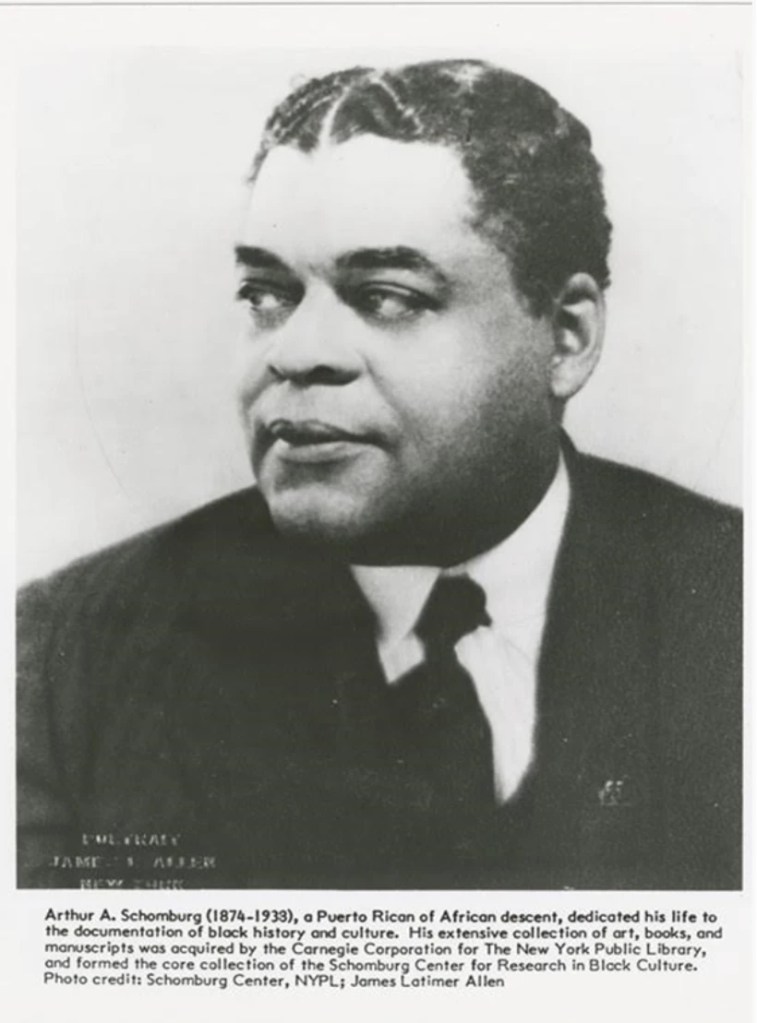
As a Black Puerto Rican, Schomburg often faced US and European societies that denigrated his culture, or worse, believed that there was no meaningful culture for Afro-diasporic and Puerto Rican peoples at all. Because of this erasure and denial of Afro-diasporic influence, Schomburg’s auto/biographical writings focused on African-descended peoples in Latin America, the Caribbean, and Spain and challenged both the white-centric and US Black-centered biographical histories that ignored the larger influences of Afro-diasporic people and migration in the United States and the Americas as a whole. In fact, one might argue that Bad Bunny’s Super Bowl performance that emphasized América and not the United States is itself aligned with Schomburg’s project.
Schomburg wasn’t only fighting against a white academy though; he was also fighting against US Black historians who frequently omitted Black history from outside the US. Despite being an autodidact with no college degree, he was a member of the American Negro Academy (and later became its president) and the Negro Society for Historical Research, which he co-founded with John Edward Bruce. Schomburg’s outsider status can also be seen in the content of his presentations. According to one of Schomburg’s biographer, Elinor Des Verney Sinnette, “Schomburg was the only presenter before the American Negro Academy who consistently reminded the membership of the role of blacks in Spain, Central America, and the West Indies.”
Schomburg’s auto/biographical writing called attention to the white racism that shaped narratives of American history. While white Americans considered their work (especially on Black people and people of color) as objective since they were not part of the community and could look from the outside without entanglement, Schomburg rejected that definition of objectivity. In his 1913 lecture to “the Teachers’ Summer class at Cheney Institute,” entitled “Racial Integrity: A Plea for the Establishment of a Chair of Negro History in Our Schools and Colleges, etc.” (which he would later revise for the 1925 piece, “The Negro Digs Up His Past”), Schomburg argued that white historians created narratives more concerned with maintaining white supremacy than providing accurate histories.[5] Indeed, he suggested that the histories of his time “bear no analogy to our [African-descended people’s] own”; so, it is imperative to build “a course of study in Negro History and achievements.” This early call for Black history as an area of study influenced future activists, students, and scholars who fought tooth and nail for Black studies, Chicana/o/x and Latina/o/x studies, Asian American studies, and other ethnic studies fields. 101 years after Schomburg’s call for Black Studies, Zohran Mamdani would graduate as an Africana Studies major from Bowdoin College.
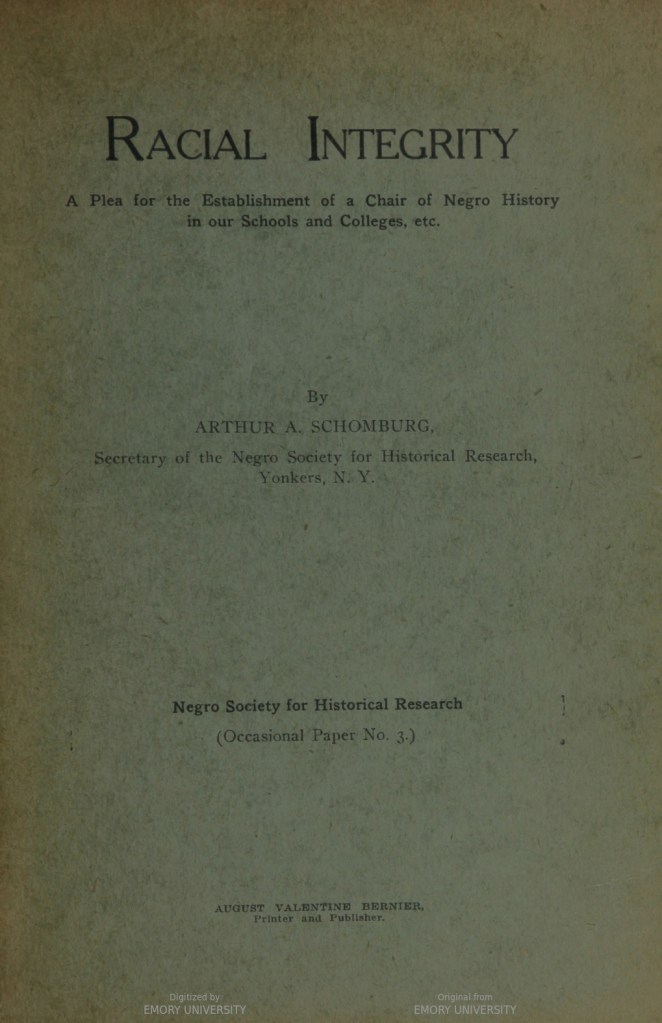
Schomburg’s Dream for “Racial Integrity”
Black Studies as a field draws from Schomburg’s view of racial integrity, which encourages African-descended people to document their traditions and celebrate their accomplishments. Schomburg wrote that he wants history “written by our men and women.” He asks, “[w]here is our historian to give us, [sic] our side view and our chair of Negro History to teach our people our own history. We are at the mercy of the ‘flotsam and jetsam’ of the white writers.” To Schomburg, what white historians wrote was trash; though it was trash that had real impacts on the lives of Black people.
Schomburg wasn’t interested in writing trash of his own though. “Racial Integrity,” as a speech argues for the creation of Black studies programs that allow Afro-diasporic people to create their own archives and knowledge. However, rather than depending on the current status quo, which privileges two kinds of Black history—race pride histories with little documentation and racist histories meant to justify Black oppression—Schomburg instead wanted to reform the practice of Black history and biography. As I write in Invisibility and Influence, “Schomburg walks the line between a radical overhaul of current historiographical methods and dependence on current standards of historical evidence. Regarding the purpose of his paper in the field of history and biography, Schomburg states, ‘The object of this paper is not to revolutionize existing standards, but simply to improve them by amending them.’”[6] Schomburg’s vision is embodied in the scholars who countered the Lost Cause narrative of the US Civil War and revised our understanding of Civil Rights movement figures like Martin Luther King, Jr and Malcolm X.[7]
In seeking to create a history with “racial integrity,” Schomburg sought to unify without homogenizing. Schomburg celebrated the heterogeneity of Blackness. He imagined racial integrity as a mosaic, where the gaps and differences are not smoothed out. Differences could be a wellspring for learning rather than an obstacle.[8]
Ultimately, Schomburg’s archival, historical, and biographical work sought to create an Afro-diasporic history that included not only US Black Americans, but AfroLatinos, Afro-Latin Americans, Black Caribbeans, Afro-Hispanics, and all Afro-descended peoples. When Zohran Mamdani chose a Qur’an from the Schomburg collection, he continued Schomburg’s work, by claiming connection and shared diasporic history between two men seeking to bring dignity to the marginalized in New York City.
[1] While Schomburg was not Muslim himself, his collection sought to collect Afro-diasporic history that reflect the diversity of Africanity.
[2] Hoffnung-Garskof, Jesse. “The Migrations of Arturo Schomburg: On Being Antillano, Negro, and Puerto Rican in New York, 1891-1938.” Journal of American Ethnic History 21, no. 1 (2001): 3–49; Arroyo, Jossianna. “Technologies: Transculturations of Race, Gender & Ethnicity in Arturo A. Schomburg’s Masonic Writings.” CENTRO Journal 17, no. 1 (2005): 5–19; Arroyo, Jossianna. Writing Secrecy in Caribbean Freemasonry. Palgrave Macmillan, 2013; Sánchez González, Lisa. Boricua Literature: A Literary History of the Puerto Rican Diaspora. NYU Press, 2001; Sinnette, Elinor Des Verney. Arthur Alfonso Schomburg: Black Bibliophile & Collector. The New York Public Library and Wayne State University Press, 1989; Holton, Adalaine. “Decolonizing History: Arthur Schomburg’s Afrodiasporic Archive.” The Journal of African American History 92, no. 2 (2007): 218–38.
[3] Mills, Regina Marie. Invisibility and Influence: A Literary History of AfroLatinidades. Latinx: The Future Is Now. The University of Texas Press, 2024.
[4] See Mills, Invisibility and Influence, 28-29 and the subsection “Anxieties and Misconceptions about Schomburg” in Valdés, Diasporic Blackness, 7-14.
[5] For an excellent analysis of the two versions (and why “Racial Integrity” should receive more attention), see Castromán Soto, Margarita M. “Schomburg’s Black Archival Turn: ‘Racial Integrity’ and ‘The Negro Digs Up His Past.’” African American Review 54, no. 1 (2021): 73–90. https://doi.org/10.1353/afa.2021.0004.
[6] Mills, Invisibility and Influence, 30.
[7] The success of Black Studies is so palpable, conservative politicians seek to suppress these narratives. For example, the Board of Regents recently voted to close the University of Texas at Austin’s department in African and African American Studies program (which is the only such PhD-granting program in the US South).
[8] In doing so, his work made connections to later ethnic studies thinkers, such as Audre Lorde and Gloria Anzaldúa.
Featured Photo Credit: Schomburg Collection Quran.
 Clio and the Contemporary
Leave a comment