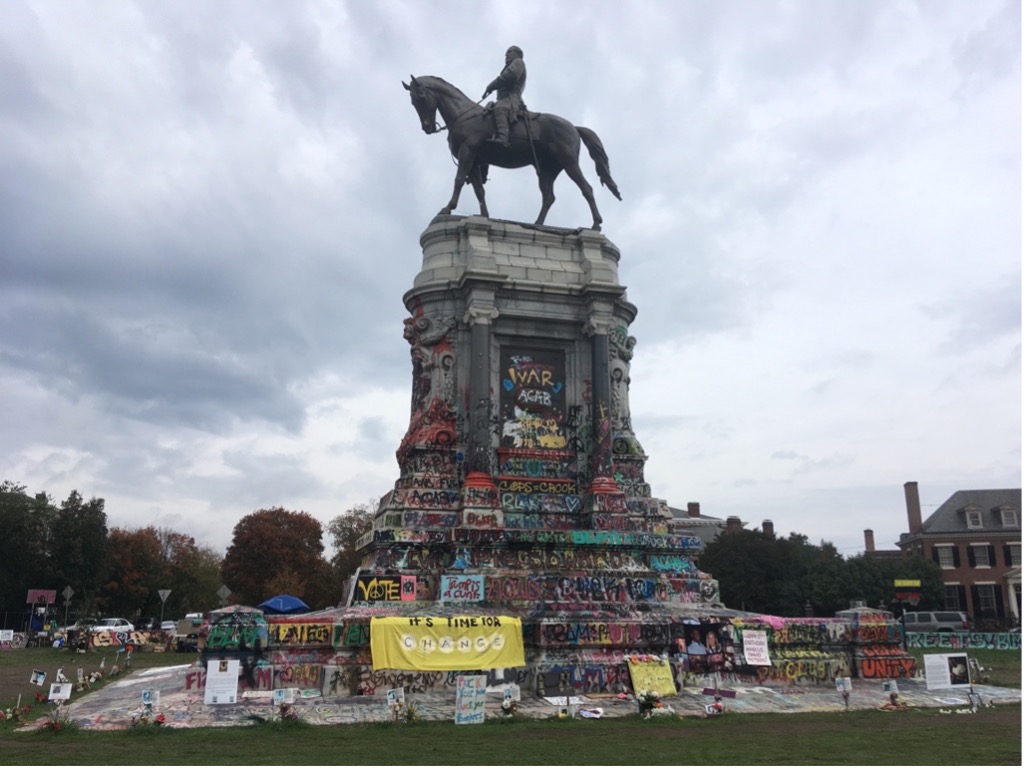
Figure 1: Photo on October 28, 2020 of the now-removed Robert E. Lee statue on “Monument Avenue” in Richmond, Virginia. Image courtesy of the author.
Tuesdays and Thursdays, 8:00-9:20 am, Blair 205
WILLIAM & MARY
Department of History
Professor Tyler Goldberger (he/him)
tjgoldberger@wm.edu
Course Description:
The production and dissemination of this syllabus already present a number of historical memory and human rights considerations. What events did I include in a post-1945 history course of the United States? Which voices have I centered as a part of this narrative? Who and what have I forgotten, and how does this contribute to a particular telling of this period? These are the questions with which we will grapple throughout the semester: Who and what have been remembered? Who and what have been forgotten? Who has had the power to establish particular narrativizations of the past? How do these decisions shape human rights and identity considerations nationally and transnationally? And, perhaps most importantly, why do all these questions matter?
This course explores historical “happenings” and their interpretations after 1945 with a heightened focus on if/how the United States has maintained, strengthened, and perpetuated its image of global excellence. For many students within the United States, high school United States history education emphasizes the triumph of World War II, contributing to unquestioned notions of exceptionalism, patriotism, and heroism for the nation at large. Perceived victories against racism and fascism thus propelled the United States as the international gatekeeper and dominant power. We will call into question the strategies in which the United States has represented itself by examining various human rights and social justice movements and mobilizations that have arguably defined the post-World War II period. The curriculum will provide students with a breadth and depth of historical coverage, both domestically and internationally, to help us arrive at understandings of history, memory, and human rights, as well as the complexities that surround these terms.
This course will require students to challenge preconceived notions regarding the United States by critically engaging with the myriad of interpretations of the past, present, and future of this nation. In particular, students will deconstruct previously understood knowledge to discuss and debate the image of the United States as a memory project. This will require students to engage with sources written by and about marginalized identities who are oftentimes taught as supplemental to traditional United States history. Students will also gain proficiency in participating in and leading conversations about representations and reconstructions of the nation’s history through monuments, memorials, museums, and other sites of memory. Lastly, students will nuance their previous grasp of the twentieth century to consider both domestic and foreign affairs influencing how the United States constructs its image, and how individuals and organizations complicate this nationalism.
Course Goals
- Engage with, support, critique, contest, challenge, and amend the argument of history as memory
- Explore the domestic and foreign affairs shaping the United States in the second half of the twentieth century
- Analyze the ways in which memory and human rights are intertwined processes and developments
- Think critically about the narratives progressed by the United States and how we can complicate them
- Debate, communicate, and dialogue the ethics, values, and shortcomings of history and memory as a discipline and in contemporary times
Classroom Decorum and Absence Policy
In consideration of the class community and the instructor, everyone must adhere to basic rules of classroom decorum. Students are expected to behave with courtesy and respect toward each other and the instructor. Anyone expressing their views courteously and on the basis of conscientious preparation is entitled to a respectful hearing, even—indeed, especially—when expressing views at odds with majority opinion in the class or with the judgments of the instructor.
Part of classroom decorum is being in class. I take attendance seriously, and I ask that you do the same. I also ask that you arrive to class promptly to prevent distractions. Absences and tardiness without prior notification will contribute to a lower evaluation. Two unexcused absences will result in a 1/3 deduction of evaluation, and three unexcused absences will result in a full letter deduction of evaluation. The instructor also reserves the right to deduct evaluation from habitual tardiness (which will start at three tardies).
That being said, I also understand that life happens. I ask that if you do have to be late or absent to class, you email me as soon as possible to notify me beforehand. I welcome you to come to office hours or schedule an appointment if you have questions about the materials. Excused absences include religious observation, physical/mental wellbeing concerns, and other reasons approved by me.
Evaluation
Skills I hope you gain from this course: growing personally and professionally; strengthening writing, reading, and analytical capabilities; communicating effectively and respectively; developing a passion; fostering and cultivating a collegial class community. As much as I know all these things are on your mind, I imagine quantitative evaluations also weigh heavily. So, let’s call this a mutual agreement – you put time, energy, and effort into the class, and you will earn an evaluation that will make you proud.
My mission for this class is to promote engagement, excitement, and energy both inside and outside our classroom. I will provide written and oral feedback throughout the semester, including in class, on submitted assignments, and during office hours. Evaluation will be taken from your semester’s work, especially related to the ways in which you improve your skills as a student, scholar, and historian. I ask, in return, that you do your work. Come to class prepared, ask questions, participate, and come see me with any questions. If we can both do our parts, I see evaluation as an opportunity to reward you for all your hard work!
Quantitative Evaluation Percentages:
Attendance and In-Class Participation: 25%
Assignment 1: 15%
Assignment 2: 20%
Site of Memory Presentation: 10%
Final Assignment: 30% (This includes your timely and substantive submissions of your explanation and draft.)
Quantitative Evaluation Scale: A (93-100); A- (90-92); B+ (87-90); B (84-86); B (80-83); C+ (77-80); C (74-76); C- (70-73) – anything below this, let’s talk.
Late Policy: Without prior consent from the instructor, an assignment turned in 0-24 hours late will be docked 1/3 evaluation letter. Assignments 24-72 hours late will be docked a full evaluation letter. Anything submitted after 72 hours late will be evaluated on a case-by-case basis.
Participation
This class requires active, frequent, and engaged participation. The success of what we gain together as a class community depends on each individual doing their part to contribute intellectually. Characteristics of active participation include, but are not limited to, expressing views in class informed by careful reading of the assigned material, responding to questions, having questions and comments of your own to share, engaging with in-class activities, and providing supporting material from the readings for your questions and arguments. If speaking up in class makes you feel nervous or self-conscious, feel free to write down your thoughts in advance and read them to the class. Please also feel free to approach me if you are worried about speaking up in class, as I can offer strategies, and we can work together, throughout the semester to ensure your intelligent thoughts contribute to the class community! I cannot ignore that this is an 8:00a course. We will make it through, together.
Monumental Break (MB)
No one should ever be forced to sit and listen to me for eighty minutes straight. This class will engage with a variety of teaching and learning styles to ensure that we remain awake, engaged, and enthusiastic. I will do my best to offer a three-minute break in the middle of class to stretch mentally and physically, do some fun puzzles, jam to my incredibly good music tastes (sometimes based thematically on our course’s material, sometimes suggested by you!), and whatever other invented traditions we produce throughout the semester.
Course Costs
Zero. Nil. Zilch. All required and supplemental readings live on Blackboard. If any resources present themselves throughout the semester that have a paywall or price attached, please request them through Interlibrary Loan (ILL) or come see me so we can work something out. ILL is a system through our university’s library system that borrows material from other libraries, free of charge to you! There should not be any financial commitments in the taking of this course.
Field Trip!
Due to the generosity of those who believe in studying public history and memory, this course offers an optional field trip to Richmond, Virginia to explore various sites of historical remembering and forgetting from the American Civil War. This trip will take place on Saturday, October 22 from approximately 9:00am-5:00pm. More details can be found on Blackboard. All transportation, food, and entry will be free of charge to you.
Highlights of our day include, but are not limited to, the American Civil War Museum, Emancipation and Freedom Monument, Richmond’s Black History Museum, Monument Avenue, and the Virginia Museum of Fine Arts!
Trip Itinerary Preliminary Interest Survey Finalized Interest Survey
Research Symposium!
This event will provide students space to share their working drafts of their final projects. The research symposium will take place in Special Collections Research Center on Wednesday, December 7 from 5:00-6:30pm. It will promote students’ abilities to present their work to both a familiar and unfamiliar audience. It will also allow William & Mary community members to get a glimpse into how this course has challenged students to think critically and create a well-informed response to how power, privilege, and silence permeate the historical discipline.
This symposium will celebrate all students who have worked diligently to challenge themselves and their peers this semester, deconstructing and nuancing their previous understanding of the post-World War II United States landscape. These projects will highlight people, places, events, and perspectives often silenced and forgotten by a traditional telling of United States history.
Technology Policies from the Old Man in the Room
In a perfect world, students with their computers open during class would be taking notes without any of the distractions of the world outside our four walls. However, I recognize that this is no utopia. I prefer that our class community remains a technology-free space outside of in-class activities, but I also understand that the digital world has its benefits. I ask you – scratch that, I implore you – to respect me and the rest of your class community by limiting all technological use to class-oriented content only. Abusing this freedom will result in consequences that minimize our engagement with technological tools throughout the semester. And, let’s be honest – the only people awake during our class time will be our class community, anyways. Our eighty minutes together will be spent much more fruitfully if we are all physically and mentally present!
Office Hours and General Communication
I really want you to come to office hours! Office hours are a great opportunity to come speak with me about any questions, comments, interests, or concerns you have regarding our class. They are also a nice way for me to get to learn more about you and your passions, personally and professionally! Every student who comes to office hours will receive extra credit reflected in their final evaluation of the course. I welcome open and honest communication throughout the semester.
Over the weekdays, defined as Monday at 8:00 am through Friday at 12:00 pm noon, you can expect an email response from me within 24 hours. Emails sent between Friday at 12:00 pm noon and Monday at 8:00 am will receive a response within 72 hours. Please reach out with questions, comments, concerns, and ways that I can best support you.
Some Quick Notes
Please note that the course syllabus is a general plan for the course. It is possible that deviations announced to the course may be necessary. Course readings and requirements are subject to change at the instructor’s discretion. I will make you aware of any changes with advanced notice.
In general, each class session will be guided by one question that you will find at the top of the day’s entry. It is my goal that we think through each question both during that class session and throughout the semester.
Course Schedule
HIST 211: Post-1945 United States Memory and Human Rights
Thursday, September 1: Course Introduction
Why did you choose to enroll in an 8:00am class?
- No reading!
Friday, September 2 by 11:59p EST: Field Trip Interest Form DUE!
PART I: THEORETICAL UNDERPINNINGS
Tuesday, September 6: The VITs (Very Important Texts)
What is history, what is memory, and what are human rights?
- Maurice Halbwachs, On Collective Memory.(Chicago: University of Chicago Press, 1925).
- Pierre Nora, “Between Memory and History: Les Lieux de Mémoire,” Representations 26 (1989): 7-25.
- Universal Declaration of Human Rights
Thursday, September 8: Remembering and Forgetting
How does the United States remember and forget its relationship with Japan during World War II?
- Michel-Rolph Trouillot, Silencing the Past. Power and the Production of History (Boston: Beacon Press, 1995). Preface and Introduction.
- John W. Dower, War Without Mercy: Race and Power in the Pacific War (New York: Pantheon Books, 1986), Chapter 11.
Supplemental Reading:
- Andrew McKevitt, Consuming Japan: Popular Culture and the Globalizing of 1980s America (Chapel Hill: University of North Carolina Press, 2017), Introduction, Chapter 1, Epilogue.
Tuesday, September 13: The Nation, Nationalism, and National Myth
Who is a part of the United States’ national identity, and who is not?
- Benedict Anderson, Imagined Communities: Reflections on the Origin and Spread of Nationalism. (London: Verso, 2006), Introduction and Chapter 3.
- Daniel Immerwahr, How to Hide an Empire: A History of the Greater United States. (New York: Farrar, Straus and Giroux, 2019). Introduction and Chapter 14.
Thursday, September 15: Nationalism Case Study: The National Mall
How does Washington, D.C. as the nation’s capital reflect notions of United States nationalism?
- Kirk Savage, Monument Wars: Washington, D.C., the National Mall, and the Transformation of the Memorial Landscape. (Berkeley: University of California Press, 2011). Introduction.
- Mabel O. Wilson, Begin with the Past: Building the National Museum of African American History and Culture. (Washington, D.C.: Smithsonian Books, 2016). Selections.
- Ana Lucia Araujo, Museums and Atlantic Slavery. (London: Routledge, 2021). Selections on National Museum of African American History and Culture.
- National Mall Virtual Tour
Tuesday, September 20: Monuments as Memory
What are monuments as sites of memory, and what are they not?
- Kirk Savage, Monument Wars: Washington, D.C., the National Mall, and the Transformation of the Memorial Landscape. (Berkeley: University of California Press, 2011). Chapter 6, Conclusion.
- “Memorialization of Robert E. Lee and the Lost Cause.”
Thursday, September 22: NO CLASS. Work on, finish, and submit assignment 1!
Friday, September 23 by 8:00am EST: Assignment 1 Due!
Tuesday, September 27: Memorials as Memory
What are memorials as sites of memory, and what are they not?
- Erika Doss, Memorial Mania: Public Feeling in America. (Chicago: University of Chicago Press, 2010). Chapter 4.
Supplemental Reading:
- Marita Sturken, Tangled Memories: The Vietnam War, the AIDS Epidemic, and the Politics of Remembering. (Berkeley: University of California Press, 1997). Chapter 2.
- Robin Wagner-Pacifici and Barry Schwartz, “The Vietnam Veterans Memorial: Commemorating a Difficult Past” American Journal of Sociology 97, no. 2 (September 1991), 376-420.
Thursday, September 29: Museums as Memory
What are museums as sites of memory, and what are they not?
- Amy Lonetree, Decolonizing Museums: Representing Native America in National and Tribal Museums. (Chapel Hill: University of Carolina Press, 2012). Chapter 3.
- Susana Torruella Leval, Voices from Our Communities: Perspectives on a Decade of Collecting at El Museo del Barrio, June 12 – September 16, 2001. (New York: El Museo del Barrio, 2001).
- Ana Lucia Araujo, Museums and Atlantic Slavery. (London: Routledge, 2021). Introduction and Conclusion.
Supplemental Reading:
- Amy Lonetree, Decolonizing Museums: Representing Native America in National and Tribal Museums. (Chapel Hill: University of Carolina Press, 2012). Introduction.
Tuesday, October 4: The Holocaust in United States Memory: Sites of Memory Case Study
Why did the United States build a national Holocaust museum on the National Mall before national Native American and African American museums?
- Peter Novick, The Holocaust in American Life. (Boston: Houghton Mifflin, 1999). Chapters 11 and 12.
- Edward Linenthal, Preserving Memory: The Struggle to Create America’s Holocaust Museum. (New York: Columbia University Press, 2001). Chapter 3.
Supplemental Reading:
- Daniel H. Magilow and Lisa Silverman, Holocaust Representations in History: An Introduction. (New York: Bloomsbury Publishing, 2015). Chapter 4.
Thursday, October 6: Archives and their Silences
Class will begin at 8:30 am. Enjoy the sleeping in!
Can archives ever be neutral spaces?
- Marisa Fuentes, Dispossessed Lives: Enslaved Women, Violence, and the Archive. (Philadelphia: University of Pennsylvania Press, 2016).pp 4-12.
- Michel-Rolph Trouillot, Silencing the Past. Power and the Production of History (Boston: Beacon Press, 1995). Chapter 5, Epilogue.
Friday, October 7 by 11:59 pm EST: Field Trip Committal Form DUE!
Tuesday, October 11: Special Collections Visit (Class will meet at Special Collections)
How can we engage with primary sources through a memory methodology?
- No reading!
Thursday, October 13: Fall Break – No Class!
Monday October 17 – Wednesday, October 19: Individual Meetings
Individual meetings with Professor Goldberger (in-person and Zoom options). Sign-up sheet to be provided.
How is the semester going so far, and how can I best support you going forward?
- No reading!
PART II: APPLICATION
Thursday, October 20: Civil Rights Movement & Narrativization
How can we change the way the Civil Rights Movement has traditionally been taught?
- Jacquelyn Dowd Hall, “The Long Civil Rights Movement and the Political Uses of the Past,” The Journal of American History 91, no. 4 (March 2005): 1233-1263.
- Danielle McGuire, At the Dark End of the Street: Black Women, Rape, and Resistance – A New History of the Civil Rights Movement from Rosa Parks to the Rise of Black Power,(New York: Penguin Random House, 2011). Chapter 3.
Saturday, October 22 – OPTIONAL FIELD TRIP TO RICHMOND: Capital of the Confederacy: Revisited – Suggested readings below.
- Nicole Maurantonio, Confederate Exceptionalism. (Lawrence: University Press of Kansas, 2019). Introduction.
- Kevin M. Levin, “Richmond’s Confederate Monuments Were Used to Sell a Segregated Neighborhood.” The Atlantic, June 11, 2020.
- Kehinde Wiley at the Virginia Museum of Fine Arts, December 10, 2019
Tuesday, October 25 by 8:00 am EST – Assignment 2 due!
Tuesday, October 25: The Myth of the Double V Campaign: Early Cold War Racism
How did the United States respond to human rights and civil rights concerns in the early Cold War period?
- Carol Anderson, Eyes Off the Prize: The United Nations and the African American Struggle for Human Rights, 1944-1955. (Cambridge: Cambridge University Press, 2003). Introduction.
- Mary Dudziak, Cold War Civil Rights: Race and the Image of American Democracy. (Princeton: Princeton University Press, 2011). Chapter 4.
- Mary Ann Glendon, A World Made New: Eleanor Roosevelt and the Universal Declaration of Human Rights, (New York: Random House, 2002). Chapter 10.
Thursday, October 27: The Myth of the Double V Campaign: Early Cold War Fascism
Why did the United States support Spain’s Franco regime while diluting human rights considerations during the Cold War?
- Mark S. Byrnes, “‘Overruled and Worn Down’: Truman Sends an Ambassador to Spain,” Presidential Studies Quarterly 29, no. 2 (1999): 263-79.
Supplemental Reading:
- Wayne H. Bowen, Truman, Franco’s Spain, and the Cold War. (Columbia: University of Missouri Press, 2017). Chapter 3.
- Neal M. Rosendorf, “‘Hollywood in Madrid’: American Film Producers and the Franco regime, 1950-1970.” Historical Journal of Film, Radio and Television 27, no. 1 (March 2007): 77-109.
Tuesday, November 1: Textbooks and Education
Can textbooks be trusted as “objective” sources?
- Carol Sheriff, “Virginia’s Embattled Textbooks: Lessons (Learned and Not) from the Centennial Era,” Civil War History 58, no. 1 (March 2012): 37-74.
- James Loewen, Lies My Teacher Told Me: Everything Your American History Textbook Got Wrong. (New York: Touchstone, 2007). Chapter 12.
Supplemental Reading:
- Paulo Freire, The Pedagogy of the Oppressed.1970. (Consortium of International Publishers translated by Myra Bergman Ramos; introduction by Donaldo Macedo, 2000). Chapter 2.
Thursday, November 3: Declassification Diplomacy
How has the United States tried to come to terms with its human rights violations in Latin America during the Cold War?
- Lesley Gill, The School of the Americas: Military Training and Political Violence in the Americas. (Durham: Duke University Press, 2004). Chapter 3.
- Argentina Declassification Project, pp 3-6, 10-17. 31-38.
Supplemental Reading:
- Peter Kornbluh, The Pinochet File: A Declassified Dossier on Atrocity and Accountability, (New York: New Press, 2003). Chapter 4.
Friday, November 4 by 8:00 am EST – Blackboard post with a brief description of your final project due, including the incorporation of at least one secondary source.
Tuesday, November 8: NO CLASS. Election Day! Go vote if you are able!
Thursday, November 10: The Vietnam War
How has the United States remembered and forgotten the Vietnam War and those who fought?
- Viet Thanh Nguyen, Nothing Ever Dies: Vietnam and the Memory of War. (Cambridge: Harvard University Press, 2017). Introduction.
- Chris Appy, American Reckoning: The Vietnam War and Our National Identity. (New York: Penguin Random House, 2016). Chapters 8 and 9.
Tuesday, November 15: The United States and Domestic Genocide
How has the United States perpetrated genocide?
- Benjamin Madley, “Reexamining the American Genocide Debate: Meaning, Historiography, and New Methods,” American Historical Review 120, no. 1 (February 2015): 98-139.
- James Waller, “‘I Didn’t Know If I Was Going to Be Seen Again:’ The Escalating Risk of Mass Violence in the United States.” Policy paper published by the Stanley Center for Peace and Security, November 2020.
Supplemental Reading:
- Bryan Newland, Federal Indian Boarding School Initiative Investigative Report. June 2022 (reading selections after break).
Thursday, November 17: The United States and International Genocide
We will be joined by guest speaker Liliane Pari Umuhoza, survivor of the Genocide against the Tutsi and human rights activist.
How has the United States responded to mass violence and genocide internationally?
- Samantha Powers, “Bystanders to Genocide.” The Atlantic, September 1, 2001.
- John Shattuck, Freedom on Fire: Human Rights Wars and America’s Response. (Cambridge: Harvard University Press, 2003). Chapter 2.
Supplemental Reading:
- John Shattuck, Freedom on Fire: Human Rights Wars and America’s Response. (Cambridge: Harvard University Press, 2003). Introduction.
Tuesday, November 22: NO CLASS. Work on your final projects. Enjoy your break!
Thursday, November 24 – THANKSGIVING BREAK
PART III: OUR CONTEMPORARY WORLD
Tuesday, November 29: Hauntings, Dead Bodies, and Dark Tourism
Does anyone ever really die?
- Tiya Miles, Tales from the Haunted South: Dark Tourism and Memories of Slavery from the Civil War Era. (Chapel Hill: University of Carolina Press, 2015). Introduction, Chapter 3.
- Bryan Newland, Federal Indian Boarding School Initiative Investigative Report. June 2022, pp. 3-4, 85-102.
Supplemental Reading:
- Avery Gordon, Ghostly Matters: Haunting and the Sociological Imagination. (Minneapolis: University of Minnesota Press, 2008). Introduction.
- Katherine Verdery, The Political Lives of Dead Bodies: Reburial and Postsocialist Change. (New York: Columbia University Press, 1999). Introduction.
Thursday, December 1: The Legacies of the Violent Past in Contemporary Times
What does/can reconciliation in the United States look like?
- Ta-Nehisi Coates, “The Case for Reparations.” The Atlantic, June 2014.
- John Campbell and Jack McCaslin, “George Floyd’s Murder Revives Anti-Colonialism in Western Europe.” Council on Foreign Relations, June 16, 2020.
- Elisa J. Sobo, Michael Lambert, and Valerie Lambert, “Land acknowledgements meant to honor indigenous people too often do the opposite – erasing American Indians and sanitizing history instead.” The Conversation, October 7, 2021.
Supplemental Reading:
- Annette Gordon-Reed, On Juneteenth. (New York: W&W Norton Press, 2021).
- Robert Cook, Troubled Commemoration: The American Civil War Centennial, 1961-1965. (Baton Rouge: Louisiana State University Press, 2011). Chapters 4 and 5.
- Ana Lucia Araujo, Slavery in the Age of Memory. (New York: Bloomsbury Publishing, 2020). Chapter 5.
Friday, December 2 by 8:00 am EST: Draft of final assignment due!
Tuesday, December 6: William & Mary and Memory
What does/can reconciliation at William & Mary look like?
- Ywone D. Edwards-Ingram, “Scholars, Lawyers, and Their Slaves: St. George and Nathaniel Beverley Tucker in the College Town of Williamsburg within Leslie M. Harris, James T. Campbell, and Alfred L. Brophy (eds.), Slavery and the University: Histories and Legacies. (Athens: University of Georgia Press, 2019).
- Danielle Moretti-Langholtz, “The Brafferton Indian School: In Memory and Legacy” within Danielle Moretti-Langholtz and Buck Woodward, Building the Brafferton: The Founding, Funding, and Legacy of America’s Indian School. (Williamsburg: Muscarelle Museum of Art, 2020).
Supplemental Reading:
- William & Mary Committee, Final Report of the Working Group on Principles of Naming and Renaming. February 21, 2021.
Wednesday, December 7, 5:00-6:30 pm – OPTIONAL Research Symposium for final projects at Special Collections Research Center
Thursday, December 8: Final Reflections
What is history, what is memory, and what are human rights?
- Monument Labs, National Monument Audit, 2021.
Tuesday, December 13: Final assignment due by 5:00 pm EST!
Assignments
Assignment 1
Produce a 1-2 page review on a scholarly secondary source related to history, memory, and human rights. Meditate on some of the following questions: What does this reading tell us about the (fickle) nature of memory? How accessible is this theoretical reading? When was this source written, and how does that influence its argument? What are the shortcomings of this piece? How can we apply this theory into United States memory in the post-1945 period? Where do human rights fit into this example? This review should not simply be a synopsis of the reading; rather, this review should allow you to critically engage with the text, its applicability, and its shortcomings.
*You may feel free to use any scholarly secondary book/article we have or will read for this course, and you are also welcome to explore a text we have not consulted for this class via Swem.
Grading Guidelines: Secondary Source Review
Your reflection should:
- Include an analytical approach that gets at the ‘why’/‘so what’ question
- Address the content of the secondary source in a substantive way
- Comment on narratives that are included and silenced
- Make use of proper punctuation, capitalization, and grammar
- Include citations when needed (footnote and bibliography)
- Be submitted as a Word document entitled Last Name_Assignment 1
Grading Scale
| A | Sophisticated and ambitious analytical commentary that frames the essay; excellent writing skills; clear, persuasive, original, and creative expression of ideas; fulfills all requirements listed above. |
| B | Good analytical commentary but falls short of being excellent; commentary is more descriptive than analytical; good writing skills, some evidence of analytical thinking; good ability to express ideas; fulfills most or all requirements listed above. |
| C | Adequate commentary; adequate writing skills; some evidence of analytical thinking; competent ability to express ideas; fulfills some or most of the requirements listed above. |
| D | Little to no attempt to present commentary; minimal analytical thinking; average writing; fulfills very few of the requirements listed above. |
| F | Does not adhere to assignment guidelines; violates the Honor Code in one or more ways |
Pluses—exceed the expectations for the grade
Minuses—do not fully meet the expectations for the grade
Assignment 2
From our Special Collections visit (or another primary source repository approved by Professor Goldberger), choose at least one primary source presented and critically think about this material as (an) interpretation(s) of the past. In 2-3 pages, meditate on some of the following questions: What does this material tell us? What does this material inherently forget to tell us? Who produced this material, and what is the intended audience? Is there anything we can read between the lines? What other sources would help corroborate or complicate the narrative of your chosen material? What is the archive’s role in preserving this material?
Grading Guidelines: Primary Source Analysis
Your reflection should:
- Include an analytical approach that gets at the ‘why’/‘so what’ question
- Address the content of the primary source in a substantive way
- Comment on narratives that are included and silenced
- Make use of proper punctuation, capitalization, and grammar
- Consider other sources that would corroborate or challenge your chosen source
- Include citations when needed (footnote and bibliography)
- Be submitted as a Word document entitled Last Name_Assignment 2
Grading Scale
| A | Sophisticated and ambitious analytical commentary that frames the essay; excellent writing skills; clear, persuasive, original, and creative expression of ideas; fulfills all requirements listed above. |
| B | Good analytical commentary but falls short of being excellent; commentary is more descriptive than analytical; good writing skills, some evidence of analytical thinking; good ability to express ideas; fulfills most or all requirements listed above. |
| C | Adequate commentary; adequate writing skills; some evidence of analytical thinking; competent ability to express ideas; fulfills some or most of the requirements listed above. |
| D | Little to no attempt to present commentary; minimal analytical thinking; average writing; fulfills very few of the requirements listed above. |
| F | Does not adhere to assignment guidelines; violates the Honor Code in one or more ways |
Pluses—exceed the expectations for the grade
Minuses—do not fully meet the expectations for the grade
Site of Memory Presentation
Choose any site of memory in the United States either commemorating an event in the post-1945 period or constructed in the post-1945 period. In a 3-5 minute oral presentation, present what this site of memory could represent. Who are the producers and consumers of this site? What narratives does this site seek to tell, and is it successful in these endeavors or not? How could people read the same site similarly? Differently? Who is the intended audience for this site, and is it possible that there are multiple audiences targeted?
This oral presentation must have a visual component as well. This semester, we will be working with the Center of Geospatial Analysis to produce an ArcGIS digital humanities analysis tool to compile all the sites of memory with which we engage throughout the semester. I ask that you all fill out this Survey 123 ArcGIS form as you prepare for your presentations. We will have a demo during class time on Thursday, September 15, and you will also be able to incorporate StoryMaps {TG: It looks like a hyperlink is missing here. Will you please add it?}into your site of memory presentation if you so choose. I ask that you fill out the Survery123 ArcGIS form and email me (tjgoldberger@wm.edu) any visual aides by 7:30 am on the day you are presenting.
Grading Guidelines: Site of Memory Analysis
Your presentation should:
- Include an analytical approach that gets at the ‘why’/‘so what’ question
- Address the context of the site of memory in a substantive way
- Comment on narratives/peoples/dates/events/etc. that are included and silenced
- Utilize some visual media format to show the site of memory to the entire class
- Consider other sources that would corroborate or challenge your chosen site of memory
Grading Scale
| A | Sophisticated and ambitious analytical commentary that frames the presentation; excellent oration skills; clear, persuasive, original, and creative expression of ideas; fulfills all requirements listed above. |
| B | Good analytical commentary but falls short of being excellent; commentary is more descriptive than analytical; good oration skills, some evidence of analytical thinking; good ability to express ideas; fulfills most or all requirements listed above. |
| C | Adequate commentary; adequate oration skills; some evidence of analytical thinking; competent ability to express ideas; fulfills some or most of the requirements listed above. |
| D | Little to no attempt to present commentary; minimal analytical thinking; average oration; fulfills very few of the requirements listed above. |
| F | Does not adhere to assignment guidelines; violates the Honor Code in one or more ways |
Pluses—exceed the expectations for the grade
Minuses—do not fully meet the expectations for the grade
Final Assignment
This course offers many different take-home final exam options, as well as the opportunity to work with me to create your own final exam/project if you would like. Please feel free to consult me throughout the semester with thoughts, questions, and enthusiasms regarding this final assignment. Traditional writing assignments should be anywhere from 7-10 pages in length, and all creative projects, such as a podcast episode, song, digital humanities project, physical manifestation, etc., must include a 1-2 page write up describing the process of the project and what it represents.
By Friday, November 4, 2022 at 8:00 am EST, all students must submit a Blackboard post explaining their final project idea. This post must include at least one secondary source to inform the project. This will allow Professor Goldberger to check in on project ideas, provide feedback, and support students.
SUGGESTED FINAL PROJECT IDEAS:
Traditional Paper Prompt Ideas:
- What is history? What is memory? Do they overlap, and if so, how? How do sites of memory play into these ideas?
- Choose an event, person, place, etc. that has been memorialized in modern United States history. What have these memorializations looked like – how have they been similar? Different? In what geographic regions have they been built? What symbols appear or reappear to serve as a representation of this past? Who is remembered, and who is forgotten?
- You have been tasked to recreate the National Mall in Washington, D.C. What sites of memory make the cut? How do you design this landscape?
- How do we construct national history museums? Should there be separate national museums for United States History and those whose identities have historically been marginalized (i.e. National Museum of the American Indian, National Museum of African American History and Culture, El Museo del Barrio), and why?
- How do memory and human rights evolve from the production of ideologies to the dissemination and consumption of them? How do these theoretical concepts evolve as they become deployed and practiced?
Creative Project Prompt Ideas:
- Construct your own site of memory for anything (person, event, etc.) in the United States that transpired after 1945. Who is the focus of your site of memory? Are they victims, survivors, heroes, etc.? Who is the audience? Who is funding this project?
- Utilize the Makers Space in the Swem Library to bring your site of memory to life.
- Utilize Minecraft or another online platform to bring your site of memory to life.
- Produce a digital map that showcases various sites of memory in a particular area and conduct spatial analysis. Or, produce a digital map that shows the various sites of memory for one particular person, event, etc. Where are these sites? How do these sites impact the United States landscape?
- Design what you believe the National Mall in Washington, D.C. should be. Why did you design it in the matter that you did?
- Schoolhouse Rock has called you with the urgent request of writing a song to explain to children discourse surrounding memory in our contemporary time. Write (and perform, if you feel comfortable) this song. What lessons and moments do you include?
 Clio and the Contemporary
Very interesting syllabus
LikeLike