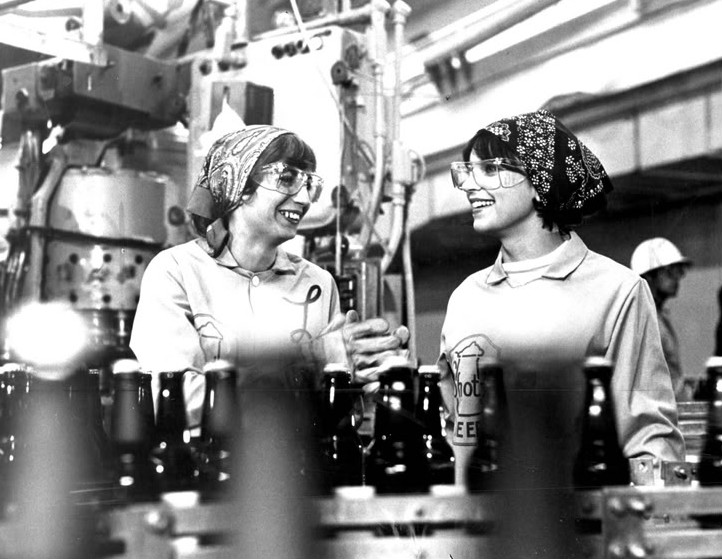
On the evening of January 27, 1976, the first episode of Laverne & Shirley aired on ABC and generated the highest Nielsen rating for a series premiere in over a decade.[1] During the subsequent 1976-1977 television season over 23 million households tuned in and watched what would become iconic opening credits.[2] The sitcom’s theme song, “Making Our Dreams Comes True” played while the titular characters walk down a sidewalk in lock step and arm-in-arm; this is followed by scenes of Laverne and Shirley in their apartment, having a snowball fight, dancing at a bowling alley, and finally daydreaming while at work on the bottling assembly line at Shotz Brewery (a fictional stand-in for the Schlitz Brewery). The opening credits clearly convey that these two working-class friends do everything together.
Laverne & Shirley was the first series about blue-collar single women. As a spinoff of Happy Days (1974–1984), the sitcom took place in Milwaukee, Wisconsin, during the late-1950s and early-1960s. Featuring the fast-talking Laverne DeFazio (Penny Marshall) and naïve Shirley Feeney (Cindy Williams), the show’s comedic storylines typically revolved around the characters’ experiences with dating, their disagreements as roommates, or antics at the brewery where they worked as bottle cappers.
The working-class setting added a different approach from previous “single-girl” sitcoms that featured the dating adventures of middle-class women. For example, programs such as The Patty Duke Show (1963–1966) and Gidget (1965–1966) featured title characters who longed for love, but were teenagers who lived at home and dated under parental supervision. By 1965, however, a new television trope emerged in response to modern feminism. Sitcoms such as That Girl (1966–1971) and The Mary Tyler Moore Show (1970–1977) featured a new liberated woman who lived independently, held career aspirations, and (for the latter series) dated numerous men, yet remained single.[3] Laverne & Shirley’s first season overlapped with The Mary Tyler Moore Show’s last season and signified yet another turning point in the single-girl sitcom—the series exhibited an uncertainty about how to portray the single American woman during a period of increasing economic and political turmoil.
While Laverne & Shirley is part of a long history of single-girl sitcoms, it also reflects a particular moment in American history. The series’ 50th anniversary provides an opportunity to reflect on its distinct contribution to the genre. The show, which ran for eight seasons and was nominated for an Emmy Award and six Golden Globes, spanned a consequential period in American history, 1976 to 1983. The historical context shaped Laverne & Shirley and is particularly evident in how the series represented anxieties about dating, sex, and marriage in the late 1970s.
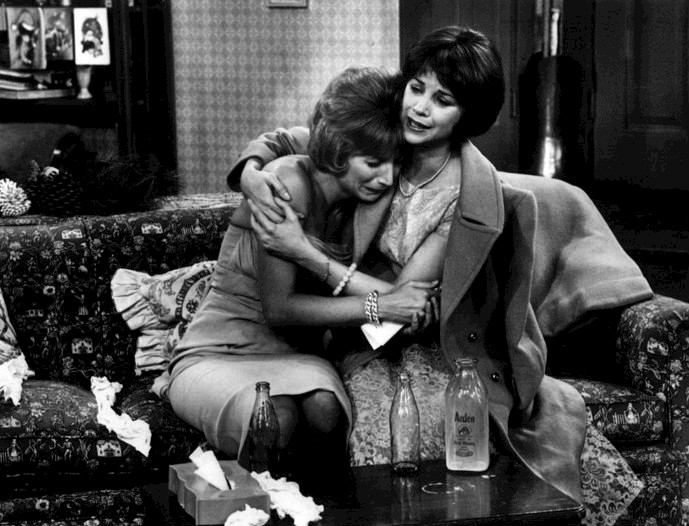
This was a decade marred by economic downturn and political failures, such as the 1973 Oil Embargo, Watergate, and the Fall of Saigon in 1975. Furthermore, social change—ranging from the Gay Liberation Movement, modern feminism, and women’s growing autonomy over their bodies to rising divorce rates and an increase in dual wage-earning households—became lightning rod issues. Some Americans considered such transformations a threat to the nuclear family.[4] By 1976, the year Laverne & Shirley premiered, the United States was gearing up for its American Revolution Bicentennial celebration, which became a way for many Americans to see parallels between their own feelings of discontent and those espoused in the past.[5] While Laverne & Shirley was not created with the Bicentennial in mind, the show’s framework grappled with America’s idealized postwar past but from a distinctly 1970s lens.[6]
In Laverne & Shirley, dating wasn’t just about finding love, it was connected to economic mobility. Thus, the series balanced the characters’ day-to-day struggles with their attempts to “make their dreams come true” of obtaining a middle-class lifestyle with a house, husband, and children. The show’s presentation of working-class single women contrasted the images of American life that sitcoms from the late-1950s and early-1960s had advanced. These earlier sitcoms painted a happy, postwar nuclear family that was usually middle-class and upheld by male breadwinners and female housewives. Notably, unlike its predecessors That Girl and The Mary Tyler Moore Show, Laverne & Shirley was not set in the present, but in the recent past—albeit ambiguously. The show’s indistinctness in terms of periodization existed not only among audiences but also within the cast. In a 2013 interview, when asked when the show was set, Cindy Williams stated “it was supposed to be 1959… we weren’t sure, none of us were sure.”[7] Uncertainty around Laverne & Shirley’s periodization is likely due to how the show dealt with the crumbling Cold War consensus of the 1960s; the nexus of consumerism, the nuclear family, and national strength appear in the show from a 1970s perspective, not the late 1950s to early 1960s. In season 6, for example, Laverne and Shirley lose their jobs at Shotz Brewery to automation, which reflects the onset of deindustrialization in the Rustbelt during the 1970s. This style of television that used the past to talk about the present was familiar to audiences. The war comedy-drama M*A*S*H (1972-1983), a contemporary of Laverne & Shirley, was “about” the Korean War but was understood to be an allegory about the Vietnam War, which was still ongoing during the show’s first three seasons.[8]
When the characters of Laverne and Shirley first appeared as guests on Happy Days in 1976—a sitcom also set in the late-1950s and early-1960s—they were written as “girls who put out.” But that premise would not suffice for a standalone show during ABC’s “family hour.”[9] To make the program more “family friendly” for an 8:00 p.m. timeslot, Laverne & Shirley portrayed the women as unlucky with love. They go on many terrible dates with men while maintaining more conservative values about sex before marriage. In the sixth episode of season 1, Shirley explains her first date rule: “A little of this, a little of that, but no petting.” In the same episode, Laverne and Shirley’s double-date goes awry when the men turn out to be bank robbers and hold both women hostage when police arrive at the scene. In a moment of despair—when they fear death as an ending to the hostage situation—Laverne and Shirley discuss their regrets in life. For Shirley, it’s not having a baby; for Laverne, it’s not having sex at all. “We saved it for nothing,” she bemoans. The next day, after the men are arrested and the women rescued, Laverne declares that she wants to start living each moment like it’s her last. Shirley reminds her friend that just because she’s been through a terrible ordeal, that doesn’t mean she has to give up her morals and ethics, to which Laverne explains that she is on her way to her first facial.[10]
The series reframed the 1950s middle-class lifestyle, which television shows like Father Knows Best (1954–1960), Leave it to Beaver (1957–1963), and The Donna Reed Show (1958–1966) portrayed as typical, as an unobtainable dream for many Americans. In the 2013 interview, Williams described what she considered an underlying sadness in the show during moments when Laverne and Shirley questioned whether their dreams would ever come true. “What we wanted to be was the mom in Leave it to Beaver,” Williams reflected, “but we weren’t.” The series’ blue-collar protagonists highlighted not only realities of the 1950s, but the intersection of class and questions about women’s liberation in the 1970s. Williams stated, “we were kind of career women in the fact that we were independent, on our own. Were we looking for men in all the wrong places? Yes. But we wanted that dream of being a housewife, a mom, and having a loving husband… that’s what we aspired to yet we were forced into being independent women.”[11] If the future of the nuclear family as it related to economic mobility seemed impossible for Laverne and Shirley, what did that mean for the future of real single American women?
Previous sitcoms, such as The Mary Tyler Moore Show, emphasized single women’s liberation in relation to work. Laverne & Shirley departed from this format and instead had more in common with the satiric nighttime soap opera Mary Hartman, Mary Hartman (MH, MH), which aired from 1976 to 1977. Developed by Norman Lear, but created by Ann Marcus, Gail Parent, Daniel Gregory Brown, and Jerry Adelman, MH, MH was the first nighttime soap opera that ran five days per week. It aired 325 episodes during its two seasons. The series, which starred Louise Lasser as a discontented housewife, premiered 22 days before Laverne & Shirley. Although the central character, Mary, is married with a daughter, the show portrayed her struggle to find happiness as a housewife in a consumerist society. Also set in the Midwest, MH, MH grounded the series in a working-class city which allowed the writers to interrogate class and gender politics after the intertwined developments of the sexual revolution, and the rise of feminist and anti-feminist movements. In the show, Mary’s search for happiness results in confusion as she tries to improve her marriage and interpersonal relationships, only to receive contradictory media messages concerning women’s roles. She has done “all the right things”—at least according to postwar standards—by getting married, becoming a mother, and purchasing the consumer products that supposedly made housework easier and housewives happier. This realization coupled with her persistent unhappiness ultimately leads to Mary’s breakdown on national television by the end of the first season.[12]
Audiences of MH, MH liked and disliked the show for the same reason: it was “real.” After the first season, roughly 75% of viewer mail came from fans who appreciated the show’s presentation of media’s influence on constructing traditional family ideals. Despite the series’ large cult following, Louise Lasser quit after the second season due to burnout from the demanding production schedule.
The central angst that came through in MH, MH centers on American womanhood in the 1970s. The same can also be said about Laverne & Shirley. Whether single or married, both series indicated that the idyllic postwar family portrayed in shows like Leave it to Beaver was an unrealistic cultural construction. Not only did the 1970s programs question its existence in the first place, but they foreclosed its continuation—real or imagined—in a world changed by the women’s movement and the 1970s economy.
Today, as was in 1976, the United States is preparing to commemorate another anniversary of the American Revolution—its semi quincentennial. It is also experiencing what many would characterize as another decade of tumult. This time, though, political turmoil, economic uncertainty, and changing sex and gender roles are met with a technological twist: the rise of Artificial Intelligence (AI) companions, increased social isolation, and dating app fatigue. Cultural critics dubbed 2025 the year of the “relationship recession” and 2026 the year of the “crush recession.” These critics, looking beyond the manosphere and tradwives, have now turned toward examining the decline of romantic love in popular culture to try to make sense of our current moment. Within this broader context, the popularity among women of HBO’s Heated Rivalry(2025), a romantic drama about two closeted hockey players, indicates a desire for more love stories on screen. But why?
The 50th anniversary of Laverne & Shirley reminds us that television does not document the past exactly as it was.[13] It does, however, offer insight into the values, moods, and attitudes of an era. With Laverne & Shirley being set in the Midwest, the series became a bellwether for the impact deindustrialization would have on the single-income family. In this case, television became a site for understanding anxieties toward traditional gender roles and American womanhood at the start of the Reagan era and the neoliberal decades that followed.
[1] “‘Laverne and Shirley’ An Ace for ABC,” The Hartford Courant, February 15, 1976.
[2] Laverne & Shirley’s opening credits have been parodied numerous times, including the 1992 film Wayne’s World.
[3] Judy Kutulas, After Aquarias Dawned: How the Revolutions of the Sixties Became the Popular Culture of the 1970s (The University of North Carolina Press, 2017), chapter 3; Katherine J. Lehman, Those Girls: Single Women in Sixties and Seventies Popular Culture (University Press of Kansas, 2011); Lauren Rabinovitz, “Sitcoms and Single Moms: Representations of Feminists in American TV,” Cinema Journal vol. 29 no. 1 (1989).
[4] Natasha Zaretsky, No Direction Home: The American Family and the Fear of National Decline, 1969–1980 (The University of North Carolina Press, 2007).
[5] M. J. Rymsza-Pawlowska, History Comes Alive: Public History and Popular Culture in the 1970s (University of North Carolina Press, 2017), 39-66.
[6] Ironically, Marshall and Williams were offered the roles of Laverne and Shirley for Happy Days while working at Francis Coppola’s Zoetrope company as writers for a television satire on the Bicentennial. Susan King, “Retro: Reunion of the Milwaukee Madcaps: ‘Laverne and Shirley’ Special Looks Back at a Sitcom that Brought Nostalgia to the Late 70s,” Los Angeles Times, May 21, 1995.
[7] Cindy Williams, interview by Amy Harrington, August 7, 2013, Television Academy Foundation, Archive of American Television: https://youtu.be/R3ICzekCTCM?si=5zrIx9Uh5wU9Yko2.
[8] Noel Murray, “M*A*S*H: Socially Relevant Comedy,” in How to Watch Television, eds. Ethan Thompson and Jason Mittell (New York University Press, 2013), 195-203.
[9] Cindy Williams interview.
[10] Laverne & Shirley, season 1, episode 6, “Dog Day Blind Dates,” directed by James Burrows, aired March 9, 1976, on ABC. DVD.
[11] Cindy Williams interview.
[12] Kate L. Flach, “America’s Nervous Breakdown: Mary Hartman, Mary Hartman, Popular Psychology, and the Demise of the Housewife in the 1970s,” Journal of 20th Century Media History 1, 1(2023): 3–29.
[13] Stephanie Coontz, The Way We Never Were: American Families and the Nostalgia Trap (New York: Basic Books, 1992).
Featured Photo: Penny Marshall and Cindy Williams are shown at work in the Shotz brewery of Laverne & Shirley. Press release is dated 16 January 16, 1976. Available at Wikimedia Commons.