As we have discussed in a previous essay, teaching with digital archives does not mean simply teaching students to locate material or navigate databases, but also showing them how to go beyond what is there to discern what is not. This means critically examining what has been preserved and collected and understanding the tacit narratives hidden in the archival records.
In this post, we focus on ethical aspects of digital archives, especially in terms of sensitive material, and we give an overview of institutional approaches by sharing examples from selected case studies. Attention to ethics allows scholars and students to understand, acknowledge and reflect upon the sources they access online, as well as the resource-intensive nature of the infrastructure underlying them, including multi-year funding and dedicated staffing.
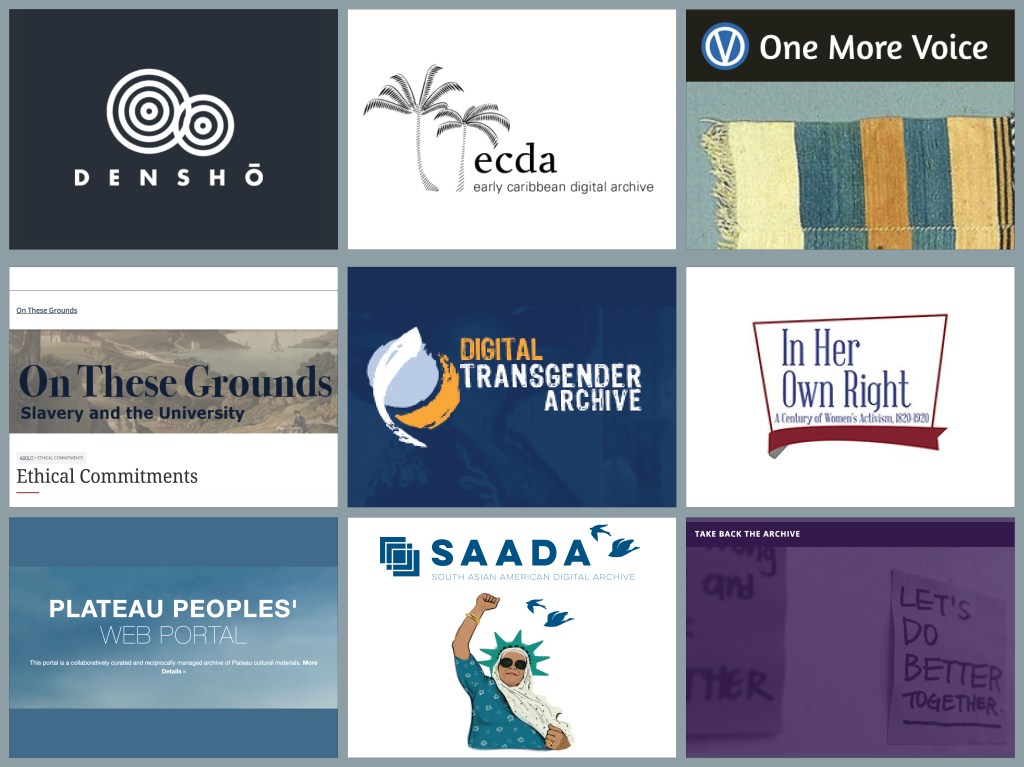
We highlight projects representing different communities, platforms, types of materials, and creators. Here, it is important to emphasize the situatedness of our examples. For the purposes of this post, we selected digital archives created by institutions in the North American context, which might not reflect the realities and conditions in other areas of the world. Nine digital archives serve as case studies across three thematic categories:
- Gender and Sexuality
- Slavery and Colonialism
- Indigeneity and Ethnicity
These projects can be used both by instructors teaching about digital archives in public history programs or digital history classes and by instructors in content-focused classes for the various subjects that these digital archives cover. Subject experts will be able to tailor their teaching according to the content of each digital archive and the ethical nuances we present below.[1]
Gender and Sexuality
Digital Transgender Archive
The Digital Transgender Archive (DTA) out of Northeastern University in Boston, MA, is an international collaboration among dozens of universities, nonprofits, public libraries, and private collections, with over seventy contributing institutions and funding from local and national granting agencies. The project’s mission is “to bridge trans-related experiences of the past with the present, which requires us to navigate shifting landscapes of cultures, languages, and understandings of identity.” The DTA focuses on archival materials created before the year 2000,with around 10 percent of the current collection from 2000 to 2023. Archival materials reflecting trans histories and people have, by and large, been challenging for researchers to find and discover within a trans-affirming portal framework. DTA’s mission is to increase the visibility of and research on transgender history. At the time of this writing, there are over 13,000 items in the DTA portal from over 80 institutions or collections representing self-identified trans people, transsexuality, genders outside of Western binary definitions, as well as many other nonconforming identities. DTA also includes self-documenting material created by individuals that are reflective of themselves and their communities, along with many underrepresented voices in trans histories, primarily from people of color. The creators of the project acknowledge that it is primarily reflective of the United States and Canada, and they are actively working to expand its geographic scope. A prominent policies page includes sections on values that guide the archive; copyright and usage; privacy and redactions; and harmful and explicit content. DTA addresses sensitive topics and is committed to privacy, stating that they routinely redact any personally identifying information. The DTA does include legacy materials, i.e., material that have been processed or described in the past in ways that today are considered harmful and offensive. In the “Harmful and Explicit Content” section, it states that “we are committed to providing unsanitized access to trans history that critically frames or contextualizes materials when possible.” An adjoining style guide in the same section includes recommendations for non-trans scholars who are writing about transexuals and/or transsexuality. The style guide includes suggestions for inclusive language, terminology, and other tips.
Due to how language and terminology have changed in recent years, it is often difficult to locate these materials due to varying levels of description and the dispersion of collections. DTA curates and brings together such materials, making them openly available, thus facilitating research and teaching. To facilitate teaching with materials, the website includes a search tips and guide, glossary, lesson plans and other ways for instructors to incorporate the DTA into the classroom. The digital collections of DTA and the adjoining lesson plans can be integrated into the classroom in a number of ways, noting that the emphasis in the collection is on 20th century content relating to transgender identity. There are very few resources that bring together primary source material like the DTA archive, particularly with its embedded ethical values of trans-affirming, accountable and accessible digital collections. The lesson plans provide discussion questions and additional readings that could be of interest in a number of history, political science, and other humanities courses. Additionally, there is a fifteen-page guide on researching race and ethnicity that could be of value for students and teachers alike, noting that the guide is providing recommendations with the lens on BIPOC trans and gender non-conforming individuals.
In Her Own Right
In Her Own Right: A Century of Women’s Activism, 1820-1920 is a project by the Philadelphia Area Consortium of Special Collections Libraries (PACSCL) that provides a searchable database of primary source documents and collection descriptions focused on women’s rights and activism from twenty-four partner repositories (with a total of forty-five contributors). The project acknowledges the historical role of libraries and archives in ignoring or exploiting records from marginalized communities; the reluctance of these communities to share their material with mainstream institutions; and the obligation of institutions to explore non-custodial approaches. In Her Own Right is a unique resource because of the number of contributors who provide breadth on the topic; there are over 13,000 rare primary source digitized items available for researchers. The website includes curated exhibits and themed essays as well as classroom resources that bring together primary source materials under four central themes. Additionally, the project highlights the importance of community-based archival collections and the need to not simply increase access and usage, but to also build on the capacity of their custodians. Most importantly, the project foregrounds the role that librarians and archivists play in the selection, description and appraisal processes, and its impact on the narratives represented in collections. There is a thoughtful acknowledgment of the work of librarians and archivists collecting, organizing, describing, and delivering the project’s collections and content. This acknowledgment includes reflections on steps towards addressing historical inequities, particularly how much decision making by archivists on what collections to keep or describe can impact discoverability. The project also provides an “Inclusive Archives Resource Guide,” which points to further collections and materials beyond the consortium that recognize the diversity and intersectional nature of women’s experiences.
Take Back the Archive
Hosted by the University of Virginia (UVA), Take Back the Archive first attempted to document the accounts of sexual violence survivors, and it later moved on to document the larger history and culture of sexual violence at UVA over time. The first phase of the digital archive included interviews with student leaders, mainly as a response to the Rolling Stone article, “A Rape on Campus” by Sabrina Erdely, published November 19, 2014 (it has since been retracted).[2] Recognizing the sensitive nature and ethical aspects of the topic of sexual violence, the project’s directors stress that their intention is not to create a ‘neutral archive’ but instead “to expose under-recognized information about sexual violence at UVA in order to contribute to reducing its occurrence.” In the section “Archival Issues,” UVA faculty, students, librarians, and archivists who worked to create Take Back the Archive note the limitations of their collections, acknowledging that it is not representative of “the entire history of sexual violence at UVA” since it relies “on documents produced in a past and present mired in white supremacy and class privilege.”
The project’s directors grappled with issues of privacy and consent that mass digitization raises, noting that it was not possible to obtain permission from each person reflected in the archive and that many of the materials were not initially intended for online, widely accessible consumption. Unlike some of the other examples discussed in this piece, in the section “Future Directions,” the Take Back the Archive project is presented as “finished for the moment,” having been suspended largely due to lack of funding. The page encourages interested parties to continue its work, a poignant call given the current political climate of defunding academic and historical institutions. This digital collection can be used for teaching, particularly the curated newspaper articles on gender discrimination, race, and LGBTQ issues. While the overall collection is smaller than the other examples, Take Back the Archive can also be seen as a case study that provides significant insights on research by UVA faculty and students on the topics of sexuality, race, gender and sexual violence.
Slavery & Colonialism
On These Grounds
On These Grounds: Slavery and the University (OTG) foregrounds the lived experiences of enslaved people who labored at institutions of higher education. The project is overseen by “a collaborative group of library and archives workers, historians, and technologists” across three universities: Georgetown, University of Virginia, and Michigan State. A dedicated page on “Ethical Commitments” outlines eight ethical principles that drive the project. The principles embody a perspective of radical empathy, centering those who were enslaved with care particularly around stories of trauma and oppression. The aggregated collections can be browsed by “events” or the individual, allowing teachers to pull selected examples into lesson plans that tie in with the originating archival collection. OTG could be used to supplement a lesson with topics on emancipation, health, labor, and many other life events as framed in the data set. (Full list can be found in the controlled vocabulary lists).
The OTG project recognizes that a lack of common documentation, description, and organization of data derived from archival records constrains “the possibilities of a broader analysis of American educational institutions’ historical ties to slavery,” creating an uneven historical representation. Thus, OTG uses linked open data through an Omeka S platform as “a common descriptive approach [that] will allow participants to build and disseminate a richly linked contextual foundation for representing and understanding the lives of the enslaved people who were bound to colleges and universities.” The OTG project team recognizes that the digital infrastructure is never neutral and emphasizes their commitment to building “a technical infrastructure that is oriented toward reparative and anti-racist practices.” Acknowledging their positionality and the inherent biases they bring to the project, the OTG project team clearly states their commitment to identifying and remediating these biases. For instance, they share references to current scholarship that has shaped their work, particularly works on ethical description, pointing to a shared Zotero library on this topic.
Note: A separate project also named On These Grounds has been developed on slavery and the University of North Carolina at Chapel Hill.
Early Caribbean Digital Archive
The Early Caribbean Digital Archive (ECDA) brings together pre-twentieth-century texts, maps, and images from the colonial era Caribbean, aiming to use digital tools to ‘remix’ Eurocentric material and “foreground the centrality and creativity of enslaved and free African, Afro-creole, and Indigenous peoples in the Caribbean world.” Material in the digital archive consists of novels, travel narratives, natural histories, colonial documentation, and slave narratives, several of which are prefaced with scholarly introductions. The ECDA recognizes how archives of the early Caribbean, often found in former colonial metropoles and largely inaccessible, were tools of European capitalist modernity meant to racialize and subjugate Indigenous and enslaved people. To subvert the epistemological foundations of colonial archives, the ECDA uses the affordances of the digital to ‘re-archive’ such problematic materials by using the practice of “remixing and reassembling.” Remixing and reassembling archival collections requires users “to disrupt, review, question, and revise the colonial knowledge regime that informs the archives from which we draw most of our materials.”
The approach of the ECDA is similar to the OTG with a collective approach to knowledge creation through multiple editors and contributors as well as an ongoing process with no end-date that reflects the experimental nature of the project (and the never-ending struggle to decolonize the archive). The ECDA uses a WordPress site with the CERES: Exhibit Toolkit, which is a WordPress plug-in created by Northwestern University specifically designed for curated exhibit pages. There are Resources for Teachers like a suggested syllabi on selected topics and class assignments as well as a way for teachers to also submit classroom materials to the project.
One More Voice
One More Voice is a digital humanities “recovery” project whose mission is to identify, document, and critically engage with “the voices of racialized creators in British imperial and colonial archives.” The project recognizes that Anglo-European intellectual traditions have silenced the voices of colonized and racialized people and that recovering such voices promises “to transform common critical understanding of global history and literatures.” One of the project’s analytical priorities is an ethical engagement with materials by racialized creators that “necessitate a cautious, historically-sensitive, critical approach” to push against stereotypes, prejudices, and other distortions inherent in the era’s European cultures. One More Voice acknowledges the impossibility of an authoritative, complete historical record and states that the project “will always be incomplete due to the biased and fragmentary nature of imperial and colonial archives.”
One More Voice does not try to serve as a digital archive in the sense of collection or preservation of materials, but rather it serves as a space to identify and engage critically with content that is already being preserved. With this in mind, the project uses a tactic they refer to as “digital recycling,” which links people to relevant materials housed in other repositories. The project encourages a collaborative approach, mimicking the peer review system and outlining the promotion of “new interdisciplinary frameworks for interpreting Victorian literature and in supporting the work of BIPOC/BAME scholars, graduate students, early-career scholars, and contingent faculty.” One More Voice also provides about a dozen critical essays that may be of interest for educators, five of which are introductory essays on selected individuals. Educators could also use materials from the collection for use in the classroom, including visual materials, literary texts, recovered texts as well as other creative works (plays, sound recordings and video).
Indigeneity & Ethnicity
Plateau People’s Web Portal
The Plateau People’s Web Portal hosted by Washington State University (WSU), is a collaboration between the University and the Spokan Tribe of Indians, the Confederated Tribes of the Colville Reservation, the Confederated Tribes of the Umatilla Indian Reservation, the Coeur d’Alene Tribe, the Confederated Tribes of Warm Springs, the Confederated Tribes and Bands of the Yakama Nation, The Confederated Salish and Kootenai Tribes of the Flathead Reservation, the Nimíipuu (Nez Perce) Tribe. The portal is a highly collaborative platform of several tribes that brings together a curated and reciprocally managed collection of cultural materials from Indigenous peoples of the Northwest Plateau, representing a number of tribal communities in the Pacific Northwest. WSU has signed a Memorandum of Understanding (MOU) with these Native American tribes within the borders of the state of Washington and has produced a “Statement of Commitment” that includes information about the management of digital content and general platform oversight. These agreements outline several processes to promote strong collaboration between the WSU and the people reflected in the archive as well as to ethically engage with the community today.
Described as a “collaborative curation method designed and sustained through the Center of Digital Scholarship Center,” the Plateau People’s Web Portal connects academics with partner tribes as collaborators through Mukurtu, an open-source platform developed with Indigenous communities in mind. Mukurtu aims to provide different access levels to the general public and community users, as well as to foreground Indigenous knowledge in metadata creation. Digital content in the Plateau People’s Web Portal has been selected, vetted, and curated by tribal representatives, and it represents the language, history, cultural belongings, and contemporary lives of participating tribes. Specifically, the process involves a collaborative model in which tribal representatives have added traditional knowledge and cultural narratives to digital historical items and curated “tribal paths” that allow users to browse and navigate digitized archival material based on access permissions and protocols developed by indigenous people. This approach, termed “respectful repatriation” in archival studies literature, enhances our understanding of how ethical engagement with traditional knowledge can center indigenous voices rather than the “authoritative” voice of institutions.
For educators, the portal can be used to inform lessons on Plateau tribes, with curated browsing categories like architecture and dwelling, artistry and artifacts, ceremony, economic development, education, lands, language, government relations, natural resources, religion and wars/conflict. There is also a robust dictionary that offers both definitions and a recorded audio clip with the pronunciation that can be used in the classroom.
The South Asian American Digital Archive
The South Asian American Digital Archive (SAADA) is a non-profit entity based in Philadelphia, PA and funded by the Mellon Foundation, Institute of Museum and Library Services (IMLS), Pennsylvania Council of the Arts, the National Endowment for the Humanities (NEH), and the Philadelphia Cultural Fund, as well as private donors. The digital archive purports values-driven work with a broad(er) definition and conception of the South Asian American.
Nine values are included in their mission, including an emphasis on the diversity of South Asian Americans on the basis of “national, religious, regional, caste, socio-economic, gender, sexual orientation and cultural identity.” Furthermore, the SAADA project team stresses the role of its collection as a catalyst for dialogue and debate. Because of its community focus, the approach is not passive, but proactive. Emphasizing the importance of the organization for community wellbeing and its vitality and dynamic nature, and juxtaposing it with the cliché view of “dusty archives,” SAADA archivists argue that “There is no dust in SAADA!” SAADA proactively seeks out contributions from community members with the goal of inclusion of multiple and diverse voices. The SAADA’s Archival Creators Fellowship program embodies the organization’s mission to highlight the diversity of South Asian American experiences, and fellows in the program engage with and bring forward stories that center issues of South Asian American identity, belonging, struggle, and resilience too.
Educators can utilize digital exhibits from the SAADA, which highlight selected topics and communities such as South Asian American queer and trans stories, the impact of HIV and AIDS within the South Asian American communities, migration and immigration stories, mutual aid efforts during the COVID-19 pandemic led by Bangladeshi women, and more. There are also collections of artwork and videos for reference specifically for educators that includes lesson plans.
Densho Digital Repository
The Densho Digital Repository addresses the forced removal and detention of over 120,000 Japanese Americans during World War II. Densho is a non-profit entity with partner institutions, mainly museums, cultural centers, and other nonprofits. The digital archive brings together videos of oral histories and textual and image documentation from several collections. As the project team emphasizes, these materials are not readily available or accessible and some lack proper preservation. Additionally, staff at the Densho project seek to improve access to content about Japanese-American history, noting that much of the content in the Densho project “ is not readily available elsewhere or is subject to complicated and often expensive licensing requirements.”
The digital repository offers ethical editing guidelines that urge its users to think carefully about truth, trust, and respect. The guidelines were adapted from materials by the University of Southern California’s Shoah Foundation iWitness, a repository of Holocaust and other genocide survivor testimonies and lessons for integrating testimony into the classroom, and “Thinking Like a Historian” by Sam Wineburg. For educators, the site offers an encyclopedia-like “living dictionary,” which currently has over 1,700 articles. The Densho creators also provide some prompts for users on how to interact and interpret their collections. There are a number of ways to browse the Densho collections, including by topic which could be useful for teachers to refer to and include subjects like sports, festivals, religion, education, race, WWII, and much more.
Conclusion
Case studies in this piece were chosen for the impactful way they foreground and make visible the ethical issues embedded in the sensitive materials they contain, as well as the processes and people involved in these projects’ design. Digital archives are not neutral repositories, they are dynamic, value-driven spaces shaped by decisions about access, representation, and infrastructure. Each digital archive poses ethical challenges—ranging from privacy and consent to inclusive metadata and community collaboration—revealing how archival work intersects with questions of power, identity, and historical accountability. Users of digital archives should reflect on and account for the invisible infrastructures structure our access to the past. Users can do so by critically engaging with collections and asking questions such as: what is being preserved, how it is described, and who gets to tell the story? These questions serve as reminders that individuals behind the scenes and throughout decades have shaped the selection, reformatting (through technologies, such as microfilming, photostatting, digitizing) and description of digital collections. Teaching with digital archives must go beyond information retrieval to include ethical inquiry and project design that enables students and scholars alike to interrogate not only what is present but also what has been excluded, silenced, or erased—and most importantly how and why.
This essay has been written by Amalia S. Levi and Virginia Dressler.
[1] For a more extensive theoretical discussion about ethical challenges in digital archives, focusing on the examples discussed in this essay, see Amalia S. Levi and Virginia Dressler, “The Past(s) We Access Online: Ethical Challenges of Digital Archives” in Libraries, Archives and Collective Grief, ed. Kaylee P. Alexander and Robert Spinelli (Bristol University Press, 2026).
[2] Rolling Stone retracted the original article in April 2015 after investigations revealed journalistic failures and lack of corroborating evidence. The original article was written November 2014 by Sabrina Rubin Erdely that falsely described a gang rape at the University of Virginia (UVA), leading to widespread media attention, institutional responses, and eventual lawsuits after the account was discredited. ABC News has a website detailing the timeline of the publication and eventual retraction here: https://abcnews.go.com/2020/deepdive/how-retracted-rolling-stone-article-rape-on-campus-came-print-42701166.
Featured image: Created by Kent State University Libraries graphic designer Matt Merten. Compilation, from top left to lower right: Densho Digital Repository; Early Caribbean Digital Archive; One More Voice; On These Grounds; Digital Transgender Archive; In Her Own Right; Plateau People’s Web Portal; South Asian American Digital Archive; and Take Back the Archive.