HIST 2025-004 / Themes in Modern US History
Spring 2026 / MWF 9:10-10:05
Dr. David Justice / david.justice@mtsu.edu
Course Overview
This course is a survey of US History from 2000 to 2015. We will examine the US through political, social, cultural, economic, and diplomatic lenses. Students will think critically about the triumphs, tragedies, and even mundane experiences of Americans. Students will learn about major historical developments during these years, including the multifaceted War on Terror, the escalation of culture-war battlegrounds, the peaks and valleys of neoliberalism, the expansion of and reliance on the Internet, and many, many more.
Required Materials
There is no textbook for this course. However, students will read, watch, and listen to a variety of primary and secondary sources throughout the semester. Readings, playlists, and videos are listed in the Class Schedule section of the syllabus. Readings will either be linked in the syllabus or uploaded to Canvas.
Course Policies:
Classroom Etiquette
This class will delve into several sensitive topics whose effects are still reverberating in our world today. Through this course, students will acquire the skills to utilize sources effectively in constructing arguments, both during class discussions and in written assignments. Please remember that not everyone may share the same opinion, but that does not discredit them. Civility and tolerance are important in and out of the classroom.
Attendance
Students are expected to attend the scheduled class meetings, come prepared, pay attention, and take diligent notes.
Late Assignments
I will accept out-of-class written work past the due date, but with significant penalties. You will lose a letter grade for each day that the assignment is missing. For example, if you are 24 hours late, your assignment will be, at best, 90%; if you are 48 hours late, it will be, at best, 80%. I WILL NOT accept assignments that are more than two days late.
Use of AI
Writing skills, as well as analytical and critical thinking skills, are among the objectives of this course. All writing assignments in this course should be prepared by the student. All submissions in this course must be your own work. AI-generated ideas, writing, and content are not your own work. This restriction encompasses the creation or revision of work by AI.
Assignments:
In-Class Writings
Throughout the semester, you will compose six in-class writings. I will give you a question related to the reading(s), and you’ll write an analytical response. These will be handwritten during class, allowing you to critically analyze and share your insights. Feel free to use the first person, as these assignments focus on your argument and interpretation. No technology—such as laptops, tablets, or phones—should be used while writing.
Playlist Responses
You will write two playlist responses. Each playlist response must be 500 words, include a typical essay structure (introduction, body paragraphs, and conclusion), and use relevant course materials to support your analysis. To cite these, you must use footnotes. A separate PDF will be uploaded to explain how to use footnotes. To cite the songs, simply write the artist’s name and the song title in quotes.
- The first Playlist Response will be based on a playlist of songs (“The Culture War on Terror,” linked in Canvas) that I have made, featuring pro- and anti-war music from the 2000s. After listening to the playlist and reading the relevant course materials, you will choose three songs to contextualize for the response. You must offer an analysis of the song’s lyrics, historical context, and how it is pro- or anti-war.
- The second Playlist Response will be of your own choosing. On a subject of your choosing (we must have covered it in the course, but it cannot be related to pro- or anti-war), you will create a five-song playlist, with a paragraph statement on each song that describes how it relates to the subject at hand. The songs must have come out between 2000-2015. You must use course materials to support your analysis and describe the historical subject.
Film Response
You will watch two films in this course—Wall-E (2008) and Black Panther (2018). You will compose a response to one of these films; it is up to you which one. Your response must be 500 words, include a typical essay structure (introduction, body paragraphs, and conclusion), and use relevant course materials to support your analysis.
Below are brief questions to help you decide which film to choose. Separate documents will be uploaded for each film to guide you on how to approach your film response.
- Wall-E
- How does the film connect overconsumption with environmental issues?
- Does the film have something to say about a reliance upon technology or artificial intelligence?
- (The assignment prompt is available here.)
- Black Panther
- In what ways does Erik Killmonger represent the frustrations of African Americans with systemic racism & inequality in post-9/11 America?
- How do the isolation/intervention themes in the film incorporate or reject the Global War on Terror? The US-Mexico border dispute?
Final
Your last assignment for the semester will be a cumulative final reflection. This is a chance for you to consider what you have been learning. You MUST ENGAGE with the materials and demonstrate your growth in understanding. The goal is for you to think back on the material, what you learned, and how you might apply it to better understand US History. Directions will be available later in the semester.
Attendance & Participation
This course focuses on student engagement and in-class discussions. Students are expected to prepare by reviewing the readings before class. Penalties won’t apply for excused absences if students can’t attend. Each student can have up to two unexcused absences without penalty, but any additional unexcused absences will result in a deduction of Attendance points. Besides attending, active participation in discussions will also earn students higher Participation points.
Class Schedule
- This syllabus and class schedule are subject to change at any moment. You are responsible for knowing when this happens. Changes, if necessary, will be announced in class and on Canvas.
- Readings will be provided via links below. If not specified, they are accessible on Canvas.
Part 1—Beginnings
- January 21 – Introductions & Syllabus Day (woohoo!)
- January 23 – I Love the 80s & 90s: Culture Wars, the End of History, Neoliberalism, & the dot-com Bubble
- January 26 – 2000: Y2K & Election Chaos
- Read “Twenty Years Ago, Rioters Tried to Stop a Presidential Vote Count – and Succeeded” by Robert Brent Toplin (linked here)
Part 2—The War(s) on Terror
- January 28 – 9/11
- January 30 – War in Afghanistan, 2001-2008
- February 2 – Selling the Iraq War
- Read David Cortright, “Building the Movement” in A Peaceful Superpower, ONLY 53-60.
- Watch an excerpt from Colin Powell’s testimony to the United Nations (linked here)
- February 4 – The Culture War on Terror
- Read “‘Dixie sluts’ fight on with naked defiance” by Duncan Campbell (linked here)
- Read Sens. Robert Byrd & John McCain’s speeches on the eve of the Iraq invasion (linked here)
- February 6 – Discussion on Pro- & Anti-War Music
- Read Peter J. Schmelz, “‘Have You Forgotten?’: Darryl Worley and the Musical Politics of Operation Iraqi Freedom,” in Music in the Post-9/11 World, 123-154.
Part 3—George W. Bush & the 2004 Election
- February 9 – Compassionate Conservatism
- Read Eric Friedman, Lawrence Gostin, & Sarah Wetter, “Pepfar funding to fight HIV/AIDS has saved 26 million lives since 2003” (linked here)
- February 11 – The 2004 Election: The Iraq War
- Read Andrew C. McKevitt, “‘Watching War Made Us Immune’: The Popular Culture of the Wars,” in Understanding the US Wars in Iraq and Afghanistan, 238–58.
- February 13 – The 2004 Election: The Battle for Marriage Equality
- Read Anthony Kennedy’s opinion on Lawrence v. Texas.
Part 4—Consumerism & Celebrity Cultures
- February 16 – Watch “The Merchants of Cool” PBS Frontline in class
- February 18 – The Web
- Read Jeff Melnick, “A Key Legacy of 9/11? The Way Conspiracies Spread Online,” The Washington Post, September 10, 2021.
- Read Tobias Rose Stockwell, “The Overwhelming Present” in Outrage Machine, 40-50. Link to MTSU Library’s e-book.
- February 20 – Celebrity Culture
- Read Sophie Gilbert, “Gossip Girls: The Degradation of Women and Fame in Twenty-First Century Media” in Girl on Girl: How Pop Culture Turned a Generation of Women Against Themselves, 175-202.
- February 23 – Discussion on Reality Television
- Read Emily Nussbaum “The Explosion: Reality Blows Up-And Becomes an Industry,” Cue the Sun: The Invention of Reality TV, ONLY pgs. 279-290 & 296-303.
Part 5—Environmental & Financial Disasters
- February 25 – Environmental Justice
- Read “What did Hurricane Katrina Teach Us About Environmental Racism” by Brandi Collins-Dexter (linked here)
- February 27 – Watch “The Storm” PBS Frontline in class
- March 2 – Bush & the Financial Crisis
- Read Steger & Roy, Neoliberalism: A Very Short Introduction.
- March 4 – Discussion on Wall-E
- Read Joshua Rivera, “Wall-E Gave Us a Future Where We Chose a Corporation Over People,” The Verge (linked here)
- Read Sean Mattie, “Wall-E on the Problem of Technology,” Perspectives on Political Science, 12-20.
- Read Kirsten Chuba, “Hollywood Flashback: When Wall-E Became an Environmental Folk Hero,” Hollywood Reporter (linked here)
- March 6 – Watch “New Orleans” Anthony Bourdain: No Reservations in class
Spring Break—March 9–13—No Classes (woohoo!)
Part 6—Barack Obama & Partisan Politics
- March 16 – The 2008 Election
- Read Barack Obama’s Inaugural Address.
- March 18 – The Affordable Care Act
- March 20 – The Tea Party & Republicans
- Read Julian Zelizer, “Tea Partied: President Obama’s Encounters with the Conservative-Industrial Complex,” ONLY pgs. 13-24.
- March 23 – Sorting the Population
- Read Karl Rove, “The GOP Targets State Legislatures” in The Wall Street Journal.
- March 25 – Discussion on “Campaign Ad” Parks & Recreation, watch in class
Part 7—Race, Terror, & Borders
- March 27 – A Postracial America?
- Read “Fear of a Black President” by Ta-Nehisi Coates (linked here)
- March 30 – Whistleblowers, Drones, & the Arab Spring
- Read “Chelsea Manning Petitions for a Pardon (2013)” (linked here)
- April 1 – Watch “Obama at War” PBS Frontline in class
- April 3 – The Battle Over the Border
- Read “Pedro Lopez on His Mother’s Deportation (2008/2015)” (linked here)
- April 6 – Discussion on Black Panther
- Read Adam Serwer, “The Tragedy of Erik Kilmonger” The Atlantic.
- Read Jamelle Bouie, “Black Panther Is a Marvel Movie Superpowered by Its Ideas,” Slate(linked here)
Part 8—Fight for Your Right
- April 8 – The Great Recession
- Read Ashley Mears, “Five Surprising Things I learned from Partying with Rich People” (linked here)
- April 10 – Feminism & GamerGate
- Read Briony Hannell, “How Tumblr Raised a Generation of Feminists,” (linked here)
- Read Vittoria Elliot, “Gamergate’s Aggrieved Men Still Haunt the Internet,” (linked here)
- April 13 – LGBT Rights, 2009-2016
- Read Anthony Kennedy’s decision on Obergefell v. Hodges (linked here)
- Read “The Rainbow Revolution: An Oral History of LGBTQ Rights, Activism, and Organizing in the 2010s,” Teen Vogue, December 18, 2019 (linked here)
- April 15 – Environmentalism – Climate Change, Indigenous Rights, & Water
- Read “Eight Years Later, Flint’s Water Crisis Rages On” by Adam Mahoney (linked here)
- April 17 – Discussion on Standing Rock Protests
- Read “How young Native Americans built and sustained the #NoDAPL movement” by Matt Petronzio (linked here)
- April 20 – 21st Century US Diplomacy
- April 22 – The War on Drugs
- Read Matthew Lassiter, “Epilogue” in The Suburban Crisis, 527-34.
- April 24 – The Gun Country
- Read Dave Cullen, “Prologue” in Parkland, 1-11.
- Read Andrew McKevitt, “Columbine 25 Years On” (linked here)
Part 9—Music
- April 27 – Hip-Hop & Emo
- Read Tyina Steptoe, “Hip-hop is the Soundtrack to Black Lives Matter Protests,” The Conversation (linked here)
- Read Sam de Boise, “Cheer up emo kid: rethinking the ‘crisis of masculinity’ in emo,” Popular Music (2014): 225-242.
- Read Jenn Pelly, “Unraveling the Sexism of Emo’s Third Wave,” Pitchfork (linked here)
- April 29 – Discussions on Your Playlist
The Wall-E assignment for this course is available here.
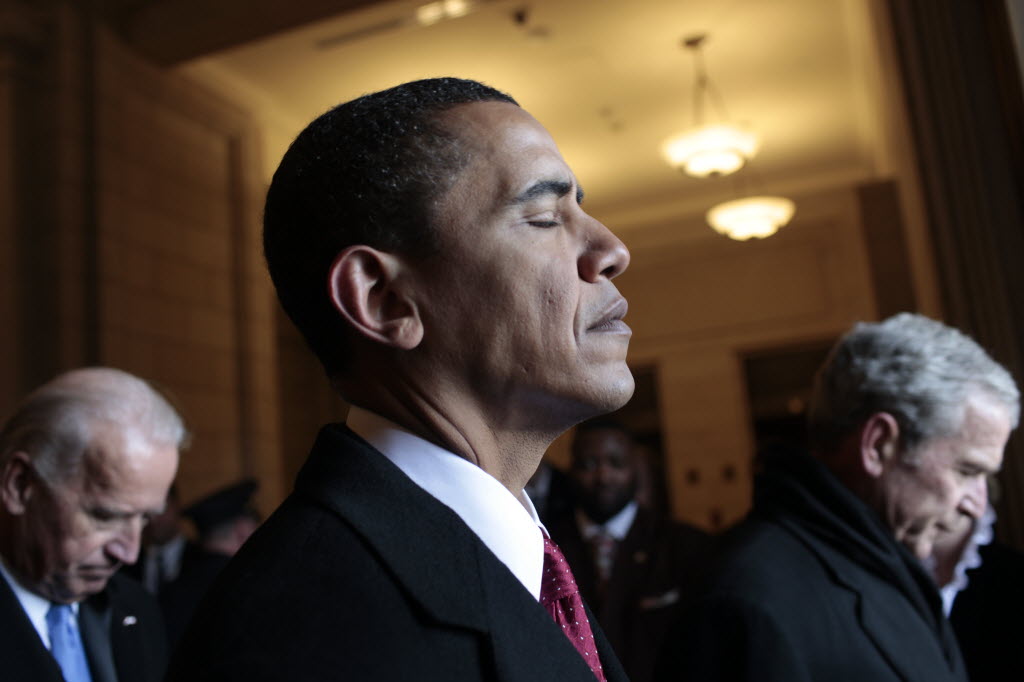
Featured image: President Barack Obama and Vice President Joe Biden wait with former President George W. Bush before a farewell to the Bushes on the steps of the U.S. Capitol following the Inaugural Ceremony in Washington, D.C., Jan. 20, 2009. Available at Wikimedia Commons.

.jpg)