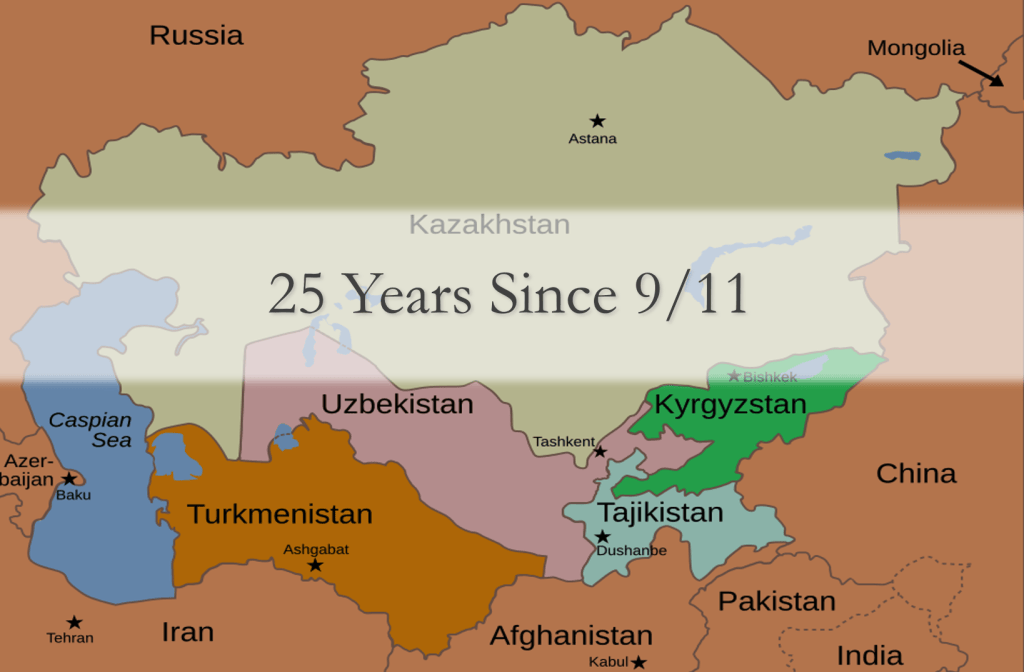
In the dominant narrative of the September 11, 2001, attacks and their aftermath, Afghanistan and Iraq have served as the principal fields of analysis: arenas in which the War on Terror manifested in its most direct form military invasion, occupation, and state-building. Yet in the shadow of these two clamorous battlefields, another region underwent one of the most profound geopolitical realignments of the post-Soviet era in a manner far less noticed, though no less significant: Central Asia. The five post-Soviet republics Kazakhstan, Uzbekistan, Turkmenistan, Kyrgyzstan, and Tajikistan prior to September 2001 had remained largely on the margins of Western strategic attention, but were transformed within a matter of weeks into a logistical and security hub, and ultimately into an arena of competition among the great powers.
This article argues that the consequences of 9/11 for Central Asia cannot be reduced merely to the temporary presence of US military bases and the duration of the wars in Iraq and Afghanistan. What occurred in the region was, rather, a three-layered process: first was the entry of the United States into a space that had previously fallen, in effect, under the Soviet Union and later Russia’s geopolitical monopoly and functioned as something of Russia’s own backyard. Second, the strategic response of Moscow and Beijing led to the formation and consolidation of rival multilateral mechanisms, foremost among them the Shanghai Cooperation Organization. Third, Central Asia’s local governments exploited the global counter-terrorism discourse to legitimize domestic repression and entrench authoritarian rule. The outcome of this threefold process was a region that, twenty-five years after that event, remains caught in the midst of a three-way rivalry among the United States, Russia, and China, and continues to carry the legacy of that era in both its institutional structure and its patterns of governance.
Background: From Mackinder’s Heartland to the Vacuum of the 1990s
To understand the significance that Central Asia acquired after 9/11, one must return to the long-standing tradition of classical geopolitics. In his celebrated “Heartland” theory of the early 20th century, geographer Halford Mackinder identified Central Asia and Eastern Europe as the geographical pivot of the world, arguing that whichever power came to dominate this “World-Island” could achieve mastery over the entire international system. Nearly a century later, US diplomat Zbigniew Brzezinski, in his influential book The Grand Chessboard, termed this same region the “Eurasian Balkans”: a fragile, tension-ridden space that, owing to the power vacuum left by the Soviet collapse, was bound to become a natural arena of competition among Russia, China, Iran, Turkey, and the United States.[1]
9/11 accelerated Brzezinski’s prediction, though not through direct great-power competition but through the operational necessities of the war in Afghanistan. In this vein, international security scholars Barry Buzan and Ole Wæver, in their theory of the “regional security complex,” argue that the security dynamics of peripheral regions such as Central Asia are largely endogenous and local, but that at moments of crisis they can undergo a temporary “mutual penetration” with the global security order[2]. The years 2001 to 2005 were precisely such a moment: Central Asia, until then a relatively closed security complex under Russian dominance, was temporarily linked to the global security system of the fight against terrorism. The linkage itself was temporary, but its consequences for the region proved permanent.
To grasp the depth of the transformation that occurred after 9/11, one must recall the condition of Central Asia in the 1990s. The collapse of the Soviet Union in 1991 thrust these five republics into the international system suddenly and without institutional preparation. Unlike Eastern Europe, which had a clear path toward integration into Euro-Atlantic institutions, Central Asia had no such prospect. The leaders of these republics, often the very elites who had held power under the Communist Party during the Soviet era, established semi-authoritarian or fully authoritarian political systems, while at the same time maintaining extensive economic and security dependence on the new Russian Federation. Russia’s effort to reorganize this space within the framework of the Commonwealth of Independent States (CIS) likewise met with only limited success.
During this same period, the threat of Islamic fundamentalism, particularly from the Islamic Movement of Uzbekistan (IMU) and the Afghan Taliban, was gradually taking shape, yet international attention to it remained limited. The 1999 Tashkent bombings and the IMU’s armed incursions into the Fergana Valley in 1999 and 2000 were warning signs that went largely unheeded[3]. In other words, Central Asia before 9/11 was a “forgotten” region in the truest sense of the word, not because it lacked security threats, but because no great power saw sufficient incentive to invest strategically in it. This situation was completely transformed within a matter of weeks after September 2001.
US Military Presence: From Bases to the Northern Distribution Network
The rapid US response to the 9/11 attacks and the launch of Operation Enduring Freedom in Afghanistan created an urgent need for logistical access and operational bases near Afghan territory. Uzbekistan, sharing a border with Afghanistan and possessing infrastructure inherited from the Soviet era, became Washington’s first and most important regional partner. A Status of Forces Agreement (SOFA) between the two countries was signed on October 7, 2001, just one hour before the start of the aerial campaign against Afghanistan, granting US forces the use of the Karshi-Khanabad airbase, known as K2. The base hosted up to 1,500 US troops and played a pivotal role in special operations, search-and-rescue missions, and logistical support.
In parallel, Kyrgyzstan made Manas International Airport, near Bishkek, available to coalition forces in December 2001. The Manas base, later renamed the Manas Transit Center, moved more than 5.3 million personnel from 26 countries over its 12 years of operation, becoming the main hub for the entry and exit of troops into Afghanistan. A significant point, often overlooked in mainstream accounts, is that the establishment of these bases would not have been possible without Russia’s tacit consent. At the time, Russian leader Vladimir Putin hoped that cooperation with Washington in the Afghan war would earn a similar silence from the West regarding Russia’s operations in Chechnya, a short-term calculation that opened a door that, within a few years, slipped beyond Moscow’s control.[4]
As insecurity intensified along Pakistan’s overland routes from 2008 onward, the United States and NATO needed an alternative corridor to supply their forces in Afghanistan. The response to this need was the formation of the Northern Distribution Network: a system of rail and road routes running from Baltic and Black Sea ports, through Russia, Kazakhstan, and Uzbekistan, to Afghanistan.[5]
This network, which became operational in the second half of 2009, gradually came to carry the bulk of NATO’s supplies, and for the first time drew the Central Asian republics into a Western military operation as direct logistical partners.
The significance of the Northern Distribution Network was not merely logistical. It gave regional governments, particularly Uzbekistan and Kazakhstan, considerable bargaining leverage vis-à-vis Washington, while simultaneously creating a mutual dependence between NATO and transport infrastructure under Russian control, a situation best analyzed through the theory of “weaponized interdependence”: control over critical infrastructural nodes generates a tool of strategic leverage even within seemingly cooperative relationships. Moscow recognized this leverage from the outset and, in subsequent years, particularly after the 2014 Ukraine crisis, made use of it to pressure transit routes.[6]
The Shanghai Cooperation Organization, the Expulsion from K2, and the Legitimization of Domestic Repression
The United States’ military presence in Central Asia, though initially accompanied by the tacit consent of Russia and China, quickly became a source of strategic concern for both powers. The Shanghai Cooperation Organization (SCO) was founded in 2001, only a few months before 9/11, with Russia, China, and four Central Asian republics as members (Turkmenistan excepted); it gradually developed into one of the mechanisms through which Moscow and Beijing coordinated to contain Western influence in the region. The turning point came at the SCO heads-of-state summit in Astana on July 5, 2005, where the member states, in a joint declaration, called on members of the anti-terrorism coalition to set a definite timetable for ending their presence at temporary facilities in Central Asia, given that the active phase of military operations in Afghanistan had concluded. A subtle point, contrary to the simplistic reading that treats this declaration as merely the product of joint Russian-Chinese pressure, is that the clause calling for a timetable was in fact added to the final text at the request of Uzbek President Islam Karimov himself, while Russia and China had in fact sought to moderate its tone. This fact demonstrates that the dynamics behind the decision reflected not so much a unified Russo-Chinese bloc confronting the West as a combination of crosscutting interests among Moscow, Beijing, and Tashkent.[7]
This declaration, issued only a few weeks before Uzbekistan’s decision to expel US forces from the K2 base, was a clear sign of strategic coordination among Moscow, Beijing, and Tashkent. The Andijan events of May 2005, discussed below, provided the immediate pretext for this decision, but its structural context lay in the shared concern of Russia and China over the entrenchment of a permanent US military presence in their “backyard.” By November 2005, US forces had withdrawn completely from K2, and Islam Karimov formally suspended security cooperation with Washington. This development can be understood within the analytical framework of “counter-hegemonic” strategies pursued by regional actors against extra-regional great powers, though this framework must be applied with caution, since Tashkent’s immediate motive, a punitive response to Western criticism of Andijan, was not necessarily identical to Moscow and Beijing’s structural motive of limiting long-term US influence.[8]
Perhaps the deepest, and yet the least noticed, consequence of 9/11 for Central Asia occurred not in the military or diplomatic sphere but in that of domestic governance. The region’s authoritarian governments, Islam Karimov’s Uzbekistan foremost among them, quickly recognized that the global discourse of the War on Terror was an unparalleled instrument for securing international legitimacy for domestic repression. Political opponents, independent religious activists, and even economic critics could now be suppressed under the label of “Islamic extremist” or “terrorist accomplice,” without Washington, which urgently needed these countries’ security cooperation for the Afghan war, raising any serious objection.
The Andijan events of May 13, 2005, represented the culmination of this dynamic. After an armed raid freed 23 local businessmen accused of Islamic extremism from prison, a large-scale protest formed in Andijan’s Bobur Square, to which Uzbek security forces responded with indiscriminate gunfire. The Uzbek government put the death toll at 173, attributed mainly to terrorist attackers and security personnel. Field investigations based on interviews with dozens of eyewitnesses, however, concluded that the actual death toll was far higher, amounting to hundreds of civilians, although the Uzbek authorities’ complete sealing off of the city made it impossible to establish a precise figure.[9]The Karimov government justified the massacre as a legitimate operation against terrorists, a narrative already sanctioned by the very discursive framework of the global fight against terrorism. Washington’s comparatively mild initial reaction to the event, set against the European Union’s more explicit condemnation, can be read as evidence that in the post-9/11 strategic calculus, military access temporarily took precedence over human rights considerations. This interpretation should not, however, be read as denying the existence of Washington’s diplomatic criticism, however limited it was. The broader pattern of relying on counterterrorism discourse to legitimize repression was likewise repeated, in milder and less well-documented forms, in Tajikistan, Kazakhstan, and to some extent Kyrgyzstan, though the severity and documentation of these cases are not comparable to the Andijan example.[10]
From the Military Arena to the Economic Arena: The Rise of China and Energy Corridors
While Washington’s military attention was fixed on Afghanistan, China quietly and unobtrusively expanded its economic presence in Central Asia. This process, which had begun before 9/11, accelerated over the following two decades and reached its peak with the launch of the Belt and Road Initiative in 2013, a plan that Xi Jinping himself first announced in a speech delivered in Kazakhstan. The Central Asia-China gas pipeline (connecting Turkmenistan, Uzbekistan, and Kazakhstan to China’s energy network) and China’s extensive infrastructure investments in railways, roads, and mining gradually shifted the region’s economic dependence from a Moscow-centered axis to a Beijing-centered one.
This shift can be analyzed through Albert Hirschman’s theory of asymmetric trade dependence (Hirschman, 1980): as China’s share of the Central Asian republics’ foreign trade and foreign direct investment grew, Beijing’s political leverage grew correspondingly, without any need for a direct military presence, a trend that can be observed within the broader framework of Russo-Chinese competition and cooperation in Central Asia.[11]A distinction must, of course, be drawn between the two spheres of influence: in the economic sphere, China’s weight has been steadily increasing, whereas in the security sphere, Russia, through the Collective Security Treaty Organization and its remaining military bases, remains the dominant actor. On this basis, the claim that China has fully replaced Russia would, as of today, be an overstatement. Nevertheless, it can be argued that the longer-term consequence of 9/11 for Central Asia was not merely the temporary US military presence, but rather the power vacuum that this presence together with its subsequent withdrawal created in the face of the gradual expansion of Chinese economic influence. In other words, while Washington focused on war, Beijing invested in infrastructure—an asymmetric rivalry whose consequences, at least in the economic dimension, are now clearly visible.
US Withdrawal and an Unfinished Legacy: Central Asia in the Post-US Era
The process of US military withdrawal from Central Asia, which had begun with the expulsion from K2 in 2005, continued in subsequent years. Kyrgyzstan’s newly elected president, Almazbek Atambayev, announced in November 2011 that the Manas base would be closed by the summer of 2014, in step with the ISAF withdrawal schedule from Afghanistan. This commitment was effectively cemented in September 2012, during Putin’s visit to Bishkek, in exchange for a fifteen-year extension of the lease on the Kant military base and the forgiveness of nearly $500 million of Kyrgyzstan’s debt. This sequence indicates that Atambayev’s initial political motive was subsequently reinforced and finalized by a concrete financial incentive from Moscow. In June 2013, Kyrgyzstan’s parliament formally set July 11, 2014, as the withdrawal date, and in June 2014 the last US troops left the Manas Transit Center, an event that marked, in the truest sense, the end of the last official US military base in Central Asia.
This process reached its symbolic endpoint seven years later, with the fall of Kabul to the Taliban in August 2021. The chaotic US withdrawal from Afghanistan not only ended twenty years of Western military presence in the region but once again confronted the Central Asian republics with a security question reminiscent of the 1990s: how to coexist with an unstable Afghanistan, absent the protective umbrella of Western security guarantees? Tajikistan’s response (continuing to host Russia’s 201st Military Base) and the more cautious approach of Uzbekistan and Turkmenistan toward the Taliban both reflected precisely this return to a pre-9/11 security logic, though this time in the shadow of extensive Chinese economic influence and an entrenched Russian security presence.
Twenty-five years after 9/11, Central Asia is no longer a “forgotten” region, not because the United States established a durable strategic presence there, but because the vacuum created by the US entry and exit entrenched the other two powers, Russia and China, as the region’s dominant actors. This situation can be explained through classical balance-of-power theory: the temporary intervention of an extra-regional power, rather than establishing a stable order, primarily intensified the dynamics of rivalry among neighboring regional powers. The continuity of Russia’s security role, made clearly evident in January 2022 with the deployment of Collective Security Treaty Organization forces to suppress unrest in Kazakhstan, together with the region’s growing infrastructural dependence on China, indicate that the security fragility to which 9/11 first drew global attention was never fully resolved; it merely dropped out of the Western media’s field of view after 2021. Drawing on two decades of experience, Central Asian governments now find themselves in a far more complex position for balancing among Moscow, Beijing, and, to a more limited extent, Washington, a strategy some analysts term “cautious multilateralism” or “multi-vector diplomacy.” This strategy should not, however, be taken as a sign of complete independence; rather, it reflects the structural constraints of states that simultaneously require Chinese capital, Russian markets and security facilities, and, to a lesser degree, Western legitimation.
Institutional Legacy: From the C5+1 Mechanism to Washington’s Limited Return
To regard the United States’ withdrawal from Central Asia as consisting essentially of its military-logistical dimension alone, and to base conclusions about Washington’s complete exit from the region solely on this, may yield an incomplete picture. The reality is that, even as its military presence gradually diminished, the United States embarked on a parallel and less costly track of diplomatic-institutional engagement that, unlike its military bases, proved more resilient against pressure from Moscow and Beijing.
C5+1 refers to the diplomatic and economic dialogue platform bringing together the five Central Asian republics Kazakhstan, Kyrgyzstan, Tajikistan, Turkmenistan, and Uzbekistan and the United States. The first meeting of the C5+1 mechanism was held on November 1, 2015, in Samarkand, led by then US Secretary of State John Kerry. This meeting brought together the five Central Asian republics and the United States within a regular institutional format. Unlike the K2 and Manas bases, whose function was purely operational and tied to the Afghan war, C5+1 was designed from the outset as a civilian, long-term mechanism encompassing trade, energy, the environment, and regional security.
It is important to note that this mechanism not only survived the withdrawal of US forces from Manas in 2014 but continued, and indeed was further consolidated, after the fall of Kabul in 2021. In 2022, a permanent C5+1 secretariat was established, and in September 2023 Joe Biden convened the first summit of heads of state under this mechanism on the sidelines of the UN General Assembly, an event that for the first time elevated engagement from the ministerial to the presidential level.
This trajectory continued in November 2025, when Donald Trump hosted the leaders of the five Central Asian states in Washington to mark the mechanism’s tenth anniversary. This summit was shaped largely around competition with Russia and China over strategic mineral resources and the Middle Corridor (Trans-Caspian route).
It can be argued that America’s withdrawal from Central Asia was not a unified, linear phenomenon, but must instead be disaggregated into two distinct tracks. The first is the military-operational track, which came to a complete and definitive end in two stages, starting in 2014 with the departure from Manas and, subsequently culminating in 2021 with the fall of Kabul. The second is the diplomatic-institutional track, which not only continued but, in the absence of the operational pressures of the Afghan war, found greater room to expand. In other words, what the news media often characterizes as the US withdrawal from Central Asia, is better understood, at the level of institutional diplomacy, a realignment rather than a complete cessation of Washington’s engagement with the region.
Moreover, greater caution should be exercised in applying the metaphor of the “new Great Game.” By reducing the agency of local governments to that of merely passive objects in great-power rivalry, this metaphor offers an overly simplistic representation of the region’s actual dynamics. The persistence and reactivation of the C5+1 mechanism show that the Central Asian governments have themselves, actively and by their own volition, participated in maintaining a channel of communication with Washington alongside Moscow and Beijing, not merely as a passive arena of competition, but as actors who strategically benefit from balancing among the three powers.
Conclusion
In the prevailing historiographical narrative of 9/11, Central Asia has consistently remained on the margins of Afghanistan and Iraq. A Central-Asian centered analysis, however, reveals a more complex history that includes a recurring pattern in the relations of great powers with post-imperial peripheral regions. First, an exogenous shock transforms a relatively neglected space into a strategic node. The intervening power then withdraws from the scene, for operational or political reasons, and, finally, neighboring powers fill the resulting vacuum, not through military entry, but through the gradual consolidation of institutional and economic influence. If this pattern, which might be termed the cycle of peripheral activation and reabsorption, is not confined to Central Asia, then its potential generalizability to the Caucasus after 2008, or even to other regions, is a subject that future comparative research should pursue.[12]
The question of whether 9/11 functioned as a principal cause or merely as an accelerator of processes already under way remains unresolved.[13] What has become increasingly evident twenty-five years after that event is that Central Asia remains not a closed chapter of history, but a dynamic and recurring arena of great-power competition over energy and transit corridors, a legacy clearly reflected in the current rivalry over routes that bypass Russia in the aftermath of the war in Ukraine.
[1] Zbigniew Brzezinski, The Grand Chessboard: American Primacy and Its Geostrategic Imperatives (New York: Basic Books, 1997).
[2] Barry Buzan and Ole Wæver, Regions and Powers: The Structure of International Security (Cambridge: Cambridge University Press, 2003).
[3] International Crisis Group, “Central Asia: Islamist Mobilization and Regional Security, ICG Asia Report No. 14” (Brussels: International Crisis Group, 2001).
[4] Alexander Cooley, Great Games, Local Rules: The New Great Power Contest in Central Asia (New York: Oxford University Press, 2012).
[5] Andrew C. Kuchins, S. Frederick Starr, and Thomas M. Sanderson, The Northern Distribution Network and the Modern Silk Road: Planning for Afghanistan’s Future (Washington, DC: Center for Strategic and International Studies, 2009).
[6] Henry Farrell and Abraham L. Newman, “Weaponized Interdependence: How Global Economic Networks Shape State Coercion,” International Security 44, no. 1 (2019): 42–79.
[7] Akihiro Iwashita, “The Shanghai Cooperation Organization and Japan: Moving Together to Reshape the Eurasian Community” (Washington, DC: Brookings Institution, 2008).
[8] Cooley, Great Games, Local Rules.
[9] Human Rights Watch, “‘Bullets Were Falling Like Rain’: The Andijan Massacre,” May 13, 2005 (New York: Human Rights Watch, 2005).
[10] Cooley, Great Games, Local Rules.
[11] Paul Stronski and Nicole Ng, Cooperation and Competition: Russia and China in Central Asia, the Russian Far East, and the Arctic (Washington, DC: Carnegie Endowment for International Peace, 2018).
[12] The experience of the Northern Distribution Network and the Manas and K2 bases demonstrate that logistical and transit infrastructures, too, even without a surveillance- or data-based function, can become instruments of strategic leverage. In other words, weaponized interdependence is not solely an economic-informational phenomenon but can also be traced in the domain of military logistics and overland transport. Extending this theoretical framework to the domain of physical infrastructure is a contribution this research can offer to the existing literature.
[13] A test of falsifiability for this question might involve comparing the pace of the SCO’s institutionalization and the expansion of Chinese investment against a hypothetical “no-9/11” counterfactual scenario, an undertaking that would require quantitative and comparative research beyond the scope of this article.