John Rambo: Sir…do we get to win this time?
Commander Trautman: This time…it’s up to you!
Introduction
In 1988, video game company Acclaim released Rambo for the Nintendo Entertainment System (NES). Film tie-ins were common in the NES’s heyday, but Rambo was a curious release. In the first film of the Rambo franchise, First Blood (1982), the character of John Rambo is a traumatized Vietnam veteran, a drifter harassed by local police who snaps and terrorizes an entire town—not exactly an ideal premise for a kid’s video game. This may explain why Acclaim modeled the Rambo game after the more bombastic sequel, Rambo: First Blood Part II (1985), in which Rambo returns to Vietnam to rescue American POWs, bolstering the myth that the US left service members behind.[1] Yet, even that plotline is subverted in the game, as players primarily battle with a red blunt knife to kill spiders and swooping bats. Put simply, Rambo for the NES, like its source material, abandoned much of the realism of Vietnam; yet, unlike its source material, it eschewed fantastical Hollywood violence in an effort to be considered acceptable for a youthful American audience.
In altering its source material, Acclaim was following the Rambo film franchise’s lead. In First Blood the novel—the 1972 work on which the initial 1982 film is based—Rambo dies alongside his commander Sam Trautman. In the film version, however, Rambo survives, but only after giving an emotional speech about indignities, real and imagined, that returning Vietnam vets had endured. Rambo claims not only to have been called “baby killer,” but also that he was spat upon by “maggots at the airport” (read: antiwar protestors).[2] The film’s sequel, however, abandoned the trope of the sympathetic misfit veteran. In Rambo: First Blood, Part II (hereafter “Rambo II”) John Rambo returns to Vietnam to rescue long-abandoned POWs and kill countless Vietnamese soldiers. In Rambo II, the most ominous “bad guys” aren’t even the Vietnamese, but rather the US commanders who hinder Rambo’s rescue mission—just as, per the film’s logic, they allegedly did during Vietnam. This shift from a confused cautionary tale to revenge fantasy resonated with audiences in the Reagan Era; Rambo II was the third-highest grossing film of 1985.[3]
The US video game industry emerged in 1972 with the concurrent releases of the Magnavox Odyssey and Pong, and it matured throughout the 1980s and 1990s—two periods of shifting cultural perceptions about the Vietnam War.[4] Today, companies like Nintendo, Sony, and Microsoft dominate an industry that regularly nets more profit than the film and music industries combined. As a major arena of American popular culture, video games reflect much about our society. Tracing the evolution of Vietnam War-themed games reveals not only the Vietnam War’s legacy, but also how American culture represented that war before 9/11, and how those representations changed in the crucial post-9/11 years of the Global War on Terror (GWOT).[5]
Video Games and the Vietnam War
Notably, from the 1980s until September 11, 2001, only 22 video games total were set during the Vietnam War. After 9/11, however, 65 Vietnam War games emerged on the American market, with a notable surge of releases shortly after 9/11. This increase of Vietnam War-themed games is notable, even though since 1993 the industry released roughly 700 video games per year.[6] Data reveal a marked increase just after 9/11, as the graph below indicates, showing that developers felt more comfortable with—or believed consumers were ready for—Vietnam War releases.

The tragic events of 9/11 became a flashpoint that led to the reconfiguration of American militarism and attitudes about the US military, which reverberated in the video game industry. Of course, 9/11 alone did not make the Vietnam War a newly “safe” setting for game developers. A decades-long reconfiguration of the war in American memory began in the 1970s; its proponents contested the “Vietnam Syndrome” that viewed American militarism, and especially the commitment of American ground troops in new wars, with skepticism.[8] While quelling the Vietnam Syndrome was not fully accomplished until the immediate years following 9/11, rhetoric to combat it first arose not long after the American withdrawal from Vietnam in 1975.
The Vietnam Syndrome
The last American personnel fled Saigon in 1975 as television cameras captured the final manic, tragic scenes: thousands of Vietnamese citizens begging for US transports to take them to safety; the American embassy, now abandoned save a few uncertain Marines; and helicopters pushed into the sea to fit more refugees. These dour images capped years of critical press coverage on Vietnam. In addition to nightly newscasts tallying American casualties, major stories included the Tet Offensive (1968) and My Lai massacre (1968 but not revealed until 1969) and at home the Kent State Massacre (1970) and publication of the Pentagon Papers (1971). Even before journalistic coverage of the war became increasingly critical in 1968, President Lyndon B. Johnson declared in 1967: “We need to get a better story to the American people.”[9] By 1975, the war left the United States fractured and exhausted.[10] In time, pundits dubbed the lingering skepticism of American militarism “the Vietnam Syndrome.”
Even as Neoconservative intellectuals railed against the Vietnam Syndrome and the US embarked on limited military actions—deploying ground troops in Grenada and Lebanon (1983) and supporting ongoing clandestine operations in Latin America, among others—the “Vietnam Syndrome” persisted in popular culture, especially in Hollywood.[11] While popular 1970s Vietnam films were mostly cautionary tales, including The Deer Hunter (1978), Coming Home (1978), Go Tell the Spartans (1978) and Apocalypse Now (1979), 1980s Vietnam films more often showed Gis doing terrible things or having terrible things done to them. These included soldiers burning hooches in Platoon (1986) and murdering and raping a civilian in Casualties of War (1989), as well as soldiers describing being on leave and fellow Americans throwing dog excrement at them in Hamburger Hill (1987). Notably, while the first two examples evoke real events from the Vietnam War, the last one is entirely cinematic.
Like in film, lingering aspects of the “Vietnam Syndrome” appeared in the era’s video games. From 1982 until 1989, the North American video game industry released just ten Vietnam-themed games. Of these, most were top-down shooters that could have been set in any jungle on earth. Two were fighter-plane or gunboat simulators. In one game, 19 Part One, players never even leave boot camp. Only two turn-based strategy games featured detailed and historical information about the Vietnam War: VC, a 1982 game for the Apple ii; and Conflict in Vietnam, a 1986 logistical strategy game co-produced by Sid Meyer. Meyer later became famous for his detailed simulation games SimCity and Civilization, and Conflict in Vietnam is clearly their logical precursor. In these games, you direct resources—ammunition, supplies, troops—to fend off National Liberation Front (NLF)—or, in the parlance of the US during the Vietnam War and the game, “Viet Cong”—forces.
With only two 1980s video games representing the war with some historically accurate details, it seems that that the Vietnam War remained a sensitive subject for developers. While two games tackled the topic with some seriousness, the inclusion of historical events, like the Tet Offensive and My Lai, were common in a 1980s home computer market that frequently marketed games as both fun and educational. As the Reagan Era gave way to the 1990s, however, education took a backseat to pure entertainment. While more detailed Vietnam War video games emerged, they remained scant in number.
The 1990s
In the 1990s, as the United States led coalition forces in the Gulf War, then-president George H. W. Bush proclaimed an end to the Vietnam Syndrome, stating “this will not be another Vietnam” and that it was finally time to “kick the Vietnam Syndrome.”[12] After the Gulf War (1990–91), Bush’s bellicosity faded as he refocused on economic issues and an unsuccessful re-election bid. Despite the forceful rhetoric and a surge of triumphalism at the decade’s outset, there was no explosion of Vietnam War-themed video games on the market.
Of the scant eleven major label Vietnam War-themed video games released in the 1990s, only two depict authentic aspects unique to the Vietnam War. The others simply adopt the Vietnam War as a ready-made backdrop for already-designed gameplay. These include five flying games, including Flight of the Intruder, a 1990 game about a Vietnam fighter pilot that was adapted the following year as a film; Gunboat, another 1990 release in which players traverse Vietnamese rivers; 1991’s Chuck Yeager’s Air Combat, which features a historical Vietnam scenario; Vietnam, a 1995 co-op flying game for CompuServ; and M.I.A., a 1998 helicopter shooter game. There was also one dyed-in-the-wool strategy game, 1999’s Operational Art of War II: Modern Battles, and one First Person Shooter (FPS), NAM, modeled after the popular game Doom.
Still, the 1990s produced a few releases with historically detailed aspects of the Vietnam War. The first, Nam 1965–1975, is a strategy game in which players can choose to act as President Johnson or President Richard Nixon, or they can command American units in Vietnam. Gameplay involves planning political or military logistics, so while gameplay itself is focused on resource allocation, the details of the wartime setting are extremely accurate.
The other two entries were sober and unflinching attempts to represent the Vietnam War experience. The first, SEAL Team (1993), toggles between above-ground strategizing and on-the-ground action, which takes the players out of a “god-like” viewpoint to the limited visibility of the jungle. The second, The Lost Patrol (1990), is arguably the most humanizing Vietnam War video game of the decade. In it, a player leads a small platoon back to safety, but this is not simply frantic flying or shooting. At times, players order soldiers to rest or forage for food, then unexpectedly find themselves in a firefight with the NLF. Such periods of relative boredom interspersed with deadly gunfights is more representative of search and destroy missions during the Vietnam War than is possible in a strategy game or shooter scenario.
The Lost Patrol and SEAL Team both demonstrated that video games were beginning to depict the Vietnam War from a more historically accurate perspective and evoke a visceral experience. Yet, with only eleven releases in ten years, the American experience in Southeast Asia was still viewed by the game industry as either too sensitive of a subject or not sufficiently marketable. That would change after 9/11.
9/11 & Beyond
The tragedy of 9/11 firmly reestablished militarism in American culture. President George W. Bush had already surrounded himself with Neocons, including Vice President Dick Cheney, Defense Secretary Donald Rumsfeld, and Rumsfeld’s deputy, Paul Wolfowitz. These men were veterans of the Gerald Ford administration and had long been pushing neoconservative ideas. With 9/11, their opportunity had arrived. During the Bush administration, US foreign policy rejected the “Vietnam Syndrome” with rhetoric that declared a new policy of preemptive war and with interventions that committed troops on the ground long-term. Those actions began in Afghanistan in late 2001, closely followed by a second war with Iraq in 2003.[13]
While there were record-setting international protests against US entry into Iraq, the vast majority of both Democrats and Republicans in Congress initially supported the Bush administration, not only in Afghanistan but also in Iraq. On October 11, 2002, Congress voted to go to war with Iraq.[14] Notably, in his famous “Axis of Evil” speech in January 2002, the president bypassed any mention of Vietnam, revealing how remote the lessons of that war appeared to his administration. Instead of the 1960s or 1970s, Bush hearkened back to World War II, calling 9/11 a “Pearl Harbor” for the twenty-first century.[15] After decades of combating the Vietnam Syndrome, a new post-9/11 reality had emerged, not only in terms of military ventures, but also, it would soon be clear, in the relationship between military and civilian authority.
Even years after public opinion turned against the Iraq War, a 2009 poll revealed that a majority of Americans still agreed that military leaders, not politicians or elected officials, should be making combat decisions on the ground.[16] It was during this period, one marked by a new willingness to defer decisions to the military, that a wave of triumphalist and otherwise problematic war films and TV series appeared. HBO’s Band of Brothers (2001), a reimagining of the popular Stephen Ambrose book, became hugely popular post-9/11. Even into the Obama administration, a slew of films—The Hurt Locker (2008), Zero Dark Thirty (2012), and American Sniper (2014) began mythologizing the GWOT while it was still ongoing. Given this trend of military mythologization in popular culture, it should not be surprising that in the 2000s, numerous violent and immersive Vietnam War video games flew off of store shelves. [17]
After 9/11, sixty-five Vietnam War-themed video games were released, with a notable surge in the immediate post-9/11 years—including ten in 2004 alone. These games were also more immersive experiences thanks to improved technology and graphics. Many featured period-appropriate rock music, including “Paint it Black” by the Rolling Stones, Canned Heat’s “Going up the Country,” and “Fortunate Son” by Creedence Clearwater Revival.[18] While the graphics and music are more realistic, it’s the dialog in these games that is most important, as it reveals a rejection of the “Vietnam Syndrome.” In Conflict: Vietnam, for example, characters routinely investigate villages while throwing out epithets like “Dirty Commie! I’ll murder you!” Any hesitancy in video games to depict unseemly aspects of the war—which were omnipresent in 1980s films but not in that era’s games—shifted after 9/11.
Most of these post-9/11 releases were first-person shooter (FPS) games, which became a dominant video game design in the early 1990s, especially after the success of Wolfenstein 3D, Doom, and Quake (all from ID Software). The trend makes sense. Counterinsurgency operations are ideal settings for FPS games, which feature squads working in small groups. Thanks to the popularity of online co-operative (or team) tournaments, FPS engines became commonplace by the 2000s. Yet, it was only after 9/11 that game developers adopted in earnest the Vietnam War as a playable FPS setting. Not all were bestsellers; in fact, most were forgettable. However, in the 2000s Vietnam War themes were featured in arguably the three biggest FPS series of the era—Call of Duty, Battlefield, and COD: Black Ops. The inclusion of the Vietnam War as a playable scenario in these games confirms that Vietnam was no longer questionable material for publishers.
Because Call of Duty, Battlefield, and Black Ops were bestsellers with the furthest reach, dialog from those titles merits analysis. Interestingly, most Non-Playable Character (NPC) dialog—meaning dialog delivered to you, the player, via non-playable characters—now blithely discuss topics that would have alarmed Americans in the 1970s. For example, in Call of Duty: Black Ops’ Vietnam level, NPCs speak casually about staging operations in nearby Cambodia and Laos—the former event, notably, is what sparked protests that included the tragedy at Kent State University. Other dialogue is clearly influenced by early 2000s Stephen Ambrose-influenced popular culture. In Far Cry 5’s downloadable Vietnam level “Hours of Darkness,” an opening text box reads: “in war, you don’t always get to choose who lives and who dies. All you can do is stand with your brothers.” Such dialog suggests that in the years following 9/11, Vietnam War video games absolved players of guilt by leaning into the mythical ethos promulgated on film and television. An emphasis on soldierly brotherhood, not decision-maker morality, was apparent in Saving Private Ryan (1998), HBO’s Band of Brothers (2001), and its follow-up, The Pacific (2010). As Michael C.C. Adams has persuasively shown in The Best War Ever, such positive pop cultural depictions of WWII were misleading yet popular, precisely because they filled a need in an uncertain post-9/11 world.[19]
Conclusion
In 2018, a new flash game was released by developer Le Hieu. Entitled NAM – Bare Feet, Iron Will, players can find themselves wielding an AK-47 as an NLF soldier, guiding other players down the Ho Chi Minh trail. Inspired by a 2010 book about the NLF perspective of the war, Bare Feet, Iron Will lets gamers play the “other side” of Vietnam.[20] What’s notable is that by 2018, that wasn’t even a bold choice. After 9/11, and the echo chamber of performative patriotism it engendered, gamers knew that morality was flexible; since all soldiers are neutral actors—be they American or “Viet Cong”—following the command of superiors in military conflicts is never up for question, so just have fun.
This lack of moral center was reflective of the post-9/11 moment. The initial surge of support for the invasion of Iraq faded as the US became bogged down in that war and, eventually, Afghanistan became America’s longest war, surpassing Vietnam in duration. Americans’ ambivalence about the post-9/11 wars was reflected in a new wave of Vietnam War-themed video games. Unlike their precursors, these post-9/11 video games largely accepted wartime Vietnam as an acceptable playable—even immersive—setting for video game audiences. In 2026, Team17 published Hell Let Loose: Vietnam, a violent First-Person Shooter, on Steam. Today, even as the US is at war with Iran, gamers, who are now accustomed to playing in a digitized jungle that represented a once-highly contentious war, continue to play at war. This is something they learned to do in a post-9/11 moment that not only sanitized American wars past, but, with President Bush’s suggestion just weeks after 9/11 to “go shopping,” encouraged escapism as a response to national strife.
[1] See Edwin Martini, Invisible Enemies: The American War on Vietnam, 1975-2000 (University of Massachusetts Press, 2007).
[2] On the “spat upon veteran” trope, see Jerry Lembcke, The Spitting Image: Myth, Memory, and the Legacy of Vietnam (New York University Press, 2000).
[3] Box Office Mojo: https://www.boxofficemojo.com/year/1985/
[4] On shifting cultural perceptions, see Christian G. Appy, American Reckoning: The Vietnam War and our National Identity (Penguin, 2016); see also David Sirota, Back to Our Future (Ballantine Books, 2011).
[5] Harold Godlberg, All Your Base are Belong to Us: How Fifty Years of Videogames Conquered Pop Culture (Three Rivers Press, 2011), xi.
[6] Dataset on total video game industry growth (not Vietnam War games) begins in 1993. Calculating any exact number of video games released in a given year is difficult because of delivery platforms, consoles, and mobile apps. Since 2010, overall video game releases increased with the widespread adoption of streaming games (i.e., less physical media). See https://gamrconnect.vgchartz.com/thread.php?id=248467
[7] Dataset began with Wikipedia’s entry on “Vietnam War Video Games,” crosschecked with Reddit and industry sites, but playthroughs showed that some entries were erroneous and not set in Vietnam; these were omitted from calculations. This list also omits homebrew or do-it-yourself games and recent Steam downloads.
[8] See Appy, American Reckoning.
[9] Chester Pach, “’We Need to Get a Better Story to the American People’: LBJ, the Progress Campaign, and the Vietnam War on Television,” in Selling War in a Media Age: The Presidency and Public Opinion in the American Century, eds. Kenneth Osgood & Andrew K. Frank (University Press of Florida, 2010), 170-199.
[10] On the fracturing of American society during and post-Vietnam, see Rebecca E. Klatch, A Generation Divided (University of California Press, 1999); see also Kevin M. Kruse and Julian E. Zelizer, Fault Lines: A History of the United States since 1974 (W.W. Norton & Co., 2025).
[11] George Herring, From Colony to Superpower (Oxford University Press, 2009), 861–97.
[12] “Bush Promises to Heal War’s Wounds,” United Press International, March 4, 1991.
[13] For a study of the Bush administration’s wars in the Middle East, see Terry Anderson, Bush’s Wars (Oxford University Press, 2011).
[14] Anderson, Bush’s Wars, 109-118; for the Congressional Resolution, seehttps://www.congress.gov/bill/107th-congress/house-joint-resolution/114.
[15] Anderson, Bush’s Wars, 94-95.
[16] CNN Opinion Research Corporation Poll, October 30-November 1, 2009; see Sirota, Back to Our Future, 243.
[17] Terry Anderson, Bush’s Wars (Oxford University Press, 2011), 36-37; FPS popularity, based on online rankings, is immense: Call of Duty is the 4th best-selling video game series of all time; Battlefield came in at 25th place. https://vgsales.fandom.com/wiki/Best-selling_game_franchises.
[18] These songs appear in Conflict: Vietnam (2004) and Vietcong (2003); on the importance of rock music for Vietnam soldiers, see Doug Bradley and Craig Werner, We Gotta Get Out of this Place: The Soundtrack to the Vietnam War (University of Massachusetts Press, 2015).
[19] On the film legacy of WWII, see Michael C. C. Adams, The Best War Ever: America and World War II
[20] James G. Zumwalt, Bare Feet, Iron Will: Stories from the Other Side of Vietnam’s Battlefields (Fortis, 2010).
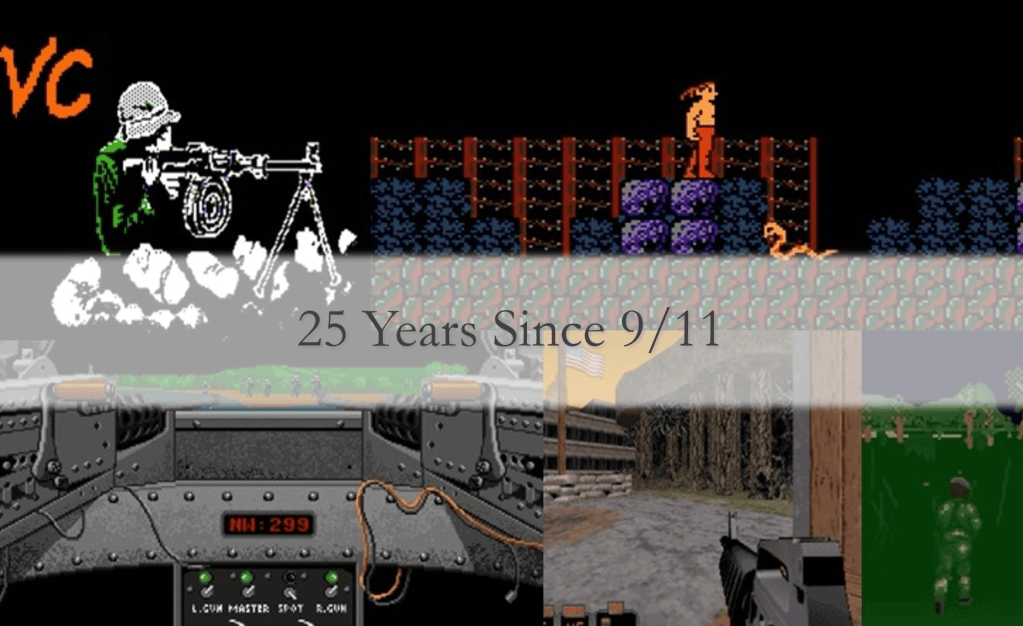
Featured image created by author. Top left: VC, a 1982 release by Avalon Hill. Top right: Rambo, a 1988 release by Acclaim. Lower left: Gunboat, (1990) by Accolade. Lower middle: M.I.A. (1998), by GT Interactive (this game sold at Wal-Mart retailers entitled Napalm). Lower right: SEAL Team (1993) by Electronic Arts.