Introduction
The history of sonic culture after 9/11 is, in large part, a history of sound’s capacity for force. In the two decades that followed 2001, different American institutions put sound to different ends. While radio programmers worried about what music might mean to listeners in the immediate aftermath of the attacks, military organizations and other state authorities began to treat sound as a tool that could be used to disorient, exhaust, injure, and coerce. This essay traces the relationship between these theories of listening—from sound as a vehicle of meaning to sound as a form of physical force—showing how these approaches came to shape one another. Together, these theories reveal a transformation in American sonic culture, where sound became increasingly understood as something that could act upon the listener.
Two days after 9/11, a program director at one of Clear Channel Communications’ eleven hundred radio stations made a list of songs he thought might be inappropriate to play that week. He sent it to some colleagues, many of whom replied-all, added their own suggestions, and forwarded it onward. By the time the list leaked—first to Hits Daily Double, and then to Slate—it covered over a hundred titles, plus a blanket entry for Rage Against the Machine’s entire catalog. In the aftermath of the attacks, Rage’s explicitly anti-military politics rendered its entire discography newly suspect. The songs rumored to have appeared on the list touch, in their titles or their lyrics, a loose cluster of nouns bearing some relation to the attacks: airplanes, bombs, fire, falling, New York, the month of September, countries in the Middle East, among others. Taken one at a time, each association makes some sense. Taken together, they produce an inchoate and oddly prescient picture of the world that was about to arrive.
Today, it might be tempting to view the Clear Channel memo as a bizarre story about a medium that streaming has since all but hollowed out. But airplay in 2001 was enormously consequential, especially for artists trying to break into the industry. As Bob Buchmann, then program director at WAXQ put it, “if you weren’t in front of a television or you weren’t an eyewitness, radio was your connection.” This meant that a suggestion that circulated among programmers could end a song’s momentum overnight, which is more or less what happened in the wake of 9/11 to the band Drowning Pool. A numetal group from Dallas, Drowning Pool had recently released the single “Bodies,” which the band maintained was about what happens in the pit (“moshing,” for the uninitiated). But, just six weeks after the song’s release, the link “let the bodies hit the floor” took on new and unintended connotations.
What exactly the memo constituted has been in dispute ever since. Reports have called it a blacklist, a “do not play list,” or a compilation of lyrically questionable songs; Clear Channel, meanwhile, denies that it banned anything at all. In a narrow sense, the denial is accurate—what became known as the “Clear Channel Memo” was a set of suggestions meant to prompt reflection rather than a strict edict. The more useful question is not whether the list carried formal power, but rather what the fact of its circulation reveals about radio in 2001. That so many people immediately understood the implicit power of such a document suggests a widely shared recognition that radio programmers could—and in moments of crisis, perhaps should— exercise judgment over what the public heard.[1] Implicit in the memo is also a theory of listening—the idea that sound is dangerous because of what it has the potential to mean.
Within two years, American interrogators working in the detention centers in Iraq and at Guantánamo Bay adopted a theory of sound that ran in the opposite direction. There, the danger lay not in what sound might mean to a listener but in what effects it could produce on or from the body. It was sound’s capacity to injure that became a tool of interrogation. In the twenty-five years since 9/11, American institutions embraced leveraging sound as a physical and painful coercive force. That movement took place at two interconnected sites: the detention camp at Guantánamo, where sound became a condition of confinement, and in American neighborhoods, where protesters encountered new forms of crowd control. Together, they reveal a theory of sound that would come to pervade American sonic culture, from the most coercive uses of volume to the most quotidian acts of listening.
Conditions of Detention
Camp Delta was the principal detention facility at the U.S. naval base at Guantánamo, built in 2002 to hold men captured in the expanding Global War on Terror. The detention center was a purpose-built environment of confinement, assembled on the southeastern edge of a military installation that was itself an unusual legal and geographic space – leased Cuban territory, which the Bush administration understood as placing the men held there beyond the reach of American law. In 2004, standard procedure at Camp Delta involved making detainees, in political scientist’s Darius Rejali’s description, “endure strobe lights and screamingly loud rock and rap music played through two close loudspeakers.”
The practice was not unique to Guantánamo. So-called futility techniques appear in the Army’s field manual well before September 2001, with the stated purpose of “convince[ing] the detainee that resistance to questioning is futile… engender[ing] a feeling of hopelessness and helplessness.” The object is not just simply bodily pain but something more expansive: the reorganization of a detainee’s sense of what is possible, an environment in which he comes to understand that he has no say in what comes next. In 2005, in American-occupied Iraq, interrogators had already subjected detainees to what one account described as “a fearsome mix of Metallica and Barney the Dinosaur.” The settings and legal arguments surrounding these circumstances differed between Guantánamo and Iraq, but in both places music operated as a feature of an environment the detainee could not alter.
After 2001, futility became one instrument within a much larger repertoire of no-touch torture, which is defined as forms of coercion that leave no visible evidence of injury. Musicologist Suzanne Cusick argues that sound and music suit contemporary torture because “current empires are all based on what could be called ‘no-touch’ principles of control, principles of controlling bodies in which there’s no person you can blame…” Across the black sites—Bagram in Afghanistan, Abu Ghraib in Iraq, and Guantánamo Bay in Cuba—interrogators combined isolation, sleep deprivation, sensory manipulation, temperature extremes, forced nudity, stress positions, and sound. These practices differed considerably in their immediate effects, but they shared the characteristic of durability. Rather than a single violent act marked by an obvious beginning and ending, coercion techniques were ambient, folded into the environment in which interrogation took place. Music played at detainees was, in the words of Cusick, are “a condition of detention, not a tactic of interrogation,” [emphasis added]. While this distinction might seem like a simple matter of semantics, it underlines an important reality. Tactics are chosen, selected in a particular moment for a stated purpose, while conditions are ever-present—the stifling heat, the buzz of fluorescent lights, the concrete slab of a cell.
Some excerpts deny that the songs themselves did any significant work. Rejali argues, “If playing Barney, Metallica or Eminem loudly was a form of SD (sensory or sleep deprivation) experimentation,” he writes, “then Amnesty International should be looking for torture victims in the American suburbs.” The song selection, in this account, is incidental. What matters is the volume, the duration, and the conditions under which they are played. That interchangeability is also the ground of Rejali’s larger historical claim: “As long as human beings have tortured each other,” he writes, “they have used noise.” While noise as a component of torture may not be new, its use by Americans as part of a matrix of coercion, in both Iraq and Guantánamo, bore distinctive and notable features.
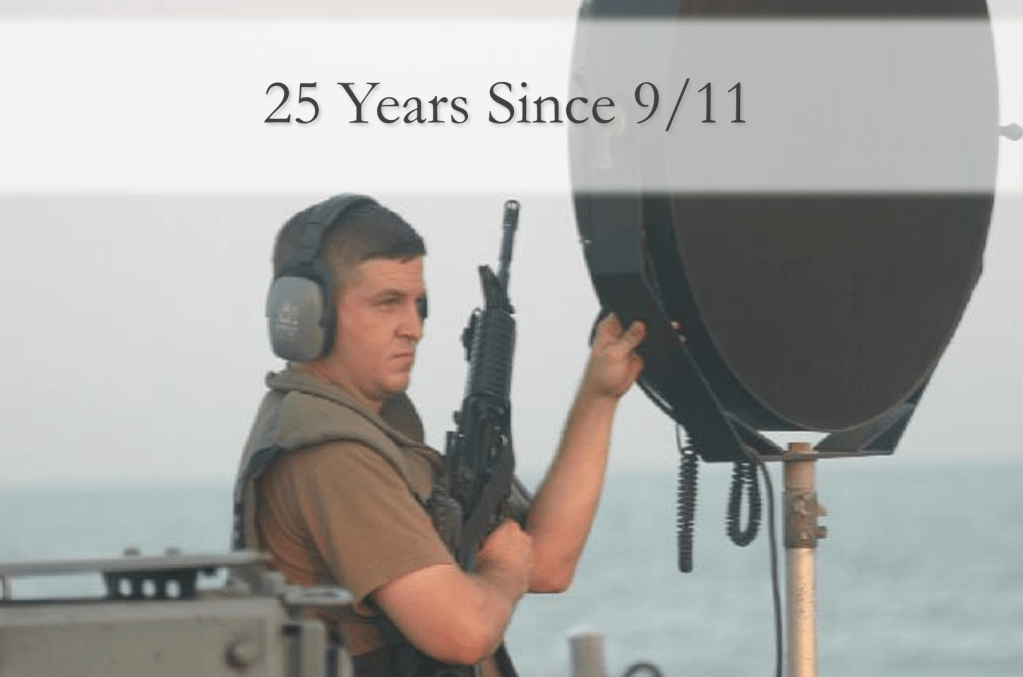
At Camp Delta, the equipment was incidental, with a range of speakers and lights assembled into a system that made sensory experience difficult to escape. The Long-Range Acoustic Device (or LRAD) was more deliberate. With the LRAD, the capacity of sound to travel farther and act with greater force is not an incidental property but the entire point of the machine. Like the doctrine of preemptive war that came to define the post-9/11 foreign policy of George W. Bush, the LRAD’s history is not one of “new foreign policy crisis produces new technologies.” The LRAD instead suggests that the security state already possesses technologies developed for one set of problems and finds them newly legible as instruments of population control when the category of threat expands. The LRAD’s origins, appearance, and migration shows that, in the post-9/11 era, sound is used to manage bodies in ways that are coercive and unexpectedly diffuse.
The Deterrent Tone
In October 2000, as the USS Cole refueled in Aden Harbor, a small boat carrying C4 explosives pulled alongside the guided-missile destroyer and exploded, killing seventeen sailors and injuring many more. One of the key problems the attack exposed was acoustic. Warships had no reliable way to hail an approaching vessel. In response, a San Diego firm called American Technology Corporation developed the LRAD, a directional loudspeaker that could put project an intelligible voice past two thousand meters of open water.
The LRAD has two basic settings. One projects speech—live or recorded, in whatever language the situation calls for—with what its manufacturer advertises as “high intelligibility.” The other setting emits a piercing, continuous alarm focused into a beam fifteen to thirty degrees wide. This “deterrent tone” can be broadcast at levels exceeding 150 decibels at one meter, well above the roughly 120-130 decibel threshold commonly associated with pain. While the primary distinction between these two settings is technical, the LRAD manufacturer also assigns them different purposes: where speech communicates, warning tones are meant to “influence behavior, gain compliance, and determine intent.” The product literature thus articulates two different theories of listening as well—one that addresses a listener who will understand, and one that does not imagine a listener at all.
In its first deployments in 2003 and 2004, LRADs were used primarily aboard warships, where the problem was specific and bounded—an unidentified small craft approaching a vessel at anchor or under way, with too little time to establish its intentions. The perils of open water shaped the device’s initial design assumptions, and from there the technology migrated outward. By 2008, commercial shipping lines adopted LRADs to deter pirates; and, before long, the device moved from the oceans into cities, where the target was no longer a careening boat but the movement of ordinary people.
In an episode the ACLU later identified as the first documented use of the device against civilians in the United States, Pittsburgh police drove an LRAD-mounted vehicle through the Lawrenceville neighborhood to disperse protestors during the 2009 G20 summit. Karen Piper, then a visiting professor at Carnegie Mellon, came to observe the marches as part of her research on globalization. She was roughly a hundred feet away from the device when the tone began. Continuous, piercing, and lasting several minutes. Piper became nauseated and dizzy and later permanently lost part of her hearing. Years later she described the experience in stark terms, “I was being treated as a brute biological entity.” Five years later, in the weeks after the police killing of Michael Brown in Ferguson, Missouri, the LRAD appeared again, this time among the tear gas and flash-bangs deployed along West Florissant Avenue. Missouri journalists reported the device was marketed for ranges exceeding 2,000 meters. Yet, Missouri police used the machine to project sound down the length of a city block. While the LRAD is not designed primarily to injure, it is designed to make remaining in place unbearable, which often means that injury results from failing—or being unable—to comply.
The distinction between conditions and tactics clarifies what is at stake in the LRAD’s two theories of listening. In both cases, classification relocates responsibility for harm. If the device is a communications system rather than a weapon, or if an effect is a condition of use rather than an intended tactic, the violence it produces can appear incidental even when it is more damaging than what would be permitted if the harm were deliberate. The LRAD is therefore more than just another entry in a catalog of crowd-control equipment; it demonstrates how theories of listening can be built into the same piece of hardware, functioning as adjacent settings on the same panel.
Brick and Whisper
Preceding both the Global War on Terror and the developments of LRADs, the music industry embraced the loudness wars, a transformation in how recorded music has been produced and mastered (the final processing and preparation of a recording for distribution and playback) since the early 1990s. The loudness wars describe the long drift in popular music toward making commercially released recordings louder, denser, and more immediately attention-grabbing. Beginning in the early 1990s, audio engineers, under pressure to make each new album release sound louder than the last, compressed the dynamic range of recordings; this meant raising the quiet passages and shaving off the peaks until the waveform, when viewed on screen, resembled a solid brick. Records did get louder, but, more significantly, they became much less variable. The drop before a chorus, the held breath before a downbeat, these were sublimated into the raised levels of the material they were meant to set off, flattened into an unbroken perceptual intensity. Metallica’s 2008 album Death Magnetic is an especially notorious case of mastering so aggressively that on ordinary equipment, portions of it sounded audibly distorted. The album arrived only a few years after Drowning Pool’s “Bodies” had appeared on the Clear Channel list, but the connection between them transcends the issue of volume, both belong to a sonic culture increasingly organized around intensity.
Notably, this sonic trend creates physiological problems. Dynamics, or the distance between a song’s quietest and loudest moments, are a mechanism through which music produces relief. The ear is an organ attuned to difference, and a signal that never changes is eventually one we stop attending to. This practice set the industry chasing an ear its own product kept deadening, each master pushing harder to seize the attention the last record had dulled. Bob Ludwig, who has worked with artists from Jimi Hendrix to Radiohead explained the problem this way in 2009, “the ear just gets tired of it.” A listener could finish a brickwalled album—one in which aggressive compression has flattened the contrast between loud and quiet–fatigued, uncertain whether they had even enjoyed it.
This provides context to Darius Rejali’s quip about torture victims in the American suburbs. His joke depends on an obvious-seeming distinction between the interrogation room and the domestic spaces of ordinary life. But what the futility technique weaponized was not any sonic property of Barney or Metallica. It was volume and duration—sound sustained past the body’s capacity to acclimate. I take this to be the real content of his assertion, though perhaps not what he intended by it. The joke is useful precisely because it exposes something about the relationship between what we call music and what we call noise. It is not that the brickwalled record is actually torturous, but rather that decisions made in sound mastering and an interrogation room arrive at the same working theory of sound—its effects do not depend entirely on what it signifies, but on what it does to a body when it is sustained.
Conclusion
In July 2003, over a ten-day stretch at Guantánamo, an interrogator identified in Senate records only as Mr. X, subjected Mohamedou Ould Slahi to variable lighting patterns and the repeated playing of “Bodies” at nauseating volume. By then the song had become, in a different register, something like an unofficial soundtrack to the Global War on Terror—circulating among service members’ iPods, appearing in military videos and popular representations of the war, attaching itself to a particular fantasy of wartime intensity. At Guantánamo, however, “Bodies” was an instrument, a tool whose force lay chiefly in what it could do to a body when made inescapable.
Each September, American media visually commemorates 9/11. In a strange echo of the bewildering days that followed the attacks, the same images return: the planes striking the towers, the buildings collapsing, clouds of dust moving through lower Manhattan. The footage loops, sometimes silently, its repetition having become one of the dominant forms through which the event is remembered. It is the visual archive of 9/11 that has become central to its commemoration, but its sonic life is no less consequential. The sounds of that day (the distinct rumble of a plane flying too low in the sky to the intrusive barrage of emergency sirens and shrieks of uncertainty) helped constitute its experience, and, in the years that followed, furnished a vocabulary through which violence could be remembered, represented, and eventually enacted elsewhere.
[1] A similar act followed the 2012 Sandy Hook shooting. Several U.S radio stations temporarily removed Foster the People’s “Pumped Up Kicks” – a song whose upbeat production obfuscated its lyrical depiction of a potential school shooting.
Featured image: “Sending our message ‘Loudly’ with the LRAD.” Available at Wikimedia Commons.