
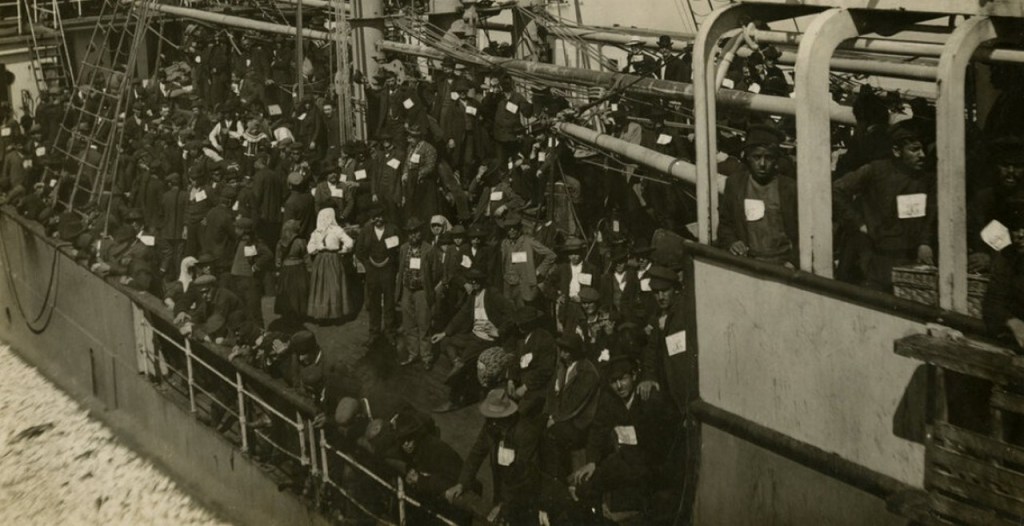
Every few years, someone becomes the latest first person ever to discover the Galveston Movement. The seven-year program, which began in 1907, brought nearly 10,000 Russian Jewish immigrants to Texas and distributed them to more than 200 US cities. Local and national news outlets covered the movement while it was happening, and its participants offered numerous retrospectives from the moment it ended in 1914. Historians began writing about it by the 1940s.[1] But in his 1984 monograph, Galveston: Ellis Island of the West, historian Bernard Marinbach claimed that its story “has not yet been fully told” and that descendants of Galveston immigrants “are mostly unaware of the unique story of their ancestors’ arrival.”[2] Ten years later, Calvin Trillin echoed that impression in the New Yorker, when he revealed the movement as the surprising reason his Russian Jewish family settled in Missouri rather than New York.[3]
Since then, a series of journalists, apparently unaware of Marinbach, Trillin, or one another, have announced their discoveries of the Galveston Movement in the Jerusalem Post (which called the program “often overlooked,” “unexpected,” “a bit of a surprise,” and a “shock”), Texas Monthly (“part of a lesser-known history of Jews in America”), the New Yorker (“overlooked” and “almost farcical”), the Times of Israel (“an unlikely premise”), Commentary (“known only to a small number of specialists”), and JTA (“mostly forgotten”). This perpetually unknown event also has a Wikipedia page, an entry in the Handbook of Texas, and a state historical marker; it has been the subject of a documentary film, a stage play, a musical, a children’s book, and a classical cantata; it appears routinely in scholarly articles and book chapters; and it is embedded in the family histories of hundreds of thousands of Americans.[4] And yet, no matter how much is known about the Galveston Movement, its existence somehow always manages to surprise. The latest book on the subject, by British writer Rachel Cockerell—who claims not only that she had never heard of the Galveston Movement but had never heard of Galveston—is billed as “the story of a long-lost plan.” It is not.[5]
Whether this surprise is genuine or feigned for narrative impact, it’s an unfortunate device. By focusing on their own momentary response rather than engaging with the well-established history of the movement, these writers overlook the deeper importance of the Galveston Movement and its relevance to immigration action and policy today.
Between 1880 and the passage of the Immigration Act of 1924 (the Johnson-Reed Act), which virtually ended all immigration to the United States, some 2.5 million European Jews arrived on American shores, about ten times the number already there, fleeing pogroms, poverty, and religious repression. Unlike earlier waves of Jewish immigrants, this group did not disperse broadly throughout the country but mostly remained in the coastal cities where they landed; about 75 percent settled in New York, where the Jewish neighborhood on the Lower East Side soon became the most densely populated half square mile on earth.

The leaders and backers of the Galveston Movement sought to ease that overcrowding, and thus to facilitate the continuing arrival of greater numbers of refugees, by drawing arriving immigrants away from New York’s overcrowded ghettos to cities and towns in the American West where jobs and opportunities were plentiful. Their audacious expectations were to divert permanently all Jewish immigration from New York to Texas, prevent restrictionist immigration law, rescue European Jews from antisemitic violence, and promote an American alternative for Jewish rescue that would undermine the Zionist campaign to establish a homeland in Palestine.
All of these ambitions failed, and pretty spectacularly. But even in its failure to achieve its original goals, the Galveston Movement sheds light on an alternative, unrealized version of American immigration. Rather than continuously forgetting and rediscovering it, scholars should take its lessons seriously. It is a rare instance of an organized response by an ethnic community in the US, reacting in a practical way to the arrival of millions of their compatriots. Its organizers sought to change the conditions and misconceptions that justified restrictionist immigration policy, particularly the myth that immigration was an economic drain on the country and a source of disruption, sickness, and crime. To prove otherwise, they systematically distributed skilled immigrant workers throughout the country to places providing employment, social support, and religious community, and they purposefully reunited them with their families to help assure social stability. In the 2020s, as rising nativist restriction on immigration dominates domestic policy, the Galveston Movement provides a compelling argument for the benefits of immigration and a model for how its advocates could develop a pragmatic, community-based response to nativist restrictionism.
To Galveston
Most of the millions of Jewish immigrants arriving in the early twentieth century came from the Russian Empire and were culturally distinct—Jewish in a different way—from those who had come previously from central and western Europe. They tended to be more religiously traditional and less secularized; they were comparatively poor; they spoke Yiddish, a language only Jews understood, and had been the frequent victims of state-sanctioned antisemitism, which fostered a more pervasive sense of Jewish distinctiveness. American Jewish leaders grew concerned that such a large and alien population would fail to assimilate, bankrupt charities, and energize antisemitism inside the United States. They feared, furthermore, that unhealthy living conditions in the nation’s largest city would motivate Congress to close the door against refugees whose situation in Europe was rapidly worsening.[6] As historian Hasia Diner explains, national Jewish leaders like Louis Marshall, Jacob Schiff, and Simon Wolf believed that Jews “should not be considered typical immigrants, migrating in search of bread.” Rather, they were “fleeing persecution. Allowing them to come to America amounted to a supreme act of humanitarianism.”[7] Keeping the golden door open meant mitigating the economic and social conditions that gave rise to restrictionism, including finding a way to ease overcrowding in New York.
Investor and philanthropist Jacob Schiff was a financial backer of the Industrial Removal Office (IRO), which had been trying with limited success since 1901 to disperse immigrants already in New York to industrial cities in the Midwest. Schiff now reasoned that if new arrivals were brought in through some other port—diverted away from New York entirely—they would be more inclined to disperse. “Unless we find effective ways to deflect the stream of immigration from New York,” Schiff wrote, “the congestion already existing here is certain to grow to proportions where it may become a menace to the status of the Jew throughout the country. This we must not risk.”[8] As his alternate port of entry, Schiff chose Galveston, which already had regular steamer service from Bremen, Germany, rail connections to cities throughout the West and Midwest, a US immigration and customs center, and few inducements for immigrants to remain there.

Pledging half a million dollars of his own funds (about eighteen million dollars today), Schiff established the Jewish Immigrants Information Bureau (JIIB) in Galveston, initially under the direction of rabbi and social worker Morris Waldman. The bureau would oversee the immigrants’ arrival, their passage through customs, job placement, and distribution by rail. Schiff orchestrated a transnational network of Jewish organizations linking IRO headquarters in New York, which took charge of the new program under director David Bressler, with partners in Kyyiv, Berlin, and London who handled promotion, recruitment, and the logistics of getting immigrants from their homes in Russia, to Bremen, and onto the ships.
During its seven years of operation, beginning in July 1907, the JIIB directed 9,332 Russian Jews through Galveston to 235 American cities and towns in 32 states. Minneapolis-St. Paul, Kansas City, Omaha, Dallas-Fort Worth, Houston, and Des Moines were the most common destinations.[9] The attention given to rural states like Nebraska and Iowa has led to a common misconception that the immigrants were pioneers or colonists, sent to found Jewish communities in remote places.[10] This notion is false. The movement’s managers assigned their charges only to places where a sturdy Jewish community already existed to support them, although many were small towns. In fact, a map of Galveston Movement destinations essentially doubles as a map of established Jewish communities throughout the Western states in the same period.
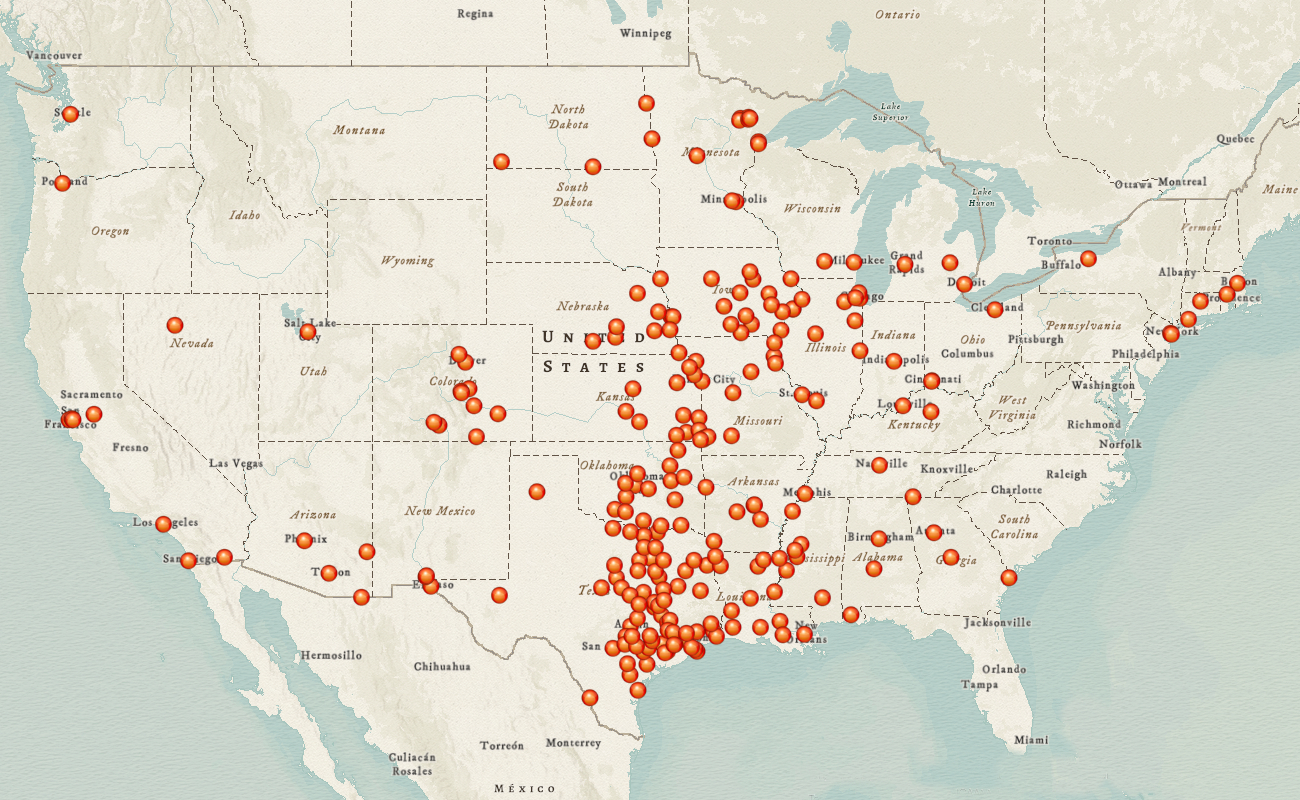
The movement’s main objective was finding employment for workers who could be readily self-sufficient and become anchors for others to join them later. Consequently, about 70% of the JIIB’s placements were men trained as tailors, shoemakers, carpenters, butchers, and in other common trades sent to selected cities for selected jobs or placed under the supervision of local agents who would find them suitable work. The other 30% were adult women or children under fifteen, mostly families traveling through Galveston to join their husbands and fathers.[11] Under US law immigrants had to pay their own passage from Europe, but the JIIB facilitated reunions by paying families’ rail fares from Galveston.
Industrial employers viewed the influx as an easy source of cheap, often skilled labor, a perception the movement’s leaders encouraged. “The general scarcity of labor in the South and West under normal conditions would be counteracted if a steady inflow of the able-bodied could be maintained,” wrote Henry Cohen, the revered Galveston rabbi who greeted every bureau passenger at the pier, “and to this end the Jewish artisan and laborer . . . could contribute in measure.”[12] The JIIB formed local committees in recipient cities to oversee the arrival and settlement of the immigrants and to advise on specific employment opportunities and general economic conditions in their areas; these committees pledged to receive and care for a designated number of arrivals each month. Reflecting the impersonal, business-minded orientation of the local committees, these pledges were termed “requisitions”; each new group of arrivals was a “shipment” or “consignment.”

According to JIIB director Bressler, the goal of industrial employment was to give each new arrival “a favorable environment where he may the sooner overcome the obstacles in his path, [to] become economically independent.”[13] Here is where the Galveston Movement offers a different narrative from the familiar story of Gilded Age immigration. The movement was selective, choosing its charges, according to Bressler, from among “classes of immigrants who may be reasonably expected to become economically independent.”[14] They were required to possess trade skills, work experience, and a willingness to acculturate. Once in the US, rather than being left to find their way on their own, or relying on family and community ties, they were embedded in a well-funded nationwide support system, from a local representative charged with their immediate care, to managers in Galveston and New York who communicated regularly about their needs and progress. Most were able to become self-sufficient within a few months to a year. “It is a notable fact,” bragged Bressler in 1910, “that co-operating agencies have been able to find employment for the newly arrived immigrants at their own trades on the very same day of their arrival.”[15] No other Jewish organization in the country could make a similar claim.
With so many Jewish immigrants ensconced in New York tenements, the mobility of Galveston Movement participants offers another contrast. The JIIB started the immigrants with a destination and a job, but they were under no obligation to remain there. Many moved to cities of their own choosing as soon as they could: fewer than half, in fact, lived out their lives where the JIIB had originally placed them.[16] Bressler observed that “drifting” back to the East Coast was inevitable for many of them, while others migrated “from the town in which the immigrant [had] been placed to the next larger town within striking distance.”[17] Wherever they chose to settle, Galveston immigrants started businesses of their own, opening tailoring and shoe repair shops or transitioning into related fields: cobblers became shoe salesmen; blacksmiths and locksmiths became plumbers or scrap metal dealers; carpenters became builders. Machine operator Boruch Plam (later Michael Pliam), for example, went to work in a Minneapolis chair factory earning nine dollars a week. He started peddling, opened a shop, and went on to found the Pliam Linoleum Company, a multigenerational business that operated across Minnesota, Wisconsin, and South Dakota.[18]
Jewish ambition, businesses, and professions thrived in New York as well, of course, but the speed with which Galveston immigrants became employed and propertied, usually stabilizing in the first generation, is striking. Although impossible to quantify, it suggests that bypassing New York—skipping a generation or two of tenements, sweatshops, and settlement houses—got them more quickly on the road to success. The immigrants found many paths to prosperity, proving Schiff’s claim that they “readily established themselves all over the West, Northwest, and Southwest, and have grown into . . . useful additions to the working population of that section.”[19] The Romanian Berisstianu (Bernstein) family, including teenaged daughters Yetta and Tina, were sent to join a Jewish agricultural colony in North Dakota, where they remained briefly before becoming farmers and landowners in their own right in the western Dakotas. Moses Lesching (Michael Leshing), sent to small-town Tyler, Texas, later moved to Hollywood and became an Oscar-winning film processing technologist; his daughter, Zenna Leshing Serrurier, a one-year-old Galveston immigrant in 1908, became a renowned educator in a predominantly Latino public school in East Los Angeles.[20] And there is perhaps no better example of immigrant ambition than Chaim Gendel, eventually the proprietor of a Dallas laundry business, who arrived in 1907, accepted employment as a carpenter in a cabinet factory, and saved enough to bring over his wife and daughter. Twin sons were born in Dallas the next year, whom the Gendels named Neiman and Marcus.[21]
Termination of the Program
Despite such successes, the JIIB faced significant obstacles. The sea voyage to Galveston was about two weeks longer than to New York, and conditions aboard the ships were notoriously uncomfortable; promises of assistance often could not induce people to travel the extra distance. In addition, legal problems plagued the movement. Customs officials had wide latitude to interpret legal restrictions like “undesirable” and “physically defective,” and Galveston inspectors enforced these terms more rigidly than at any other American port. The longer voyage exacerbated passengers’ preexisting health issues, giving officials more problems to find, and the smaller number of immigrants landing at Galveston gave them more time to find them. It was also widely believed that at least one of the port’s chief medical inspectors was antisemitic.[22]
As a consequence, debarral (deportation) rates were much higher in Galveston than at East Coast ports: over the life of the movement, about 4 percent of Jewish immigrants were returned to Europe from Galveston, as opposed to fewer than 1 percent from New York.[23] Debarral, which meant immediate return to Europe and the forfeit of their fare, was the worst-case scenario—“being thrown back to Russia,” in the words of Galveston JIIB director Henry Berman—and it dampened the bureau’s ability to recruit participants. “Galveston became synonymous with uncertainty,” Berman wrote. “Confidence gave way to doubt, disbelief, and distrust [that] could not easily be dispelled.”[24] As word spread of the frequency of debarral, fewer immigrants were willing to risk a Galveston entry.
Essential relationships between the JIIB and its local agents began to sour as the bureau’s European partners often exaggerated the salaries immigrants could expect, resulting in a work force that was frustrated and disillusioned. Such misunderstandings fomented mistrust between the bureau and its American and European agents, and made it harder to attract more participants from Europe. By 1914, Schiff and Bressler recognized that Jewish immigration to Galveston had never exceeded 3% of the total Jewish immigration to the US, and they determined that their effort had failed. Bressler credited the disappointment primarily to poor conditions on the ships, which made it impossible to secure a steady stream of passengers for the longer voyage, and the “unduly severe enforcement of the Immigration Laws” at the port of Galveston.[25] Schiff terminated the program in April 1914, mere months before the outbreak of World War I would most likely have ended it anyway.
But such statistical accounting does not adequately assess the movement’s success or failure. Regardless of the number of immigrants Schiff and his managers hoped to accommodate, the number they did accommodate, nearly 10,000, is significant. For Jews who came to Galveston prior to World War I, the greatest benefit was simply getting out of Europe in time, and indeed Schiff intended the program as a means of rescuing Russian Jews from pogroms and other state-sanctioned repression; it was an “immediately practicable” solution to an “existing emergency.”[26] Schiff couldn’t have known that providing a refuge for Jews in immediate danger—most of them from Poland, Ukraine, and Belarus—also spared them greater horrors coming in two world wars, but, in fact, it did. Every Jew who went to New York in the same period was also effectively “rescued” from Europe—but not on purpose, nor systematically, nor with the assistance of American organizers.
The Galveston Movement underscores the urgency of immigration. This picture of the Gurwitz family, taken in Alice, Texas, in 1937, makes that point.
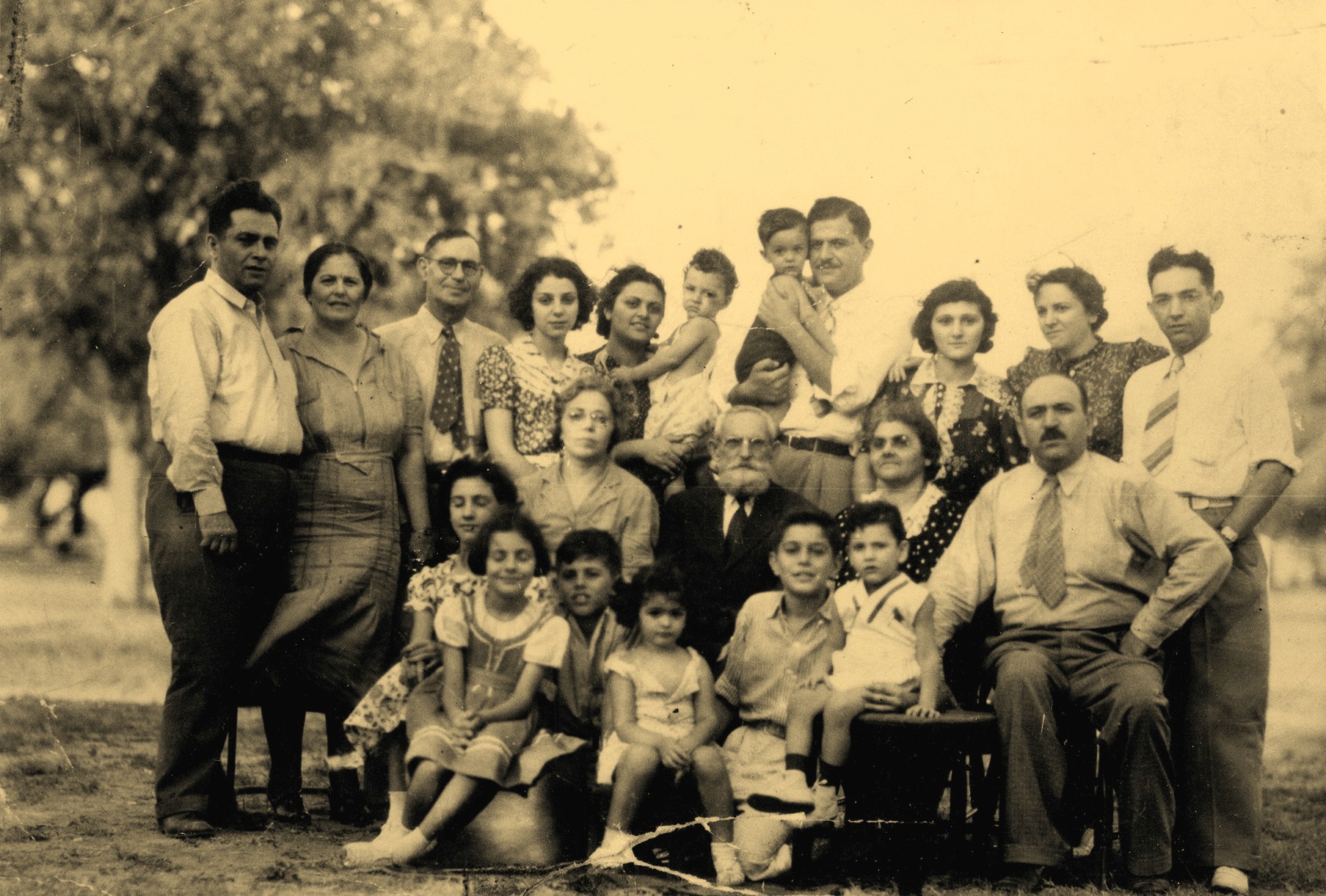
In the center is Alexander Gurwitz, who traveled with his wife and four young children in 1910 from eastern Ukraine through Galveston to San Antonio.[27] Three of those children, plus an older daughter for whose family Gurwitz secured passage in 1923, appear in this portrait with him as adults, along with their spouses, children, and relatives. The children were all Texas-born, but every adult in this picture immigrated, and every one of them, shown in Texas in 1937, was not in Europe in 1937. This is a reminder that immigration saves lives, not only from imminent threats but from unforeseen future ones. The Galveston Movement highlights America’s traditional role as a refuge for people whose lives were endangered at home, and it shows how Americans who value that legacy can endorse and leverage it.
Immigration is Good, Actually
The Galveston Movement, which historian Bernard Marinbach described as “the only substantial example of organized Jewish immigration to the United States,” is a unique and unduplicated event.[28] It may seem quaint in today’s climate, when the news is filled with stories of walls, detention camps, and murderous ICE raids, rather than discussion of more effective doors and bridges. But for all its remoteness, the Galveston Movement resonates with our current moment. It provides an example of what a systematic, community-based, and pro-immigration program might look like and how it could encourage and facilitate continuing immigration even in the face of a resistant government.
When the movement began, Schiff expected that federal officials would recognize its value—in fact, the U.S. Commissioner-General of Immigration first suggested to Schiff the idea of diverting Jewish immigration to a western port.[29] But as the effort proceeded, Schiff became increasingly aware that “the greatest handicap was the attitude of the Federal Government,” which “did not always show itself as sympathetic” but has “shown what must be called a repressive policy.”[30] Without allies in the government, the JIIB operated within the Jewish community exclusively, forging a global network of Jewish organizations to provide a path along which immigrants could travel directly from Russian shtetl to American workplace. They acted with the conviction that rescuing the Jews of Europe could be accomplished while strengthening—indeed, by strengthening—Jewish communities in America. It’s an example that could encourage American communities today looking for ways to support and accommodate the arrival of more people like them.
Jacob Schiff’s plan was predicated on the simple, and self-evident, assumption that immigration to the United States is good—both for the country and for those who come. Schiff asserted that directing Jewish immigration into the American West “will surely aid in promoting the happiness of the immigrant and prove a boon to the area.”[31] The movement served “two purposes,” added Rabbi Cohen, the immigrant’s “own maintenance and the crying need of American industries.”[32] Any defense of immigration must start with a statement of its practical value, and the Galveston Movement provides nearly 10,000 case studies of immigration working as intended. These immigrants thrived, raised American families, and gave to this country their skills and creativity.[33] This, of course, is the fundamental narrative of all American immigration, but what sets the Galveston Movement apart is its deliberateness, the confidence of its leaders that the advantages of immigration could be multiplied through a methodical approach of selecting, placing, reuniting, and supporting individual immigrants and their families.

Fakakta
In the 2024 film A Real Pain, a pair of estranged Jewish American cousins, played by Kieran Culkin and writer-director Jesse Eisenberg, reconnect in Poland on a guided Holocaust tour. At one point on the trip, their traveling companions share their family histories, and one woman points at her husband and says, “His family came through Galveston for some fakakta reason.”[34] When I saw that, I jumped off my sofa and shouted at the screen, “I know the reason!” I know because I’m a historian and this is what I study, but to other people, the very idea of Jewish migration to Texas is fakakta, ridiculous. This apparent disconnect may be the reason it’s been so easy for historians and journalists to forget the Galveston Movement.
But remembering gives us a useful model for how immigration supporters today could frame their argument and plan a response to the most hostile anti-immigration environment the US has experienced in a century. To be sure, immigrants today face an even more repressive environment than in 1907; certainly nothing like ICE existed then. Furthermore, Galveston’s Jewish immigrants, who were mostly perceived as white, had a relatively easy time finding acceptance and opportunity in America. It’s hard to imagine similar proportions of Somali, Haitian, Honduran, or Syrian migrants receiving the same acceptance in most American cities and towns today. In terms of its organizers’ grandest ambitions, it was an abject failure. But at a granular level, viewed from the ground up as the story of 10,000 individuals, the Galveston Movement did what American immigration is supposed to do—provide opportunity, hope, and survival to people in need, while incalculably enriching the country by their energy, creativity, and labor.
Featured photo: Immigrants arriving at Galveston, c. 1910. Galveston and Texas History Center Digital Collections, Rosenberg Library, Galveston, TX. G_529_FF1_3. The author thanks the Community College Writing Group for their support and ideas.
[1] See, for example, Jacob H. Schiff, “The Galveston Movement,” Jewish Charities 4 (June 1914): 5–6; Henry Berman, “The Galveston Movement: A Resume,” Jewish Herald (Houston), June 25, 1914; David M. Bressler,
“Results and Significance of the Galveston Movement,” Jewish Charities 5 (August 1914): 4–5; Morris D. Waldman, “The Galveston Movement,” Jewish Social Service Quarterly 4 (March 1928):197–205; and Morris D. Waldman, Nor By Power (New York: International Universities Press, 1953). The earliest academic histories of the movement are Leo Shpall, “Spreading the Jewish Migrant in America (The Galveston Experiment),” The Jewish Forum 28 (June, July, and August 1945); Ronald A. Axelrod, “Rabbi Henry Cohen and the Galveston Immigration Movement, 1907–1914,” East Texas Historical Journal 15 (1977): 24–37; and Gary Dean Best, “Jacob H. Schiff’s Galveston Movement: An Experiment in Immigration Deflection, 1907–1914,” American Jewish Archives 30 (April 1978): 43–79.
[2] Bernard Marinbach, Galveston: Ellis Island of the West (SUNY Press, 1984), xiii.
[3] Calvin Trillin, “Messages from My Father,” New Yorker 70 (June 20, 1994).
[4] For scholarship besides Marinbach, see Wendy H. Berghoffen, “Taking Care of Our Own: Narratives of Jewish Giving and the Galveston Movement,” Shofar 34 (Winter 2016): 26–58; Joshua J. Furman, “‘A Good Place to Emigrate to Now’: Recruiting Eastern European Jews for the Galveston Movement in 1907,” Southern Jewish History 25 (2022): 99–137; Susan W. Hardwick, “Early Twentieth Century Networks of Ethnicity: The Galveston Movement,” Historical Geography 31 (2003): 131–50; Bryan Edward Stone, “The Cassel: Tracing the Immigrants on the Galveston Movement’s First Ship,” in Migration in Jewish Imagination and Experience, ed. Mara Cohen Ioannides and Natalie Wynn (Cambridge Scholars Publishing, 2025), 82–111; and Bryan Edward Stone, “The Galveston Diaspora: A Statistical View of Jewish Immigration Through Texas, 1907–1913,” Southern Jewish History 21 (2018): 121–76.
[5] Rachel Cockerell, Melting Point: Family, Memory, and the Search for a Promised Land (Farrar, Strauss and Giroux, 2025), 3.
[6] In the Kishinev Pogrom, in Moldova in 1903, forty-eight Jews were killed and thousands left homeless; it was followed by succeeding waves of anti-Jewish violence across the western Russian Empire. The increasing violence motivated the creation of a variety of American Jewish social and benevolent programs, of which the Galveston Movement was one. See Hasia R. Diner, The Jews of the United States, 1654–2000 (University of California Press, 2004), 184–85.
[7] Diner, Jews of the United States, 184.
[8] Jacob Schiff, “Mr. Schiff ’s Address,” American Hebrew, August 2, 1907, qtd. in Cockerell, Melting Point, 108.
[9] Bressler, “Results of the Galveston Movement,” 4; Stone, “Galveston Diaspora,” 135, 138.
[10] A Jerusalem Post reporter stated, for example, that Galveston immigrants “found their place in ‘middle America,’ fortifying small Jewish communities or on occasion being the lone Jew in town.” A children’s book about the movement incorrectly claims that “[t]hese ten thousand were the seeds of strong Midwestern Jewish communities.” On some occasions individuals ventured on their own to towns without Jewish communities already in place, but the JIIB never sent them there. Batsheva Pomerantz, “Diaspora: Catching Up with the Galveston Movement,” Jerusalem Post, August 23, 2007; Andrea Shapiro, illus. Valerya Milovanova, A Place Called Galveston (Apples & Honey Press, 2025).
[11] Stone, “Galveston Diaspora,” 143–45.
[12] Henry Cohen, The Galveston Immigration Movement (Galveston, 1908), 3–4. By “the South,” Cohen means Texas, which was the only Southern state to retain a significant number of the immigrants. Schiff deliberately avoided the rest of the South, where he feared the immigrants would meet with bigotry and would be forced to compete with Black laborers. Marinbach, Galveston: Ellis Island of the West, 11–12.
[13] David M. Bressler, “The Removal Work, Including Galveston,” Sixth Biennial Session of the National Conference of Jewish Charities (Baltimore, 1910), 113.
[14] Ibid.
[15] Ibid., 126.
[16] This statement is based on my current, unpublished research and is supported by data in the Galveston Movement Immigrant Database.
[17] Bressler, “The Removal Work,” 126.
[18] After Michael Pliam died in 1930, his son Nathan took over the business he had founded and expanded it to ten stores in three states. “Nathan Pliam, Linoleum Firm Head, Dies at 60,” Minneapollis Star, December 4, 1965.
[19] Jacob Schiff to B.S. Cable, Assistant Secretary of Commerce and Labor, August 22, 1910, in Cyrus Adler, ed., Jacob H. Schiff: His Life and Letters (Doubleday, Doran and Company, 1928), 2:108.
[20] In 1944, Michael Leshing was investigated by federal authorities on suspicion of spying for the Soviet Union. He was never charged, nor did the allegation seem to affect his career in Hollywood. See “Assessment of Michael Leshing, head of 20th Century Fox film laboratory,” National Security Agency.
[21] Founded in Dallas in 1907, the same year Gendel arrived, the Jewish-owned Neiman Marcus department store immediately attained a reputation for glamor, fashion, and style, making a particular point of catering to those whom oil had made newly wealthy. See Don M. Coerver, “Neiman Marcus,” Handbook of Texas Online.
[22] Stone, “Galveston Diaspora,” 130, 175n18.
[23] Stone, “Galveston Diaspora,” 129.
[24] Henry Berman, “The Galveston Movement: A Resume,” American Hebrew, June 19, 1914, qtd. in Cockerell, Melting Point, 161.
[25] Letter from “Secretary” [David Bressler], April 13, 1914, Henry Cohen Papers, MS Collection 263, box 1, folder 4, Jacob Rader Marcus Center of the American Jewish Archives, Cincinnati, reproduced in Stone, “Galveston Diaspora,” 167–70.
[26] Jacob Schiff to Israel Zangwill, August 24, 1906, in Adler, Jacob H. Schiff: His Life and Letters, 97.
[27] Gurwitz’s memoir describes his life in Russia, migration through Galveston, and subsequent life in San Antonio. Alexander Z. Gurwitz, ed. Bryan Edward Stone, Memories of Two Generations: A Yiddish Life in Russia and Texas (University of Alabama Press, 2016).
[28] Marinbach, Galveston: Ellis Island of the West, xiii–xiv.
[29] Marinbach, Galveston: Ellis Island of the West, 9.
[30] Schiff, “The Galveston Movement,” 5–6.
[31] Schiff, “The Galveston Movement,” 6.
[32] Cohen, The Galveston Immigration Movement, 4.
[33] My current project, the Galveston Movement Immigrant Database, seeks to document the immigrants’ American lives subsequent to arriving and to provide the individualized narratives I call for below.
[34] Jesse Eisenberg, writer and dir., A Real Pain (Topic Studios, 2024).
Featured Image Credit: Immigrants arriving at Galveston, c. 1910. Galveston and Texas History Center Digital Collections, G_529_FF1_3.




.jpg)
.jpg)
Leave a Reply