Christopher Nolan’s The Odyssey is the story of a world in transition. The new order has not yet emerged, and the laws and norms of the old order persist. However, its rules and rituals are sufficiently weak that characters openly mock or weaponize the old ways against those who still practice them. Nolan exemplifies this with Xenia (referred to as “Zeus’s Law” in the film), the custom of hosts showing hospitality to guests with the expectation of reciprocity. A crowd of male “suitors” take advantage of Xenia in the years of Odysseus’s absence from Ithaca after the Trojan War, residing in the palace and barely concealing their threat to Queen Penelope and Prince Telemachus. Even though Xenia has clearly been broken by the suitors, their sheer numbers preclude evicting them, forcing Penelope to use all her political skill simply to survive without capitulating to remarriage until Odysseus returns to Ithaca. Xenia thus perversely functions as a trap that nearly costs the queen and prince their lives because only one party practices it.
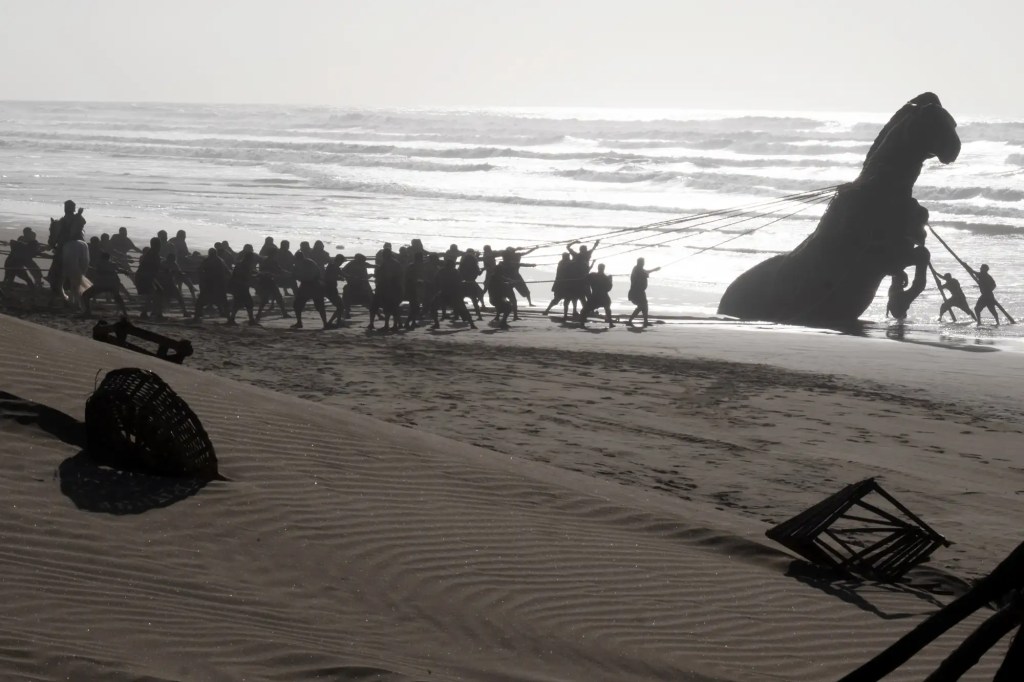
However, for Nolan, it is Odysseus himself who strikes the mortal blow to the old order during the Trojan War. After nearly a decade of fruitless war against the impregnable walls of Troy, Odysseus leads the desperate Greeks to subterfuge: they fashion the legendary Trojan Horse as an ostensible offering to the goddess Athena. Secreted inside, Odysseus and a small contingent of Greek soldiers gamble on the piousness of the Trojans. The horse is brought inside the walls and the Greeks emerge to open the gates of Troy, enabling Agamemnon and the army waiting outside to annihilate the city and win the war. For Nolan, the victory comes at the expense of breaking Xenia and using the reverence of the Trojans against themselves.
As Odysseus remembers the Sack of Troy near the film’s end, Nolan speaks through the protagonist, condemning the breaking of Xenia and characterizing the weaponizing of religious observance as blasphemy. Underlining this reading, Odysseus’s memory depicts an avatar of Athena brutally executed as Troy burns. The audience realizes that it was this breaking of Zeus’ Law that curses Odysseus and the Ithacans and has loomed over their fruitless voyage home.
Throughout the film, stalemate and desperation repeatedly force Odysseus and his men to compromise the norms and rituals of the old order. Early in their voyage home from Troy and low on supplies, the Ithacans stop at an unknown settlement. We do not see the interaction between the crew and the residents, only the aftermath as the residents destroy their own homes and flee. The obligations of the residents under Xenia are referenced as justification for the incursion, but it is clear that the invaders plan to take what they wish, welcomed or not. Odysseus and the doomed expedition also gradually abandon the practice of honoring their comrades killed in war. Gradually the weight of these broken customs overwhelms Odysseus and his men as their voyage deteriorates.
At the same time, everywhere from Ithaca to Sparta, Penelope, Telemachus, and Odysseus encounter rumors of “the people from the sea,” harbingers of a new order who attack unprovoked from the ocean and threaten the stability of the Greek states. It is only at the end of the film, when Odysseus returns to Ithaca and reunites with Penelope that he understands that the Greeks themselves, through their actions, are the feared people from the sea. Only here, at the end of a chain of compromises and pragmatic necessities does Odysseus realize that it is he who has unwittingly invited a new, more dangerous world into his home.
Nolan’s film clearly invites comparisons to the contemporary United States. Everywhere in 2026 it appears that the old order is dying, giving way to something new and ominous. Much like the world of Odysseus, this transition seems to permeate every aspect of society—the home, government, and the international order. Christopher Nolan is an eclectic filmmaker, and his films are often thematically complex. However, in The Odyssey he seems to finally give voice to deep misgivings about the direction of society he has heavily hinted at throughout his earlier works. This concludes a conversation Nolan began with Oppenheimer, as scholars have noted.
Norms and Institutions
The themes of The Odyssey, alongside the film’s immense popularity, behoove us to consider the academic approaches to norms and rituals and their role in society. Social scientists conceptualize them as institutions, a broad category of behaviors that provide stability and predictability in daily life. These practices include informal norms such as forming a line at the grocery store checkout or working across the aisle in Congress on noncontroversial items. Institutions make our lives easier and more certain, reduce the costs of interacting with one another, and increase social capital and trust among people. However, because many informal institutions are voluntary and socially constructed, they are vulnerable.
The language of game theory and economics illustrates this dynamic. Complying with “rules” (voluntary or not) is a prisoner’s dilemma played by two or more actors. In the prisoner’s dilemma, the two sides each face the choice to either cooperate (work together) or defect (betray the other side). Both sides have an incentive to work together rather than betraying and simultaneously being betrayed. However, the greatest payoff of all comes from betraying the other player while they choose to cooperate. While the dilemma is abstract, its applications throughout the world of social interaction range from the difficulties of demilitarization to paying taxes.
The chart below shows a typical example of “payoffs” or rewards from various combinations of cooperation and defection among the players in a prisoner’s dilemma game. The abstract quantity of points stands in for increases to one’s wellbeing. The payoff to players (5 points each) for both cooperating is significantly higher than if both defect (2 points each). However, a player who defects while their opponent cooperates receives 10 points while their opponent receives no benefit.
| Cooperate | Defect | |
| Cooperate | 5, 5 | 10, 0 |
| Defect | 0, 10 | 2, 2 |
Payoffs for Cooperation and Defection in a Prisoner’s Dilemma Game
This logic applies to many institutions that constrain behavior. Interactions (even between opponents or strangers) go better for both sides when there are some basic forms of cooperation or understanding compared to when no such norms exist. However, a player who does not obey norms (defects) while their counterpart is bound by them (cooperates) wields a significant advantage. For the counterpart who is betrayed, they are tempted to respond in kind and thus both sides abandon the norm. Odysseus’s subterfuge against the Trojans is such a defection from a tenuous commitment to decency and religious observance in the midst of war. Once the Greeks make this choice, that norm is vanishes from Odysseus’s world..
However, game theory by itself does not explain why people obey rules. Psychologists studying norms find that they often lose their power when we need them most: in times of social uncertainty. Part of the power of norms to structure behavior is social and anthropological—peer pressure pushing against defection. People internalize norms and obey them; thus, in times of stability, unity prevails and norms command near universal adherence. However, in times of uncertainty when a population may be divided, norms lose adherents and the consensus that once gave them their power to organize behavior disintegrates. In 2026, a breakdown in Americans’ shared reality works against norms once upheld by consensus. The proliferation of different epistemic authorities that guide our behavior and beliefs virtually precludes any consensus on what behavior is appropriate.
At the same time, Americans’ trust in each other is declining. A 2025 study by the Pew Research Center found that only 34% of Americans believed that “most people can be trusted.” The report also found that those who did express trust in others were more likely to engage in norms of cooperation such as conserving resources if asked by public officials and assisting neighbors and friends in need. Notably, forces like affective polarization and rising inequality push American society further from norms of reciprocity.
A similar story plays out in The Odyssey. The uncertainty of the voyage, the flouting of rules by Odysseus, and superstition over the voyage’s bad luck devastate the trust of his crew. The audience sees the breakdown first in glances between soldiers when Odysseus’s back is turned. Eventually, the soldiers reach a tipping point and soldiers openly mutiny against their king. The social system of the expedition quickly collapses.
Norms in American Politics
Norms and informal institutions also undergird the American political system—and face similar threats. To function, the American constitutional order requires cooperation, even among ideological opponents. Research in political science shows that norms drive congressional action, allowing Democrats and Republicans to work together. Such informal institutionsmotivate members of Congress to overcome the tremendous costs the system imposes for collective action, especially in times of divided government.
However, in her book, Insecure Majorities, political scientist Frances Lee argues that the deep division between the Democratic and Republican parties in recent years incentivizes them to highlight their differences, deny credit to their opponents, and abandon the cooperation and compromise required for responsible governance. Lawmaking has given way to perpetual conflict as both parties seek a breakthrough to the stalemate that the next election always promises; American politicians choose to “defect” rather than “cooperate” in the hope of securing a governing trifecta of the White House, the Senate, and the House in order to enact an uncompromising policy agenda.

Norms are a casualty of this desperate attempt to break the stalemate, both in Congress and the broader American political system that is deeply divided at state and local levels. For example, while redistricting has always been a contentious and partisan process, many states were previously content with status quo congressional maps that protected incumbents of both parties while modestly overrepresenting the majority party in the state. The recent spate of aggressive mid-decade gerrymandering on the part of Republican states has triggered a prisoner’s dilemma for both parties where Democrats in states such as California and Virginia have attempted to respond in kind.
Arguably, the duration of the American political system’s stalemate has exceeded the Trojan War. The last major piece of federal legislation the US government passed that did not deal with the budget was probably the Affordable Care Act, signed into law in 2010—sixteen years ago. Since then, the federal government has limped along on reconciliation bills and continuing resolutions. And the second Trump Administration has vastly expanded executive power beyond previous understandings of what was permissible, aided by a Supreme Court that is increasingly willing to defy its own norms of behavior.
Christopher Nolan has used the prisoner’s dilemma to explore cooperation and trust explicitly before. In 2008’s The Dark Knight, the Joker places bombs aboard two ships in Gotham Harbor—one barge ferrying residents home, the other carrying convicts. The Joker gives each barge the detonator to the explosives aboard the other ship and assures both boats that if they destroy the other, they will be spared. In the film, the residents of both ships defy him and do not use the detonators. Since The Dark Knight, however, Nolan’s perspective has shifted. Throughout The Odyssey, when faced with difficult dilemmas, rules and institutions fail. In the end, there is little left except in this new world full of danger and bereft of cooperation.
The disintegration of the norms and institutions in our contemporary world clearly troubles Nolan. Odysseus’s conversation with Penelope after returning to Ithaca is unusually direct in laying out the central moral argument of the film. The characters of The Odyssey realize only too late that they have made the world a more dangerous place through incremental actions. Society is built on social norms and rules. The death of these institutions threatens to destroy society and make us all people from the sea.
Featured image: Still of the Trojan Horse from The Odyssey (Photo by Melinda Sue Gordon, Courtesy of Universal Pictures).