
Even though Americans said they would “never forget” the terrible events of 9/11, sometimes it’s unclear if they remember 9/11 at all outside of a few frozen images. Moreover, the initial impulse to uphold unity, to look beyond division and see one another’s humanity, and to rally around the flag have given way to just the opposite. To an extent, the post-9/11 unity was always a mirage, as American citizens of certain backgrounds and religions were singled out for violent reprisal. Twenty-five years later, even the idea of unity has been thoroughly displaced by a powerful cocktail of performative patriotism and bellicose intolerance. 9/11 has become yet another weapon in the arsenal of the country’s forever culture wars.
In the wake of that stunning, awful day in 2001 there was a brief window when Americans seemed to come together. That window closed with blistering speed.
After a few days of stunned disbelief, daily life slowly resumed, and that resumption included, after a brief interregnum, the playing of sporting events—baseball was in the midst of its pennant race, while college and professional football had just started new seasons. At those early post-9/11 games, Americans engaged in the ritual of singing the national anthem, and they did so with a passion and robustness that indicated actual patriotism, as opposed to the pro forma flag-waving that often characterizes such moments.
This moment did not last and before long, politics intervened. Unity never really surmounted a sense of vengeance and inchoate anger aimed at not only Muslims, but at anyone who might be perceived as Muslim, which included Sikh, Jewish, and other Americans, revealing not only an ignorance of non-white cultures and peoples but also a willingness to resort to racism and xenophobia. On numerous occasions President George W. Bush made clear that Muslims, Islam, and Arabs were not the enemy. Too often these calls for tolerance fell on deaf ears. In other ways, the Bush administration capitalized on the tragedies to push through a host of changes. These ranged from the relatively benign—a color-coded terror alert system that seemed to fluctuate less based on actual threats (which were generally minimal) and more on political expediency—to changes both significant and enduring. The Department of Homeland Security, a bipartisan endeavor, quickly took the form of an unaccountable internal intelligence-cum-policing organization that over time increasingly became disconnected from its original purpose.
In short order, the country went from at least putative unity to a politics of grievance, with the added element of even greater paranoia than usual and a heightened state apparatus to enforce or coerce compliance. A presidential administration and its enablers, which had ignored overt warnings about potential terrorist attacks from al-Qaeda and Osama bin Laden prior to 9/11, created and used new tools to identify threats real and imagined. The guns of war were ready to thunder, not only in Afghanistan but also Iraq, and soon the administration and its allies seemed determined to find enemies on the home front.
The national anthem before games and the addition of “God Bless America” during the seventh-inning stretch—both used to promote unity in the days and weeks after 9/11—soon became weapons in this newest iteration of America’s culture wars.
The 1918 World Series famously introduced the national anthem to sporting events in the United States. During the seventh-inning stretch of game one at Fenway Park between the Boston Red Sox and the Chicago Cubs—and at the height of American involvement in the Great War—a military band spontaneously played the anthem. It was so popular among fans and media that management of the teams repeated it before each subsequent game. Prior to 1918, some hosts might choose to play the anthem before particularly big competitions, including Army-Navy football games and Opening Day of the baseball season, but it was not a regular occurrence across professional sports. Since this tradition began in 1918, it has become a phenomenon that is largely unique to North America. In most countries, playing the national anthem prior to sporting events is reserved for international competitions involving national teams. It is rare for the anthem to be played before domestic competitions such as professional soccer, rugby, or cricket matches, never mind school or youth competitions.
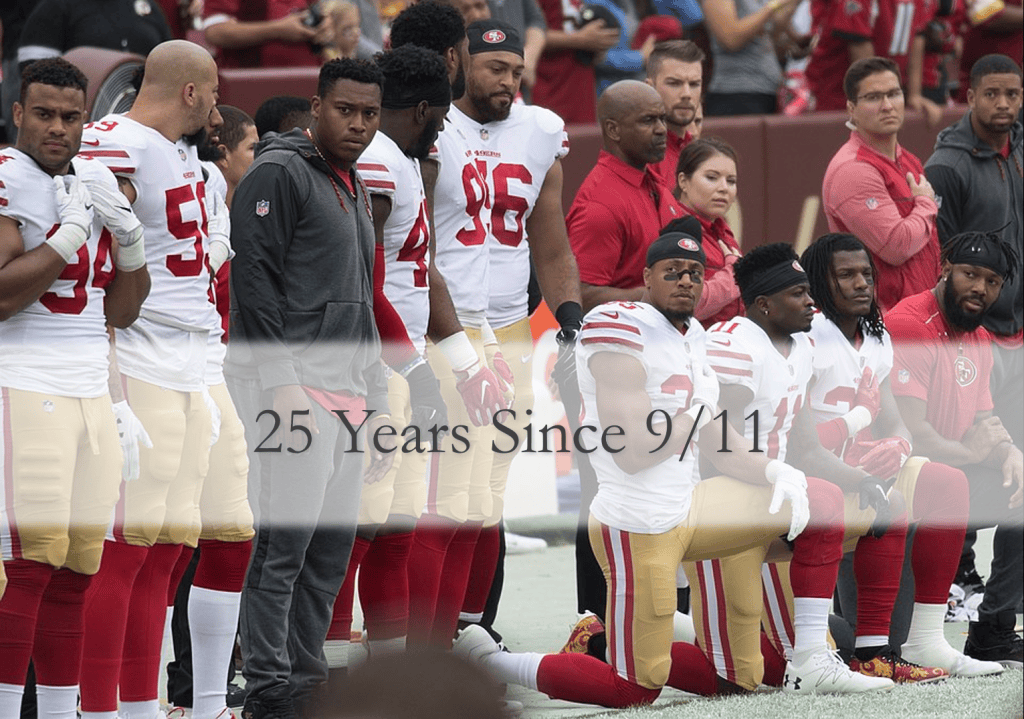
Fast forward to 2016. Beginning that September, Colin Kaepernick of the San Francisco 49ers knelt during the pre-game national anthem to protest police brutality and racism in the United States. Other players followed suit in a gesture that spread across professional, college, and even high school sports. Notably, taking a knee was not only non-violent, it was not even civil disobedience; this should have made Kaepernick’s tactic less disruptive and objectionable than a host of American protests that, while lauded today, were controversial at the time. In other words, taking a knee, in theory, should have been viewed as a perfect example of protesting “the right way.” Instead, it met with outrage. In 2017, newly elected President Donald Trump declared at one of his rallies that the NFL should “get that son of a bitch off the field.” Trump went further the next year, clarifying his general attitude toward anthem protests by praising an NFL ban on kneeling during the anthem and suggesting of those who would kneel, “maybe you shouldn’t be in the country.”
Years before Kaepernick’s dissent, the national anthem, along with other forms of patriotic gesture, had become wrapped up in US cultural politics, a phenomenon that 9/11 exacerbated. In the wake of those terrible events, Americans rallied around the flag in ways that at first seemed natural and inspiring, but almost immediately became performative and enveloped in the roiling divisiveness that has come to characterize America.
Post-9/11 rituals became sources of conflict in the years after 2001, sometimes in deliberate protest and other times by accident. In 2003, amidst the Bush administration’s headlong rush into war in Iraq, Toni Smith, the captain of Division III Manhattanville College’s women’s basketball team, started turning her back on the flag during the national anthem. Her actions, and the outrage they inspired, became a national story. In the years after 9/11, the New York Yankees tried to mandate that fans remain in their seating zone and stand for the playing of “God Bless America” during the seventh-inning stretch. In 2008, NYPD officers physically removed a fan who tried to walk to the restroom during the playing of the song. The New York Civil Liberties Union stepped in and filed suit on the fan’s behalf. The city settled, agreeing to pay damages, and the Yankees made clear that they had no policies mandating participation or restricting movement during the song. In 2011, Goshen College, a Mennonite university in Indiana, decided to play “America the Beautiful” rather than “The Star-Spangled Banner” before sporting events because of the militaristic nature of the national anthem. Even this roused controversy. Any form of deviation from now-sanctified patriotic rituals ran the risk of erupting in controversy, retribution, and threats.
Of course, controversies over the national anthem and other public displays of patriotism (at sporting events and elsewhere) are not always sporting-event related. Flag burning has always been a sensitive issue, one that exploded in frequency and intensity during the Vietnam War era. But sports have provided the most consistently fertile backdrop for such controversies. At the 1968 World Series, fifty years after the Red Sox-Cubs World Series, singer José Feliciano performed a rendition that veered from traditional versions rhythmically and melodically and sparked significant controversy despite being respectful and devoid of any hints of protest. In 1995, NBA player Mahmoud Abdul-Raouf (who had recently converted to Islam and changed his name from Chris Jackson) decided that he could no longer stand for the national anthem, believing the flag to be a “symbol of oppression, of tyranny.” It took several months for a journalist to even notice, at which point the vilification began.
Performative patriotism pre-dated 9/11, as did controversies over attempts to avoid, challenge, or doubt the sincerity of patriotic symbols and rituals. 9/11, however, served as an accelerant. The months and years after September 2001 saw a rise in vocal conservatives claiming the mantle of patriotism alongside liberal and especially leftist critiques of policies, foreign and domestic. When Natalie Maines, the lead singer of the Dixie Chicks (now known as The Chicks) criticized the Bush administration’s pursuit of the Iraq War at a March 2003 concert in London, the backlash was swift and brutal, resulting in the sort of “cancelation” that conservatives would later claim to revile. In this and other cases, critiques of the United States, its leaders, or its policies instantly aroused the ire of self-proclaimed patriots, from the decorous, with their suits and cable news shows, to reactionary members of the public, with their flag-festooned T-shirts and bikinis.
And eventually their MAGA hats.
As he has done with so many issues, Donald Trump exacerbated and took advantage of these divides, and social media has meant that there was no such thing as a local dispute, no such thing as a reasonable response, and no place to hide. It is impossible to predict counterfactual trajectories and thus know the outlines of American politics in a world in which 9/11 never happened. It is clear, however, that 9/11 gave shape to the decades that followed. It created easy narratives, convenient bad guys, and bombastically self-righteous (and self-proclaimed) good guys. The short-lived, earnest, wounded patriotism of the days after 9/11 gave way to a shallow and angry jingoism, characterized by xenophobic country songs talking about kicking the asses of our enemies and a wider hyper-patriotism evocative of the “100% Americanism” and crackdowns on civil liberties that characterized the era of the World Series back in 1918. During World War I, hyper-patriotism contributed to the lynching of a German-American man and the staggeringly draconian Sedition Act. To an even greater extent than the fervor created by World War I, the post-9/11 hatred of dissenters has outlasted the historical moment that produced it. Even as we’ve forgotten all but the most iconic and dramatic moments of September 11, 2001, we are still living in the warped politics it created.
Featured image: San Francisco 49ers National Anthem Kneeling, 15 October 2017. Photo by Keith Allison. Available at Wikimedia Commons.

.jpg)