
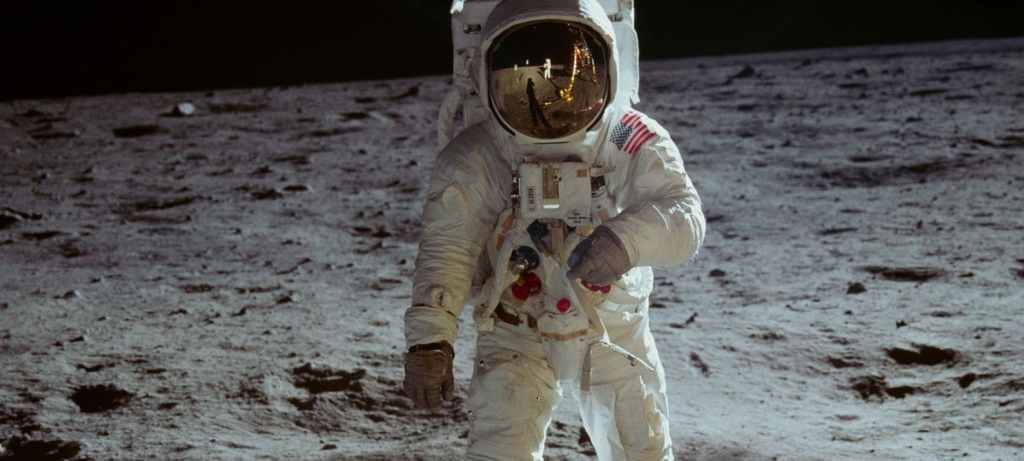
Less than 20 percent of the Earth’s population alive today was alive when Neil Armstrong took his “one small step” onto the Sea of Tranquility on July 20, 1969. Just three and a half years later, Gene Cernan took the last steps on the lunar surface to date. The year 2026 marks an obvious time to reflect on that brief slice of the past, as the Artemis II crew has finally snapped the drought of travel by humans beyond low Earth orbit. Comparing the eras illustrates that moon missions are grounded not only in technologies, but also in the social and political realities of their time.
NASA’s Race to the Moon and its Subsequent Retreat
Human technological achievements do not necessarily move in a straight line. For example, more than 2,000 years ago, the ancient Romans used volcanic ash in their concrete that contained self-healing properties and grew stronger over time. Concrete used in subsequent years degraded over time, as people had lost the formula that the Romans had once followed. The ancient Greeks used a hand-cranked device called an Antikythera mechanism that made complex astronomical calculations. Historians consider this the world’s first analog computer, but do not find anything comparable showing up again until the medieval era more than a thousand years later. The ancient Chinese mass produced cast iron a thousand years before European people did. Even after the world had become more interconnected, historians can point to significant gaps between accomplishments. Roald Amundsen and Robert Scott went to the South Pole in December 1911 and January 1912, respectively, but no human being went there again until U.S. aircraft landed there in 1956. In 1960, Jacques Piccard and Don Walsh reached the deepest point on the ocean floor (the Mariana trench), but no human being reached that point in a submersible vessel again until 2012. Spaceflight achievements have not always moved in a straight line either. The Space Shuttle fleet spent thirty years sending humans to low Earth orbit and then returning them to runway landings on Earth, but since its retirement in 2011 no person has made a runway return from orbit.
Another related lesson from history is that governments are not necessarily willing to sustain the support that will move technology forward. During the Ming dynasty in the early 1400s, for example, the Chinese built enormous vessels that could traverse oceans and were larger than anything Europeans could produce. Yet the Ming court ended state-sponsored ocean expeditions out of their desire to focus on internal stability. More recently in the U.S., taxpayer funding could have supported the development of supersonic transport aircraft that could routinely carry passengers around the world faster than the speed of sound. Yet U.S. Congress halted funding on this project in 1971.
Progress is often messy and unpredictable, and this is especially true in spaceflight. Many factors influenced U.S. President John F. Kennedy’s involvement in the Space Race in the 1960s, and none of them were motivated by an intrinsic fascination with spaceflight while growing up in Massachusetts or while representing the state in Congress. As president, Kennedy’s decision to prioritize a moon landing was shaped by Cold-War rivalry with the Soviet Union and events that questioned the United States’ ability to dominate the worldwide struggle against Communism. In 1961, the Soviets successfully completed the first human spaceflight when Yuri Gagarin completed one orbit of Earth. Kennedy feared that if the people of non-aligned nations in the Cold War witnessed enough of these events, they would gravitate to the Soviet side of the Cold War. He pointed to this in his address to Congress on May 25, 1961, when he said, “If we are to win the battle that is now going on around the world between freedom and tyranny, the dramatic achievements in space which occurred in recent weeks should have made clear to us all, as did the Sputnik in 1957, the impact of this adventure on the minds of men everywhere, who are attempting to make a determination of which road they should take.” More broadly, the Bay of Pigs invasion in Cuba in April 1961, a major failure of US foreign policy, amounted to another black mark for the United States in the Cold War. In response, Kennedy tasked the US space program with producing dramatic results to stir the rest of the world. While Kennedy’s proposal involved landing humans on the Moon, the primary motive was not to gain knowledge about the Moon itself, but to elevate the United States’ status in the global Cold War.
Political support for NASA’s budget to meet this goal did not last. Historian Roger Launius has argued that the Cold War “political crisis that brought public support to the initial lunar landing decision in 1961 was fleeting.”1 Public opinion polls and statements by elected officials reflected a waning level of enthusiasm for Apollo as the years passed. Strains on the federal budget during the mid to late 1960s exacerbated this, as spending on Great Society programs and the Vietnam War took higher priority than NASA spending. By 1969, President Richard Nixon took office willing to continue the Apollo program, but both public trust in government programs and the sense of rivalry that had propelled Apollo forward in the first place had declined. In fact, his administration pursued detente (meaning a relaxation of tensions) in the Cold War.2 After six Apollo crews achieved lunar landings and secure a victory for the United States, political will for space exploration declined.
Although scientists wanted to continue studying the Moon beyond the work of just twelve surface explorers, as expressed in the work of authors such as Andrew Chaikin, their voice in the U.S. political process was not strong enough to justify the kind of spending that more crewed moon landings required. Landing humans on the Moon, and the incredible rise of the NASA budget that went along with that (more than 4 percent of the total U.S. budget by the mid-1960s, much greater than at any point ever since), appeared to be an anomaly of the past. Several presidents after Kennedy found that despite their interest in sending humans beyond low Earth orbit again, the kind of alluring rationale that had motivated lawmakers to fund the Apollo program was no longer in place. Thus, after 1972 human spaceflight moved to low Earth orbit in the form of the Space Shuttle fleet and the International Space Station. Presidents George H.W. Bush, George W. Bush, and Barack Obama all introduced grand new initiatives only to see NASA shift in another direction in subsequent congressional and presidential terms. Despite these barriers, NASA advanced two pieces of hardware: the Orion spacecraft (introduced in 2004) and the Space Launch System (SLS) rocket (introduced in 2011). In 2010, the Obama administration canceled the Constellation program which focused on returning humans to the Moon and called for the use of SLS and Orion for an asteroid redirect mission instead.
However, the Trump administration renewed attention to lunar travel. On December 11, 2017, President Trump issued a policy directive that called for a crew to return to the Moon riding the SLS-Orion combination. The National Space Council chaired by Vice President Mike Pence renewed focus on the Moon. “Since the disastrous decision to cancel the Constellation program in 2010, the truth is NASA’s exploration efforts were left adrift with no clear direction, focus, or mission,” Pence argued on March 26, 2019. The council offered multiple reasons for revisiting the Moon: it was a more attainable target than a near-Earth asteroid; testing technologies on the lunar surface would help pave the way for voyages to Mars; and attaining access to lunar resources ahead of the Chinese would benefit the United States. Echoing Cold War rhetoric of global rivalry, Pence said, “We’re in a space race today, just as we were in the 1960s, and the stakes are even higher…China revealed their ambition to seize the lunar strategic high ground and become the world’s preeminent spacefaring nation.” Pence’s bold proclamation on that day to return Americans to the Moon by 2024 did not reach fruition, because the level of urgency spurred by Chinese accomplishments did not translate into the same kind of funding commitment that NASA received during the Apollo era. But the team at Marshall Spaceflight Center listening to the Vice President on that day did continue working on an SLS rocket that launched successfully in 2022.
The Significance of Artemis II
The Artemis II crew undertook their lunar flyby in April 2026 with the understanding that their program has historically significant similarities to the Apollo program. In 1958, officials at the newly formed NASA decided that the first astronauts should come from the ranks of high-performance aircraft pilots. These were the men, famously known for having what the author Tom Wolfe called “the right stuff,” who voyaged aboard the Mercury, Gemini, and Apollo spacecraft. The crews rehearsed their time-sensitive maneuvers aboard simulators that were electronically integrated with Mission Control, so that they could develop familiarity with cockpit procedures and communicate with flight controllers in the process. They took field trips to diverse locations in the United States and overseas to familiarize themselves with collecting rock samples as well.
In the 2020s, the Artemis-era astronaut corps is still filled with experienced pilots who go through similar simulations (three of the four astronauts on the Artemis II mission, Reid Wiseman, Victor Glover, and Jeremy Hansen, had test piloting backgrounds and the crew piloted their Orion spacecraft manually for a proximity operations demonstration). They also take field trips to hone their geology skills, like their predecessors. Although the Artemis II crew did not make a landing, they met with a lunar science team assigned to their mission to prepare them for never-before-seen images of the Moon’s far side. Deputy lunar science team lead Jacob Richardson’s recent statement, “The crew has completely leaned into being a part of our science team and for the science that we’ll get out of this mission,” echoes the mentality of the Apollo crews who wanted their missions to stand out in this way as well. Meanwhile, flight controllers again went through simulations for their side of the time-sensitive maneuvers while preparing for a communications blackout that came when the crew went around the far side of the Moon. Personnel from NASA and the Department of Defense trained for their roles in recovering a spacecraft after an ocean splashdown, as they did in advance of the Apollo missions.
As Artemis continues towards the first lunar landing of the program, the personnel inside the spacecraft, the Mission Control Center, administrative offices, and engineering facilities will all study Apollo and draw upon whatever relevant lessons learned they can find. For instance, they will study the rapport that crews and flight controllers developed as they worked together to solve problems during a fast-paced lunar landing sequence. They will study the way crews navigated their way across lunar features while walking or driving, again with the help of flight controllers. They will study the way lunar dust clung to the Apollo suits and created an annoyance for the astronauts wearing them. Those who work in the spaceflight industry today can even read an entire textbook called Human Spaceflight Operations: Lessons Learned From 60 Years in Space, a luxury that those who worked during the Apollo era did not have. As illustrated again and again in this book, spaceflight is a pursuit that builds upon and seeks to learn from past operational progress. This is why there are significant technical similarities between the Apollo and Artemis eras, even if the social and political contexts differ.
Yet Artemis is not simply a repeat of what the United States accomplished during the 1960s and 1970s. The Space Launch System (SLS) for Artemis is slightly shorter than the Saturn V rocket produced for Apollo, but produces 8.8 million pounds of thrust compared to 7.6 million pounds for the Saturn V. The SLS also differs from the Saturn V in that it draws on a technical heritage from the Space Shuttle program, in the form of twin Solid Rocket Boosters and four RS-25 engines that lifted the shuttle stack. Meanwhile, the Orion spacecraft (named Integrity by the Artemis II crew) accommodates four crewmembers for up to 21 days, compared to three aboard the Apollo for no longer than 12 days, and contains 30 percent more cubic volume.
New technology supports these advancements. Engineers used 3D-printed parts and additive manufacturing techniques that did not exist during the Saturn V era. The service module, provided by the European Space Agency, utilizes solar panels for electricity rather than the fuel cells used in the Apollo service module. The most striking difference is in digital technology. The Orion computers are lighter while containing 128,000 times more memory than the computers in the Apollo spacecraft. Astronauts aboard Orion will not need to worry about controlling a vast array of physical switches; touchscreens will make the astronauts’ job more convenient. Stan Love, the astronaut who worked to develop displays and controls for Orion, adds, “We’re going to do everything faster and more accurately. And it’s going to make spaceflight much, much safer and less error prone.”
Beyond Orion and SLS looms the one aspect of the Artemis program that has arguably raised the most concern, as articulated by then NASA Administrator Sean Duffy in October 2025: the lunar landing vehicle. SpaceX won the contract in 2021 to develop the Starship Human Landing System (HLS), a reusable vessel that looms 165 feet tall compared to about 23 feet for the expendable Apollo Lunar Module. Blue Origin is developing a HLS as well, called Blue Moon. Filling either of these gargantuan ships with all the fuel they will need for their missions will require the launch of many other Starship or Blue Origin vehicles that will carry propellant for the one headed to the lunar surface. The mission architecture is therefore much more complicated than Apollo. Whereas the first generation of astronauts to reach the Moon did so with just one launch from Earth carrying all of the equipment they need, the Artemis missions will require numerous launches using two kinds of rockets: Starship or New Glenn (the Blue Origin launch vehicle) and SLS. Had the U.S. government given NASA the goal of simply recreating the Apollo missions whenever the opportunity for flight beyond low Earth orbit had come along over the years, there may not have been such a long gap since the last time a human set foot on the Moon. But as demonstrated most emphatically with the HLS, the goal is not a repeat of the past.
Artemis crews will explore a location far away from any the Apollo crews visited: the South Pole. The crew of the first planned landing (recently changed to Artemis IV), will spend 6.5 days on the pole and thus double the longest amount of time spent by an Apollo crew on the lunar surface. The astronauts aim to travel much further away from their lander than the 4.7-mile record set during the Apollo program thanks to their rover. When they climb out of their rover to explore the terrain, they will be able to squat, kneel, and bend over much more easily in their suits than their Apollo predecessors. The work that they do in extracting ice from the pole will then be crucial in demonstrating whether humans can successfully industrialize lunar resources, a task likely to continue for centuries to come.
Another difference is the greater diversity of the Artemis participants. Only white men flew to the Moon during the Apollo era. Yet beginning with the Space Shuttle era, women not only contributed to the success of space missions, but encouraged girls to consider careers in spaceflight. “I’d seen a lot of astronauts, on TV, in pictures; none of them looked like me,” explained Cady Coleman, selected in the astronaut class of 1992. “Then I meet Sally Ride and I think, maybe that could be me.”3 By 2023, the selection of Christina Koch to the Artemis II crew made her the first woman to travel beyond low Earth orbit. Her own astronaut class had been evenly split by gender and the public had come to accept women on space crews. Meanwhile, three NASA facilities essential to the success of the Artemis program—the Johnson Space Center, Kennedy Space Center, and Marshall Spaceflight Center—all contain women directors as of 2026. In addition, Victor Glover was the first African-American to travel past low Earth orbit. The days of spaceflight being dominated by white men are long over.
Despite these differences, there are some reasons to think that Apollo will remain a greater cultural landmark than Artemis because of the sentimental value attached to it. Apollo was the first time that humans went to another world. That it happened after the tragic assassination of President Kennedy and during a Cold War competition with the Soviet Union added to the sentimental value. That hundreds of thousands of Americans worked together to make Apollo possible with 1960s technology (particularly given that a modern smartphone has over 100,000 times the processing power and contains millions of times more RAM than the guidance computer aboard the Apollo spacecraft) remains a point of fascination. When the first moon missions took place, the public had far fewer options by which to take in current events. Without all of the television channels, websites, and social media platforms that the public has in the 2020s, the public of 1969 was less fragmented and could more easily unite around an event like the Apollo 11 mission. As Neil Armstrong and Buzz Aldrin strolled around the Sea of Tranquility, 650 million people worldwide (including 93 percent of American households with televisions) gathered around TV sets to watch history unfold on their TV screens.
The glaring commonality in the Apollo and Artemis eras is their tumultuous political contexts. During the 1960s, the Apollo astronauts embarked on their journeys during a time of global unrest. The Vietnam War, political assassinations, and incidents of racial injustice all contributed to a sense that positive news was difficult to come by, especially in the United States. The editors of Time Magazine were even planning on naming “The Dissenter” as Man of the Year in 1968, before the Apollo 8 crew of Frank Borman, Jim Lovell, and Bill Anders inspired the world with their voyage in December. During the 2020s, the world has witnessed a global pandemic, an insurrection at the U.S. Capitol building, wars in Gaza and Ukraine, more incidents of racial injustice, and widespread protests concerning immigration enforcement. In April 2026, Washington Post author Philip Kennicott even described the American public as witnessing the Artemis II lunar flyby while “individually staring at their cellphones, wondering whether there might be nuclear bombs” in a conflict with Iran. This reflects both the media fragmentation and dissension of the 2020s, which was somewhat successful in diverting attention from the Artemis II mission. The launch of the mission drew an estimated 18.1 million viewers, an impressive total but far from the Apollo 11 total cited above. But if the program can build on the success of Artemis II, it will be poised to remind people across the globe, as Apollo once did, what humans can achieve when all are pulling in the same direction in a peaceful way. It would be hard to imagine a better legacy than that, for either the twentieth century or the twenty-first.
- Roger Launius, NACA to NASA to Now: The Frontiers of Air and Space in the American Century (Washington, DC: NASA SP-2022-4419, 2022), 99 ↩︎
- Ibid, 98-115. ↩︎
- Lynn Sherr, Sally Ride: America’s First Woman in Space (New York: Simon & Schuster, 2014), 326. ↩︎
Featured Image Credit: Buzz Aldridge on the moon, July 20, 1969. NASA.






Leave a Reply