From Gaza to Tehran, Meta’s online surveillance apparatus, built during the War on Terror, censors political speech. Between 2021 and 2025, Meta restricted online content related to Palestinian struggles in at least 3,520 cases, according to a report by 7amleh – The Arab Center for the Advancement of Social Media. The content examined in the report is not egregious content that praises or provides material support to terrorist organizations. Some of it is journalistic reporting on the Israeli-Gaza war. For example, Meta removed a post by Raya FM, a Palestinian radio station, which stated: “The Qassam Brigades [the military wing of Hamas] claim responsibility for shelling Netivot, Okafim, Ashdod and Ashkelon with dozens of rockets in response to Israeli aggression.” The report documents how Meta not only removes Palestinian content from Facebook and Instagram but also enacts restrictions on account functionality to limit the visibility of content that the company finds in violation of its Community Standards. Fabio Cristiano, assistant professor at Utrecht University and lead researcher of the aforementioned report, notes that Meta’s content moderation system is characterized by overbroad policy application that often sweeps up legitimate speech, ostensibly to keep “terrorist” content off its platforms.
In 2026, a quarter century after 9/11, systems of online content moderation, including actions such as content removal and deplatforming, are descendants of the War on Terror. The legal framework established after 9/11 normalized mass digital monitoring, while the rise of social media exacerbated concerns about online extremist propaganda and radicalization. Under pressure from governments, platforms such as Facebook developed sophisticated tools to identify, remove, and suppress content associated with terrorist organizations like Al-Qaeda and ISIS, ultimately transforming how governments and corporations conceptualize security in the digital age. Today, such tools shape the public discourse around a host of geopolitical issues, particularly those based in the Middle East.
The trajectory from 9/11 to 2026 begins with US counterterrorism policy enacted after 9/11, particularly the USA PATRIOT Act and the Foreign Intelligence Surveillance Act, which facilitates the collection of digital communications and shapes platform technical architecture. Another key development was Meta’s Dangerous Organizations and Individuals (DOI) policy, publicly revealed in Meta’s 2015 Community Standards revamp. A number of cases issued by Meta’s Oversight Board show how over-enforcement of the DOI policy has led to the censorship of legitimate political expression. These cases show how Meta moderates the Arabic word shaheed (“martyr”), Lebanese activism against Hezbollah, and political information in rapidly changing conflict situations such as Syria during its civil war. An under-examined legacy of the War on Terror—its digital architecture—continues to have profound implications for freedom of expression.
US Counterterrorism Policy and the Expansion of Government Power
Prior to the 9/11 terrorist attacks, the United States had a collection of fragmented terrorist “watch lists” across the federal government. One of these efforts—the State Department’s foreign terrorist organizations (FTOs) list—empowers the Secretary of State to designate foreign organizations engaged in terrorist activity a “foreign terrorist organization,” which carries financial and immigration consequences for members of these groups. As part of his national security response to the 9/11 attacks, President George W. Bush signed Executive Order 13224, creating the Specially Designated Global Terrorists (SGDTs) list, which directs the Department of Treasury to impose economic sanctions on individuals deemed to pose a significant terror threat, as well as persons or entities found to be providing support to those individuals. President Bush would eventually issue Homeland Security Presidential Directive HSPD-6, consolidating data from these efforts under the Threat Screening Center. The expansion of US-backed watch lists broadened monitored threat criteria, functioning as a critical structural antecedent that later helped institutionalize American counterterrorism concerns on global digital platforms.
In addition to terrorist watch lists, lawmakers further expanded the US federal government’s surveillance powers. Six weeks after September 11, 2001, the US Congress expeditiously passed the USA PATRIOT Act. This package of law enforcement policies expanded the US government’s authority to spy on people in the US to protect Americans against international terrorism. Section 215 of the PATRIOT Act permitted the federal government to force third parties, such as AT&T and Verizon, to turn over records of their users. As Edward Snowden revealed in 2013, the National Security Administration (NSA) used blanket court orders to compel telecommunications companies to turn over customer metadata like phone numbers and call timestamps. In 2020, then-Director of National Intelligence John Ratcliffe admitted that the US government had exercised authority under Section 215 to gather website visitor logs. Congress let Section 215 expire in March 2020; however, other aspects of the PATRIOT Act, such as Section 505 that allows the FBI to issue administrative subpoenas demanding customer data from Internet companies, remain part of American law today.
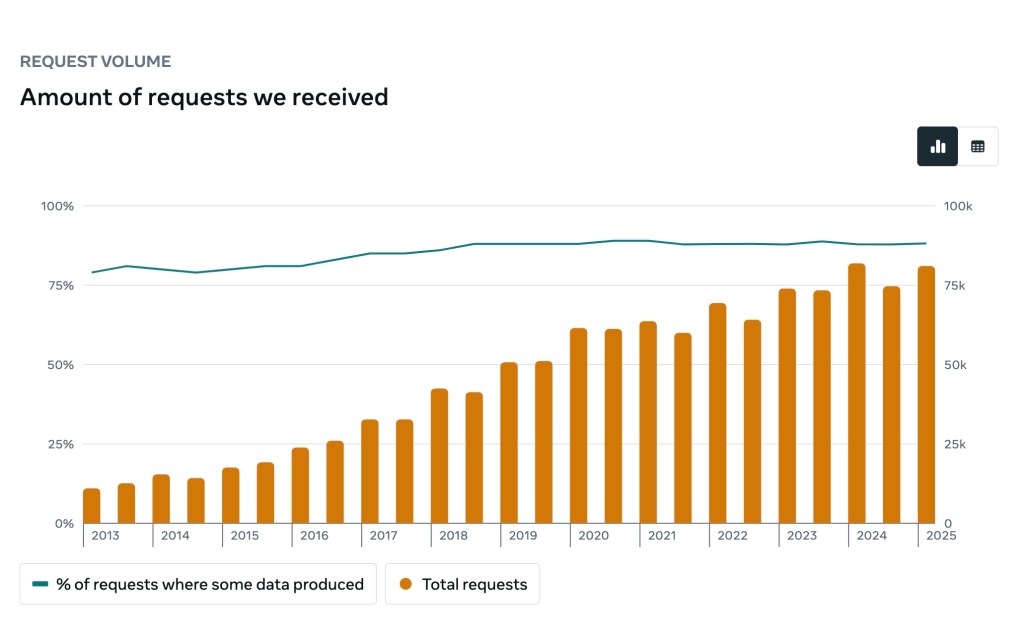
To further American intelligence gathering capability, in 2008, Congress enacted Section 702 of the Foreign Intelligence Surveillance Act (FISA). While Section 215 of the PATRIOT Act allowed for the collection of metadata, FISA Section 702 gave the federal government the power to demand that companies like Google and Meta turn over a suspected foreign target’s communications. Snowden’s leaks also revealed how the NSA relied on Section 702 to justify PRISM, a downstream surveillance program that collected millions of internet communications annually. This led to public inquiries into how platforms like Facebook integrated counterterrorism policy and data-sharing requests from governments into the company’s operational architecture. In 2013, Facebook’s general counsel put out a press release disclosing that in the last six months of 2012, the company received between 9,000 and 10,000 requests from US government entities. Data collected from these requests came from 18,000-19,000 Facebook accounts.
While FISA Section 702 lapsed in 2026, the infrastructure that online platforms like Facebook built to comply with government requests still exists and is actively used by governments around the globe to obtain data on Meta customers. In the first half of 2025, Meta published that it received 81,064 requests from US government entities for data on 149,615 accounts. To avoid any potential sanctions and to keep its platforms attractive for people who do not wish to engage with terrorist content, Meta maintains a Dangerous Organizations and Individuals (DOI) policy meant to keep terrorist organizations, members, and supporters off its platforms. As Meta has disclosed, the entities on this non-public list “include organizations and individuals designed by the United States Government as Foreign Terrorist Organizations (“FTOs”) or Specially Designated Global Terrorists (“SDGTs”), including any prominent members of those organizations.” Thus, for compliance and market reasons, platforms like Facebook created systems to index and search their users’ content. These systems use a combination of automated processes and employees to scan users’ messages, photos, and videos for terrorist content. In essence, after 9/11, the government created legal rules that leaned on platforms to help stop terrorism, and, as a result, platforms built content moderation systems to proactively scan for “terrorist” speech.
From Government Legislation to Your Phone: Meta’s Dangerous Organizations and Individuals Policy
Created in 2004 by Mark Zuckerberg, Facebook, now Meta, was established at a time when the United States was at war in Afghanistan and Iraq. As Kate Klonick’s research highlights, it would not be until late 2009 that Facebook would create a formal content moderation team, which subsequently rolled out the company’s Community Standards in 2010. This changed the company’s moderation of user speech by attempting to standardize removal criteria for “lawful-but-awful” content. As Dave Willner, Facebook’s former Head of Content Policy, described the change, content moderation went from a one-page guidance document that essentially instructed employees to remove Hitler and naked people to all-encompassing standards that attempted to create objective rules around sometimes hard-to-distinguish content like hate speech, racism, nudity, and violence.
In 2015, under pressure from the US and Europe to stem ISIS from using social media to recruit individuals, Meta focused on identifying and removing “terrorist” content from its platforms. Such efforts facilitated the creation of Meta’s DOI policy, which is designed to prevent designated terrorist, criminal, and violent organizations from using the platform. According to Meta, the policy exists because the company seeks “to prevent and disrupt real-world harm,” and therefore does “not allow organizations or individuals that proclaim a violent mission or are engaged in violence to have a presence on our platforms.” Under the policy, Tier 1 entities, which include FTOs and SDGTs, are subject to the strongest restrictions. Meta removes the “glorification, support, or representation” of these entities, and prohibits certain forms of “channeling information, including official communications, on behalf of a designated entity.” Recognizing that the political discourse around such entities is not black and white, the DOI policy has exceptions for content that can be characterized as news reporting, factual statements, or condemnation and criticism. Meta thus recognizes that its users may use its platforms to discuss designated organizations for informational, journalistic, legal, humanitarian, or political purposes. Nevertheless, “if a user’s intention is ambiguous or unclear,” Meta defaults to removing the content.
The Oversight Board: Meta’s Collateral Censorship Harms Free Expression
In 2018, Zuckerberg announced the creation of the Oversight Board, an independent body of human rights experts designed to review Facebook and Instagram content moderation decisions. The Board functions much like a quasi-judicial appellate panel, hearing appeals from users and Meta itself concerning the application of the platform’s Community Standards. It has the authority to issue binding decisions requiring Meta to restore or remove specific pieces of content, meaning it can reverse the company’s original moderation decisions. The Board also issues non-binding recommendations, allowing it to propose changes to Meta’s rules, enforcement practices, transparency measures, and governance systems. Meta has committed to publicly respond to these recommendations, even when it chooses not to implement them.
Three recent Oversight Board decisions demonstrate how Meta’s DOI policy, meant to prevent terrorist content from spreading online, has repeatedly been applied in an overbroad manner, leading to the collateral censorship of political speech with journalistic and humanitarian purposes. These notable cases took place around the Middle East and show how Meta’s content moderation systems often presume support for designated entities—the individuals and organizations that Meta has classified as dangerous actors that should be censored—when users are instead engaged in legitimate political expression. The decisions highlight how Meta struggles to contextualize discussions around terrorism, failing to distinguish support from criticism.
The broadest critique emerged in the Board’s March 26, 2024, Referring to Designated Dangerous Individuals as “Shaheed” policy advisory opinion. The review stemmed from Meta’s longstanding practice of automatically removing content that referred to any person designated under the DOI policy as a shaheed (“martyr”). Meta had maintained this rule for years and formally asked the Board in February 2023 whether it should continue. Under the company enforcement approach, any use of the term in connection with a designated individual was presumed to constitute praise and therefore violated DOI rules. The Board found that this policy was overbroad because shaheed carries numerous cultural, journalistic, political, and religious meanings across the Arabic-speaking world. Shaheed is frequently used in news reporting and human rights debates. By treating every use of the term as support for terrorism, Meta disproportionately restricted Arabic-language reporting and civic discussion. The Board concluded that the policy substantially and unnecessarily burdened freedom of expression while failing to distinguish genuine glorification of violence from neutral or informative uses of the word.
The Board confronted a similar problem in its Lebanese Activist summary decision, decided on September 13, 2023. The case concerned a January 2023 Instagram post by a Lebanese political activist discussing Hassan Nasrallah, the Secretary General of Hezbollah, a designated entity under the DOI policy. The activist did not praise Nasrallah. Quite the opposite: he criticized and mocked him, contrasting Nasrallah with a professional soccer player and condemning Hezbollah’s history of kidnappings and hijackings in Lebanon. Nevertheless, Meta removed the content under the DOI policy. After the Board selected the case for review, Meta acknowledged that the removal was incorrect and restored the content. The Board pointed to the case as evidence that DOI enforcement regularly mistakes criticism, satire, and political commentary for prohibited support. Rather than protect users from terrorism, the policy silenced a political dissident criticizing one of the Middle East’s most powerful armed movements.
A third case, Posts Sharing Speeches in Syrian Conflict, decided October 2, 2025, illustrates the challenge of moderating terrorist content during a rapidly evolving conflict situation. In November and December 2024, Syrian Facebook users shared speeches given by Hay’at Tahrir al-Sham (HST) commander Abu Zubair al-Shami and HTS leader Ahmed al-Sharaa, who became Syria’s president shortly thereafter, during the offensive that overthrew the Assad government. At the time, HST, a former affiliate of al-Qaeda, remained a designated terrorist organization under the State Department’s FTO list and thus Meta’s Tier 1 DOI system. Meta removed both posts within minutes, applied strikes to the users’ accounts that restricted their ability to create content, and reduced page visibility. The company argued that the posts violated DOI rules because they “channeled” official communications from a designated organization and contained violent rhetoric. The Board agreed that the content technically violated the DOI policy but concluded that Meta’s removal decisions were inconsistent with its human rights responsibilities. In the middle of a rapidly evolving civil war, Syrians relied on Facebook to understand military developments and political transitions. By automatically removing content from HST, Meta created what the Board called “information asymmetries,” that prevented civilians from accessing information about actors who were becoming de facto governing authorities. The Board ordered both posts restored under a newsworthiness exception.
These Oversight Board cases demonstrate a consistent over-enforcement pattern. While Meta’s DOI system was originally designed around counterterrorism concepts derived from US government terrorist lists and security frameworks, in practice the policy often treats the mere mention, discussion, quotation, or documentation of designated actors as suspicious. Whether users were describing individuals as shaheed, criticizing Hezbollah’s leader, or sharing statements from HST during a historic political transition, Meta’s systems repeatedly defaulted toward removal rather than contextual assessment. Consequently, political activism, satire, reporting from conflict zones, and the discussion of rapidly changing political events that involve terrorist organizations are vulnerable to censorship by over-enforcement.
Descendents of the War on Terror
The post-9/11 War on Terror produced legal and technical infrastructure designed to monitor communications and suppress terrorist propaganda. The legal architecture constructed after September 11, 2001, fundamentally transformed how governments and corporations understood security in the digital age. Provisions—such as Section 215 of the USA PATRIOT Act, the expansion of surveillance authorities under FISA, and the growing reliance on terrorist watch lists—established a governing logic centered on the identification, monitoring, and disruption of perceived threats before harm occurred. Eventually, that logic migrated beyond intelligence agencies and into online digital platforms. What started as a system for tracking suspected terrorists became a framework for regulating online speech and political participation.
Meta’s DOI policy represents a clear example of this evolution. At its core, the DOI policy represents one way in which contemporary counterterrorism policy is operationalized. Government designated systems shape Meta’s private blacklist. Concerns about material support for terrorism become restrictions on political discussion. The result is a system that often treats designated actors not as subjects of political discourse but as categories of content risk. While the DOI policy was developed with the legitimate goal of preventing terrorists from using Facebook for recruitment and propaganda, the Oversight Board’s decisions repeatedly demonstrate how the company struggles to distinguish support for a designed entity from criticism, the documentation of human rights abuses, or reporting on rapidly changing political events.
The War on Terror did not disappear when the US withdrew from Afghanistan. Its legal categories and assumptions about risk live on, embedded in the governance of online platforms. Across the globe, billions of people experience the legacy of post-9/11 counterterrorism through opaque moderation systems that remove their online content or restrict their account. While technology companies like Meta may not deliberately seek to suppress political speech, their moderation systems repeatedly default toward removal when encountering ambiguity. For platforms to live up to the promise of promoting free expression for democratic society, work must be done to ensure that efforts to prevent support for violent organizations do not come at the expense of the public’s right to access information and engage in political discourse.
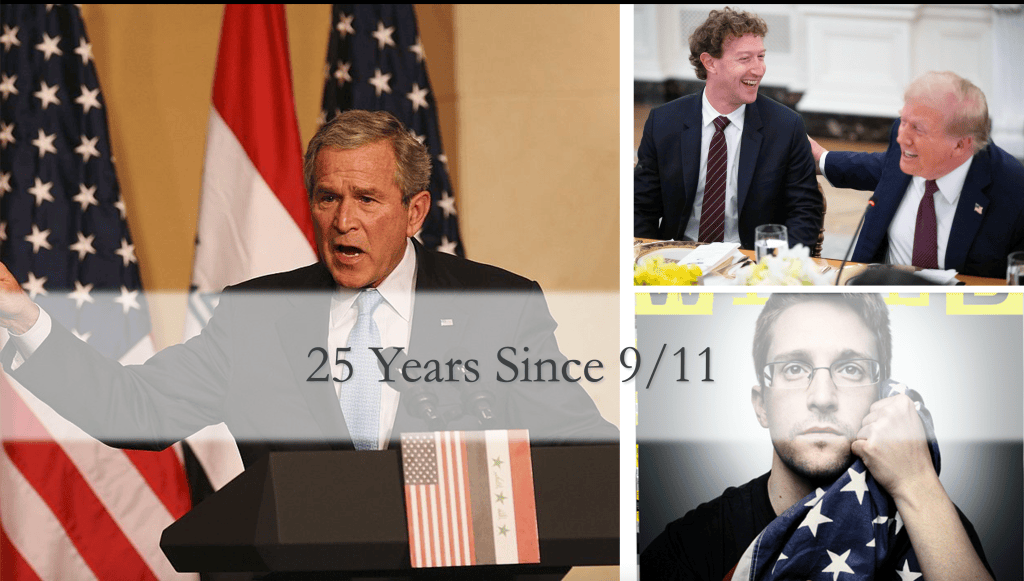
Featured image created by author. From left to right: President George W. Bush holds a joint press conference with Iraqi Prime Minister Nuri al-Maliki November 30, 2006, in Amman, Jordan (Photo by Salah Malkawi/Getty Images). President Donald Trump with Meta CEO Mark Zuckerberg in the State Dining Room of the White House, in Washington, D.C., Sept. 4, 2025 (Photo by SAUL LOEB—AFP/Getty Images). Wired Magazine cover featuring Edward Snowden, June 13, 2014 (Photo by Platon).